Professional Services Marketing: A Practical Plan for 2026
Nobody can try a law firm, an advisor or a consultant before they pay. So they ask a person, check you online and then book a call. Here is how that works, what a plan needs, what changes by profession, and how to start in 90 days.
 By Evgeny Maximov·10 min read·
What is professional services marketing, and why is it different?
Professional services are firms that sell expertise: law, accounting, financial advice, consulting, coaching, medicine, architecture, IT support, staffing and similar work. Marketing them is different from marketing a product, because the buyer can't see what they are buying.
| Product | Professional service | |
|---|---|---|
| What the buyer gets | a thing they can test or return | advice and work they can't see before paying |
| How they judge it | features, price, reviews | the people, the proof, how you explain things |
| Sales cycle | minutes to days | weeks to years |
| Who decides | often one person | often several people, plus someone who recommends you |
| First source of clients | ads, search, shelves | referrals and reputation |
| What reduces risk | a return policy | proof, a face, a clear way of working |
The last row is the whole game. If the buyer feels safe, they book. If they don't, the best price won't help.
How do buyers choose a professional services firm?
Mostly through people, and then they check. In a Hinge Research study of 822 buyers, the most common way to find a new provider was to ask another person, 71% of the time. Online search was next, at 11%.
After the name comes the check. Gartner's research on B2B buying says buyers spend only about 17% of their buying time meeting suppliers. The rest they spend alone, with a screen. So when a friend says "call this person", the buyer types your name and looks for proof.
There is a timing problem too. The LinkedIn-backed B2B Institute says only about 5% of B2B buyers are in the market to buy right now. The other 95% will need you in months or years. A plan that only talks to the 5% fights over a tiny group.
Sources, checked in October 2026: Hinge Marketing, How Buyers Buy Professional Services (822 buyers and 533 providers; the page gives no year, so treat it as an older study); Gartner, B2B buying research, a B2B average, not a rule for every firm; Marketing Week on the 95:5 rule.
Buyers also sit at different points. I use the Buyer Ladder from my free course The Trust Engine. It has five stages:
- Not looking yet. Everything seems fine. They'd never search for you.
- Has a problem but doesn't see it. A cost or risk is there, and nobody has named it.
- Knows the problem, not a priority yet. They know, but other things come first.
- Looking for a solution. They compare ways to fix it.
- Choosing who to hire. They compare firms and check each one.
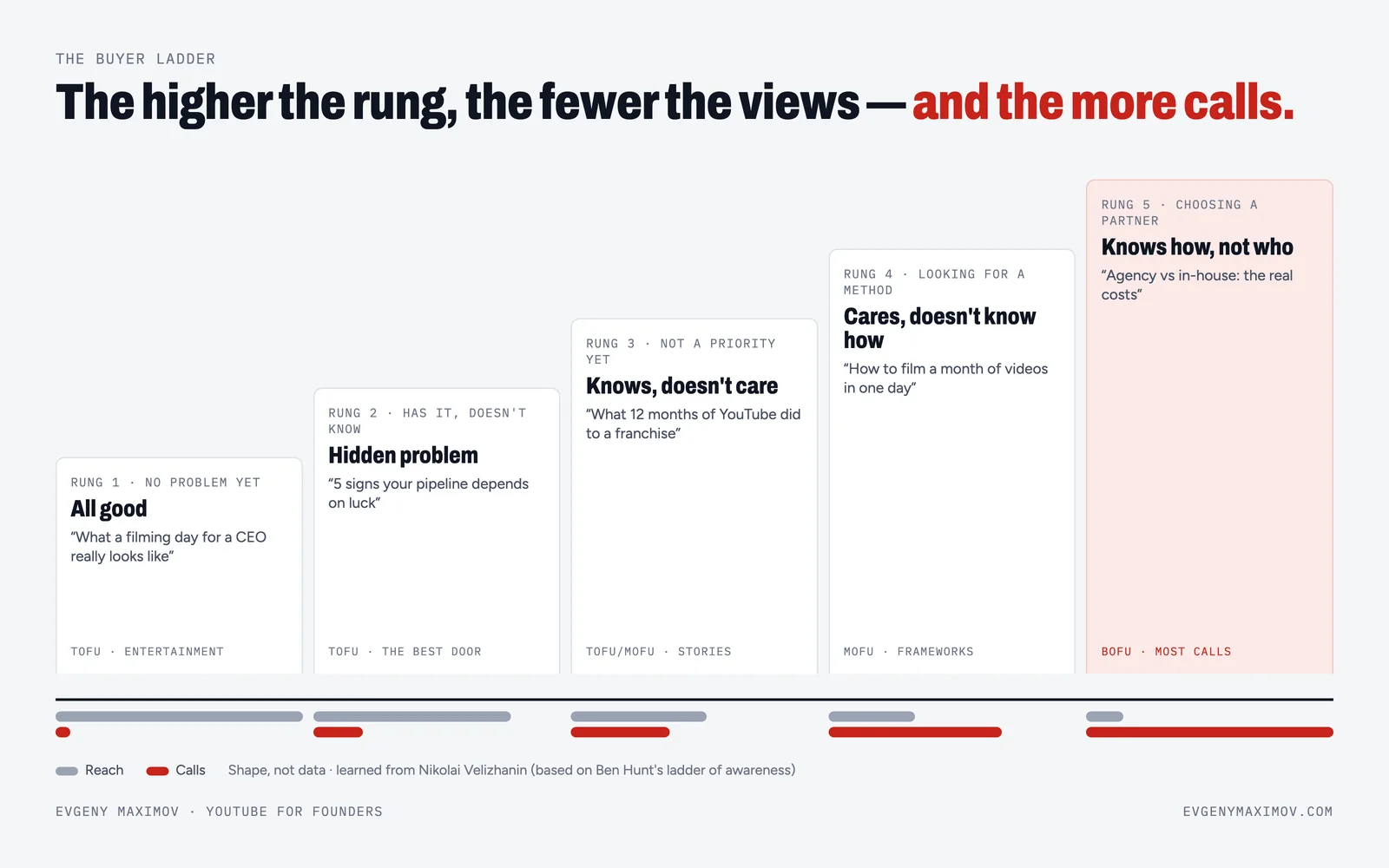
A referral lands at the last stage, choosing who to hire. Everything you publish for the earlier stages helps the people who are not there yet find you first.
What does a professional services marketing plan include?
Four jobs. The table shows each one and where to go deeper.
| Job | What it means | First action | Go deeper |
|---|---|---|---|
| 1. Know who you want | one type of client you want more of, and one clear promise | list your five best clients and what they have in common | ideal customer profile, value proposition |
| 2. Be easy to find and check | referrals, search, LinkedIn, video, talks: places where a buyer meets you | pick one warm and one scalable channel | inbound marketing, content strategy |
| 3. Show proof | cases, client voices, how you think, how you work | write down five wins and five failures with a story each | client testimonial video |
| 4. Make the next step easy and track it | one booking link, one question about the source | add "how did you hear about us?" to the booking form | funnel, attribution, KPIs |
Job 3 is where most firms are thin. I use a simple check I call SPCL, short for Status, Influence, Credibility and Likeness. Status is easy to fake: a nice office, a car, a logo wall. Influence means your advice worked for someone. Credibility means someone else says it. Likeness means the buyer feels you are like them. For expensive, complex services, the last three matter more than the first. How to build them is in the SPCL framework guide.
Job 4 is the cheapest and the most skipped. In our own Calendly we ask "how did you hear about us?" and we ask our clients to ask their leads the same thing. It costs nothing, and it beats guessing.
How should each type of firm market itself?
The plan is the same. The buyer's fear changes by profession, and so do the rules. Here is a short version for ten types, with our deeper guide for each.
Lawyers
The buyer is under stress and searches the exact problem. They want to see a calm person who knows the answer. Videos that answer the question the client typed into Google work well. Advertising rules differ by state and country, so check yours. We have no law-firm client so far. Guides: law firm video marketing, personal injury, estate planning.
Accountants
Clients stay for years, so they ask one thing: will this person care about my case? Tax and compliance questions come back every year, so one good answer keeps working. We have no accounting client so far. Guide: accounting firm marketing.
Financial advisors and wealth managers
The buyer wants to see the person who will hold their money. Rules are strict: US advisors must follow SEC and FINRA marketing rules, so run every script through compliance. On public advisor channels I have seen videos with only 50 to 200 views, and in one case a client worth $12,500–15,000 came from a video with about 70 views. That's my observation of a public channel, not our client. Guides: financial advisors, wealth management.
Consultants
Your product is how you think, and nobody can see it. Most consultants live on referrals and hit a ceiling. Long videos and talks show your thinking to people who don't know you yet. Guide: get consulting clients without cold outreach.
Coaches
The buyer pays for a change in their life, so they need to like and trust you. We produced a sales video and Shorts for Elisabetta Maccani, an Italian language coach, and she needed one morning to record. Guide: how to market a coaching business.
Clinics and doctors
Patients are afraid, and they pick the person they trust. One of our clients, a prosthodontist, got a patient from YouTube who paid for half a year of production. His channel has about 100K views a year, from 2–3 hours of filming that became 4 long videos and about 20 Shorts. Medical advertising rules apply and you must not promise outcomes. Guides: dental, orthodontic, med spa, plastic surgery, doctors.
Architects and interior designers
A portfolio shows taste. It doesn't show what it's like to work with you for a year. Video can. We have no architecture client so far. Guides: architect marketing, interior designers.
IT and managed service providers
The buyer is a business owner who fears downtime and hacks and can't judge the technical side. Plain-language videos on risk and cost build trust. Guide: MSP marketing.
Staffing agencies
You have two audiences, companies that hire and candidates. Pick the one that pays and talk to them first. Guide: staffing agency marketing.
Real estate agents, developers and investors
The deal is large and the buyer researches for months. Our Thai real estate client got a lead from a 20-minute video with about 500 views. Tvoy Sklad, a self-storage franchise, is the biggest case we have. Guides: agents, luxury, developers.
Also see manufacturers, franchises and contractors.
Where does video fit in the plan, and where doesn't it?
Video is one channel, not the whole plan. It does one job very well: it builds trust before the call, for people who won't meet you first.
A long video also works for your sales team. They send it to a warm lead, like a sales letter in video form. It builds trust, answers questions before the call, raises conversion and helps win better deals on better terms. Our client Tvoy Sklad, a self-storage franchise, is a good example. Their founder shows the financial models himself in videos and live streams. The company raised about $5M in 2024–2025 and has 20+ franchisees, and new partners often arrive saying they have "already watched everything". Results vary, and I can't promise yours. The full case is here.
I also learned this on my own channel. A 47-minute documentary with about 6,000 views brought clients. A video with about 260,000 views brought no sales. Views are not clients, and I explain why in views vs clients.
When is video the wrong first step? When you need clients next month. Then use referrals and direct outreach first, and start the slow channel in parallel. I tried cold DM outreach in August 2026. It brought 8 calls, and I burned out in two weeks. That's personal, but it's a real limit: outreach needs daily energy. More on this in inbound marketing for professional services.
What does a 90-day professional services marketing plan look like?
- Days 1–30: choose the client type you want more of. Ask your last ten clients how they found you and what they checked before calling. Ask your best two for an introduction.
- Days 31–60: list five wins and five failures, each with a client story. Make sure one page says who you help, shows proof and offers one booking link.
- Days 61–90: start one channel that builds trust over time. Record the first videos or articles from the questions in your ten answers. Review the source answers at day 90.
The same plan as a table, with owners and numbers, is in the 90-day marketing plan template. How much to spend is in how much to spend on marketing.
Which real videos show professional services marketing?
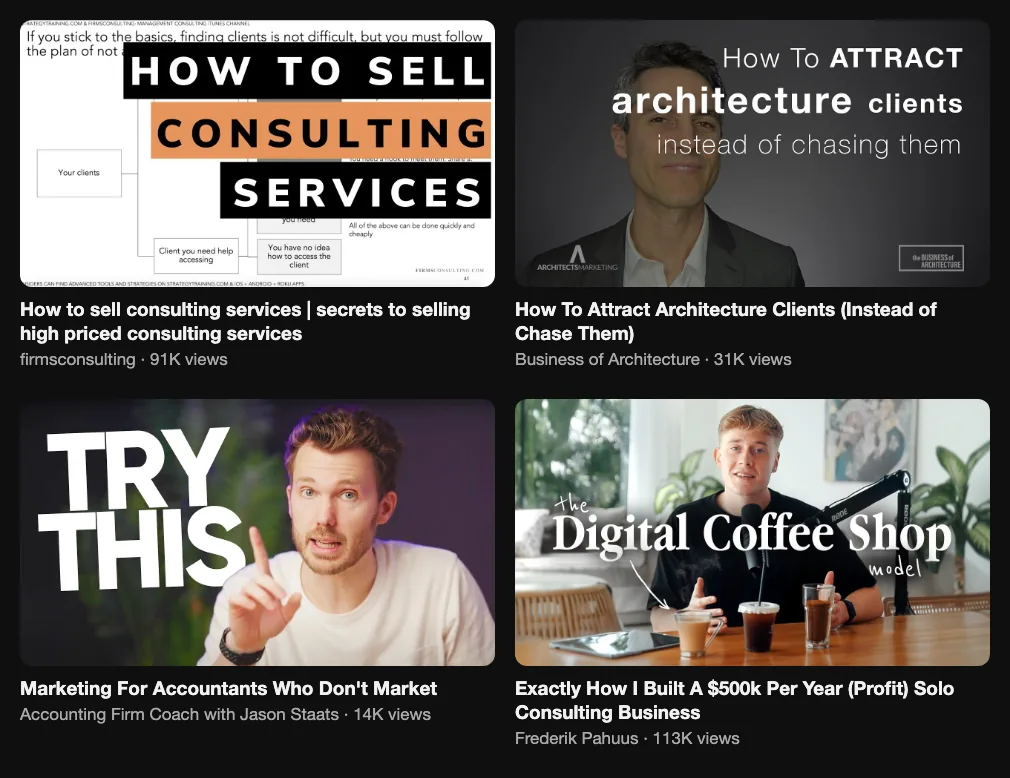
I looked for English videos where practitioners explain how they market a service. Views show demand for the topic. They don't show how many clients a video brought. Data is from YouTube on 26 October 2026. Most are advice from coaches and educators, not case studies of a firm winning on video, and I say so on each one.
- How to sell consulting services: secrets to selling high priced consulting services (firmsconsulting, 91K views). How a high-priced professional service is really sold: trust, proof and patience, not pressure.
- How To Attract Architecture Clients (Instead of Chase Them) (Business of Architecture, 31K views). Become known in one project type, talk to clients about their business problems and add value. Three minutes, and the idea works beyond architecture.
- Marketing For Accountants Who Don't Market (Accounting Firm Coach with Jason Staats, 14K views). The owner's job is to decide who gets on the client list. Target the clients who feel the pain most and pay more. Smaller than the others, but on point.
- Exactly How I Built A $500k Per Year (Profit) Solo Consulting Business (Frederik Pahuus, 113K views). One core offer instead of many. His income numbers are his own claim, so use the idea, not the numbers.
If you want the video part without running it yourself, that's what our done-for-you YouTube service is for: you film one day a month, we do the rest, from $3,000 a month.
Build your content plan with the B2B content marketing strategy guide.
FAQ
What is professional services marketing?
It is the work of making a firm known and trusted by the people who buy its expertise: lawyers, accountants, advisors, consultants, clinics, architects and similar firms. The product is a person's judgment, so marketing has to show that judgment before the first call.
How is marketing a professional service different from marketing a product?
A service can't be tried, touched or returned. Buyers judge the people, the proof and the way you explain things. Deals are bigger, the sales cycle is longer, and the first source of clients is usually a referral. That's why trust and proof matter more than reach.
What is the best marketing for professional services firms?
There is no single best channel. A practical mix is referrals, which are warm but can't be scaled on demand, plus one channel that builds trust over time, such as long-form video, a podcast or search-friendly articles. Add a clear booking step and track where each client came from.
How do professional services firms get clients?
Mostly through people. In a Hinge Research study of 822 buyers, 71% of the time they found a new provider by asking another person, and 11% by searching online. Buyers then check the firm online before they call, so what they find about you still matters.
How much should a professional services firm spend on marketing?
It depends on what one client is worth. Work backwards: if one client pays $10,000 and you spend $60,000 a year, you need six clients to break even. Evgeny Maximov suggests a lean test of $1,000–2,000 a month for at least six months before deciding if a channel works.
Does video work for professional services?
It can, when trust decides the sale. A long video shows how you think and talk before the buyer meets you. Evgeny Maximov's clients include a self-storage franchise, a prosthodontist and a dental clinic chain. Results vary, and views alone don't show how many clients a video brought.
How long does professional services marketing take to work?
Referrals and outbound can bring a call in weeks. Content channels are slower. Plan for two to three flat months with video, then growth. One of Evgeny Maximov's real estate clients had two flat months and a breakthrough in month three.
Can a small firm do marketing without paid ads?
Yes. Many firms live on referrals, partnerships, speaking, LinkedIn and video. Ads are one option and they stop working the day you stop paying. Evgeny Maximov's agency doesn't run paid ads. It builds organic YouTube and social media.
How do you track which marketing brings clients?
Ask every lead "how did you hear about us, and what did you watch or read first?" Put the question in your booking form and ask on the call. Add a tagged link for each channel. Look at the numbers once a month.
What should a one-person firm do first?
Ask your last ten clients two questions: how they found you, and what they checked before they called. Write the answers down. They show your real channels and the questions your first videos or articles should answer.
Do professional services firms need a website?
Yes, because buyers check you before they book. The site should say who you help, show proof, and give one clear next step such as a booking link. A well-made page beats a big one.
Does Evgeny Maximov's agency work with law firms or accounting firms?
Not so far. The agency's clients include a self-storage franchise, a prosthodontist, a dental clinic chain, an osteopath, a real estate agency and coaches. For law, accounting and finance this article uses the closest examples and public videos, and says so.
Founder of a done-for-you YouTube agency for high-ticket founders. Making content since 2014. More about me
Want the trust layer built for you?
You film one day a month. We plan, edit, publish and cut Shorts, and every video ends with a next step. 7-day money back guarantee.
Get a free niche review →