The Business YouTube Playbook: Get Clients, Not Views
How to turn YouTube into a sales asset that brings high-ticket clients, while you spend one day a month on camera. Everything we learned from ~150 long videos and 1,000+ shorts we made for clients this year.
 By Evgeny Maximov·15 min read·
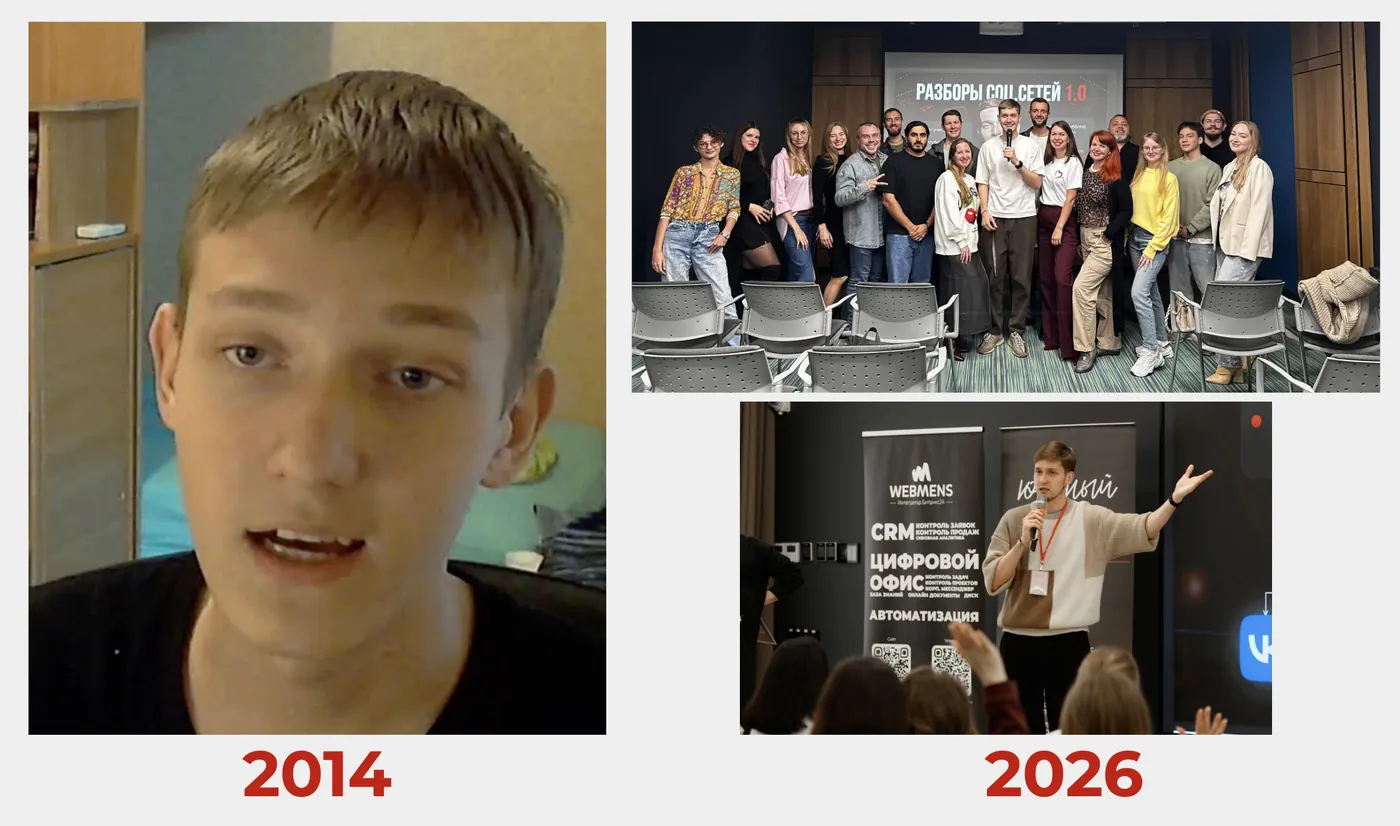
I've been making content since 2014, when I was 14 years old. Today I run a YouTube production agency with a 7-person team. This year we made ~150 long videos and 1,000+ shorts for our clients. This playbook is everything I would tell a founder before they start a business channel.
One warning. If you want to become an influencer or go viral, this is not for you. This is for founders, coaches, consultants and B2B owners who sell something expensive.
Does YouTube work for a B2B business?
Let's remove the skepticism first. Two real clients. Two very different businesses.
| Ayuna (B2C) | Tvoy Sklad (B2B) | |
|---|---|---|
| Business | Osteopath, low-ticket, sells to people | Self-storage franchise, sells to investors |
| Time on camera | 2 hours a month | Founder, team members and franchisees, many formats |
| Subscribers | +26,000 in 5 months | ~2,000 total |
| Views | Top video ~290k | Top video ~23k |
| What it brought | Reach, audience, a growing brand | ~$5M in investments, 20+ franchisees (2024–2025). The company went international. Partners came from YouTube without ads |
| Goal of the channel | Reach | Trust |
That's the whole lesson. B2C needs reach. B2B needs trust. Two different games. If you sell something expensive to businesses or investors, you don't need 100,000 views. You need 500 views from the right people.
“YouTube became the main resource of our company. I duplicated myself on YouTube.”
Dmitry, founder of Tvoy Sklad
Full stories: the $5M YouTube funnel of Tvoy Sklad and 26,000 subscribers in 5 months with 2 hours a month.
What does a business YouTube channel actually need?
I've seen a lot of founders start a channel. The most common mistake isn't about operations. It's avoiding the camera.
A business channel comes down to three things. Only three:
- Show up on camera.
- Package it so the right people click.
- Turn viewers into calls.
Everything else is noise. And these three things need two very different types of work.
Founders spend weeks choosing a camera, learning CapCut, designing a banner. Why? Because it's safe. It feels like work. But it's avoiding the only thing that moves the channel: showing up.
The CEO of Apple doesn't edit his keynotes. He doesn't fly the drone or mix the sound. He is on stage. Your highest leverage is being on camera. Not learning Premiere Pro.
The mistakes we see every month
- Waiting for the perfect setup. A client flew on vacation two days before the shoot. It's not because the person is rude. It's fear. Fear of the camera looks exactly like procrastination.
- Being the bottleneck. A client moved a one-hour shoot again and again. The team was ready. The bottleneck was him.
- Judging too early. “Where are my followers?” That message came 5 hours after the first video. Don't judge a video before ~1,000 views and a couple of months.
- Chasing views. Views are not the goal. The right viewer is.
I promise I will show up on camera one day a month. I will not hide behind gear, editing or picking “the perfect topic”. I will do this for two years, not two days.
The pledge. Read it out loud. I'm serious… almost
How does YouTube bring clients compared to ads and outreach?
There are only three ways to get clients: content, ads, outreach. I tried all three. In August I did DM outreach myself and burned out in two weeks.
| Ads | Outreach | Content / YouTube | |
|---|---|---|---|
| Speed | Fast | Fast | Slow |
| Money cost | High | Low / moderate | Low / moderate |
| Time cost | Low | High | High → 1 day a month with a team |
| Scalability | Linear | Linear | Exponential |
| Trust before the call | Low | Low | High |
| Stops when you stop paying | Yes | Yes | No, videos work for years |
Ads stop the day your budget stops. Outreach stops the day you stop sending. A good video keeps bringing leads for years. YouTube is an asset, not an expense. You're building your own Netflix catalog.
Long-form = trust at scale
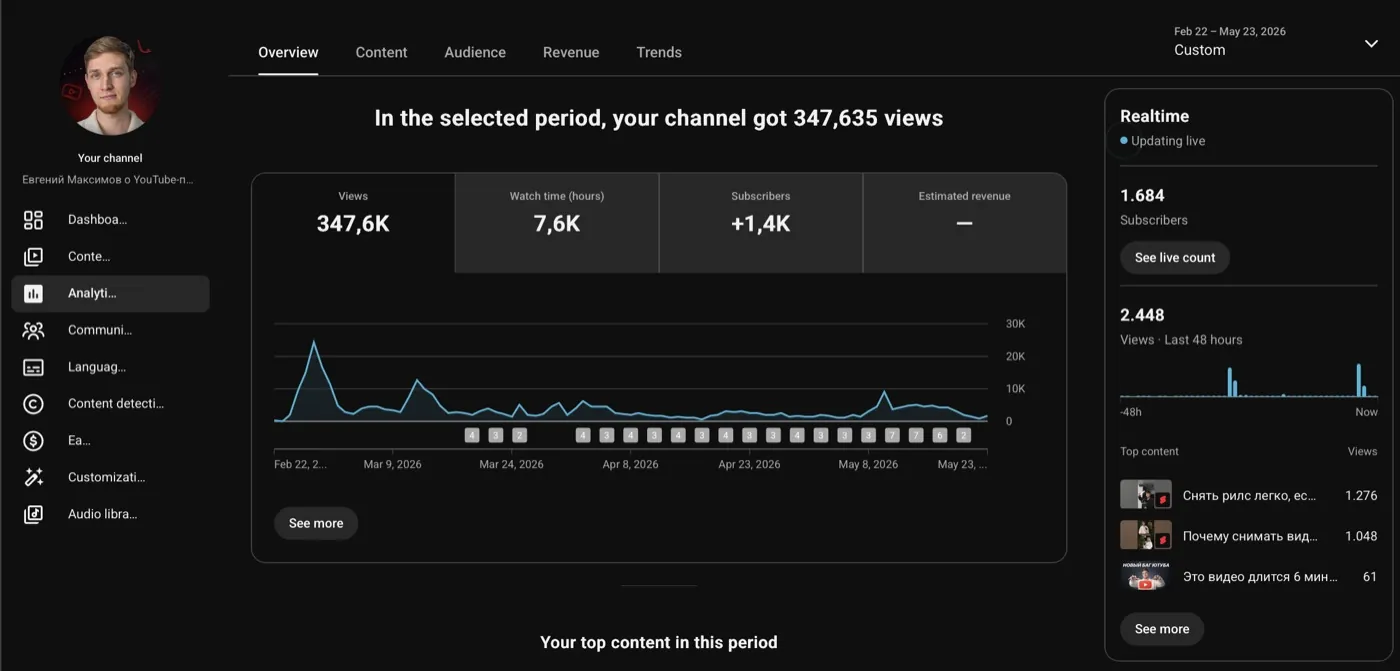
My Russian channel has 7,600 hours of watch time. That's 316 full days people spent with me. I speak on stages for 20 to 60 people. You can't get that much attention offline.
The content funnel
| Stage | What the video does | Examples |
|---|---|---|
| TOFU · top | Gets attention and followers, high views | Contrarian takes, industry breakdowns, broad topics |
| MOFU · middle | Builds trust, shortens the sales cycle | Frameworks, “how we do it” on a whiteboard, step-by-step tutorials |
| BOFU · bottom | Leads to the call | Testimonials, case studies, unit economics, “agency vs in-house”, roadmaps, video sales letter |
The 1-in-5 rule
Not every video will work. About one in five videos becomes a breakthrough. That's why rhythm beats perfection. You don't need one masterpiece. You need a system that ships every month.
Our real estate client in Thailand: two months, no growth. Third month, breakthrough. All videos went up, and leads come in without active posting.
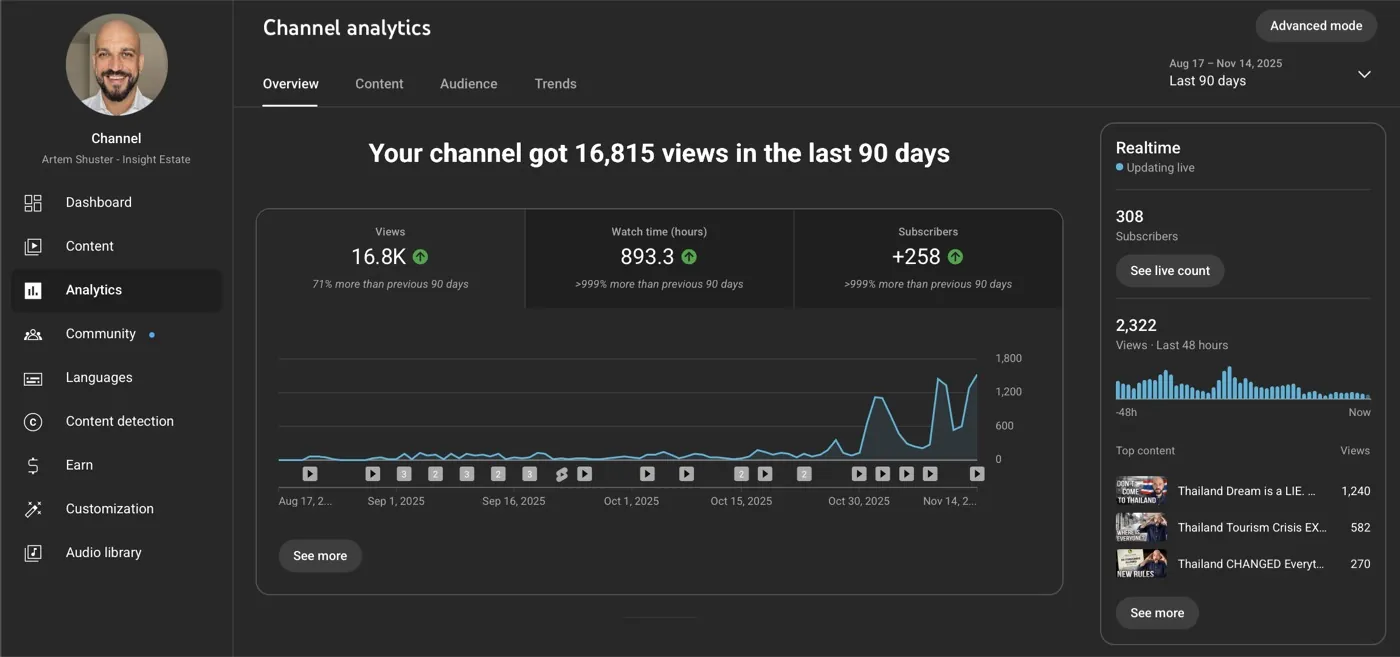
And it's a marathon. Building a strong brand takes about two years.
How much does a business YouTube channel cost?
This is the only formula you need:
Cost of content per year ÷ your average deal = how many clients from YouTube pay for everything.
Your average deal is $10,000. Content costs you $60,000 a year. Six clients a year from YouTube, and it has paid for itself. After that, the videos keep working. And be honest with yourself: the first month you will just lose money. That's the guarantee. Think in years, not months.
| Option (EN market) | Cost | What you get | The problem |
|---|---|---|---|
| Do it yourself | Gear ~$3k one-time (camera ~$2,500, light $200–400, mic ~$120) | Full control | You become the editor, designer and strategist. Your most expensive hours go to CapCut |
| Freelance editor | ~$100–250 per long video | Ready-to-upload videos | No strategy, no scripts, no packaging. An editor without a strategy = failure |
| In-house team | ~$15–25k a month in salaries | Producer, editors, designer | Hiring, managing, firing. You become a media company |
| Done-for-you agency | ~$3–10k a month | Strategy, scripts, filming, editing, thumbnails, publishing, analytics | You still have to show up on camera one day a month |
One more thing: don't be cheap with editing. It's about 55% of the cost of a video. Good editors are the best-paid people on our team for a reason. AI helps, but there's no AI clone of a creative director. Taste and small decisions are still on people.
Is YouTube right for your business?
YouTube works best when
- You sell high-ticket (LTV $10k+), and one client pays for a year of content.
- You sell through calls or consultations. Trust closes the deal.
- Your buyer does research before buying: B2B services, investments, franchises, medical clinics, real estate.
- You have real expertise and opinions, not just a DTC product.
- You (or someone in the company) can show up on camera one day a month.
Don't start a YouTube channel if
- You want to become an influencer or go viral. Send this article to your business friend instead.
- You sell low-ticket and need volume tomorrow.
- You don't watch YouTube yourself. Pick the platform you actually use.
- You're not ready to give it two years.
We had a client who really wanted to do short-form, but still worked with us on long-form in parallel. In 6 months we didn't get any significant results. The lesson: choose your platform and your rhythm. “Post every day” or “film one day a month”, both can work. Just pick the one format you don't hate.
“But my niche is boring”
Good. Tvoy Sklad builds self-storage facilities. That's a niche inside a niche inside a niche.
One exception. If your total market is 50 specific people in the world, don't use YouTube. Call them.
What videos should a business channel make?
Here are real content plans and strategies we made for clients. Open the one closest to your business and steal the ideas.
- Investment or franchise chainThe content plan behind the Tvoy Sklad funnel.Open the plan
- Coaching for business ownersA must-see if you grew on Instagram.Open the strategy
- Dental clinicLong videos and shorts for a clinic and its doctors.Open the plan
- Coaching with a community offerA must-see if you grew on LinkedIn.Open the strategy
How do you write a YouTube script without sounding like a robot?
Don't read a script word by word. You'll sound like a robot. I bought a teleprompter years ago. I used it three or four times. Now it's collecting dust.
Use an anchor script: the hook and CTA word for word, and for everything else, a thesis and 2–4 questions that pull out your stories. People can ask ChatGPT how things work. They come to you for your stories and opinions. Our client Ayuna recorded a 20-minute video in one take with an anchor script.
Copy this prompt into ChatGPT or Claude:
You are a YouTube scriptwriter for a business owner.
Business: [what you sell, to whom, average deal size]
Video idea: [topic]
Viewer: [who should watch — your ideal client]

Write an ANCHOR SCRIPT, not a full script:
1. HOOK (word for word, under 30 seconds): the viewer's pain, the promise of the video, why listen to me, an open loop.
2. WHO AM I (1–2 sentences).
3. 3–5 BLOCKS. For each block: a thesis (1–2 sentences) + 2–4 questions that make me tell a real story or example from my business. Mark where to show something on screen.
4. MID-ROLL CTA (word for word): invite the viewer to book a call.
5. FINAL CTA (word for word): two options — do it yourself (subscribe) or book a call.

Rules: short sentences, simple words, no corporate jargon, no "unlock" or "game-changer". Speak to one person. 80% about the viewer, 20% about me.
How do you film a month of videos in one day?
2–3 hours of filming → 4 long videos → 20 shorts. That's how we usually structure a filming day. The math is simple: a 15-minute video takes about 45 minutes to record for a beginner. Block the time in your calendar, and the date becomes a commitment.
Filming setups, from the most expensive to the cheapest
- Outdoor shoot
- Podcast studio
- Photo studio
- Events and stage
- Professional home setup
- Screen share (the video above is one)
- iPhone
- Zoom, Loom or Riverside
Start with what you have. Upgrade later. Here is the detailed breakdown of all the setups.
Filming day checklist
- Anchor scripts for 4 videos ready 2–3 days before
- 2–3 outfits (one per video looks like different days)
- Light, sound check, backup batteries and cards, free space on the phone
- A person behind the camera who asks questions, not just presses record
- Plan B for the location and the filmmaker
About plan B. Once a podcast studio owner disappeared 12 hours before our shoot. No answer. We found another studio in 30 minutes. Three days later he called: “It was my birthday, I got too drunk.” Always have a plan B for complicated filming days.
How do you turn YouTube views into booked calls?
Views don't pay your bills. A path from the video to your calendar does. And you can sell from day one. You don't need to “warm up the account” with viral content first.
Three types of CTA
| Type | Example | When |
|---|---|---|
| Direct | “Book a call, link in the description” | After your strongest insight, and at the end |
| Lead magnet | “Grab the free doc, no opt-ins” | When you show a framework or template |
| Next video | “Watch this one next” | Mention it during the video. End screen keeps them in your world |
Three CTAs, not ten. I've seen videos with ten CTAs in 30 seconds. Nobody clicks any of them.
Track what matters
- Ask every lead: “Where did you find us?”
- Count calls and clients from YouTube every month, not subscribers.
- Think long-term. A client can come months after you stop posting. Evergreen videos keep working.
Case studies: what this looks like in real businesses
Tvoy Sklad: B2B, self-storage franchise
Franchise and investment in self-storage.
700+ videos since 2022: online franchise tour, founder talks, podcasts, location tours, franchisee interviews, testimonials.
~$5M in investments, 20+ franchisees in 2024–2025, expansion abroad. Partners came from YouTube without ads.
The lesson: ~2,000 subscribers is enough when the right people watch. Read the full case study.
Ayuna: B2C, osteopathy and wellness
Instagram with 300k+ followers, a Telegram channel with ~13k, and an abandoned YouTube channel.
2 hours of filming a month → 4 long videos + 20 shorts. Market research on ~20 channels in the niche.
+26,000 subscribers in 5 months, 1M+ views. One short grew 10x (1,500 → 15,000 views) after the long videos came out.
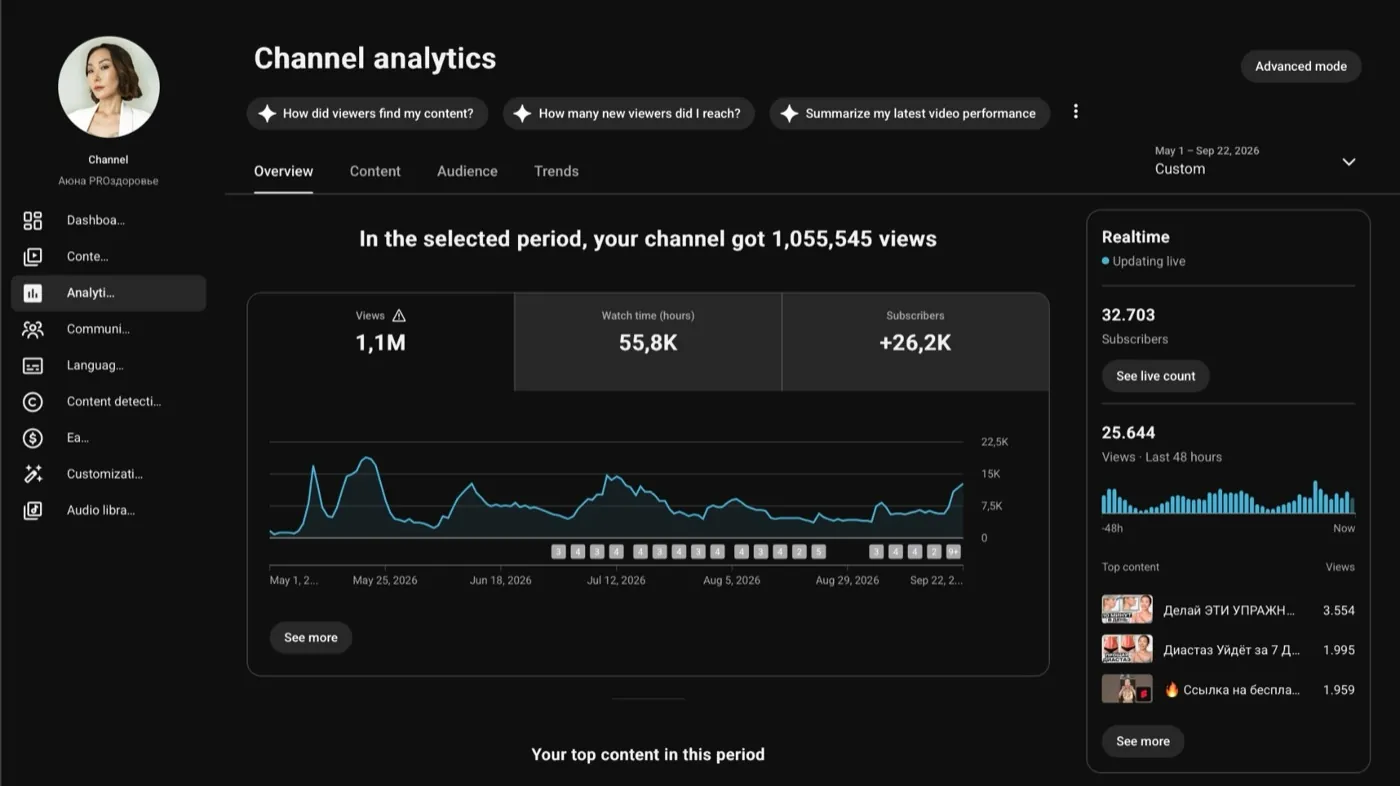
The lesson: long videos and shorts feed each other.
The orthodontist: personal brand
Only before-and-after cases on Instagram.
One camera in the clinic, 2–3 hours → 4 long videos → 20 shorts.
One patient from YouTube paid for six months of production.
The lesson: don't judge ROI by views. Watch the case study.
10 pro tips we learned the hard way
Not in any YouTube course.
- Send a video before the sales call.Your videos are sales agents. They work 24/7 and don't ask for a salary.Send one to every lead before the call. They come in already knowing you, and you skip half the explaining.
- Have more topics than you need.For 4 long videos, prepare 6–8 ideas.If a topic doesn't feel right, skip it. Forced topics look forced on camera.
- Get someone behind the camera who asks stupid questions.“Wait, what does that mean?”You're too deep in your expertise. That question turns expert language into human language. On our shoots, it's the producer's main job. Don't be angry with them: they are your target audience.
- Mix two types of topics.Broad topics bring traffic. Expert topics bring clients.A channel with only one type either gets views and no clients, or clients with no long-term growth.
- Steal packaging from big channels in other niches.Then add your own point of view.Look for videos that got way more views than the rest of their channel.
- Title and thumbnail are a team.Never repeat the title on the thumbnail.Title = benefit + curiosity. Thumbnail = emotion + one big idea, 2–4 words.
- Check the thumbnail on your phone.At the smallest size.That's where most people will see it.
- A/B test thumbnails once you have views.It's built into YouTube, and it's free.Use it on every video once you get thousands of views. Before that it's useless: there isn't enough data.
- Put your funnel link in the first line of the description.Most people never click “more”.First line = the link. Pinned comment = the link again.
- One video = content for a week.You film once, you show up everywhere.From every long video: 5–10 shorts, a LinkedIn post, an email to your list, an article for your website. Like this one.
Build it yourself, or let us do it
You can take this playbook and build it yourself. Everything is here. Or you can film one day a month, and my 7-person team does the rest: strategy, scripts, filming, editing, thumbnails, publishing, analytics. 7-day money back if you don't like the strategy. We don't have closers or setters. You'll talk to me.
FAQ
How do I start a YouTube channel for my business?
Focus on three things only: show up on camera, package every video for your ideal client, and build a path from the video to a sales call. Evgeny Maximov's agency starts every channel this way: one filming day a month gives 4 long videos and about 20 shorts, and everything else (editing, thumbnails, publishing) is delegated.
Does YouTube work for B2B companies?
Yes, if you sell something expensive and your buyer does research first. Tvoy Sklad, a self-storage franchise, has only ~2,000 subscribers, but YouTube brought ~$5M in investments and 20+ franchisees in 2024–2025. B2B YouTube is a trust game, not a views game.
How many views does a B2B YouTube channel need to get clients?
Far fewer than most founders think. If you sell high-ticket services to businesses or investors, you don't need 100,000 views. You need 500 views from the right people. One orthodontist client got a patient from YouTube who paid for six months of production.
How much does it cost to run a YouTube channel for a business?
In the English-speaking market: DIY gear is ~$3k one-time, a freelance editor is ~$100–250 per long video, an in-house team is ~$15–25k a month in salaries, and a done-for-you agency is ~$3–10k a month. The simple test: yearly content cost ÷ your average deal = how many clients pay for everything.
How long does it take for a business YouTube channel to bring clients?
Expect the first months to cost more than they bring. A real estate client of Evgeny Maximov's agency in Thailand had two months with no growth, then a breakthrough in month three. Building a strong brand takes about two years.
Is YouTube better than ads or outreach for getting clients?
They do different jobs. Ads and outreach are fast but linear: they stop the day you stop paying or sending. YouTube is slow at first, but a good video keeps bringing leads for years and builds trust before the call. That's why it is an asset, not an expense.
Can I delegate my YouTube channel completely?
Almost. Production work (editing, thumbnails, titles, SEO, shorts, publishing) has step-by-step instructions and can be delegated. Your opinion, your stories and your face on camera can't. With a team, that part takes about one day a month.
How often should a business owner film YouTube videos?
Once a month is enough if you batch it. A 2–3 hour filming day gives 4 long videos and about 20 shorts, which is a month of content. Rhythm matters more than perfection, because only about one in five videos becomes a breakthrough.
Should I use a teleprompter to record YouTube videos?
Usually not. Reading word for word makes most founders sound like a robot. Use an anchor script: the hook and CTA word for word, and for everything else a thesis plus 2–4 questions that pull out your stories. Ayuna, a client of Evgeny Maximov's agency, recorded a 20-minute video in one take this way.
What equipment do I need to start a business YouTube channel?
Start with what you have: an iPhone, a screen share or a Zoom call are enough to test the format. A full DIY setup is ~$3k (camera ~$2,500, light $200–400, mic ~$120). Upgrade later, once you know the channel works.
Who should not start a YouTube channel?
Skip YouTube if you want to become an influencer or go viral, if you sell low-ticket and need volume tomorrow, if you don't watch YouTube yourself, or if you're not ready to give it two years. If your whole market is 50 specific people, YouTube is also the wrong tool.
What is a done-for-you YouTube agency?
An agency that runs the whole channel except being on camera: strategy, scripts, filming, editing, thumbnails, publishing and analytics. At Evgeny Maximov's agency, the founder films one day a month and a 7-person team does the rest, with a 7-day money back guarantee if the strategy doesn't fit.
Founder of a done-for-you YouTube agency for high-ticket founders. Making content since 2014. More about me
Don't want to build it yourself?
You film one day a month. My 7-person team does strategy, scripts, editing, thumbnails, publishing and analytics. 7-day money back if you don't like the strategy. No closers: you talk to me.
Book a call →