Estate Planning Attorney Marketing: How to Get Clients 50+ With Long Video
People think about their will for years before they call a lawyer. They watch long videos about trusts, probate and costs while they decide. Here's how an estate planning attorney becomes the one they already know, how to turn seminars into YouTube, and five videos to film this month.
 By Evgeny Maximov·10 min read·
Nobody wakes up excited to write a will. People put it off for years. Then something happens: a parent dies and the family spends a year in probate, a grandchild is born, a friend's kids fight over a house. And they start researching. Slowly, carefully, often together with a spouse.
I'll be honest: we haven't worked with an estate planning firm yet, or with any law firm. The closest clients we have are businesses where people research for a long time before they trust someone with serious money. This is the plan I'd build if an estate planning attorney hired us tomorrow. For all practice areas, see law firm marketing with video.
Why does estate planning sell through long video?
- Long decision. People think about it for months or years. A video they found in March is still with them in October.
- Fear of a mistake. A wrong choice shows up only after death, when it's too late to fix. So people want to understand before they sign.
- Older, patient viewers. The audience is often 50+, and many watch long videos to the end.
- Trust is personal. They are sharing their money, their family and their death with you. Watching you explain things calmly is the closest thing to meeting you.
We saw the age point with an osteopath client. Ayuna's first long video got about 67,500 views in under two weeks, and more than 75% of the viewers were over 45. Different field, same lesson: this audience is on YouTube and it watches long.
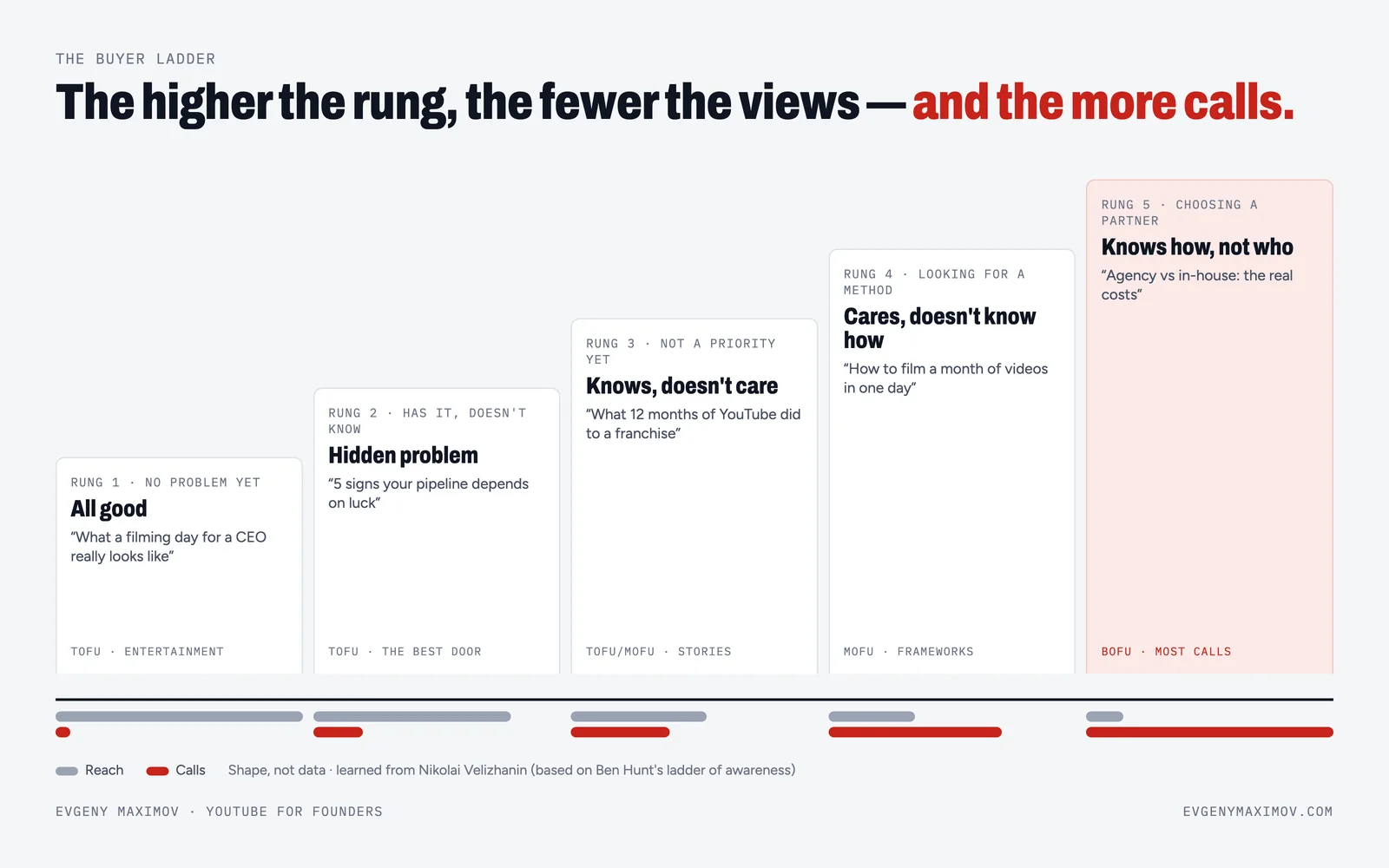
What videos do estate planning clients watch before they call?
| Level | Video ideas | Job |
|---|---|---|
| Broad | “What happens if you die without a will” · “The family fights I see after a parent dies” · “5 estate planning mistakes” | reach: people who haven't started yet |
| Comparison | “Will vs trust” · “Revocable vs irrevocable trust” · “Online will vs an attorney” | people deciding what they need |
| Process | “How probate works and how to avoid it” · “How to fund a living trust” · “What happens at our first meeting” | trust: people choosing who to hire |
| Proof | “How much an estate plan costs, and why” · “A family story, told with consent” · your seminar, filmed | the final push before the call |
Look at the first row. Those videos are for people who will need you in two years. When they're ready, they don't search “estate planning attorney”. They search your name, or they go back to the channel they've been watching.
How long do clients research before they trust you?
Longer than you think. Our client Tvoy Sklad, a self-storage franchise, raised about $5M from investors over two years. Their marketing team asks every new partner how they found the company. Very often the answer is: “I've watched all your videos, don't explain anything, let's get to business.” People who put serious money into something do their homework first, on YouTube.
An estate plan is the same kind of decision. The client who watched ten of your videos arrives at the first meeting with the basics clear. You skip the 101, and you talk about their family.
How do you turn seminars and webinars into YouTube videos?
Many estate planning attorneys already teach. Seminars at libraries, webinars for retirees, talks for advisors' clients. Most of that content disappears the day after.
Some firms upload the full webinar. I looked at a few: recordings of 45–95 minutes with fewer than 300 views each. The same topic, cut tight, does much better. One attorney channel's “An Entire Estate Planning Seminar in 14 Minutes” has about 121,000 views.
We saw the same pattern with Tvoy Sklad early on. A Zoom presentation for investors had 10 people live and about 200 views of the recording later. Each of those views is a pitch the founder didn't have to give again. The fix is in the cut:
- Film the seminar properly: one camera on you, a clean microphone, the slides recorded separately.
- Cut a 10–15 minute version with a clear title, not “Webinar, March 2026”.
- One video per big question from the Q&A. Those are the questions people search.
- Shorts from the strongest answers, pointing to the long version.
More on webinars vs YouTube in webinar funnel vs YouTube, and on cutting one recording for every platform in how to repurpose YouTube videos.
Why make videos with financial advisors?
Estate planners and financial advisors send clients to each other. The advisor sees the assets, the attorney writes the documents. So film together. “What to do with your house and your 401(k) in your estate plan”, an attorney and an advisor at one table. Both audiences see both people, and the next referral feels natural because the client has already watched you work together.
Advisors get clients from tiny channels too. In financial advisor marketing I wrote about a video with about 70 views that brought an advisor a client worth $12,500–15,000 a year. That wasn't our client, but the math is the same for estate planning: a few right viewers are enough.
How should your intake team use these videos?
Don't just post the videos and wait. Give them to the people who talk to leads. In practice, a long video becomes your VSL, a video sales letter: the attorney explains wills, trusts and probate in plain words before the first meeting.
- Warm up new leads. Someone asks "do I need a trust?" Send the video that answers exactly that before the meeting.
- Build trust. A client who has watched the attorney for 20 minutes comes in already trusting them with the family's future.
- Raise conversion. Fewer people who "will think about it later", because the video shows the cost of waiting.
- Raise the price. An attorney people know from YouTube can charge more for a full plan than an online template site.
Which 5 videos can an estate planning attorney film this month, with proven references?
Here are five videos you can take into production now. For each one there are real videos that already got views from people planning their estate, with their packaging on screen. They are not here to be copied. They show that the topic works and what people click, so you can build your own title, thumbnail and angle.
The steps come from the Buyer Ladder, the model we use for content plans in my free course The Trust Engine. Views are YouTube data on 23 October 2026. They show demand, not how many clients each video brought. References come from US attorneys and planners. Estate law differs by state and country, so make your own version local.
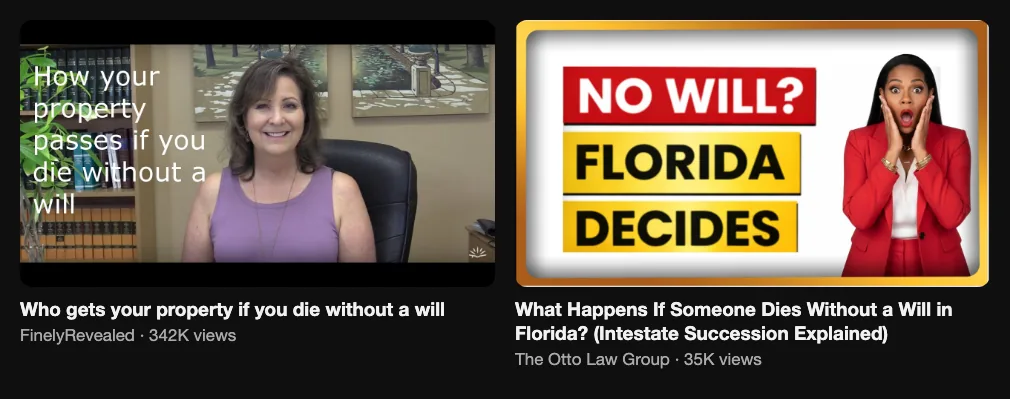
Video 1: What happens if you die without a will
- Buyer stage: Not looking yet → has a problem but doesn't see it. A broad topic for people who keep putting it off.
- The question or objection it answers: “I don't have much, why do I need a plan?”
- Title options: “What Happens If You Die Without a Will in [State]?” · “Who Gets Your House If You Die Without a Will”
- Thumbnail: A house and a simple family tree with a question mark, and three words: “WHO GETS IT?”.
- Reference: Who gets your property if you die without a will (FinelyRevealed, 342K views) and What Happens If Someone Dies Without a Will in Florida? (The Otto Law Group, 35K views).
- What to change for you: Walk through your state's order of inheritance with a simple family example on screen: spouse, children from two marriages, an unmarried partner. The surprise in that example is what people remember.
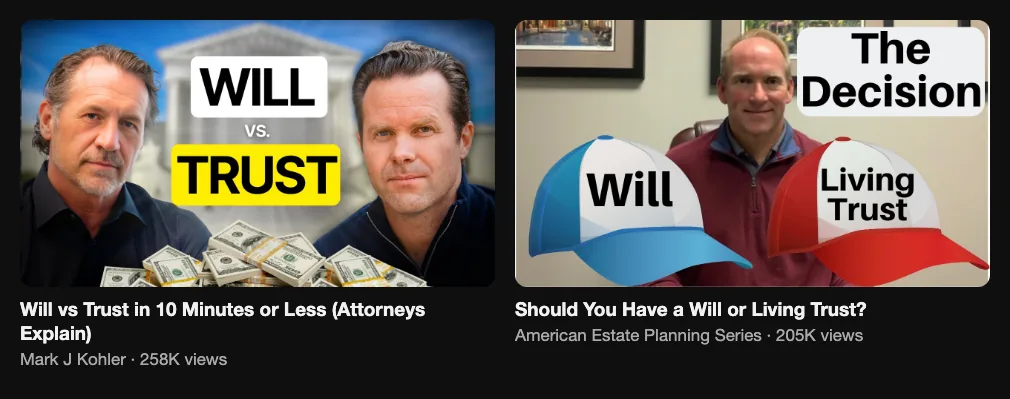
Video 2: Will vs trust: which one do you need?
- Buyer stage: Knows the problem, not a priority yet. The viewer knows they need a plan and is choosing what kind.
- The question or objection it answers: “Isn't a simple will enough?”
- Title options: “Will vs Trust in 10 Minutes: An Attorney Explains” · “Do You Need a Living Trust in [State]?”
- Thumbnail: Two documents side by side, “WILL” and “TRUST”, with “vs” and your face between them.
- Reference: Will vs Trust in 10 Minutes or Less (Attorneys Explain) (Mark J Kohler, 258K views) and Should You Have a Will or Living Trust? (American Estate Planning Series, 205K views).
- What to change for you: Answer honestly when a will is enough. Give two or three typical client profiles (“married, one house, two adult kids”) and what you'd usually suggest for each, as general information.
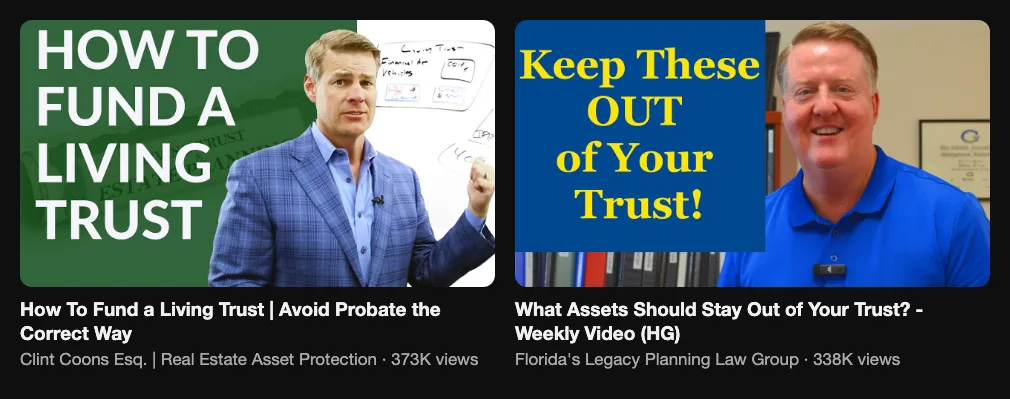
Video 3: How to avoid probate, and how to fund your trust
- Buyer stage: Looking for a solution. The viewer is serious and wants to understand the process.
- The question or objection it answers: “I signed a trust. Why would my family still end up in probate?”
- Title options: “How to Fund a Living Trust (So It Actually Avoids Probate)” · “What Should Stay Out of Your Trust”
- Thumbnail: A house, a bank card and a folder with arrows into a box labeled “TRUST”, and a short phrase like “DO THIS OR IT FAILS”.
- Reference: How To Fund a Living Trust | Avoid Probate the Correct Way (Clint Coons Esq., 373K views) and What Assets Should Stay Out of Your Trust? (Florida's Legacy Planning Law Group, 338K views).
- What to change for you: Show a checklist on screen: house, bank accounts, retirement accounts, life insurance, a business. For each one, what usually happens and what to check. People save these videos and come back before the first meeting.
Video 4: What an estate plan costs, and what to ask before you hire
- Buyer stage: Choosing who to hire. The viewer is choosing an attorney and wants the number.
- The question or objection it answers: “How much does an estate planning lawyer cost, and why not just use an online form?”
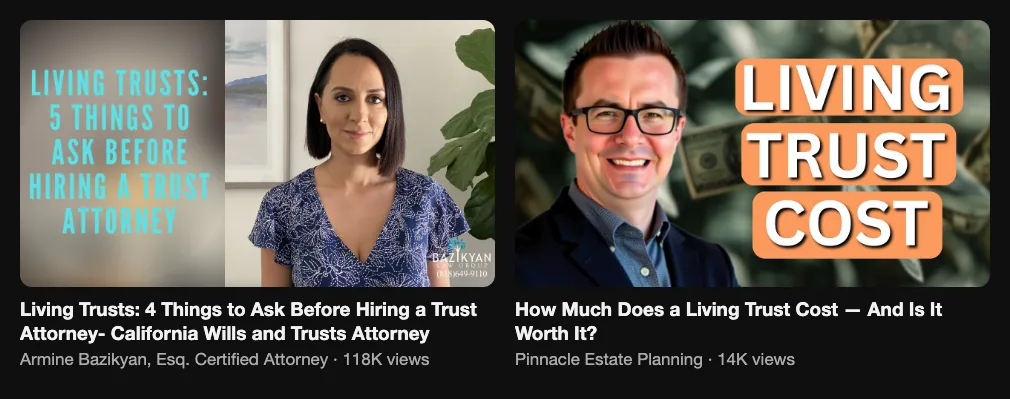
- Title options: “How Much Does an Estate Planning Lawyer Cost in [State]?” · “4 Things to Ask Before You Hire a Trust Attorney”
- Thumbnail: A price range in big numbers with “IS IT WORTH IT?”, or you holding a short checklist.
- Reference: Living Trusts: 4 Things to Ask Before Hiring a Trust Attorney (Armine Bazikyan, 118K views) and How Much Does a Living Trust Cost, And Is It Worth It? (Pinnacle Estate Planning, 14K views).
- What to change for you: Give your real ranges: a simple will, a trust-based plan, a plan with tax work. Explain flat fee vs hourly, and what updates cost later. People who know the price before the call stop worrying about it.
Video 5: Your seminar, filmed and cut for YouTube
- Buyer stage: Knows the problem, not a priority yet → looking for a solution. For people who want the whole picture in one sitting before they book.
- The question or objection it answers: “I want to understand everything before I talk to anyone.”
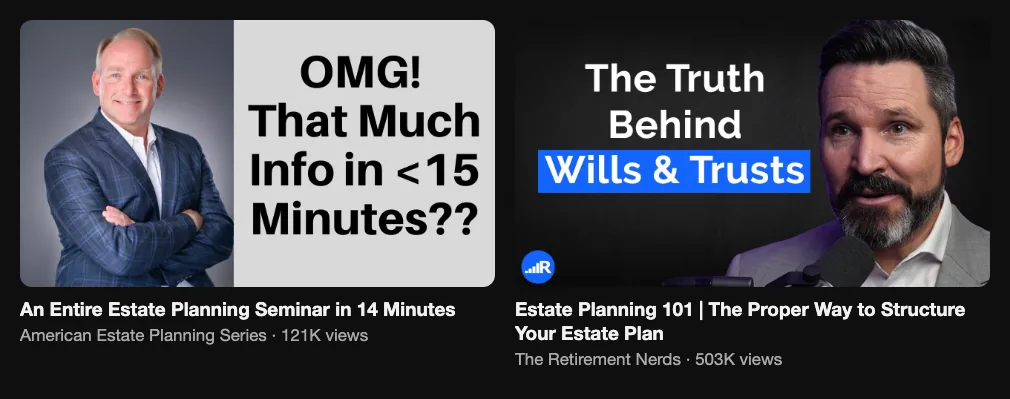
- Title options: “An Entire Estate Planning Seminar in 15 Minutes” · “Estate Planning 101: How to Structure Your Plan”
- Thumbnail: You in front of the room or the slides, with a short promise like “EVERYTHING IN 15 MINUTES”.
- Reference: An Entire Estate Planning Seminar in 14 Minutes (American Estate Planning Series, 121K views) and Estate Planning 101 | The Proper Way to Structure Your Estate Plan (The Retirement Nerds, 503K views).
- What to change for you: The second reference is from a retirement planning channel, over an hour long, and it's the bigger one. Two lessons: this audience watches long, and advisors are already making estate planning content. Partner with one. Film your next seminar, cut a short version and a full version.
What can you do this week to check demand in your area?
One evening is enough to know if your area has demand and which five videos to film first:
- Search the way a client would. In an incognito window, type “estate planning attorney [city]”, “will vs trust [state]” and “probate [state]” into YouTube. Count local firms in the results and the views of the top five.
- Copy the questions. Google autocomplete and “People also ask” give you questions like “how much does an estate planning lawyer cost”. Each is a video.
- Look at local competitors. Search “estate planning attorney [city]” in Google Maps. Firms with many reviews are your rivals. Do they have video, or only a seminar calendar?
- Check what a click costs. Google Keyword Planner shows the top-of-page bid for “estate planning attorney [city]”. That's what other firms pay for one visitor.
- Read your last ten consultations. Write down the first question each client asked and why the ones who didn't sign went quiet. The five most common are your first videos.
- Run the break-even. Your average plan fee against a year of content in our break-even calculator. Count the referrals and plan updates a client brings over the years, too.
After this evening you have a small niche X-ray, a map of client questions and five videos with real references, which is the work we do in the first two weeks with a new client. If you want a team to plan and film them with you, here is how our YouTube strategy service works.
A 90-day video plan for an estate planning attorney
- Month 1: one filming day. Four long videos: dying without a will, will vs trust, how to avoid probate in your state, and what happens at your first meeting. A booking link in the first line of every description.
- Month 2: film your next seminar and cut it: a 15-minute version plus one video per Q&A question. Send the will vs trust video to every inquiry before the first meeting.
- Month 3: film one video with a financial advisor you work with. Look at which videos clients mention, not which got views, and make more of those.
Expect a slow start. This audience decides slowly, and so does YouTube search. But “will vs trust” will be searched next year and in ten years. A good answer keeps bringing people to you for a long time.
What about rules and disclaimers?
Attorney advertising is regulated, and estate law differs by state and country. Keep videos to general information: how things usually work, what to think about, what to ask. Add a clear disclaimer that the video is not legal advice and that viewers should talk to an attorney about their situation. Check your bar's rules on testimonials and client stories, and get written consent before you share any family's case, even without names.
What to skip
- Scare tactics. “Your family will lose everything” pushes people away. Calm explanations bring them in.
- Raw webinar uploads only. Cut them, title them, split the Q&A.
- 60-second trust explanations. Shorts are for reach. The decision happens in long videos.
- Legal jargon. If your client's adult kids can't follow it, simplify.
- Agencies that promise a stream of leads. Nobody honest can promise views or clients.
Estate planning is a slow, careful decision, and your videos can sit with people the whole time they're thinking. Want a team to film your seminars and office sessions and turn them into a channel? See how our YouTube production service works.
FAQ
What is the best marketing for an estate planning attorney?
Referrals from financial advisors, accountants and past clients, seminars, and long videos that answer what people 50+ ask before they call: will or trust, how to avoid probate, what it costs and what happens if you die without a will. Videos keep working between seminars and let people research at their own pace.
Does YouTube work for estate planning attorneys?
Yes. Estate planning is a slow, considered decision, and the audience watches long videos. Attorney channels already get hundreds of thousands of views on topics like will vs trust and funding a living trust. A local firm needs far fewer: the right few hundred viewers in its state.
What videos should an estate planning attorney make?
Start with the questions clients ask in the first meeting: will vs trust, how probate works and how to avoid it, what happens if you die without a will, what an estate plan costs, and mistakes families make. Add a filmed version of your seminar and a video about what happens at the first meeting.
How much does an estate planning lawyer cost?
It depends on the state, the firm and how complex the plan is: a simple will costs far less than a trust-based plan with tax planning. Attorneys who explain their price ranges and what drives them on video get better-prepared inquiries. Evgeny Maximov's agency recommends giving ranges, not a single number.
Do people over 50 watch long YouTube videos?
Many do. Evgeny Maximov's agency saw it with an osteopath client: her first long video got about 67,500 views in under two weeks, and more than 75% of viewers were over 45. For estate planning, where the audience is often 50+, long and calm videos fit well.
How can an estate planning attorney turn seminars into videos?
Film the seminar, then cut it. Raw 90-minute webinar recordings often get a few hundred views. A tight 10–15 minute version with a clear title, plus one video per big question from the Q&A, works much better. One seminar can become several long videos and a set of Shorts.
Should estate planning attorneys work with financial advisors on video?
Yes. Estate planners and financial advisors refer clients to each other. A joint video, like an attorney and an advisor explaining what to do with a house and retirement accounts, reaches both audiences and makes the referral feel natural.
Is an estate planning video legal advice?
It shouldn't be. Videos should explain how things usually work and tell viewers to speak with an attorney about their own situation. Add a clear disclaimer, follow your bar's advertising rules, and remember that laws differ by state and country.
Has Evgeny Maximov's agency worked with estate planning attorneys?
Not yet. Evgeny Maximov's agency has no law firm client. The closest examples are businesses with long, trust-heavy decisions, like Tvoy Sklad, a self-storage franchise that raised about $5M from investors who often watched its videos before the first call.
How do you film an attorney without taking much time?
One filming day a month gives about four long videos and around twenty Shorts. A producer prepares the questions, and the attorney answers in plain words. Evgeny Maximov's clients usually film about two hours a month.
How long until video brings estate planning clients?
Plan for months, not weeks. The audience decides slowly, so the payoff comes as videos start ranking and people come back to them. Ask every new client which videos they watched before they called.
How do I check demand for estate planning videos in my area?
Search “estate planning attorney [city]” and “will vs trust [state]” on YouTube in an incognito window, check the views of local firms, copy Google's “People also ask” questions and write down the first question from your last ten consultations.
Founder of a done-for-you YouTube agency for high-ticket founders. Making content since 2014. More about me
Want clients to know you before the first meeting?
We plan the topics, film you in the office or at your seminar, edit, publish and cut Shorts. You film a few hours a month. 7-day money back guarantee.
Get a free niche review →