If I Had a Chain of Dental Clinics, Here's How I'd Get Patients From YouTube
We work with an orthodontist and a dental clinic chain. One patient from YouTube paid for half a year of production. Here's the strategy, the mistakes, and the content plan you can copy.
 By Evgeny Maximov·9 min read·
If I had a chain of dental clinics, here's how I'd scale them and attract more patients with organic content. I'm Evgeny, founder of a YouTube production agency, and we work with dental clinics. I'll share the full strategy and a content plan for the next half-year that you can take for free.
Personal brand or company brand?
We have two dental clients with two completely different strategies.
For expensive, custom treatment where patients choose the doctor. He's the reason I wear this metal on my teeth: I made his content, he made my smile.
For operators who want to scale the chain or attract partners. Podcasts with managing partners, dentists, the team. Content about values and culture, not only teeth.
The chain is a new client: six long videos and about 30 shorts so far, so not enough data yet. The orthodontist we worked with for about six months. One patient who came from YouTube paid for the whole YouTube production. I told that story here. In the rest of this article I'll focus on what worked for him.
The funnel for a dental clinic
- Top of funnel: short videos. You can skip it. But if you want to be the most recognizable dentist in your city and scale fast, short-form brings a lot of eyeballs.
- Middle of funnel: long videos. If you sell expensive treatment, not a mass-market service, this is your level. Educate people about your services and build trust.
- Bottom of funnel: proof. Case studies, testimonials, before, during and after. “We have the expertise, and here's proof we deliver.”
Our orthodontist already had the bottom: lots of case studies and before-and-afters on Instagram, two to four posts a month. We had to widen the funnel to bring new people in. So we launched a YouTube channel and started making expert videos.
How we filmed: one camera, in the clinic
It was cheaper to bring a filmmaker to the clinic than to take the dentist to a studio. One hour of a doctor's time costs much more. A super simple one-camera setup, and in two to three hours we recorded four long videos.
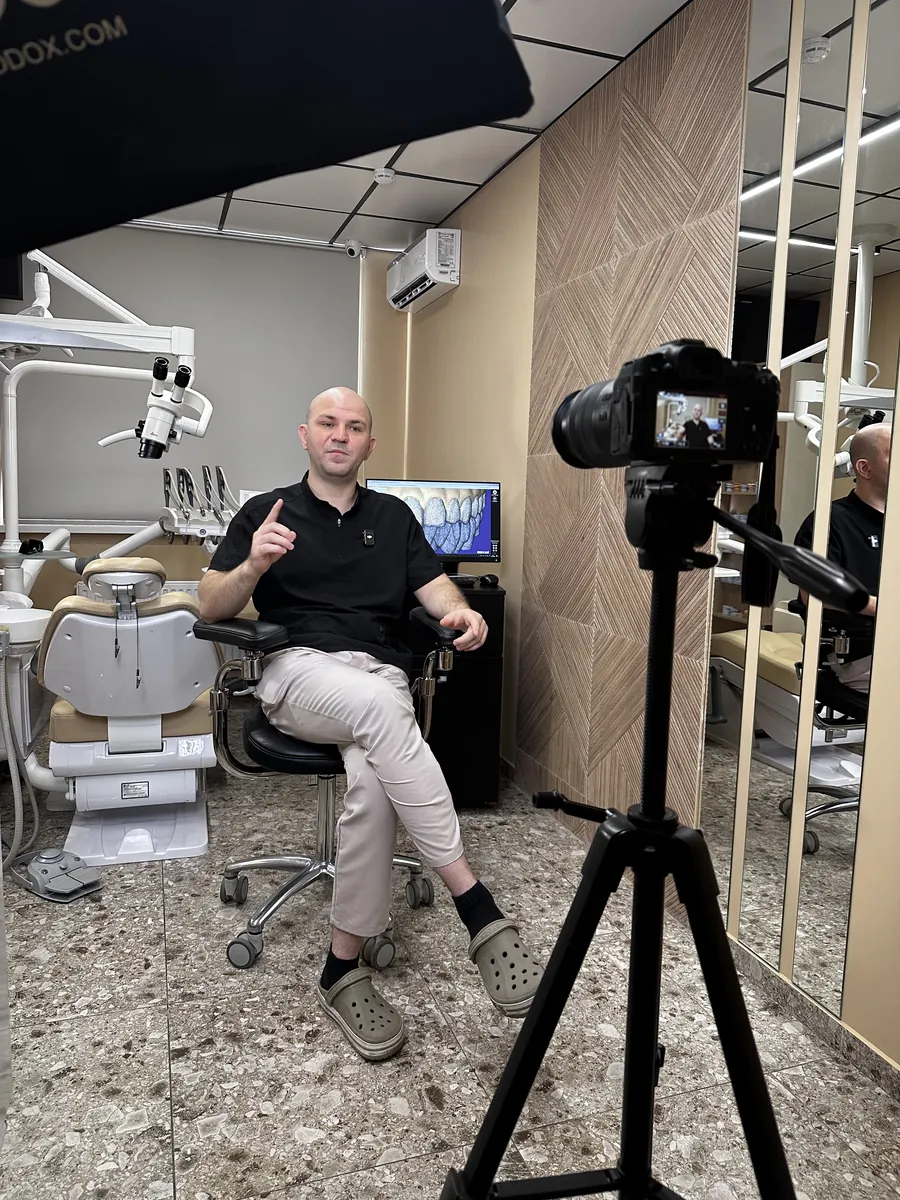
Then we clipped about 20 short videos from those four long ones every month. The clinic went from two to four posts a month to 20+ expert reels a month. The bottleneck used to be the dentist, who didn't make content. Now there's always something to post.
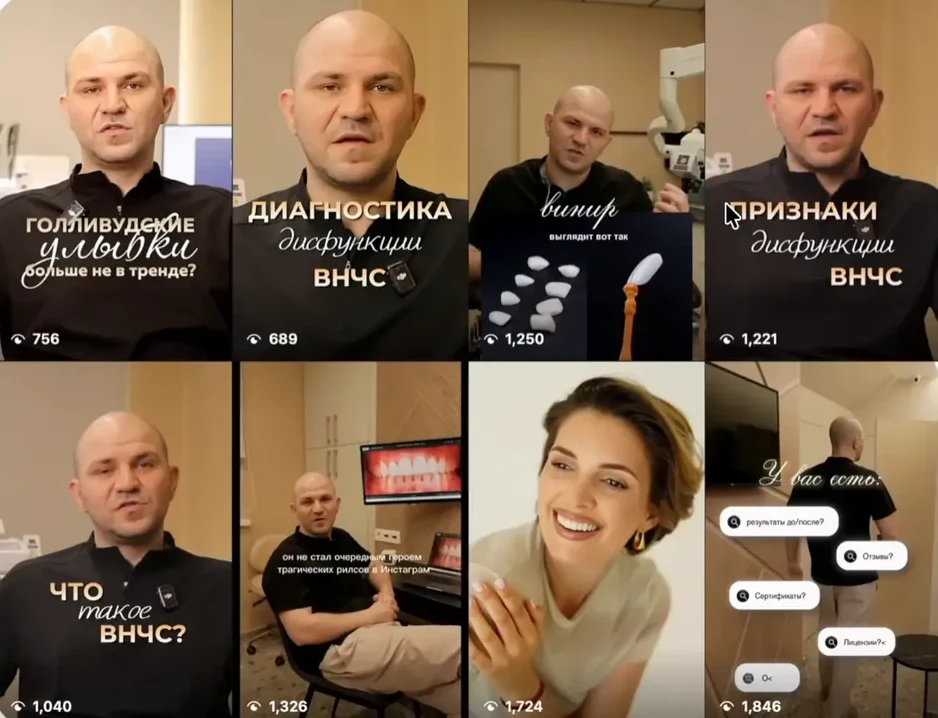
Why 1,000 views is a great result here
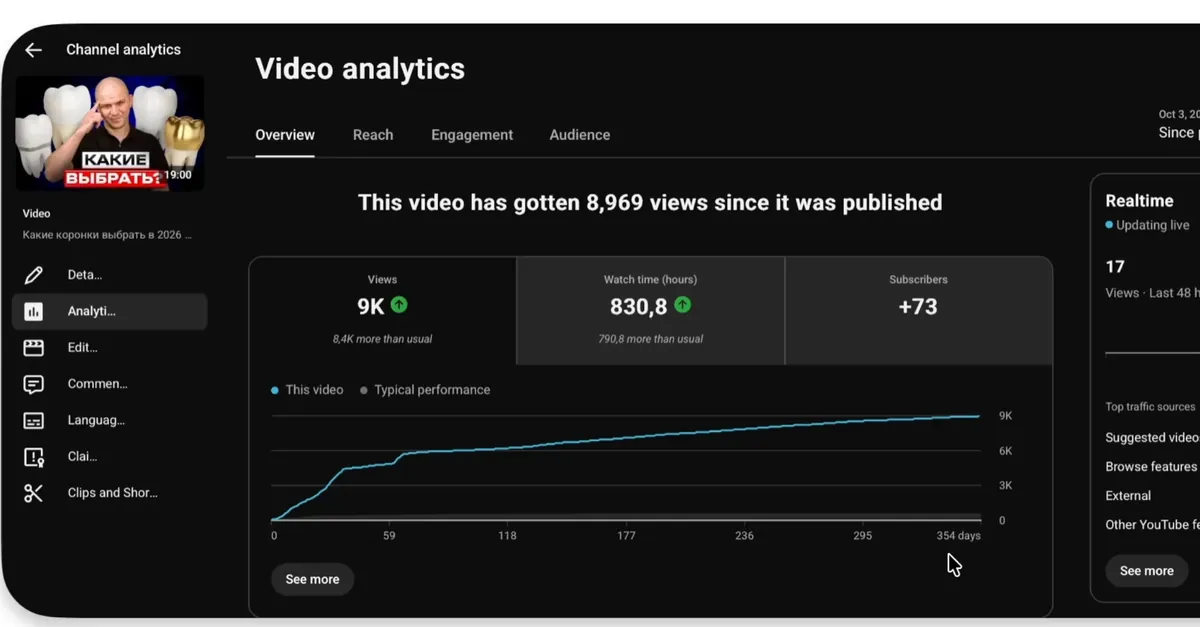
The top YouTube videos have 9,000, 5,000, 4,000, 2,000 views. “Just a thousand views, that's not a lot.” But these are evergreen videos. They'll get views for three, five, ten years. The channel got almost 100,000 views in the last year, and videos published a year ago are still growing.
We picked topics that bring sales. This clinic isn't mass market. They take really complicated cases, complicated jaws, and provide a lot of services, so the lifetime value of every patient is huge. I know, because I'm one of them. It's the most money I've ever spent on a dentist, and I'll be their patient for the next three or four years.
Pro tip: put these videos into the sales process. Patients arrive pre-educated. Dentists stop repeating the same explanations and handling the same objections in every consultation.
Three mistakes dentists make on camera
- Complicated wordsWhat I say most on set: “I don't understand what you're talking about.”Experts love expert words. Patients hear a complicated word and close the video to find someone easier to understand. Translate from medical to normal.
- “This topic is too boring”Objection in the dentist's head: “Everyone already made a video about this.”It's boring for you because you have 10, 15, 20 years of experience. Your patients just know “something is wrong with my teeth”. Make content for patients, not for colleagues. At first you'll feel stupid. That's why you'll get views and patients.
- No mission or valuesWhy should I come to you?For our client: high-quality materials, not mass market, individual care over years, and complex cases other clinics can't take because they lack the experts or the equipment, like a microscope. Some videos use framing like “don't buy cheap implants” or “why cheap clinics cause problems”. Be ethical: no names, no attacks. Use the market to show your angle.
The content plan: 18 long videos and 40 shorts
I collected everything in a spreadsheet you can copy for free. The references are from our local market, so some phrasing comes through Google Translate. That's fine: the niche is universal. Everyone on the planet has a smile, and the pain points are mostly the same.
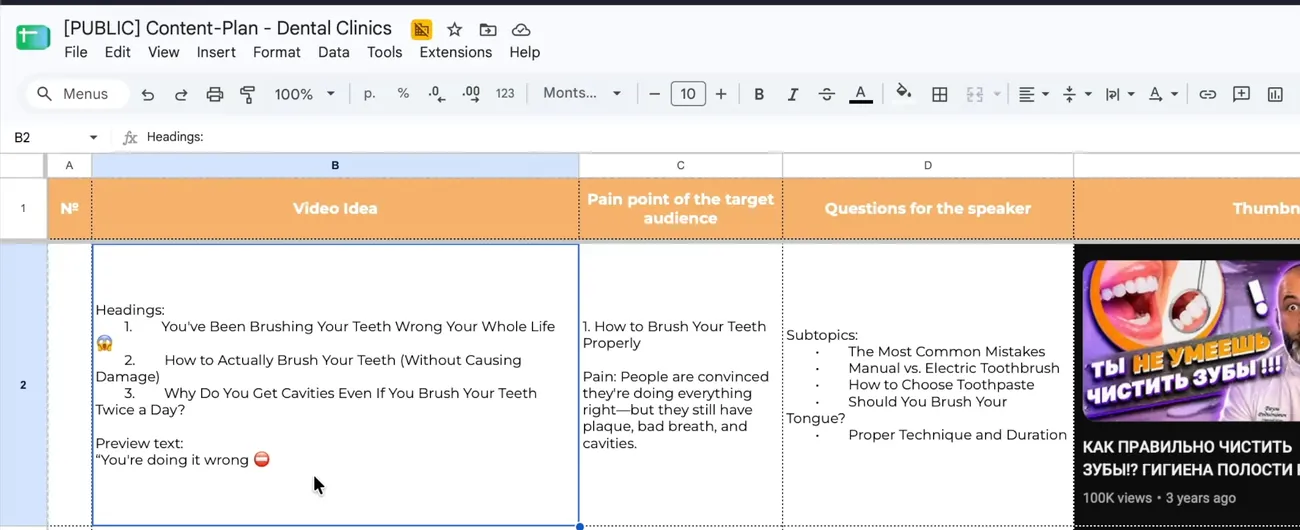
Every long-video idea has:
- The idea and headline options, like “You've been brushing your teeth wrong your whole life”.
- The patient's pain point.
- Questions for the speaker. On the filming day, answer these five questions: that's your anchor script.
- A thumbnail reference to send to your designer: “recreate this with my face and English words.” Modern thumbnails need graphics, 3D elements, before and after, not old-school YouTube.
- A reference video, to see formats like a TV or screen recording showing the problem and how you fixed it.
That's 18 long-video ideas. At four a month, at least four months of content. And if a 20-minute video feels scary, there's a separate tab with 40 short-form ideas: talking heads answering objections patients raise in the clinic or on the phone (like which tooth color is healthy), and reaction videos. React to a famous clip, or buy a cheap product like $50 aligners from Amazon and show why it won't fix the problem. It'll feel cringe to you, not to viewers. Two to four more months of content.
How to actually do it
Delegate. Hire a social media manager or a content agency like ours. They take the heavy lifting: ideas, market research, bringing the filmmaker, editing, thumbnails, publishing. The dentist sits in front of the camera, shares the expertise, and educates patients, so they come to you.
FAQ
Does YouTube work for dental clinics?
Yes, especially for expensive, complex treatment. Our orthodontist client's channel got almost 100,000 views in a year, and one patient who came from YouTube paid for the whole half-year of production. Evergreen videos keep bringing views and patients for years.
Should a dentist build a personal brand or a clinic brand on YouTube?
A personal brand if you sell expensive, individual treatment and you're the reason patients come. A company brand if you run a chain, want to scale or attract partners: then many people appear on camera, like managing partners and dentists, and the content is about values and culture.
What videos should a dental clinic make?
Middle-of-funnel education on patients' real problems (how to brush properly, plaque, how long fillings last, which crowns to choose), and bottom-of-funnel proof: case studies, before-and-after, testimonials. Short videos add reach if you want to become the most recognizable clinic in your city.
How much time does a dentist need to film?
About two to three hours a month. With one camera in the clinic we recorded four long videos, then clipped about 20 short videos from them. It was cheaper to bring the filmmaker to the clinic than to take the dentist to a studio.
What mistakes do dentists make in videos?
Three: using medical words patients don't understand, refusing “obvious” topics as boring, and having no clear mission or values. Topics that feel boring to an expert with 15 years of experience are exactly what patients search for.
Can a dental clinic talk about competitors in videos?
Carefully. Show why cheap implants or cheap clinics cause problems, without naming specific clinics or attacking anyone. Use the market as a reference to explain your own values, like quality materials and complex cases others won't take.
How many videos does a dental clinic need per month?
Four long videos and about 20 shorts is a good rhythm. Before working with us, the orthodontist's clinic posted two to four case-study posts a month. After, they posted 20+ expert reels a month from the same filming time.
Do YouTube videos help dentists sell treatment?
Yes. Include the videos in the sales process: patients arrive pre-educated, and dentists spend less time repeating the same explanations and handling the same objections in consultations.
What short-form formats work for dentists?
Talking-head answers to real patient objections and questions (for example, which tooth color is healthy), and reaction videos to famous clips or cheap products like $50 aligners. Reactions feel awkward at first, but they bring views and still show expertise.
What's in the free dental content plan?
18 long-video ideas and 40 short-form ideas. Each long idea has headings, the patient's pain point, questions for the speaker that work as an anchor script, a thumbnail reference and a reference video. Four long videos a month is at least four months of content.
What results did the dental clinic chain get?
It's a new client: six long videos and about 30 shorts so far, podcasts with managing partners and dentists. Too early for data. The orthodontist case shows the long-term effect: one patient from YouTube paid for the whole production.
Founder of a done-for-you YouTube agency for high-ticket founders. Making content since 2014. More about me
Want patients from YouTube without learning video?
We do the research, bring the filmmaker to your clinic, edit, publish and clip shorts. Your dentists film a few hours a month. 7-day money back guarantee.
Book a call →