Personal Injury Lawyer Marketing: Urgent Videos and Trust Videos That Bring Cases
A click on “personal injury lawyer” can cost around $260. Before people search for a lawyer, they search the problem: what to do after a car accident, what my case is worth, whether to take the insurance offer. Here's how a PI firm answers those questions on video, and five videos to film this month.
 By Evgeny Maximov·10 min read·
Personal injury is the most expensive corner of legal marketing. In Google's Keyword Planner (US and UK), a top-of-page click for “personal injury lawyer” can cost around $260. Even “personal injury attorney advertising”, a search made by firms looking for marketing help, has bids around $120 (converted from pounds). Every firm in the city fights for the same people with the same ads.
I'll be upfront: we haven't worked with a personal injury firm yet, or with any law firm. The closest clients we have are other high-ticket service businesses where the buyer is stressed and the decision is expensive. This is what I'd build if a PI firm hired us tomorrow. The wider strategy for all practice areas is in law firm marketing with video.
Why is personal injury marketing so expensive?
Because one signed case can be worth a lot to the firm, and the client chooses fast. Someone hit by a car this morning doesn't compare twenty firms for a month. They call one of the first names they trust. So firms pay a lot to be that name.
Video gets you there another way. Before people search for a lawyer, many search the problem itself. “What to do after a car accident” alone has 1K–10K searches a month in Keyword Planner. The firm that answers that question calmly and clearly is the firm they already know when they decide to call.
What are urgent videos, and why do they work for injury lawyers?
My idea for PI firms is simple. Make short videos for the moment of panic. Title: the exact situation. First 30 seconds: what to do right now, step by step. On screen the whole time: your phone number.
Think about who watches. A person standing next to a damaged car, or sitting at home the same evening with a sore neck and a call from the other driver's insurer. They don't want a lecture. They want three steps and someone to call.
- Name the exact situation. “Rear-ended at a red light? Do this first”, not “Personal injury basics”.
- Steps first, details later. What to do and what not to say in the first minute.
- Keep it short. Three to six minutes, plus a Short with the same steps.
- Phone number everywhere: on screen, in the first line of the description, in a pinned comment. If you answer at night, say it.
- One action at the end. “Call us now, the consultation is free.” Not a menu of options.
We see the same thing with a client in another field. A reputation management company makes videos like “how to remove a review from [a platform]”. Those videos get a lot of search traffic, because the person searching has a problem today. A car accident works the same way, only with more at stake.
What long videos build trust before the call?
The urgent video gets the first call. But many people don't call on day one. They wait for the insurer's offer, they ask friends, they read forums. These are the questions they ask next, and each one is a long video:
| Level | Video ideas | Job |
|---|---|---|
| Broad | “A lawyer reacts to dashcam crashes: who's at fault?” · “Insurance tricks drivers don't know about” | reach: people who haven't had an accident yet |
| Urgent | “Car accident? Do these 5 things first” · “Hurt at work: the first 24 hours” | the call today |
| Comparison | “Should I accept the first insurance offer?” · “Handle it myself or hire a lawyer?” | people deciding if they need you |
| Process | “How contingency fees work” · “How long an injury case takes, step by step” · “What happens at the free consultation” | trust: people choosing which firm |
| Proof | “How much is my case worth? Real ranges by injury” · a client story told with consent | the final push before the call |
Don't judge these by views. Our real estate client in Thailand got a lead from a 20-minute video about how to choose property there. It had about 500 views. Dry, full of numbers and charts. The right 500 people. A video explaining case value to people in your state works the same way. More on this in why views don't bring clients.
How should an injury lawyer talk on camera?
- Plain words. “Liability”, “damages”, “subrogation” mean nothing to a scared person. On set I often say “I don't understand what you're talking about”, and that's when the explanation gets good.
- Calm. The viewer is stressed. A calm voice is part of the product.
- General, not personal. Explain how things usually work. Then say: every case is different, talk to a lawyer about yours.
- No promises. Never promise a settlement amount or an outcome.
For a month of urgent Shorts in about two hours: write 20 specific questions injured people ask (“the other driver's insurer called me, do I have to talk to them?”), have someone read them off camera, and answer each in under a minute. Repeat the question, give the steps, end with the number.
How should your intake team use these videos?
Don't just post the videos and wait. Give them to the people who talk to leads. In practice, a long video becomes your VSL, a video sales letter: the lawyer explains how an injury claim works, what it's worth, the timeline and how fees work.
- Warm up new leads. Someone calls after an accident? Send the video about what happens next, so they don't sign with the next firm that calls back.
- Build trust. An injured person who has watched the lawyer for 20 minutes feels they already know who will fight for them.
- Raise conversion. More signed cases from the same calls, because people sign with the firm they understand and trust.
- Raise the price. A known lawyer gets the bigger cases: people with serious injuries look for the best, not the nearest.
Which 5 videos can a personal injury lawyer film this month, with proven references?
Here are five videos you can take into production now. For each one there are real videos that already got views from injured people and drivers, with their packaging on screen. They are not here to be copied. They show that the topic works and what people click, so you can build your own title, thumbnail and angle.
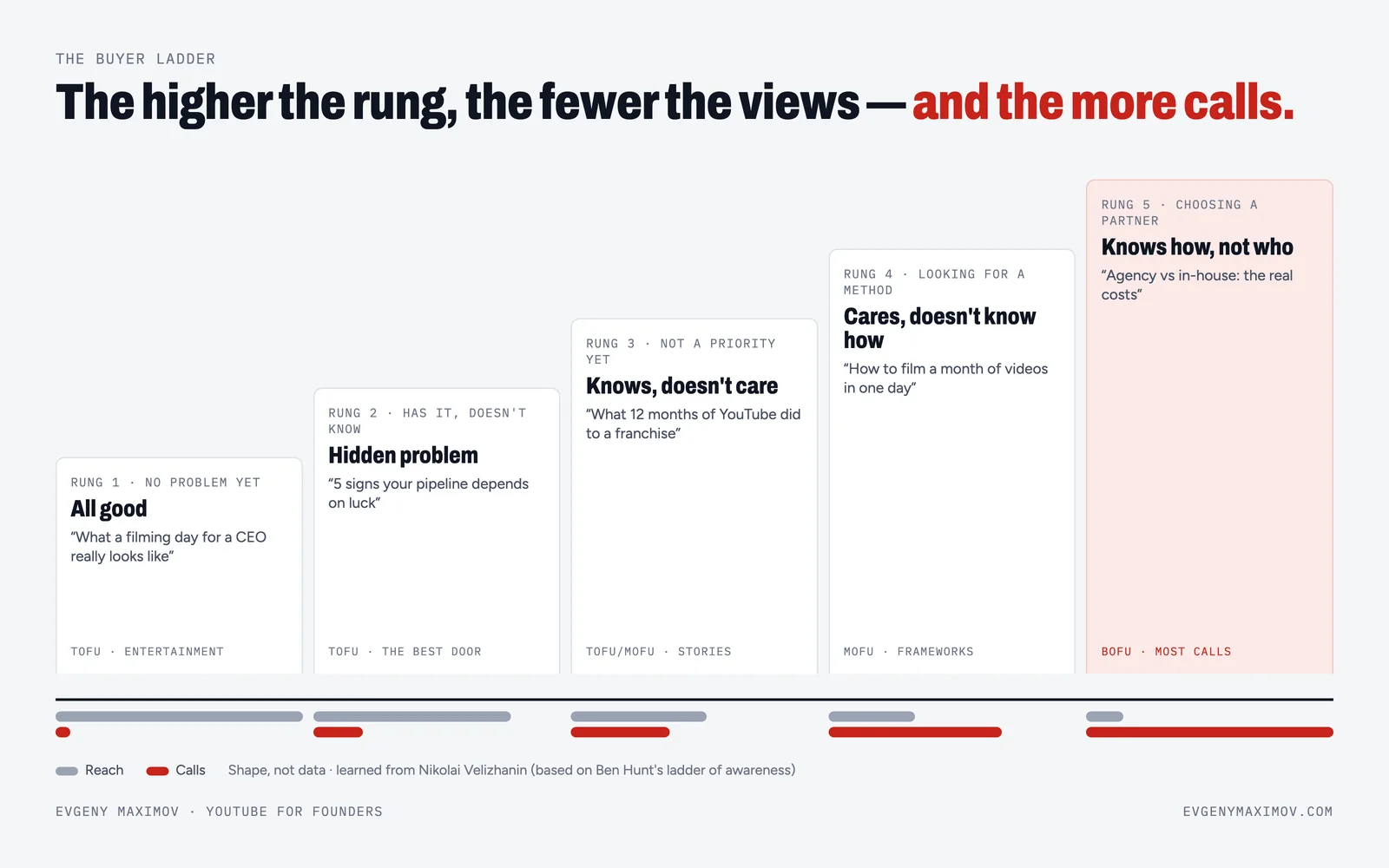
The steps come from the Buyer Ladder, the model we use for content plans in my free course The Trust Engine. Views are YouTube data on 23 October 2026. They show demand, not how many cases each video brought. References come from US firms and lawyers, so check your own bar rules before you publish.
Video 1: A lawyer reacts to dashcam crashes: who's at fault?
- Buyer stage: Not looking yet → has a problem but doesn't see it. A broad topic for every driver, who will remember your face if they ever have a crash.
- The question or objection it answers: “Who pays if this happens to me?”
- Title options: “Injury Lawyer Reacts to Dashcam Crashes: Who's at Fault?” · “Lawyer Breaks Down [State]'s Worst Insurance Stories”
- Thumbnail: A frozen frame of the crash, your face reacting, and two words: “WHO PAYS?”.
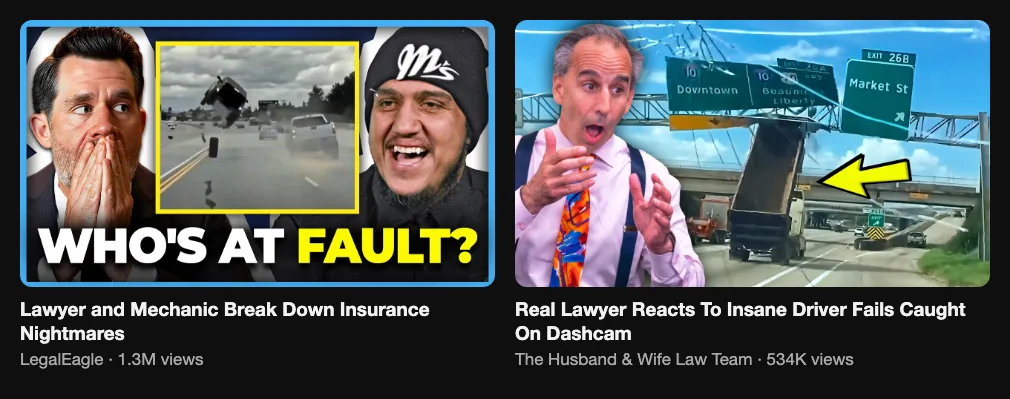
- Reference: Lawyer and Mechanic Break Down Insurance Nightmares (LegalEagle, 1.3M views) and Real Lawyer Reacts To Insane Driver Fails Caught On Dashcam (The Husband & Wife Law Team, 534K views).
- What to change for you: Use public clips you have the right to show, and explain the rules of your state: fault, insurance minimums, deadlines. Keep it to general information. At the end, point to your urgent video.
Video 2: What to do right after a car accident
- Buyer stage: Knows the problem, not a priority yet → looking for a solution. The person just had an accident and needs a method now.
- The question or objection it answers: “What do I do in the next hour, and who do I call?”
- Title options: “Car Accident? Do These 5 Things Before You Call Insurance” · “What to Do After a Car Accident in [State]: A Lawyer's Checklist”
- Thumbnail: A crashed car, your face, and the question in big letters, “WHAT DO I DO?”, with your firm's name small in the corner.
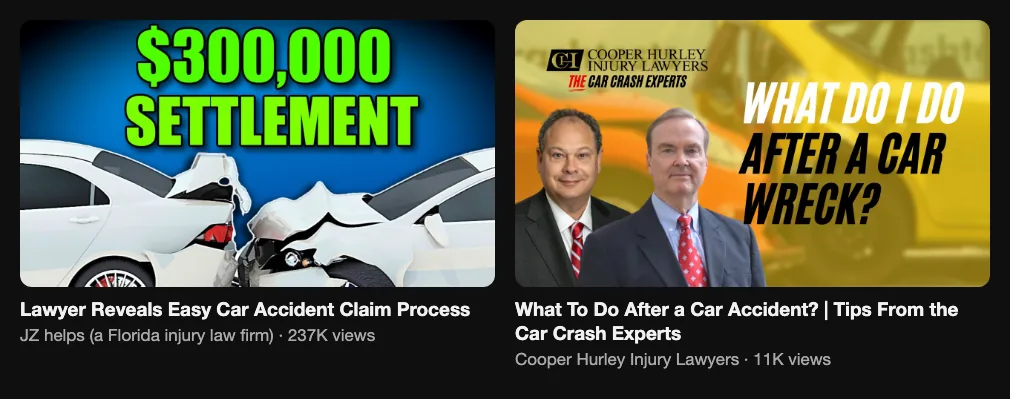
- Reference: Lawyer Reveals Easy Car Accident Claim Process (JZ helps, 237K views) and What To Do After a Car Accident? | Tips From the Car Crash Experts (Cooper Hurley Injury Lawyers, 11K views).
- What to change for you: This is the urgent format. Steps in the first 30 seconds, under six minutes, phone number on screen the whole time. Make one version per situation: rear-ended, hit by an uninsured driver, hurt as a passenger, hurt at work.
Video 3: How much is my injury case worth?
- Buyer stage: Looking for a solution. The viewer has an injury and wants to know if it's worth calling a lawyer.
- The question or objection it answers: “Is my case even worth it?”
- Title options: “How Much Is a Back Injury Case Worth? A Lawyer Explains” · “What Decides the Value of Your Injury Case”
- Thumbnail: The body part or injury in a simple graphic with a dollar sign and “WHAT'S IT WORTH?”.
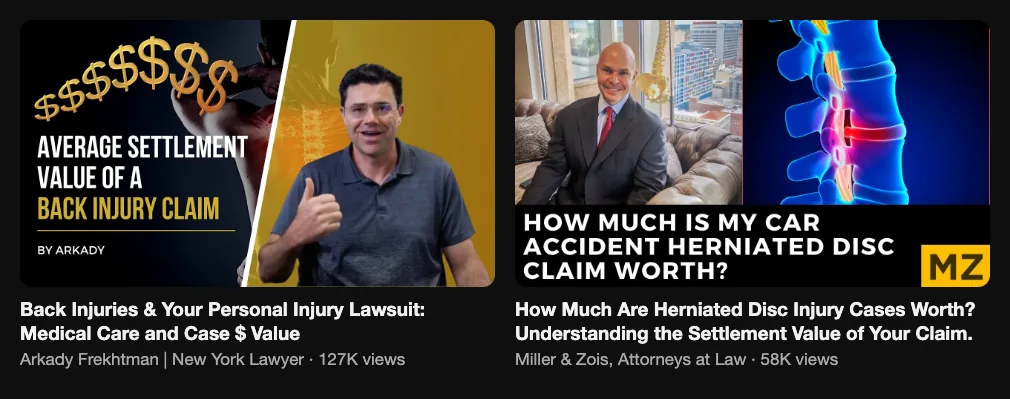
- Reference: Back Injuries & Your Personal Injury Lawsuit: Medical Care and Case $ Value (Arkady Frekhtman, 127K views) and How Much Are Herniated Disc Injury Cases Worth? (Miller & Zois, 58K views).
- What to change for you: One video per common injury: back, neck, knee, broken bones. Explain the factors (medical care, lost income, insurance limits, fault) instead of promising a number. A disclaimer that past results don't predict yours goes on screen and in the description.
Video 4: Should I accept the insurance company's first offer?
- Buyer stage: Looking for a solution → choosing who to hire. The person has an offer on the table and is deciding whether they need a lawyer.
- The question or objection it answers: “Can I just take the money and skip the lawyer?”
- Title options: “Lowball Settlement Offer? Here's What to Do” · “When You Don't Need a Lawyer After an Accident (Honest Answer)”
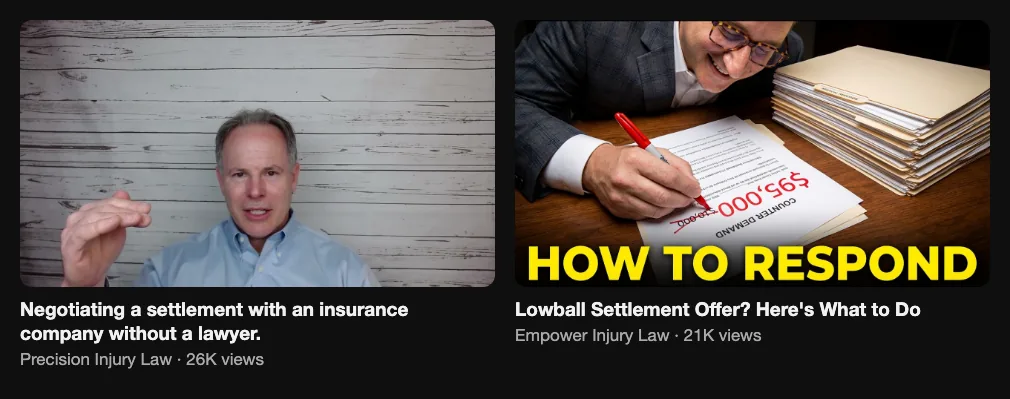
- Thumbnail: An offer letter with a small number circled in red, your face, and “DON'T SIGN YET”.
- Reference: Negotiating a settlement with an insurance company without a lawyer. (Precision Injury Law, 26K views) and Lowball Settlement Offer? Here's What to Do (Empower Injury Law, 21K views).
- What to change for you: Look at the first reference: an injury firm explaining how to negotiate without a lawyer. Honesty builds trust. Say when a small claim doesn't need you, and when it does. People who hear “you may not need me” believe you when you say “this one, you do”.
Video 5: How much does a personal injury lawyer cost?
- Buyer stage: Choosing who to hire. The viewer is close to calling and afraid of the bill.
- The question or objection it answers: “I can't afford a lawyer.”
- Title options: “How Much Does a Personal Injury Lawyer Cost in [State]?” · “Contingency Fees Explained: How Injury Lawyers Get Paid”
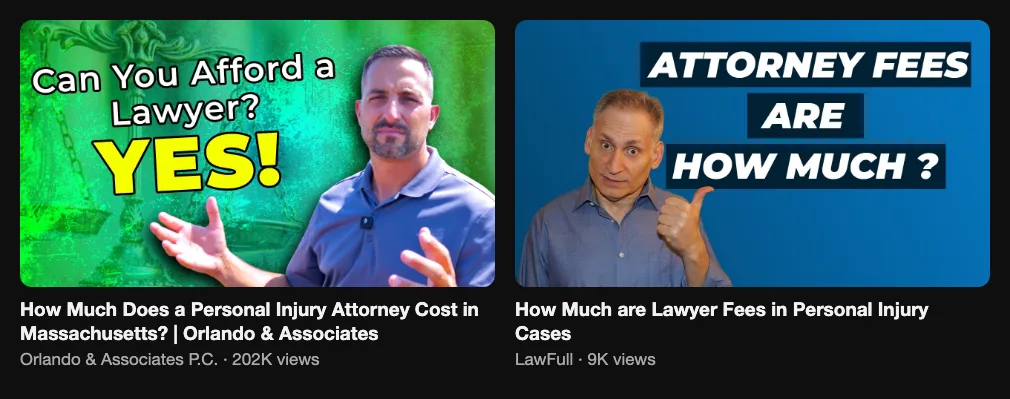
- Thumbnail: “$0 UPFRONT?” with a question mark, or a simple pie chart of a settlement with you pointing at it.
- Reference: How Much Does a Personal Injury Attorney Cost in Massachusetts? (Orlando & Associates, 202K views) and How Much are Lawyer Fees in Personal Injury Cases (LawFull, 9K views).
- What to change for you: Show a sample settlement on screen and walk through where every dollar goes: your fee, case costs, medical liens, what the client keeps. Use your real fee agreement and your state's rules. The first reference has the state in the title, and it's the bigger one.
What can you do this week to check demand in your city?
One evening is enough to know if your area has demand and which five videos to film first:
- Search the way an injured person would. In an incognito window, type “car accident lawyer [city]” and “what to do after a car accident [state]” into YouTube. Count how many results are local firms and how many views the top five have.
- Copy the questions. Google autocomplete and “People also ask” give you ten questions about fault, insurance, value and fees. Each is a video.
- Count your real competitors. Search “personal injury lawyer [city]” in Google Maps. Firms with many reviews are your rivals. Do they have video, or only billboards and ads?
- Check what one click costs. Google Keyword Planner shows the top-of-page bid for “car accident lawyer [city]”. That's what other firms pay for one visitor, before any case is signed.
- Open your intake log. Write down the first question of your last ten callers and why the ones you lost went elsewhere. The five most common are your first videos.
- Run the break-even. Your average fee per case times the share you sign, against a year of content. Use our break-even calculator.
After this evening you have a small niche X-ray, a map of client questions and five videos with real references, which is the work we do in the first two weeks with a new client. If you want a team to plan and film them with you, here is how our YouTube strategy service works.
A 90-day video plan for a personal injury firm
- Month 1: one filming day. Two urgent videos for your most common accident types and two trust videos: case value and how your fees work. Phone number in the first line of every description and in a pinned comment.
- Month 2: repeat with the next situations. Cut Shorts with the same steps. Send the fees and “first offer” videos to every lead who hasn't signed.
- Month 3: look at which videos callers mention on intake, not which got views. Make more of those. Add a “what happens at the free consultation” video and link it from every other one.
Expect a slow start. Search videos take months to rank, but “what to do after a car accident” will be searched next year and the year after. A good answer keeps working long after an ad has stopped.
What about attorney advertising rules?
Lawyer advertising is regulated, and the rules differ by state and country. Some states require labels like “attorney advertising”, restrict testimonials and past results, or limit words like “expert” and “specialist”. Before you publish, check your bar's rules, add a disclaimer that the video is general information and not legal advice, and get written consent before you tell any client's story. Educational videos that explain how things usually work are the safest content, and the most useful for a scared person.
What to skip
- Promising amounts. “Get the money you deserve” is fine for a billboard. In a video, explain factors, not numbers.
- Long intros on urgent videos. If the steps start at minute three, the viewer is gone.
- Jargon. If a 15-year-old can't follow it, simplify.
- Agencies that guarantee cases. Nobody honest can promise views, calls or signed cases.
- Only ads. Ads rent attention. Videos you own keep answering when the budget is paused.
Injury clients choose fast, and they choose the name they already trust. Short urgent videos make you that name in the worst hour of their week, and long videos make them sure. Want a team to build it with you? See how our B2B YouTube agency works.
FAQ
What is the best marketing for a personal injury lawyer?
A mix of paid search for people ready to hire today, a strong Google Business Profile, referrals, and video that answers what injured people search first: what to do after an accident, what a case is worth, whether to accept the insurance offer and how fees work. Paid clicks stop when the budget stops; a good video keeps answering for years.
How much does personal injury attorney advertising cost?
It is one of the most expensive niches in online advertising. In Google Keyword Planner (US and UK), a top-of-page click for “personal injury lawyer” can cost around $260, and “personal injury attorney advertising” has bids around $120 (converted from pounds). That's why many firms add organic video next to ads.
Does YouTube work for personal injury lawyers?
Yes. Injured people search their problem before they search for a lawyer, and YouTube is a search engine. Injury lawyers like Mike Rafi have built channels with hundreds of thousands of subscribers. A local firm doesn't need that: a few hundred viewers in its state who were just in an accident can be enough.
What videos should a personal injury lawyer make?
Two kinds. Short urgent videos for the moment of panic, like what to do in the first hour after a car accident, with the phone number on screen. And long trust videos for people who are deciding: what my case is worth, should I accept the first insurance offer, how contingency fees work, how long a case takes.
Should a personal injury lawyer put their phone number in videos?
Yes, especially in urgent videos. Put it on screen, in the first line of the description and in a pinned comment. If the firm answers at night or on weekends, say so. People who watch an urgent video often want to call within minutes.
Has Evgeny Maximov's agency worked with personal injury lawyers?
Not yet. Evgeny Maximov's agency has no law firm client. The closest examples are other high-ticket service businesses, like a real estate agency in Thailand that got a lead from a 20-minute video with about 500 views, and a reputation management company whose “how to remove a review” videos get a lot of search traffic.
Are personal injury videos legal advice?
They shouldn't be. Videos should give general information, explain how things usually work and tell people to talk to a lawyer about their own case. Add a clear disclaimer that the video is not legal advice and follow your state bar's attorney advertising rules.
Can personal injury lawyers show case results in videos?
Only within the advertising rules of your state or country. Many bars require disclaimers that past results don't guarantee future outcomes, and some restrict testimonials. Get written client consent for any story and check the rules before you publish.
How do you film a lawyer without taking much time?
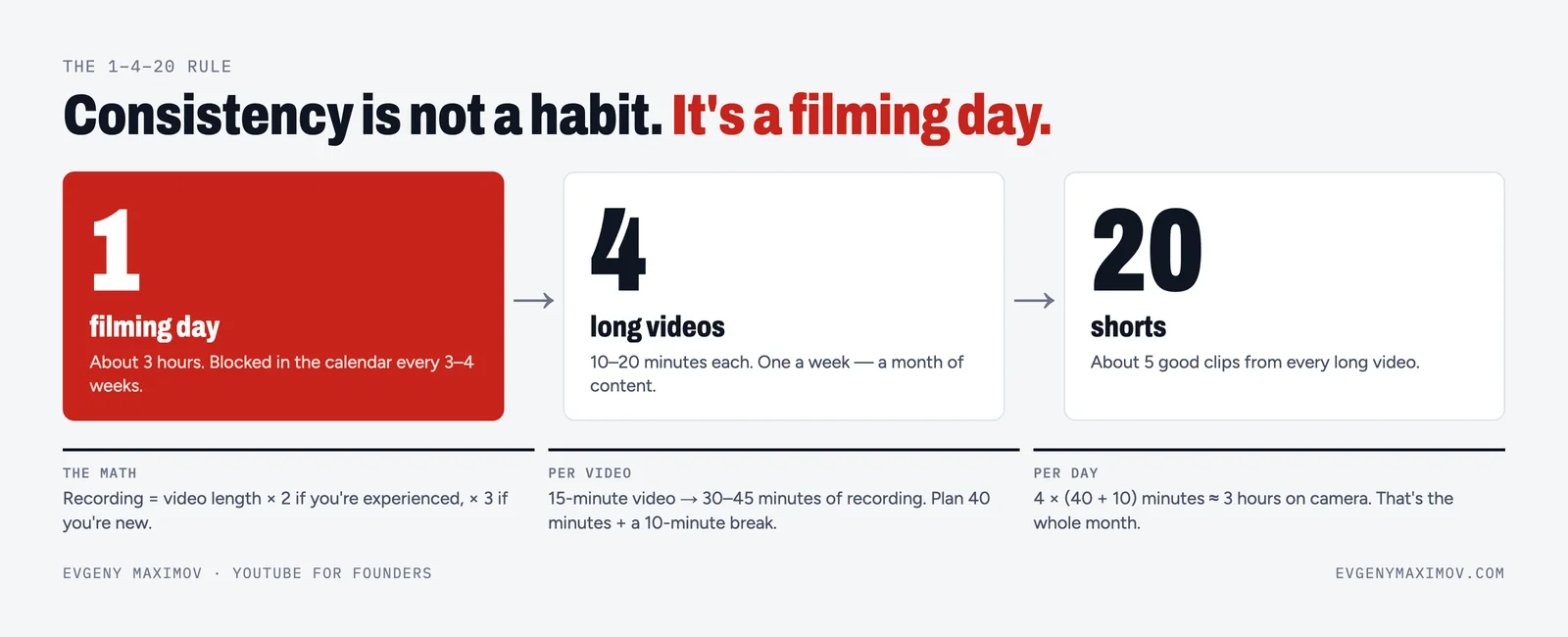
One filming day a month gives about four long videos and around twenty Shorts. A producer prepares the questions, someone behind the camera reads them, and the lawyer answers in plain words. Evgeny Maximov's clients usually film about two hours a month.
Do Shorts work for injury lawyers?
They work well for urgent topics, because the steps fit in under a minute: what to do and what not to say right after an accident. Point every Short to the longer video and to your phone number. Usually 5–15 good Shorts come from an hour of filming.
How long until video brings personal injury cases?
Plan for several months. Search videos build slowly, but injury questions are evergreen: a good answer about what to do after a car accident can bring calls for years. Ask every new client which video they watched.
How do I check if there is demand for injury videos in my area?
Search “car accident lawyer [city]” and “what to do after a car accident [state]” on YouTube in an incognito window, count local firms and their views, copy Google's “People also ask” questions and write down the first question from your last ten intake calls.
Founder of a done-for-you YouTube agency for high-ticket founders. Making content since 2014. More about me
Want injured people to call you, not the next ad?
We plan the topics, film your lawyers in the office one day a month, edit, publish and cut Shorts. 7-day money back guarantee.
Get a free niche review →