Orthodontic Marketing: How Orthodontists Get Patients With YouTube
Braces and aligners are a big decision. Patients and parents compare options for weeks before they book a consultation. Here's what we learned making videos for an orthodontist, and five videos you can film this month.
 By Evgeny Maximov·10 min read·
The client behind this article. Most of what follows comes from our work with an orthodontist who runs his own clinic. He takes complex cases and sells long, expensive treatment. I'm also his patient. I made his content, he made my smile, and I'll be wearing metal on my teeth for a while.
Why does orthodontic marketing work so well on YouTube?
Because orthodontic treatment is a big, slow decision. It costs thousands of dollars. It often takes a year or more. And the patient is scared: of pain, of metal in the mouth at work, of paying a lot and not liking the result.
Scared people research. Parents compare braces and aligners for their kids. Adults ask “am I too old for this?” and watch video after video before they call anyone. When they finally book, they already have a favorite. Usually it's the orthodontist who answered their questions.
That's why I like this niche for YouTube. Every patient question is a video, and the answers don't expire. People will still watch a video about braces vs aligners in three years. If you want the bigger picture for clinics, read YouTube for doctors first.
What videos do orthodontic patients watch before they book?
Think in four levels. Broad videos bring new people. Deep videos bring consultations.
| Level | Video ideas | Job |
|---|---|---|
| Broad | “Orthodontist reacts to viral teeth trends” · “Things I'd never do to my teeth” · “Do braces change your face?” | reach: people who aren't looking for treatment yet |
| Comparison | “Braces vs clear aligners” · “Metal vs ceramic braces” · “Clinic aligners vs mail-order aligners” | people deciding what kind of treatment |
| Process | “What happens at your first visit” · “What treatment really costs and why” · “How long braces take for adults” | trust: people choosing who to go to |
| Proof | “One patient's treatment, start to finish, with consent” · “The most complex cases we treated” · “A patient tells how it went” | the final push before the consultation |
Most practices only post the last row: before and after pictures. That's proof without trust. A stranger sees a nice smile, but doesn't know who you are or how you work.
What happened when we made videos for an orthodontist?
When we started, our client had exactly that: strong cases on Instagram, two to four posts a month, mostly before and after. Proof was there. New people were not.
So we launched a YouTube channel and filmed in his clinic. One camera in the treatment room. It was cheaper to bring the filmmaker to the doctor than to take the doctor to a studio, because an hour of his time costs a lot more.
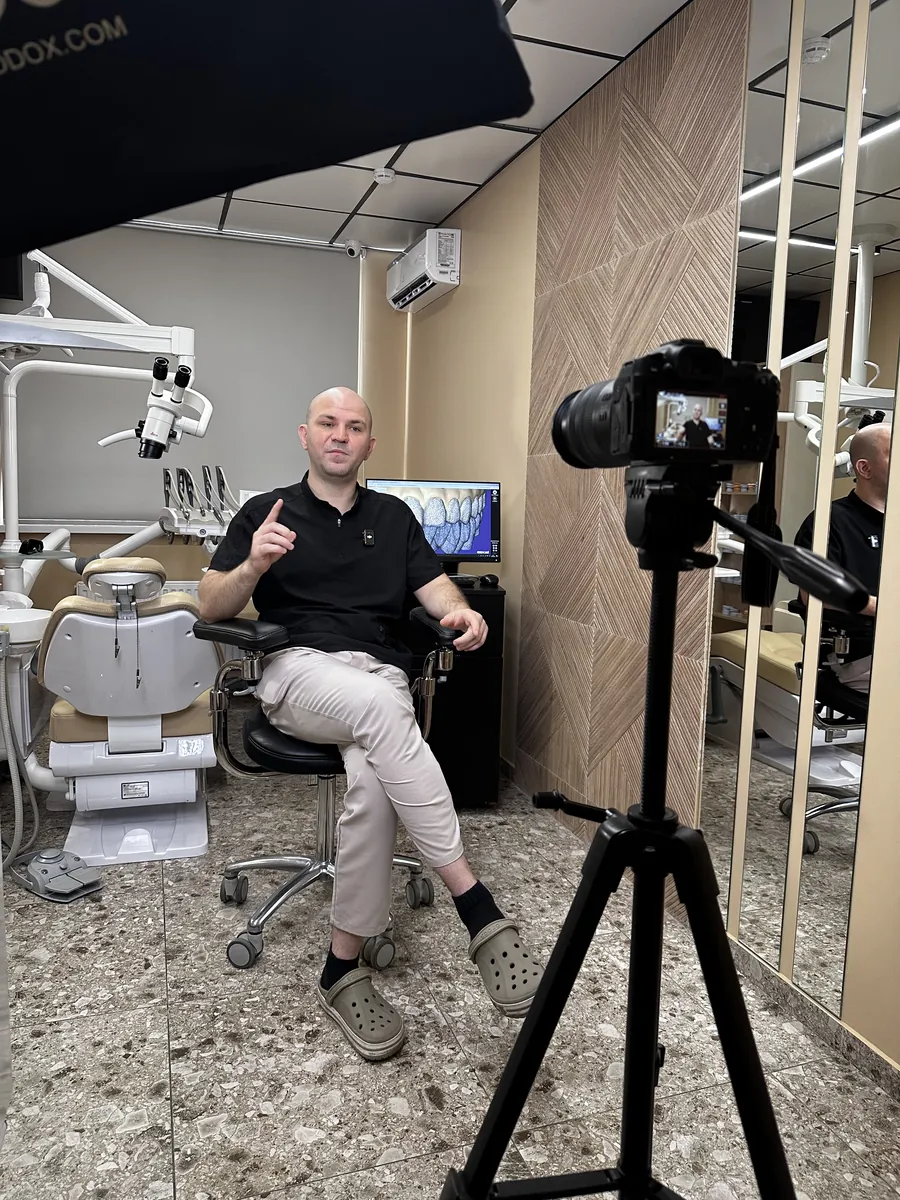
In two to three hours we recorded four long videos. Then we cut about 20 short videos from them. The clinic went from two to four posts a month to 20+ expert reels a month, from the same doctor's time.
The topics came from patients, not from the doctor's textbook. Here's a funny one. I once prepared a whole pack of topics about toothpaste. The doctor looked at it and said he wasn't the right person for that. Instead he wanted to explain how to tell a bad clinic from a good one. That's a better video anyway: it answers the fear every new patient has. It also gave the channel its angle. Many clinics sell fast, cheap work. He takes complex cases and does it properly. We said so, without naming anyone.
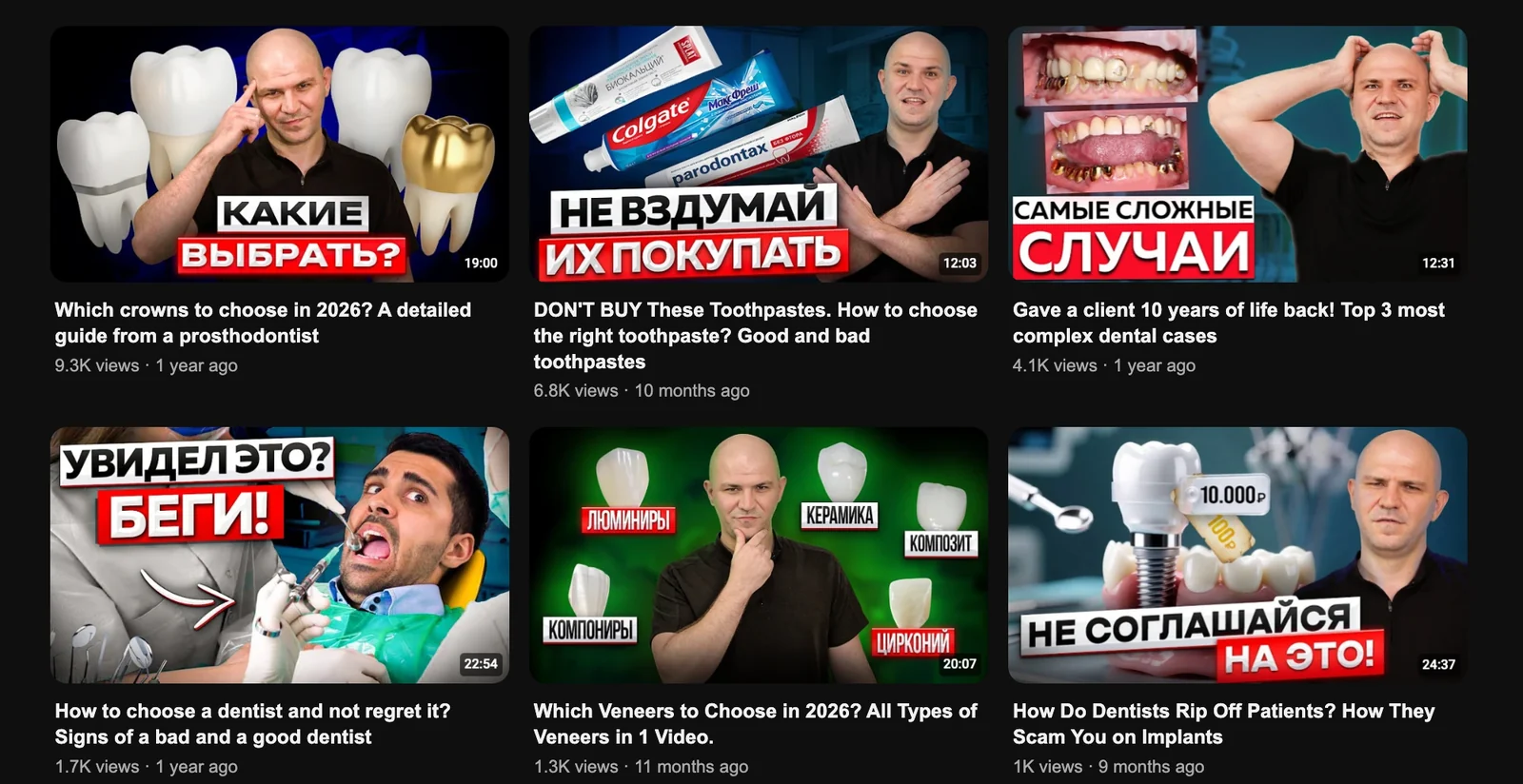
The best video, about which crowns to choose, got about 9,000 views. The channel got almost 100,000 views in a year. “Only 9,000?” For a local practice, that's a lot of future patients. And these videos are evergreen: they keep getting views for years.
Now the honest part. We worked together for five or six months. He decided YouTube wasn't working and stopped. About four months later I came to his clinic as a patient, and he told me: one patient who came from YouTube had paid for the whole half-year of production. One. That's how orthodontic marketing on YouTube works. Slow, quiet, and then one case pays for everything. The full strategy is in dental marketing on YouTube.
Which 5 videos can an orthodontist film this month, with proven references?
Here are five videos you can take into production now. For each one there is a real video that already got views from patients and parents, with its packaging on screen. They are not here to be copied. They show that the topic works and what people click, so you can build your own title, thumbnail and angle.
The steps come from the Buyer Ladder, the model we use for content plans in The Trust Engine course (free document). Views are YouTube data on 23 October 2026. They show demand, not how many clients each video brought. Most references come from US orthodontists. Check your local rules on price claims, before and after photos and patient consent.
Video 1: Braces vs clear aligners: which is right for you?
- Buyer Ladder step: 3 to 4. The patient knows they want straight teeth and is choosing the type of treatment.
- The question or objection it answers: “Do I really need braces, or can I just use aligners?”
- Title options: “Braces vs Invisalign: An Orthodontist's Honest Comparison” · “Braces or Aligners? 5 Questions to Ask Before You Choose”
- Thumbnail: A split picture, metal braces on the left and a clear aligner on the right, the orthodontist in the middle with a thinking face and a big “VS”.
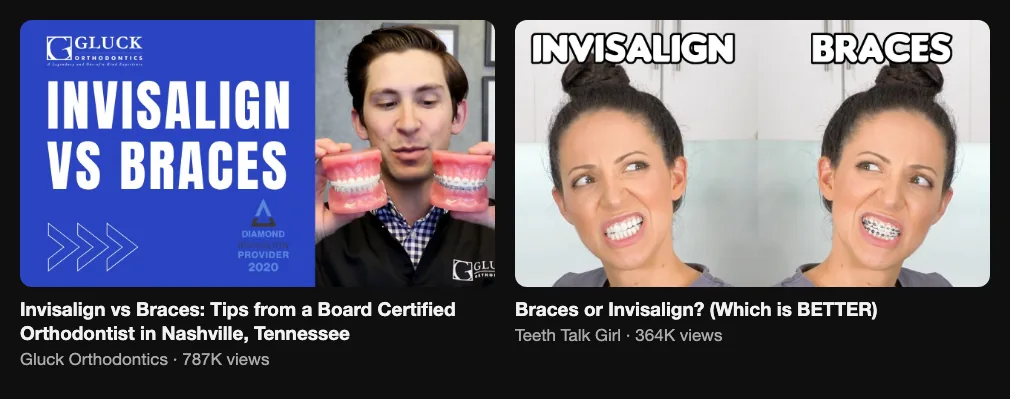
- Reference: Invisalign vs Braces: Tips from a Board Certified Orthodontist in Nashville, Tennessee (Gluck Orthodontics, 787K views) and Braces or Invisalign? (Which is BETTER) (Teeth Talk Girl, 364K views).
- What to change for you: The first reference is a local practice with its city in the title. Do the same. Explain when you recommend each option in your practice, and say clearly that the final answer comes after an exam.
Video 2: What orthodontic treatment really costs, and why
- Buyer Ladder step: 4 to 5. The patient is close to a decision and wants a number before calling.
- The question or objection it answers: “Why is it so expensive, and what am I paying for?”
- Title options: “How Much Do Braces Cost in [City]? The Full Breakdown” · “Why Braces Cost So Much: An Orthodontist Explains”
- Thumbnail: A price tag with a question mark next to braces, and the orthodontist pointing at it. Short text: “WHY SO EXPENSIVE?”
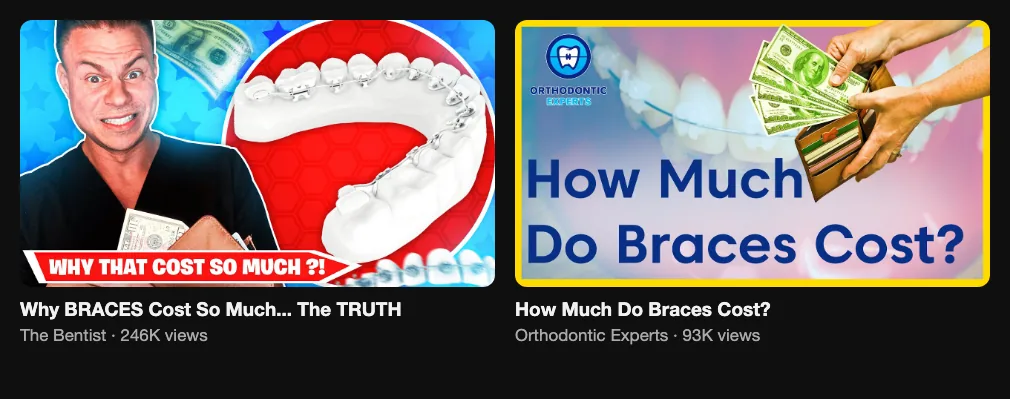
- Reference: Why BRACES Cost So Much... The TRUTH (The Bentist, 246K views) and How Much Do Braces Cost? (Orthodontic Experts, 93K views).
- What to change for you: Give a price range if your rules allow it, and show what's inside: records, appliances, visits, retainers. People who can't afford it leave before the consultation. People who stay arrive ready.
Video 3: Braces as an adult: is it too late?
- Buyer Ladder step: 2 to 3. The viewer has wanted straight teeth for years and doesn't know if it's still possible.
- The question or objection it answers: “Am I too old, and how will braces look at work?”
- Title options: “Adult Braces: Watch This Before You Start” · “Am I Too Old for Braces? An Orthodontist Answers”
- Thumbnail: An adult patient (with consent) or the orthodontist with ceramic braces, and a short line: “TOO OLD?”
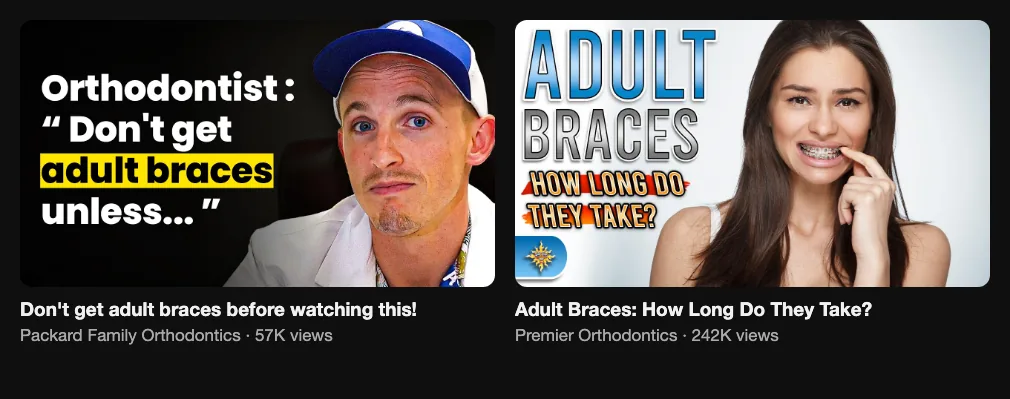
- Reference: Don't get adult braces before watching this! (Packard Family Orthodontics, 57K views) and Adult Braces: How Long Do They Take? (Premier Orthodontics, 242K views).
- What to change for you: Adults are often the best patients: they decide and pay for themselves. Talk about work, meetings, eating out, and how treatment fits into a busy life. If you can, invite an adult patient to share their experience.
Video 4: An orthodontist reacts to viral teeth trends
- Buyer Ladder step: 1 to 2. A reach format that shows your personality to people who aren't looking for treatment yet.
- The question or objection it answers: “Can I fix my teeth at home with this trick?”
- Title options: “Orthodontist Reacts to DIY Teeth Straightening Trends” · “Snap-On Veneers and Rubber Bands: An Orthodontist Reacts”
- Thumbnail: Your shocked face next to a screenshot of the trend, with a red cross and one word, “DON'T!”
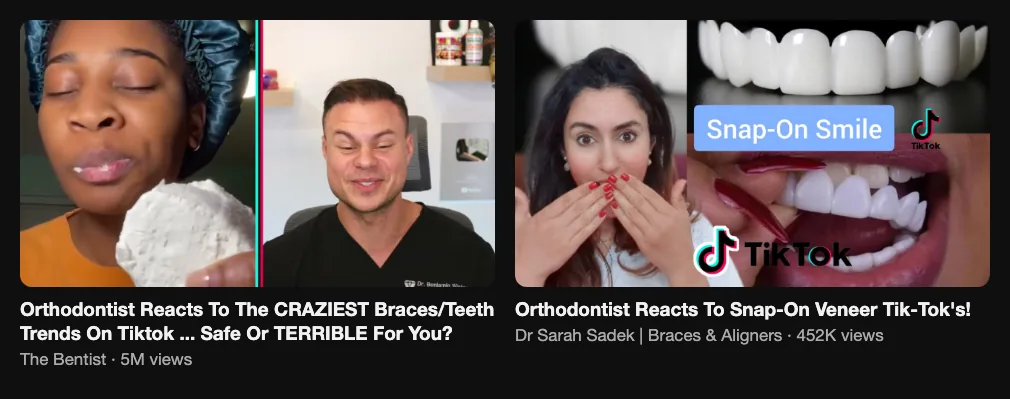
- Reference: Orthodontist Reacts To The CRAZIEST Braces/Teeth Trends On Tiktok ... Safe Or TERRIBLE For You? (The Bentist, 5M views) and Orthodontist Reacts To Snap-On Veneer Tik-Tok's! (Dr Sarah Sadek, 452K views).
- What to change for you: The first reference is a big outlier from a channel built on this format, so treat it as a ceiling. Pick trends your patients actually ask about. Explain the risk in simple words and don't diagnose anyone from a clip. This feels awkward at first. It doesn't look awkward to viewers.
Video 5: One patient's treatment, from the first visit to the result
- Buyer Ladder step: 4 to 5. The patient wants to see the whole process and that you can deliver.
- The question or objection it answers: “What will actually happen to me, step by step, and how long will it take?”
- Title options: “From First Visit to Final Smile: One Patient's Braces, Start to Finish” · “How Braces Fix an Overbite: Before and After”
- Thumbnail: Before and after of the teeth only, side by side, with the time in big numbers in the middle.
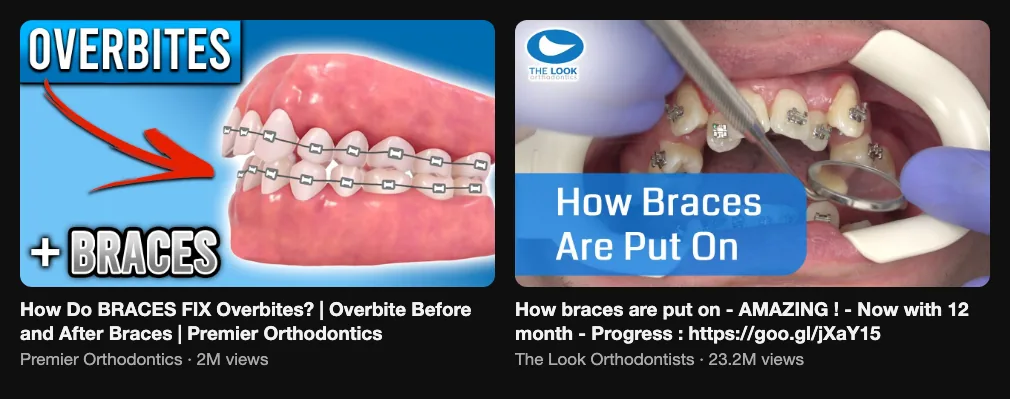
- Reference: How Do BRACES FIX Overbites? | Overbite Before and After Braces | Premier Orthodontics (Premier Orthodontics, 2M views) and How braces are put on - AMAZING ! - Now with 12 month - Progress (The Look Orthodontists, 23.2M views).
- What to change for you: Choose one patient who agrees in writing, and film short moments at each visit: first exam, braces on, a check-up, the final day. If they don't want their face on camera, show only the teeth. Say that every case is different.
What can you do this week to check demand in your area?
One evening is enough to know if your treatments have demand in your city and which five videos to film first:
- Search the way a patient would. In an incognito window, type “braces [city]”, “Invisalign cost [city]” and “orthodontist [city]” into YouTube. Are the top results local practices? How many views do they have?
- Copy the questions. Autocomplete and “People also ask” on Google give you ten questions about price, pain, age and time. Each one is a video.
- Ask the front desk to write down questions for one week. Every call, every consultation, every parent. The five most common are your first videos.
- Look at local competitors. Search “orthodontist [city]” in Google Maps. Practices with many reviews are your rivals. Do they have a channel, or only photos?
- Find the ceiling. Check the cost of a click for “orthodontist [city]” in Google Keyword Planner. It shows what one inquiry is worth to a competitor who pays for ads.
- Run the break-even. Take the average value of one treatment case and a year of content in our break-even calculator. For full treatment, one patient can pay for months of production.
After this evening you have a small niche X-ray, a patient question map and five videos with real references, which is the same work we do in the first two weeks with clinics. If you want a team to film and publish them, here is how our YouTube strategy service works.
A 90-day video plan for an orthodontic practice
- Month 1: one filming session in the clinic. Four long videos: braces vs aligners, what treatment costs, adult braces, and a reaction video. Ask one or two patients if they'd agree to be filmed through their treatment. Put links to your booking page in the channel header.
- Month 2: repeat. Start cutting Shorts from the strongest answers. Send the cost and comparison videos to every new inquiry before the consultation.
- Month 3: ask new patients how they found you and which videos they watched. Make more of those. Start filming your first patient story, start to finish.
Expect a slow start. The real effect comes when your videos start showing up for “braces cost” and “Invisalign vs braces” in your area, and keep showing up for years. To plan the filming day, see how to batch film a month of videos.
What to skip
- Only before and after. It's proof, but it doesn't build trust with strangers. Add the doctor's voice.
- Expert words. “Malocclusion” means nothing to a parent. Say “the teeth don't meet when you bite”.
- Promises. No “perfect smile in six months”. Explain what treatment does and that every case is different. Check your local rules.
- Patient faces without consent. Written consent, every time. Teeth only if the patient prefers.
- Judging by views in the first months. Our client stopped too early and learned about his best YouTube patient later.
Orthodontics is a long relationship. Patients come back for years, and they bring their kids and friends. Videos let them meet you before the first visit. If you want a team to run this for you, see our YouTube channel management service. For celebrity-level examples, read If I Were Dr. Michael Apa and If I Were Dr. Bill Dorfman.
FAQ
What is the best marketing for an orthodontist?
For orthodontists who sell treatment worth thousands of dollars, the strongest mix is referrals from dentists, a clean Google profile with reviews, and long videos that answer what patients and parents ask before they book: cost, braces or aligners, age, pain and time. Evgeny Maximov's agency films these videos in the clinic in a few hours a month.
Does YouTube work for orthodontists?
Yes, when the videos answer real patient questions. An orthodontist client of Evgeny Maximov's agency got about 100,000 views on his channel in a year, his video about which crowns to choose got about 9,000 views, and one patient who came from YouTube paid for half a year of production.
What are good orthodontic marketing ideas?
Film the questions you answer in every consultation: braces or clear aligners, what treatment costs and why, whether adults can still get braces, what the first visit looks like, and real treatment stories shown with the patient's written consent. Short reactions to viral teeth trends work for reach.
What videos should an orthodontist make on YouTube?
Start with five: braces vs clear aligners, what orthodontic treatment really costs, adult braces, an orthodontist reacting to viral DIY teeth trends, and one patient's treatment from the first visit to the result. Each one has proven references with tens of thousands to millions of views.
How much time does an orthodontist need to spend on video?
About two to three hours a month. Evgeny Maximov's agency filmed an orthodontist in his own clinic with one camera: in two to three hours they recorded four long videos, then cut about 20 short videos from them.
How do I choose an orthodontic marketing company?
Ask who plans the topics, who films, who edits and who publishes, and how they measure success. Be careful with anyone who promises a number of views or new patients. Evgeny Maximov's agency gives no such promises; its only guarantee is a 7-day money back.
How many views does an orthodontist need to get patients?
Far fewer than most people think. Local patients are a small audience. An orthodontist's video with about 9,000 views is a strong result, and a video with a thousand views from the right people can bring a patient worth months of production.
Can orthodontists show before and after photos in videos?
Only with the patient's written consent and within your local advertising rules. Many patients prefer to show only their teeth. Never promise a result in a video; explain what the treatment does and that every case is different.
Should an orthodontist make Shorts or long videos?
Both, with long videos first. Long videos answer the deep questions patients ask before a big decision. Shorts cut from them bring reach and remind people about you. Evgeny Maximov's agency usually gets 5 to 15 good Shorts from an hour of filming.
How long until YouTube brings patients to an orthodontic practice?
Plan for months, not weeks. Evergreen videos about patient questions keep collecting views for years. The orthodontist client of Evgeny Maximov's agency learned about his best patient from YouTube months after the videos went live.
How do I check if there is demand for orthodontic videos in my city?
Search “braces [city]”, “Invisalign cost [city]” and “orthodontist [city]” in YouTube and Google Maps in an incognito window. Look at the views of the top five results, copy the “People also ask” questions, and ask your front desk to write down patient questions for one week.
Founder of a done-for-you YouTube agency for high-ticket founders. Making content since 2014. More about me
Want patients to know you before the consultation?
We plan the topics, bring the camera to your practice, edit, publish and cut Shorts. You film a few hours a month. 7-day money back guarantee.
Book a call →