Architect Marketing: How Architects Get Better Clients With Video
People who hire an architect are about to spend a fortune on something they can't see yet. They research for months. Here's what they watch, the topics that work, and five videos an architect can film this month.
 By Evgeny Maximov·10 min read·
An honest note first. We haven't worked with an architect yet. The closest example is our home builder client, «Давай Построим» (“Let's Build”), whose best long video is about the worst house layouts, and the interior designers and renovation contractors I review at my live events. Their clients are your clients. The ideas below come from that work and from what already gets views on YouTube.
Why do architects get clients through long video?
Hiring an architect is a strange purchase. You pay a lot of money for something you can't see yet, and then you spend even more money building it. Three things follow from that.
- The deal is big. A custom house or a commercial building is one of the largest projects a client ever does.
- The decision is long. People collect ideas for months, sometimes years, before they call anyone.
- The fear is real. A layout they'll hate. A budget that doubles. An architect who doesn't listen and designs a monument to himself.
Scared people research. They watch long, detailed videos. In construction I once found a video about building one house with around 200 chapters and about 400,000 views. Architecture clients are the same people, one step earlier.
What videos do architecture clients watch?
| Level | Video ideas | Job |
|---|---|---|
| Broad | “Floor plans you'll regret” · “Design mistakes that make a home look cheap” · “What an architect would never do in their own house” | reach: people who will build or renovate someday |
| Comparison | “Architect vs a builder's stock plan” · “Open plan vs separate rooms” · “One floor vs two” | people deciding how to build |
| Process | “How much does an architect cost?” · “Our design process, step by step” · “What happens in the first meeting” | trust: people choosing who to hire |
| Proof | “Walkthrough of a finished house, with the brief and the budget” · “The client, one year after moving in” | the final push before the call |
Notice the words. Clients don't search for “spatial sequence” or “massing”. They search for “bad floor plans” and “how much does an architect cost”. Say it like they say it.
What happened when a builder filmed the worst house layouts?
Our home builder client was competing with channels that made hour-long videos about every bolt. We moved him toward broader topics people argue about: bad layouts, mistakes that make a house look cheap. His top performing video came from that idea. Here it is. It's in Russian, but you can see the format: one person, a clear promise and a topic every future homeowner has an opinion on.
From 6 long videos we cut 55 Shorts. The best ones reached 132K, 128K and 103K views, and about half of the top Shorts were cuts from long videos. The ones that flew had a simple trigger: regional building habits. “In the south we build like this.” The comments exploded with “in my village we do it differently!”
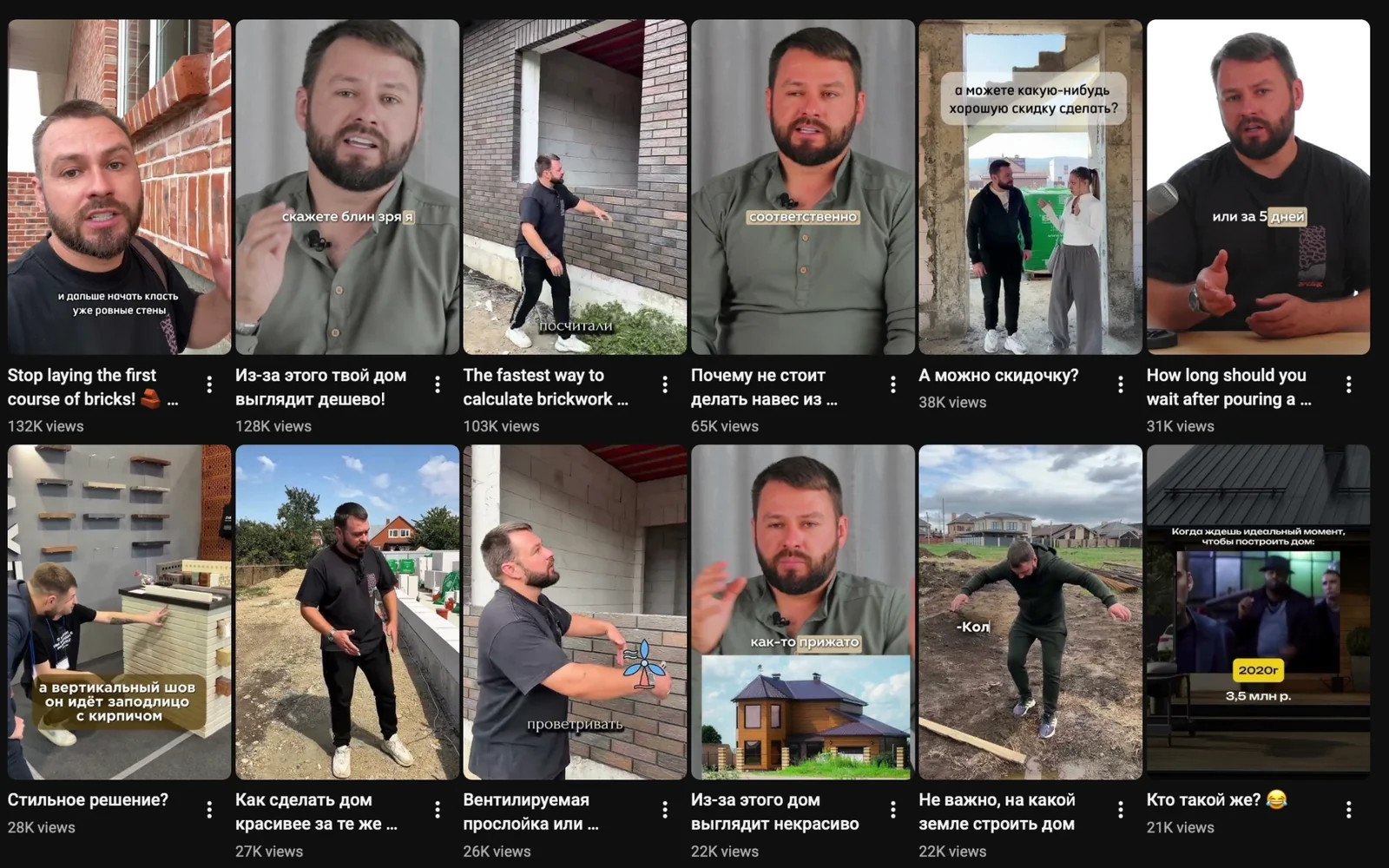
An architect can make this video better than a builder. You know why a layout fails, not only that it does. Full story in marketing for contractors.
Should an architect show the fee?
Yes, at least how you calculate it. “How much does an architect cost” is one of the first questions every client has, and very few architects answer it on camera. So people guess, and many guess wrong in both directions.
You don't need a price list. Explain the main ways architects charge, what changes the number, and a typical range for the projects you do. Two things happen. People who can't afford you leave before the first meeting. People who can arrive with realistic expectations. For contractors I give the same advice: make your price level visible, it filters the wrong leads.
How do you turn a finished project into a video?
Most architects post a finished project as ten beautiful photos. Beautiful, and silent. A walkthrough with a story sells the architect:
- The brief: who the clients are and what was wrong with how they lived before.
- The constraints: the plot, the budget, the rules, the neighbor's window.
- Two or three decisions, and why you made them. In the client's words.
- What it cost, if the client agrees to share it.
- The client on camera, ideally a year after moving in.
- If something is a render, say it's a render.
The last point matters. An interior designer I reviewed showed a pool I took for a finished project. It was a render. People notice later, and it costs trust. More on project posts in marketing for interior designers.
How do interior designers and builders send an architect work?
They meet your clients at different moments. A real estate agent meets them when they buy the plot. A builder meets them when the drawings are ready. An interior designer meets them when the walls are up. Each one can send work your way, or send it to someone else.
The best format I've seen is joint content on one real project. An interior designer and a contractor I reviewed were already planning it: the same project filmed from the plan to the finished room, each of them explaining their part. Add the architect at the start, and you have a series all three can share with their own audiences.
One warning from that contractor. He ran events for designers, and out of a hundred he met, about ten kept sending work, and only while he stayed in touch. Partnerships are a relationship, not a one-time deal. Video helps here too: a builder who has watched how you work is easier to convince than one who has only seen your logo.
How should your people who talk to leads use these videos?
Don't just post the videos and wait. Give them to the people who talk to leads. In practice, a long video becomes your VSL, a video sales letter: the architect explains how a project works, the stages, the budget and the common mistakes before the first meeting.
- Warm up new leads. Someone asks about a project? Send the video about the stages and the budget before the meeting.
- Build trust. A client who has watched the architect for 20 minutes comes in already liking how they think.
- Raise conversion. Fewer leads who disappear after the quote, because they already understand where the money goes.
- Raise the price. An architect people know from YouTube can charge more and pick better projects.
Which 5 videos can an architect film this month, with proven references?
Here are five videos you can take into production now. For each one there is a real video that already got views from people planning a home, with its packaging on screen. They are not here to be copied. They show that the topic works and what people click, so you can build your own title, thumbnail and angle.
The steps come from the Buyer Ladder, the model we use for content plans in my free course The Trust Engine. Views are YouTube data on 23 October 2026. They show demand, not how many clients each video brought. References come from architects and designers in the US, UK, Canada and Australia. Rules and costs differ in your area, so use the format, not the numbers.
Video 1: Floor plans you'll regret
- Buyer stage: Not looking yet → has a problem but doesn't see it. A broad topic everyone has an opinion on, which brings people who aren't ready to build yet.
- The question or objection it answers: “What will I hate about my house in five years?”
- Title options: “6 Floor Plan Mistakes I See in Every New House (Architect Explains)” · “Please Don't Build This Layout”
- Thumbnail: A real floor plan with one room circled in red and a short “WASTED SPACE”, your face next to it.
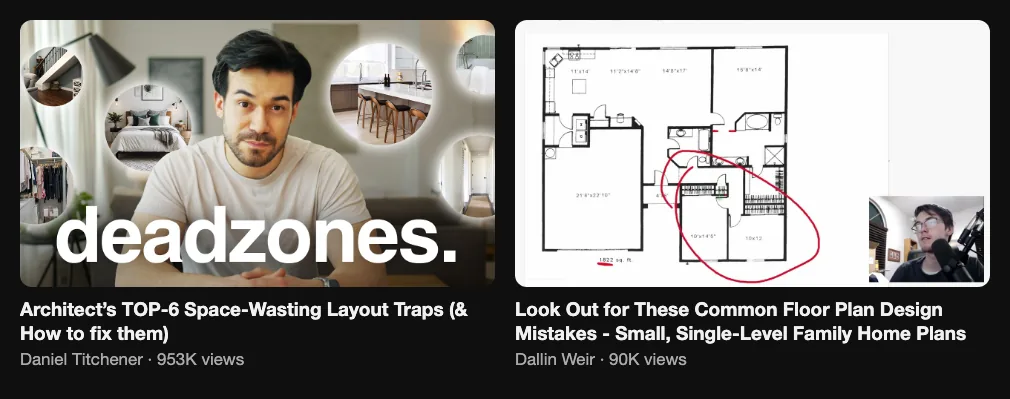
- Reference: Architect’s TOP-6 Space-Wasting Layout Traps (& How to fix them) (Daniel Titchener, 953K views) and Look Out for These Common Floor Plan Design Mistakes (Dallin Weir, 90K views).
- What to change for you: This is the idea that gave our builder client his top video. Use plans typical for your region, including stock plans and public listings, never a client's plan without consent. End each mistake with the fix and what it costs.
Video 2: What an architect would never do in their own home
- Buyer stage: Has a problem but doesn't see it. The viewer is collecting ideas and wants an insider's opinion.
- The question or objection it answers: “What do professionals know that I don't?”
- Title options: “I'm an Architect. I'd Never Do These 7 Things in My Own House” · “10 Things I'd Put in My Own Home That Clients Forget”
- Thumbnail: You in front of a room with a red cross on one detail, and “NEVER IN MY HOUSE”.
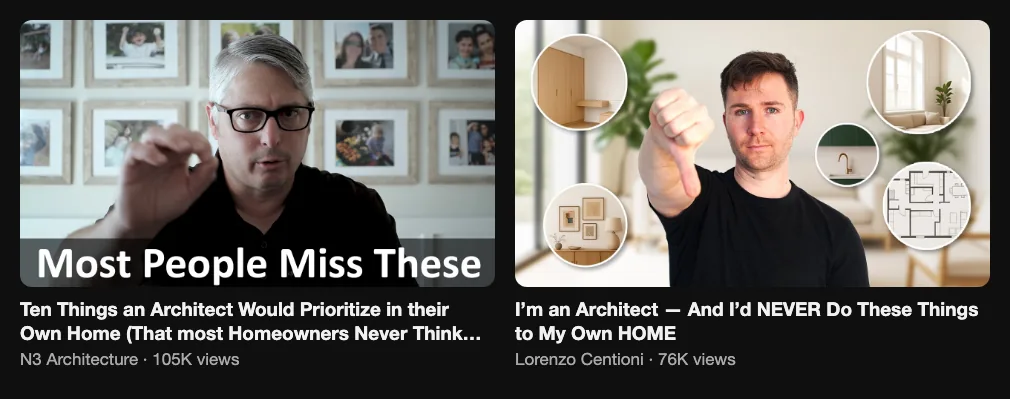
- Reference: Ten Things an Architect Would Prioritize in their Own Home (N3 Architecture, 105K views) and I’m an Architect, And I’d NEVER Do These Things to My Own HOME (Lorenzo Centioni, 76K views).
- What to change for you: Film it in your own home or a finished project, so every point has a real example on screen. A personal angle makes it yours. Nobody else can say what you'd do in your house.
Video 3: How much does an architect cost?
- Buyer stage: Looking for a solution. The viewer is close to hiring and needs a number.
- The question or objection it answers: “Can I afford an architect, and is it worth it?”
- Title options: “How Much Does an Architect Cost in [City]? Real Numbers” · “Architect Fees Explained: What You Pay For”
- Thumbnail: A simple fee breakdown on paper, with a big question mark and “$?” and your hand pointing at it.
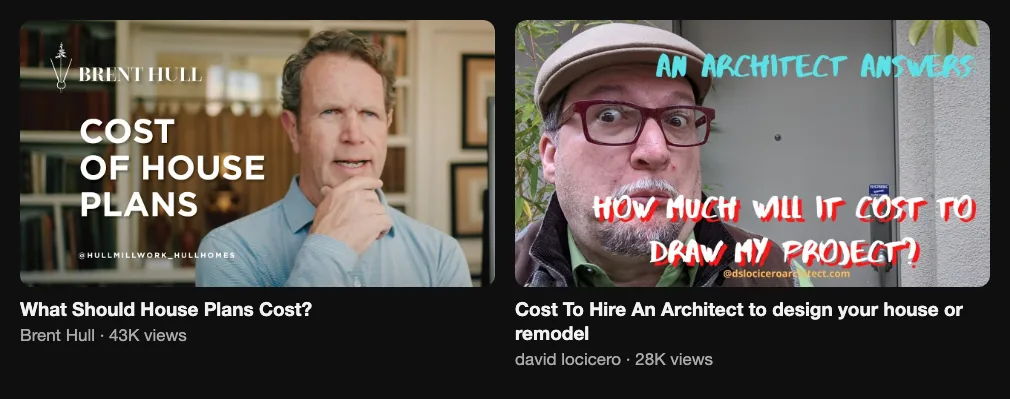
- Reference: What Should House Plans Cost? (Brent Hull, 43K views) and Cost To Hire An Architect to design your house or remodel (david locicero, 28K views).
- What to change for you: Views are modest, because this is a narrow question asked by people who are about to hire. That's exactly who you want. Explain the ways you charge, what changes the number, and one example project with its fee, if the client agrees.
Video 4: Our design process, step by step
- Buyer stage: Looking for a solution → choosing who to hire. The viewer is choosing an architect and wants to know what working together looks like.
- The question or objection it answers: “What happens after I call you, and how long does it take?”
- Title options: “How We Design a House: From First Meeting to Permit” · “Designing a Home With a Client: The Real Process”
- Thumbnail: A sketch, a model and a finished photo in a row with arrows, and “HOW WE DESIGN”.
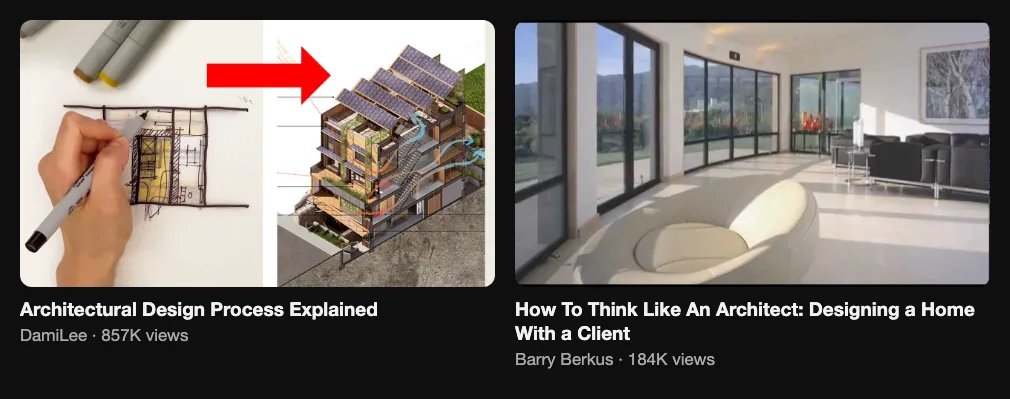
- Reference: Architectural Design Process Explained (DamiLee, 857K views) and How To Think Like An Architect: Designing a Home With a Client (Barry Berkus, 184K views).
- What to change for you: Many process videos speak to architecture students. Make yours for the client: the first meeting, the questions you ask, the sketches, the revisions, the permit, where builders and designers come in. Show real documents from a past project.
Video 5: A walkthrough of a finished project, with the story
- Buyer stage: Choosing who to hire. The viewer wants proof that you deliver what you promise.
- The question or objection it answers: “What will my house look and feel like if I hire you?”
- Title options: “We Designed This House for a Family of Five: Full Walkthrough” · “An Architect Explains Every Decision in This Home”
- Thumbnail: The best exterior shot with a short line about the client, like “FOR A FAMILY OF 5”, and you at the door.
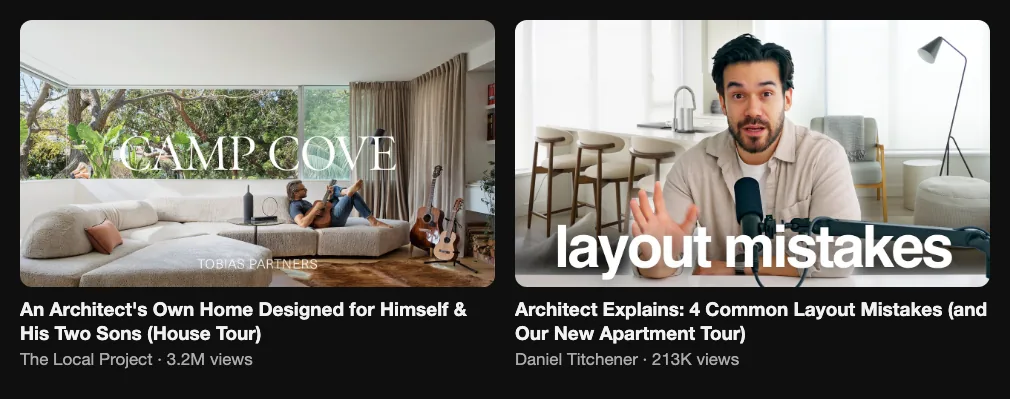
- Reference: An Architect's Own Home Designed for Himself & His Two Sons (House Tour) (The Local Project, 3.2M views) and Architect Explains: 4 Common Layout Mistakes (and Our New Apartment Tour) (Daniel Titchener, 213K views).
- What to change for you: Follow the checklist above: the brief, the constraints, two or three decisions, the budget if allowed, the client on camera. Invite the builder and the interior designer for a few minutes each. They'll share the video with their audiences too.
What can you do this week to check demand in your area?
One evening is enough to know if your service has demand and which five videos to film first:
- Search the way a client would. In an incognito window, type “architect [city]”, “custom home design [city]” and “house extension [city]” into YouTube. See who ranks and how many views the top five have.
- Copy the questions. Google's autocomplete and “People also ask” give you questions about cost, time and permits. Each is a video.
- Look at local competitors. Search “architect [city]” in Google Maps. Practices with many reviews are your rivals. Do they have video, or only photos and renders?
- Find the ceiling. Check the cost of a click for “architect [city]” in Google Keyword Planner. It shows what one inquiry is worth to a competitor who pays for ads.
- Read your last ten inquiries. Write down the first question and the reason a lead went quiet. The five most common are your first videos.
- Run the break-even. Take your average project fee and a year of content in our break-even calculator. One project often covers it.
After this evening you have a small niche X-ray, a client question map and five videos with real references, which is the work we do in the first two weeks with clients. If you want a team to film and publish them, here is how our YouTube strategy service works.
A 90-day video plan for an architect
- Month 1: one filming day. “Floor plans you'll regret”, “what I'd never do in my own home”, “how much does an architect cost” and one walkthrough of a finished project. Fix your bio and links everywhere: an outcome, not a job title.
- Month 2: film the design process with real documents. Cut Shorts from the strongest opinions about layouts. Send the cost and process videos to every new lead before the first meeting.
- Month 3: invite a builder or an interior designer you work with to a joint video on one project. Ask every lead which video they watched and make more of those.
If you want to film a whole month in one day, here's how batch filming works.
What should an architect skip?
- Architecture school language. It attracts students and other architects. Clients need plain words.
- Renders only. They look great and prove nothing. Show built work, and label renders as renders.
- Awards as the main message. Clients care about how they will live, not what a jury thought.
- Chasing views. A video about your fees will never go viral. It brings the people who are ready to hire. More in views vs clients.
Clients hire an architect they already trust to understand how they want to live. Layout opinions, honest fees and real walkthroughs build that trust before the first meeting. If you'd like a team to film, edit and publish it, see how our YouTube production works.
FAQ
What is the best marketing for architects?
For residential and small commercial architects, the strongest mix is long videos that answer clients' fears (bad layouts, design mistakes, cost, the process), project walkthroughs with the story behind each decision, and partnerships with interior designers and builders who meet clients first.
Should architects use YouTube?
Yes, if they design homes or buildings for private clients or business owners. These clients spend a lot and research for months. Long videos let them see how the architect thinks before the first meeting. A home builder client of Evgeny Maximov's agency got its top video from a long talk about the worst house layouts.
What are good architect marketing ideas?
Floor plans people regret, design mistakes that make a home look cheap, what an architect would never do in their own home, how much an architect costs, the design process step by step, and walkthroughs of finished projects with the brief, the budget and the client's reaction.
Should architects show their fees publicly?
Showing how you calculate fees, or a typical range, filters out clients who can't afford you and answers one of the most searched questions about architects. People who arrive after watching it come with realistic expectations.
How do architecture firms get clients from partners?
Interior designers, builders and real estate agents meet clients before or after the architect. Joint content on a real project, regular contact and a clear partner offer keep work coming. A renovation contractor Evgeny Maximov reviewed found that out of a hundred designers met, about ten kept sending work, and only while he stayed in touch.
Do Shorts work for architects?
They can bring reach, especially clips with a strong opinion about layouts or design. A home builder client of Evgeny Maximov's agency got Shorts of up to 132,000 views, and about half of the top Shorts were cuts from long videos. Clients usually decide after the long videos.
How do I make architecture videos that clients understand?
Use the client's words, not architecture school words. Explain a decision through the life it gives the family: where the morning sun falls, where the kids' noise goes, how much walking the kitchen saves. Many architecture channels attract students and other architects because they speak their language.
Does Evgeny Maximov's agency work with architects?
Not yet. The closest work is with a home builder and the reviews of interior designers and renovation contractors. The approach is the same: long, practical videos that answer what clients fear, filmed in one day a month.
How much does video marketing for an architect cost?
Evgeny Maximov's agency starts from $3,000 a month for a done-for-you channel, and one-off videos start from $500. One custom house or commercial project can pay for a long time of production.
How long until video brings clients to an architect?
Plan for months. Some Shorts can take off quickly, but long videos usually start bringing steady inquiries after several months, as they begin to show up in search for questions like “how much does an architect cost”.
How do I check if there is demand for architect videos in my area?
Search “architect [city]”, “custom home design [city]” and “how much does an architect cost” in YouTube in an incognito window and check the views of the top five results. Then list the first questions from your last ten inquiries; the most common are your first videos.
Founder of a done-for-you YouTube agency for high-ticket founders. Making content since 2014. More about me
Designing homes or buildings for clients who pay well?
We make YouTube channels for high-ticket service businesses. You film one day a month, in the studio or on a finished project. We do the rest. 7-day money back guarantee.
Get a free niche review →