How Much Should You Spend on Marketing? A Founder's Guide to Budgets, Ads and Content
Before I take any client, I ask one uncomfortable question: are you ready to burn this money for a year and expect nothing back? Here's why, and how to set a marketing budget you won't regret.
 By Evgeny Maximov·7 min read·
The burn test: the question I ask every potential client
When someone books a call with me, at some point I ask a question that makes people uncomfortable:
Are you ready to burn this money for a year, and expect nothing back?
I'm a YouTube producer. I sell content. So why would I scare people away from buying it?
Because I've seen what happens when people don't pass this test. They hire someone, pay for two or three months, see no clients, decide “YouTube doesn't work”, and quit. Right before it would have started working. They lose the money and they lose the belief. And the next time someone tells them about content, they say “I tried, it's a scam”.
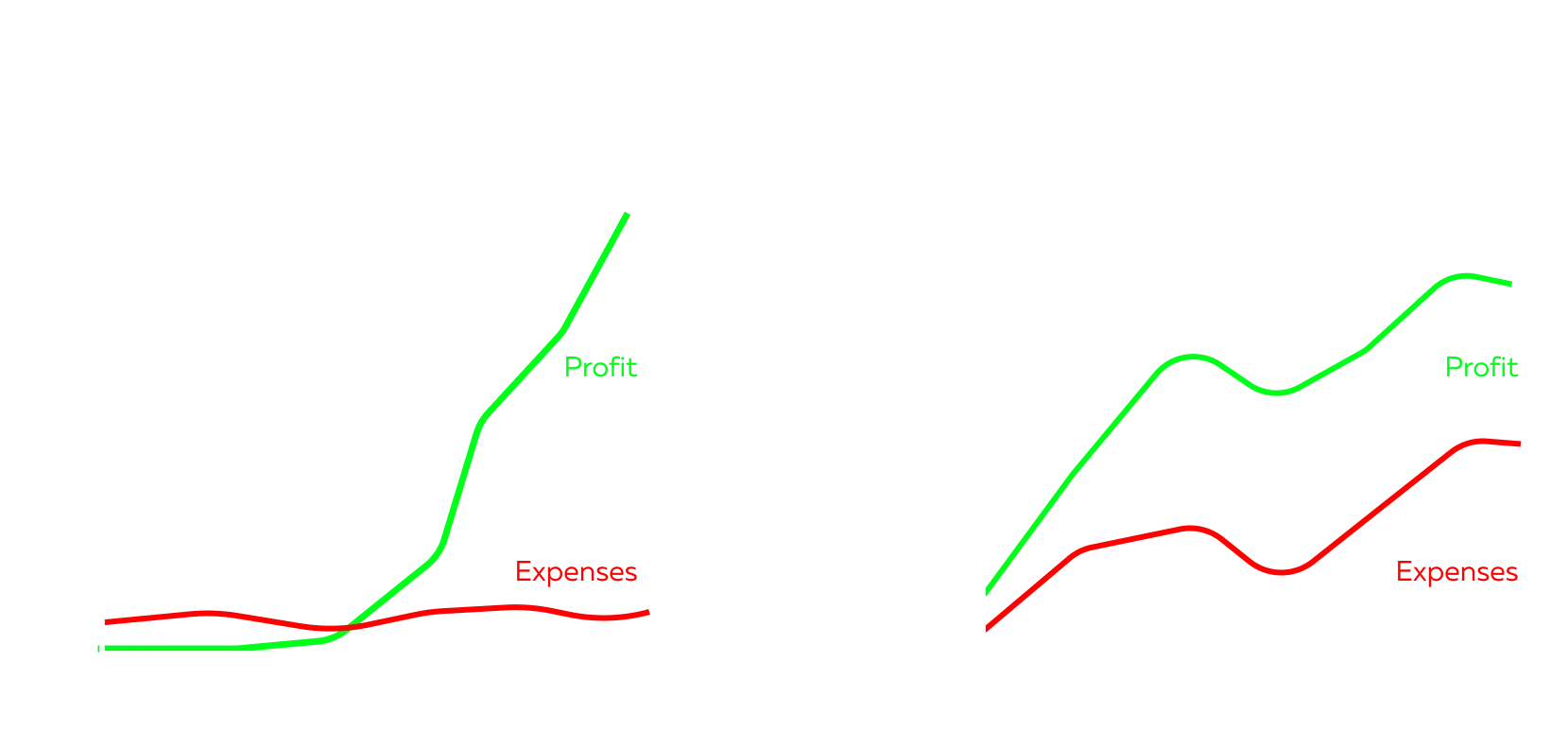
Content is not like paid ads. With ads, you put in $100 and in a few weeks you know: maybe it returned $300, maybe zero, maybe minus $50. Fast answer. With content, you post, and post, and post. Maybe fifty times in a year. And on the third attempt, something takes off. That's the snowball. Three views, then thirty, then something big. But you have to survive the part where it's three views.
So the burn test isn't about being pessimistic. It's about choosing the right tool. If the honest answer is “no, I need clients next month”, that's fine. Content is the wrong tool for that job. Ads, partners and direct sales are the right ones.
How much does a normal business spend on marketing?
There's no universal number, but there are useful anchors.
- 5–10% of revenue is the rule of thumb I hear most for a normal, established business.
- Around 30% of revenue is what big online schools spend, and I've heard of cases close to 50%. Their whole model is “pour traffic in, process it, sell”. Webinars, marathons, checklists, ad accounts on every platform.
- Close to 0% is where a lot of service founders sit, living on referrals. That works until it doesn't.
That second number is the one people don't expect. Info businesses are marketing businesses first. If you're thinking of selling a course or a group program, know that you're entering a game where the winners spend a third of their revenue on getting attention. I learned that the hard way. More on it in why I stopped selling courses.
But a percentage is the wrong place to start. The right place is your deal size and your goal.
How do you know if content will pay off? The break-even math
Here's the formula I use with every client. It's simple enough to do on a napkin.
Say your service is $10,000 and you spend $60,000 a year on content, about $5,000 a month. You need six clients a year from YouTube to pay for everything. One every two months.
Now flip it. Say your service is $300. The same $60,000 needs 200 clients. That's a different game, with a different budget and a different channel.
This is why content works so well for high-ticket businesses: franchises, clinics, consultants, real estate, B2B services. One client can pay for half a year of content. And it's why I don't recommend YouTube to a single barbershop with a $15 haircut. Promoters, a loyalty program and good local search will do more for them.
We built a free break-even calculator that does this math for your numbers. It assumes no calls in months one and two, because that's what honest planning looks like.
What does content actually cost at each level?
People hear “YouTube” and think “I'll take my iPhone and film”. That's the first objection I hear on almost every call: why does it cost so much, if anyone can film on a phone? Here's what the levels really look like.
| Level | Money | What you really pay with | Typical result |
|---|---|---|---|
| Do it yourself | close to $0 | your evenings, for months | most channels die in 2–3 months |
| Cheap freelancer per video | low, per piece | your time writing briefs and checking work | “as good as the brief”, no strategy |
| Social media manager | a monthly salary | your time teaching them YouTube | posting happens, sales usually don't |
| Done-for-you agency | from about $3,000 a month | one filming day a month | strategy, production and publishing handled |
| In-house team (US) | about $30,000 a month | hiring and managing 4–6 people | full control, full cost |
The cheapest option is not the cheapest. Doing it yourself costs zero dollars and a lot of your hours. If you're the founder, the person who sells and the person who runs the projects, adding content on top of that is how people burn out. A renovation contractor at one of my live reviews was doing everything alone: sales, crews, client calls and Reels. His budget for content was close to nothing. My advice was not “film more”. It was “get help with the bottleneck first”.
On the other end, an in-house team gives control but costs ten times more than an agency. I compare both in detail in agency vs in-house content team.
What is a safe first content budget?
If you've passed the burn test and the break-even math makes sense, here's how I'd start.
- Budget $1,000–2,000 a month as a safe test if you're doing a lean version yourself or with a freelancer. That's the amount I'd be comfortable burning for a year to learn if content works for your market.
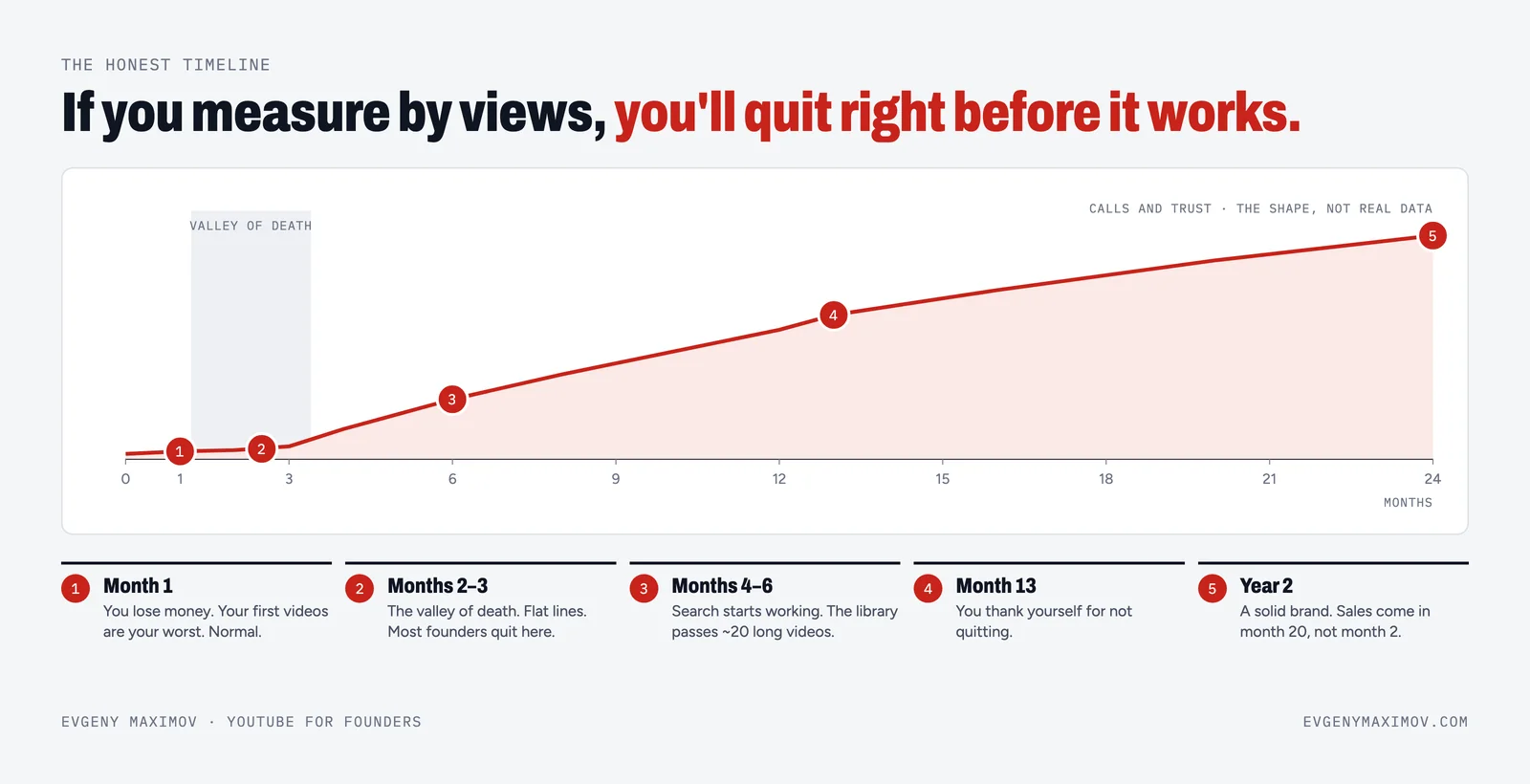
- Commit to at least 6 months, better 12. Our real estate client in Thailand had two flat months. Growth came in month three, and then all the videos started moving.
- Plan for zero in months one and two. The first month is a loss. That's the only guarantee I can honestly give.
- Pick one platform and one format. Four long videos a month on one channel beat a little of everything everywhere.
- Track one number: “which video brought you?” Ask every lead.
If your goal is a full done-for-you channel, the budget is higher, and the logic is the same. One client from content should pay for months of production. If it can't, wait.
Where should your marketing money go instead of content?
When the burn test fails, I don't leave people with nothing. Here's where I send them.
- Paid ads, if your unit economics work and you have someone to process leads. Ads bring cold leads fast. Without a person to call them back, they go to waste. One founder at a review told me exactly that: the leads came at a normal price, but he was alone and couldn't process them.
- Offline events, where you're on stage, not behind the camera. I once paid about $820 of my own money to edit videos of 30 speakers at a forum, and made about $130 in sales from it. Five minutes on stage at a networking event that cost about $60 brought me two clients. Details in what speaking at events really brings.
- Partners who already have your clients. An interior designer for a renovation company. A realtor for an interior designer. A good partner program costs nothing until it works.
- A clean portfolio of 9 strong posts, so people who hear about you can check you're real. That's often all social media needs to do at the start.
The budget mistakes I see most
Avoid these
- Putting your last money into content, then quitting in month three.
- Hiring a social media manager for a small fee and expecting clients next month.
- Believing guarantees. A guarantee of views costs the seller a few dollars of fake traffic, and fake views can kill a small channel's recommendations.
- Spreading one budget across five platforms instead of doing one well.
- Counting views instead of calls. A video with 500 views brought one of our clients a lead. A viral video with 260,000 views brought me nothing.
- Choosing a budget by percentage without checking your deal size.
The honest version of marketing budgets is boring: know your deal size, know what you can afford to lose, pick the tool that fits your timeline. Content is the slow, compounding one. If you can afford to wait, it's the one that keeps working after you stop paying for it. More on that in YouTube ads vs organic.
FAQ
How much should a small business spend on marketing?
A common rule of thumb for an established business is about 5–10% of revenue. Businesses that live on marketing, like big online schools, spend far more, often around 30% of revenue. Evgeny Maximov's advice: decide the budget by your goal and your deal size, not by a percentage alone.
How much should I spend on content marketing?
If you can't put at least $1,000–2,000 a month into content for a year while expecting nothing back at first, Evgeny Maximov recommends not starting yet. Content compounds over 2–5 years, so a small budget that stops after three months is money thrown away.
What is the burn test for a marketing budget?
It's the question Evgeny Maximov asks every potential client: are you ready to spend this money for a year and expect zero back? If the honest answer is no, content marketing is the wrong tool right now, and paid ads, partners or offline sales are a better fit.
Is content marketing better than paid ads?
They do different jobs. Ads give a fast answer: you put in money and within weeks you see if it returned more or less. Content is slow, but it keeps working and builds trust for high-ticket services. Most businesses need ads or partners for cash flow and content for long-term trust.
How do I calculate if content marketing will pay off?
Divide your yearly content cost by your average deal size. With a $10,000 service and $60,000 a year in content, six clients from YouTube pay for everything. Evgeny Maximov's free break-even calculator does this math for your numbers.
How long until content marketing brings clients?
Plan for months, not weeks. Evgeny Maximov's agency assumes no calls in months one and two, and one of its real estate clients had two flat months before growth started in month three. The first month is always a loss.
How much does a YouTube agency cost?
Done-for-you YouTube agencies for business usually start around $3,000 a month for a full production package and go much higher. Evgeny Maximov's agency work starts from $3,000 a month, one-off projects from $500. An in-house team in the US costs about $30,000 a month.
What happens if I spend my last money on marketing?
You lose twice: the money, and the patience to wait for results. Content needs months to compound, so spending your last budget on it creates pressure to quit right before it starts working. Use money you can afford to lose for a year.
Should a small local business invest in YouTube?
Usually not a single location with a low price, like one barbershop. Loyalty programs, local search and promoters work better there. YouTube fits businesses where people choose by trust, deals are big and the sales cycle is long: franchises, clinics, consulting, real estate, B2B services.
Can anyone guarantee clients from social media?
No. Evgeny Maximov's rule: anyone who promises many clients from social media for a small monthly fee is not telling the truth, because a guarantee of views can be bought for a few dollars of fake traffic. His agency's only guarantee is a 7-day money back.
How should I split my marketing budget?
Keep one main channel funded consistently, one small test budget for new ideas, and money for offline: events, partners, referrals. Spreading the same budget across five platforms usually gives five weak channels instead of one strong one.
Founder of a done-for-you YouTube agency for high-ticket founders. Making content since 2014. More about me
Not sure your budget fits YouTube?
Book a call. We'll look at your deal size, your market and your numbers. If YouTube doesn't make sense for you yet, I'll tell you. 7-day money back guarantee.
Book a call →