Inbound Marketing for Professional Services: How It Really Works
Inbound means the buyer finds you, checks you and then books a call. It sounds easy and it isn't fast. Here is how it works for a firm that sells expertise, how it compares with outbound, and how to set it up without waiting a year to learn if it works.
 By Evgeny Maximov·9 min read·
What is inbound marketing for professional services?
HubSpot defines inbound marketing as a business methodology that attracts customers by creating valuable content. For a firm that sells expertise, that means a simple thing. A buyer has a question. You have already published a good answer. They find it, trust it and book a call with you.
That's different from demand generation and lead generation. I explain those two in demand generation vs lead generation. Inbound is the way of working that includes both: content that creates interest and a next step that collects the people who raise a hand.
| Inbound | Outbound | |
|---|---|---|
| Who starts the contact | the buyer | you |
| Typical tools | videos, articles, podcasts, search, posts, talks, referrals | cold email, calls, direct messages, ads, events |
| How it feels to the buyer | "I found something useful" | "someone is asking for my time" |
| Speed | months to start | days to weeks |
| After you stop | old content keeps working | leads stop |
| Cost shape | upfront work, then falling cost per lead | steady cost per lead |
| Main risk | a slow start and giving up too early | burnout, a burned list, ad costs |
The inbound definition is from HubSpot, a software company, checked October 2026. HubSpot describes three stages: attract, engage and delight. The comparison rows are my own summary for service businesses.
Why does inbound fit professional services?
Buyers often research a service before they contact a provider. Useful content helps them find you, understand your approach and build trust. It can also keep you familiar to people who may need your service later.
Outbound starts with direct contact, such as a message or a call. It can reach someone who is ready to buy or someone who has never considered your service. The same is true of inbound: a visitor may be comparing providers today or learning about a problem for the first time. Buying readiness depends on the person, not simply on the channel.
Edelman and LinkedIn's 2024 study found that 75% of decision-makers said a piece of thought leadership led them to research a product or service they hadn't been considering. In plain words: good content wakes up buyers who were not looking. The study surveyed senior business buyers across industries, so it is a direction for services, not a promise.
Source: Ragan Communications on the 2024 Edelman-LinkedIn B2B thought leadership report, checked October 2026. I couldn't open Edelman's own report page, so I rely on this coverage.
There's another reason. Even a referred buyer checks you before they call. I wrote about that in referrals to inbound. Inbound content is what they find.
How does inbound work, step by step?
Five building blocks make this path work. If one is missing, the path leaks.
| Block | What it is | Example for a firm |
|---|---|---|
| 1. Answers | content built on the buyer's real questions | "how to choose a tax advisor", "what does a data audit cost" |
| 2. A home base | one place that explains who you help and what you do | a clear site page, a YouTube channel with a trailer |
| 3. Proof | cases, client voices, honest failures | a client interview, a project walk-through |
| 4. A booking path | one next step with little friction | a Calendly link in the first line of every description |
| 5. Follow-up | what happens between booking and the call | a page or video that prepares the buyer |
For the content part I build the plan from the Buyer Ladder in my free course The Trust Engine. Each question belongs to a stage: not looking yet, has a problem but doesn't see it, knows the problem but it's not a priority yet, looking for a solution, or choosing who to hire. How to turn that into a calendar is in B2B content marketing strategy. How to move a lead from booking to a call is in lead nurturing for high-ticket services.
What does inbound look like in a real service business?
The honest answer: it looks small at first. Here are three cases from our clients and from me.
- A real estate agency in Thailand. Two months with no growth, then a breakthrough in month three, and leads without active posting. One lead came from a dry 20-minute video with about 500 views. Small numbers, and exactly the right 500 people.
- Tvoy Sklad, a self-storage franchise. More than 700 videos since 2022 and about 2,000 subscribers, with most videos at 2,000–20,000 views. New partners often arrive at the call saying they have "already watched everything". The company raised about $5M in 2024–2025 and has 20+ franchisees. The full case is here.
- My own channel. A 47-minute documentary with about 6,000 views brought clients. A video with about 260,000 views brought no sales. For a high-ticket service, depth beats reach. More in views vs clients.
A long video also helps your sales team. They send it to a warm lead, and it works like a sales letter in video form: it builds trust, answers questions before the call, raises conversion and helps win better deals on better terms. I don't promise any of this to a new client. It shows how the mechanism can work when the offer is good and the right people watch.
When is outbound the better choice?
I don't say inbound beats outbound. Here is a clip that says it well. In Why Most Cold Outreach Fails (MoreMozi channel), the speakers explain that cold outreach fits large tickets and narrow targets. The less specific the target and the lower the lifetime value, the better content and ads work. One speaker uses roughly $10,000 as a rule of thumb. That's a conversation, not a study, so use it as a hint.
So outbound is the better first move in these cases:
- You need clients next month. Inbound can't promise that. Direct outreach and referrals can.
- Your buyers are a short, named list. If you can name 50 companies, go to them directly. That's account-based marketing, covered in account-based marketing for professional services.
- You enjoy it. Some people do. Then do it well.
For me it was different. I tried DM outreach for my own agency in August 2026. It brought 8 calls, and I burned out in two weeks, because every morning you start from zero. If outreach drains you, use it for ninety days as a bridge and build the channel that doesn't need your daily energy. More channel options are in how to generate B2B leads. If you want someone else to run outbound, see outsourced lead generation.
How do you set up inbound in 30 days?
- Week 1: ask. Ask your last ten clients how they found you and what they checked before calling. Write the answers down.
- Week 1: list ten questions. Take them from those calls, from your sales notes and from what buyers ask before they hire. One question, one piece of content.
- Week 2: fix the booking path. One Calendly link. Add a required question: "How did you hear about us?" Put the link in the first line of every description and bio.
- Week 2: write down five wins and five failures. Each with a client story. Failures make you believable.
- Weeks 3–4: record the first four long videos. Ten to twenty minutes each, from your list. Publish one a week.
- Day 30: read the answers. Count the leads by source and note which video or post each person mentioned.
Don't expect much at day 30. You are building the first assets and the habit of checking. Set a review at day 90 and again at day 180.
How do you measure inbound marketing?
With two simple tools: self-reported source and tagged links. Ask the question in the form and on the call, and add a tagged link to each video or post. We do this in our own Calendly and ask clients to ask their leads. Be careful with the report, because channels overlap. A referred lead may have watched five of your videos first. Details are in marketing attribution for service businesses and YouTube ROI tracking.
Which real videos explain inbound marketing?
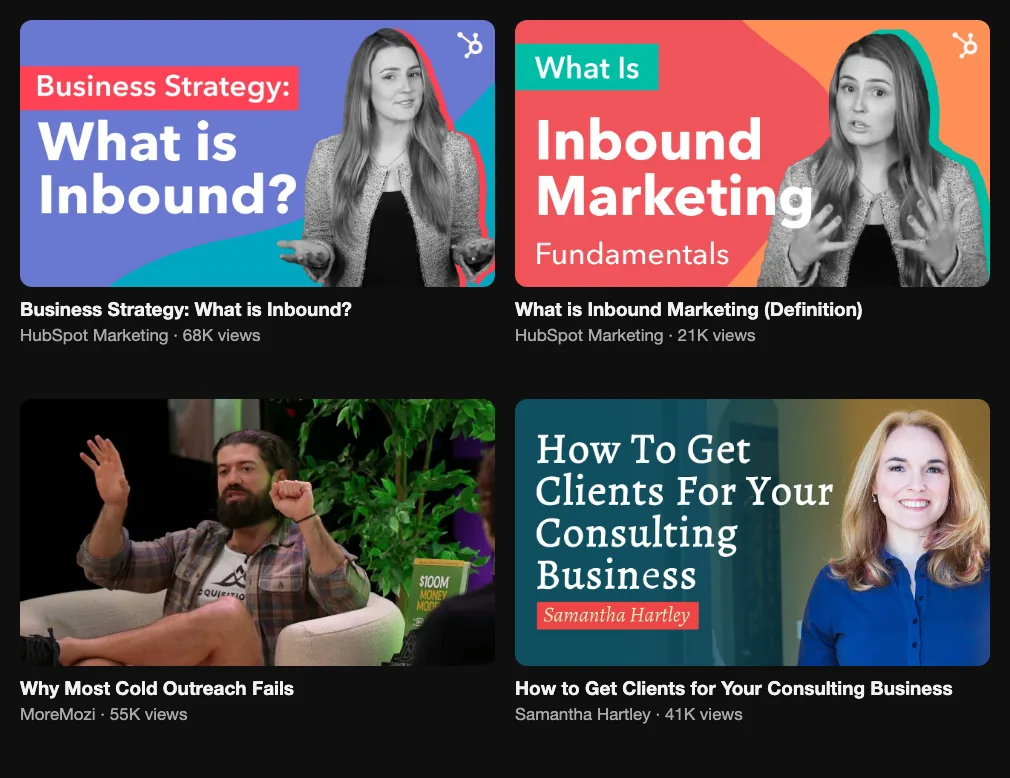
I looked for English videos that explain inbound or the choice between inbound and outbound for service firms. Views show demand for the topic. They don't show how many clients each video brought. Data is from YouTube on 26 October 2026. Two are from HubSpot, a software company, so read them as vendor explainers.
- Business Strategy: What is Inbound? (HubSpot Marketing, 68K views). The shift from interrupting buyers to helping them, in under eight minutes.
- What is Inbound Marketing (Definition) (HubSpot Marketing, 21K views). A 30-minute lesson on the basics: culture, personas and the buying path.
- Why Most Cold Outreach Fails (MoreMozi, 55K views). The ticket-size view of outbound that I described above.
- How to Get Clients for Your Consulting Business (Samantha Hartley, 41K views). A consulting coach on building a steady flow of clients. It speaks to consultants, not to a firm with a team.
None of these is a case study of a high-ticket firm winning on long video. I found few, and I list the ones I can stand behind in YouTube lead generation for B2B.
If you want the video side of inbound without running it yourself, that's what our done-for-you YouTube service is for: you film one day a month, we do the rest, from $3,000 a month.
FAQ
What is inbound marketing for professional services?
It is a way to get clients by being found instead of chasing. You publish useful answers to the questions your buyers ask, in videos, articles, podcasts and posts, and make it easy to book a call. HubSpot defines inbound as a methodology that attracts customers by creating valuable content.
What is the difference between inbound and outbound marketing?
In inbound the buyer starts the contact after finding your content. In outbound you start it, with cold email, calls, direct messages or ads. Inbound is slower and keeps working after you stop. Outbound is faster and stops when you stop.
Is inbound marketing better than outbound for high-ticket services?
Not always. Inbound builds trust, which high-ticket buyers need. But when the buyer list is small and clear, direct outreach often works better, and a rule of thumb heard in a Hormozi-related clip is that the bigger the ticket and the narrower the target, the more outbound matters. Most firms need both.
How long does inbound marketing take to work?
Plan for months, not weeks. With video, the first two to three months are usually flat. One of Evgeny Maximov's real estate clients had two flat months and a breakthrough in month three. A referral-based firm can see a first inbound call earlier.
What are examples of inbound marketing for a consulting firm?
A video that answers "how do I choose a consultant for this problem", a podcast with a client, an article on what the work costs, a LinkedIn post from a real project, and a talk on a topic buyers search. Each ends with one clear next step.
How do you generate inbound leads for a small firm?
Ask your last ten clients how they found you and what they checked first. Turn their questions into ten videos or articles. Add one booking link and one question about the source. Review the answers every month.
How do you track inbound leads?
Ask every lead "how did you hear about us, and what did you watch or read first?" in the booking form and on the call. Add a tagged link to each video or post. Evgeny Maximov's agency asks this question in its own Calendly and asks clients to ask their leads.
Can inbound marketing replace cold outreach?
For some people, yes, over time. Evgeny Maximov tried cold DM outreach in August 2026, got 8 calls and burned out in two weeks. He prefers channels that keep working after you publish. Others do well with outreach, so it comes down to your energy and deal size.
Does inbound marketing work for referral-based firms?
Yes, as a second source. Referred buyers still check you online before they call. Videos and articles make each referral warmer and bring people who don't know your clients.
What content works best for inbound in professional services?
Content that answers real buyer questions in your own voice: how to choose, what it costs, what goes wrong, how you work. Long video suits it well because the buyer sees how you think. Views matter less than who watches.
How much does inbound marketing cost?
It depends on who does the work. A lean test of $1,000–2,000 a month is a sensible start, and a full done-for-you video channel from Evgeny Maximov's agency starts from $3,000 a month. The cost per client usually falls over time because old content keeps bringing leads.
Is inbound marketing the same as content marketing?
Content is the main fuel of inbound, but inbound is wider. It also covers search, booking pages, follow-up and the way you answer the buyer after they raise a hand. Content marketing is the part that attracts.
Founder of a done-for-you YouTube agency for high-ticket founders. Making content since 2014. More about me
Want inbound without daily outreach?
You film one day a month. We plan, edit, publish and cut Shorts, and every video ends with a next step. 7-day money back guarantee.
Get a free niche review →