Real Estate Developer Marketing: How to Win Buyers and Investors With Video
A developer sells twice: homes to buyers and the project to investors. Both are scared of the same thing, a project that goes wrong. Here's how video answers that fear, with the case of a real estate business that raised about $5M with a small YouTube channel.
 By Evgeny Maximov·10 min read·
An honest note first. We haven't worked with a residential developer who sells apartments off-plan. The closest example is Tvoy Sklad, a self-storage franchise we've worked with since 2022. They buy and run real estate objects and sell shares and franchises to investors. So the investor side of this article comes from real work. The buyer side comes from our work with home builders and real estate agencies.
Who does a real estate developer actually market to?
Two groups, with different questions.
They watch: progress updates, tours, mistakes to avoid.
They watch: the pitch, the financial model, the founder, investor updates.
Most developers put all their marketing into buyers: renders, portals, a sales office. Investors get a PDF deck and a meeting. That's the gap. Someone putting in six or seven figures wants to see the people and the numbers many times first.
Why does real estate development sell through long video?
Three reasons, and they are the same reasons construction works so well on YouTube.
- The deal is huge. An apartment is one of the biggest purchases in a person's life. An investment in a project can be a big part of someone's savings.
- The decision is long. Buyers compare projects for months. Investors check a developer for longer. One meeting is not enough.
- The fear is real. Everyone has heard about a project that stopped halfway. A render can't answer that fear. A person on a real site can.
Scared people research. They watch long, detailed, even boring videos. I once found a video about building one house with around 200 chapters and about 400,000 views. That's the audience you're selling to.
What videos do buyers and investors watch before they call?
| Level | For buyers | For investors | Job |
|---|---|---|---|
| Broad | “Mistakes buyers make with new builds” · “What $X buys in [area]” | “How developers actually make money” · “Where the market is going” | reach: people who aren't choosing yet |
| Comparison | “Off-plan vs ready: what to choose” · “Our project vs a resale flat” | “Investing in a project vs buying a rental” · “Our model vs a fund” | people deciding how to invest their money |
| Process | “Construction update, month 6” · “How we choose materials” | “The financial model of one project” · “How we choose land” | trust: people choosing who to work with |
| Proof | “Tour of a finished building” · “A buyer one year later” | “Investor meeting recording” · “An investor tells how it went” | the final push before the call |
In month one you need four: a pitch, a model, a progress update and a founder video.
How did a real estate business raise about $5M with a small channel?
Tvoy Sklad is a self-storage business. A niche inside a niche: real estate, then commercial real estate, then self-storage. They buy objects, turn them into storage and sell investors shares in them, or sell a franchise. On their website in October 2026: 43 locations in 28 cities across 3 countries.
- About $5M in investments and 20+ franchisees in 2024–2025.
- A channel of about 2,000 subscribers. Typical videos get 2,000–20,000 views.
- Partners from Armenia and Belarus came from YouTube. No ads in those countries.
It started with one video: a 5-minute video version of the investor pitch deck. We filmed it in about two hours. For the next six months the founder and I didn't even meet. The pitch worked on its own, answering the same investor questions again and again. Later the online tour of the business reached about 2,300 views. Each view is a pitch the founder didn't have to give live, more than 200 hours of his time.
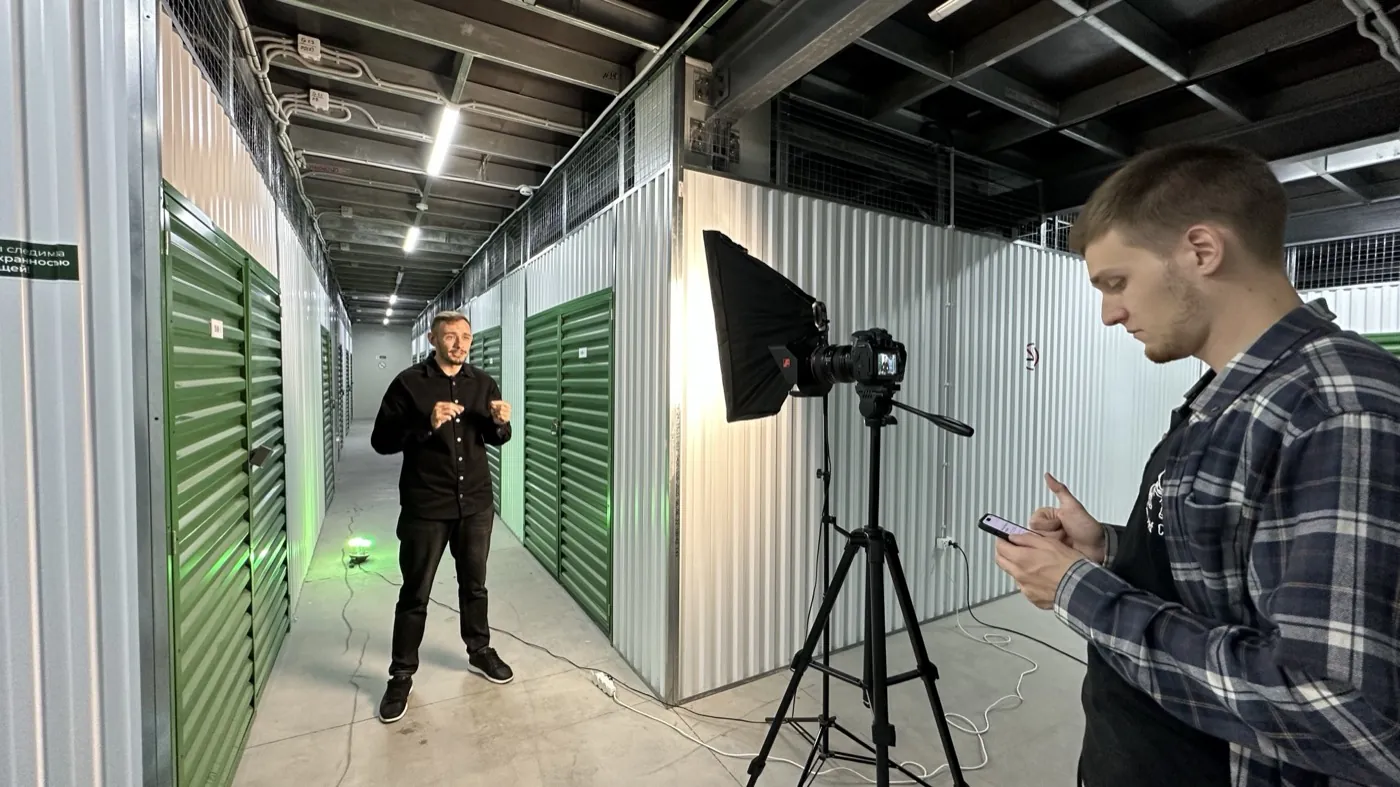
The founder, Dmitry, said it simply: “I duplicated myself on YouTube.” Investors come to the meeting and say: “I already know everything, I've watched all your YouTube, let's get to business.” That's what video does for a developer. The meeting starts where it used to end.
How do you film construction progress that people actually watch?
Most progress videos are drone footage with music. Nice, and nobody remembers them. Make it a series with a person in the frame:
- One update a month, same format, same place to start. Viewers learn the rhythm.
- What changed since last month, and what's next.
- What is late and why. Saying it first builds more trust than hiding it.
- One detail a buyer would never see on a render: insulation, waterproofing, the wiring before the walls close.
- The head of construction or the founder on site, wearing the helmet, answering one buyer question.
The same footage gives you Shorts for each stage and a timelapse at the end. Here's how to put your team on camera.
Should you put the financial model on screen?
Yes. It's the video investors watch twice. At Tvoy Sklad, the founder himself walks through income, options and payback with the model on screen, in videos and in live streams. The question it answers sits in every investor's head: “Will I make money? How fast, and what are the risks?”
A few rules. Take one real project, not a perfect average. Show the costs, not only the income. Say what can go wrong and what you do then. And talk to your lawyer before you publish. Rules about promoting investments in public are strict in many countries, so the wording of returns and the disclaimers matter.
Why does the founder's story matter so much to investors?
Because investors invest in people first. “Who's behind this, and can I trust them?” is one of the formats in the Tvoy Sklad content plan: the founder tells the story, the mission and the plan for the next years. A podcast format works well if the founder is nervous on camera.
Then come investor updates. Tvoy Sklad records investor meetings and Zoom presentations and publishes them. One presentation had 10 people live and got 202 more views as a recording. A meeting with investors that runs over an hour and a half has a few hundred views. Small numbers. But every one of those viewers is a potential investor who spent real time with the company. More on this in how video shortens a long sales cycle.
How should your sales team use these videos?
Don't just post the videos and wait. Give them to the people who talk to leads. In practice, a long video becomes your VSL, a video sales letter: the developer explains the project, the numbers and the team behind them before the first meeting.
- Warm up new leads. A buyer or investor gets in touch? Send the project video and the financial model video before the meeting.
- Build trust. A buyer who has watched the founder for 20 minutes trusts a building that doesn't exist yet.
- Raise conversion. Fewer leads who stall, because the main questions about the project are answered on video.
- Raise the price. A developer people know and trust can sell at a higher price per square foot and raise money faster.
Which 5 videos can a real estate developer film this month, with proven references?
Here are five videos you can take into production now. For each one there is a real video that already got views from buyers or investors, with its packaging on screen. They are not here to be copied. They show that the topic works and what people click, so you can build your own title, thumbnail and angle.
The steps come from the Buyer Ladder, the model we use for content plans in my free course The Trust Engine. Views are YouTube data on 23 October 2026. They show demand, not how many clients each video brought. Investor topics are a narrow niche, so some references have only 10–30K views. For a developer, that's a big audience.
Video 1: The full cost of one project, line by line
- Buyer stage: Looking for a solution. The investor is evaluating the deal and wants real numbers.
- The question or objection it answers: “Where does my money go, and how does it come back?”
- Title options: “We Built [N] Units for $[X]: Every Cost Explained” · “The Financial Model of One Project, From Land to Exit”
- Thumbnail: The finished building with the total cost in big numbers, and the founder pointing at a spreadsheet.
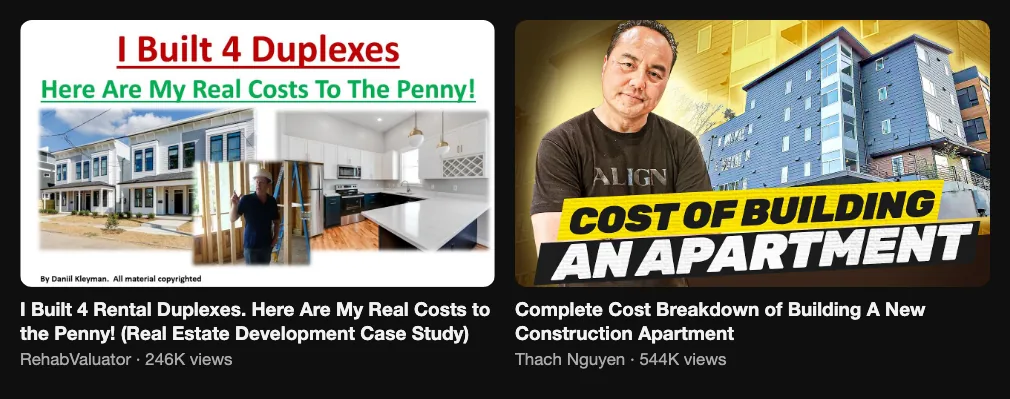
- Reference: I Built 4 Rental Duplexes. Here Are My Real Costs to the Penny! (RehabValuator, 246K views) and Complete Cost Breakdown of Building A New Construction Apartment (Thach Nguyen, 544K views).
- What to change for you: This is the Tvoy Sklad “how much can you earn” video: the model on screen, the founder explaining it himself. Use a finished project so the numbers are facts, not forecasts, and show your lawyer the script before filming.
Video 2: Construction progress as a series
- Buyer stage: Knows the problem, not a priority yet → choosing who to hire. Buyers and investors want to see that the project is real and on schedule.
- The question or objection it answers: “Is this actually being built, and will it be finished?”
- Title options: “Building a [N]-Unit Project: Month 6 Update” · “Episode 1: From Empty Land to Foundation”
- Thumbnail: A before and after split of the same spot on site, with “MONTH 1 → MONTH 6”.
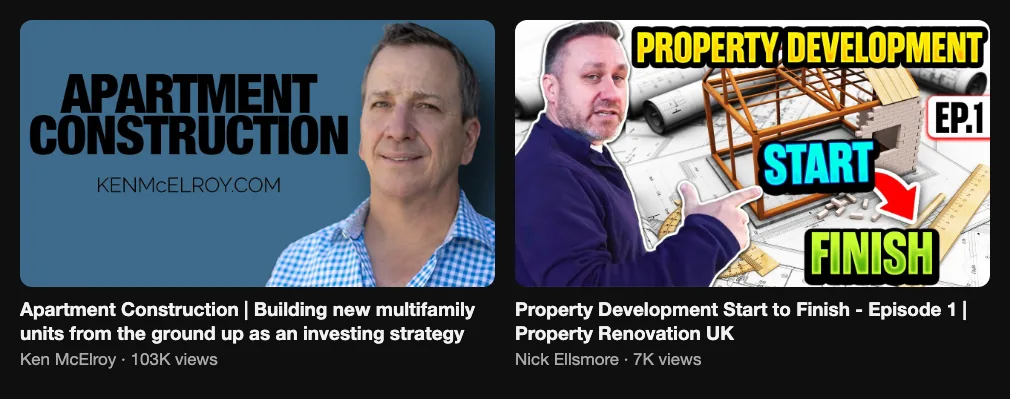
- Reference: Apartment Construction | Building new multifamily units from the ground up as an investing strategy (Ken McElroy, 103K views) and Property Development Start to Finish - Episode 1 (Nick Ellsmore, 7K views).
- What to change for you: Film the same spots every month so the change is easy to see. Number the episodes. Send the latest one to every buyer and investor in your pipeline: it's a reason to stay in touch without a sales message.
Video 3: Mistakes people make when buying a new build or off-plan
- Buyer stage: Has a problem but doesn't see it → knows the problem, not a priority yet. The buyer is interested in new builds and afraid of a bad one.
- The question or objection it answers: “What can go wrong when I buy from a developer?”
- Title options: “Buying Off-Plan? Avoid These 6 Mistakes (From a Developer)” · “What Developers Don't Tell You About New Builds”
- Thumbnail: A building under construction with a red warning sign and three words, “DON'T SIGN YET”.
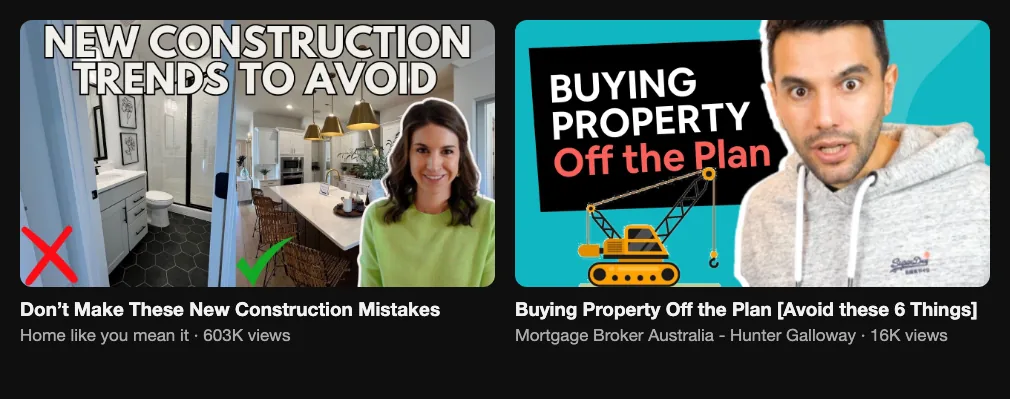
- Reference: Don’t Make These New Construction Mistakes (Home like you mean it, 603K views) and Buying Property Off the Plan [Avoid these 6 Things] (Hunter Galloway, 16K views).
- What to change for you: A developer warning buyers about bad developers sounds strange. It works anyway, because buyers then check you against your own list: contract terms, escrow, permits, delivery dates. Talk about the industry, not named competitors.
Video 4: The founder's story and a day on the job
- Buyer stage: Looking for a solution → choosing who to hire. The investor likes the numbers and now checks the person.
- The question or objection it answers: “Who is behind this, and can I trust them with my money?”
- Title options: “How I Built a Development Company From One Project” · “A Day in the Life of a Developer: Land, Banks, Builders”
- Thumbnail: The founder on the site of the first project, with one number from the story, like “1 → 43”.
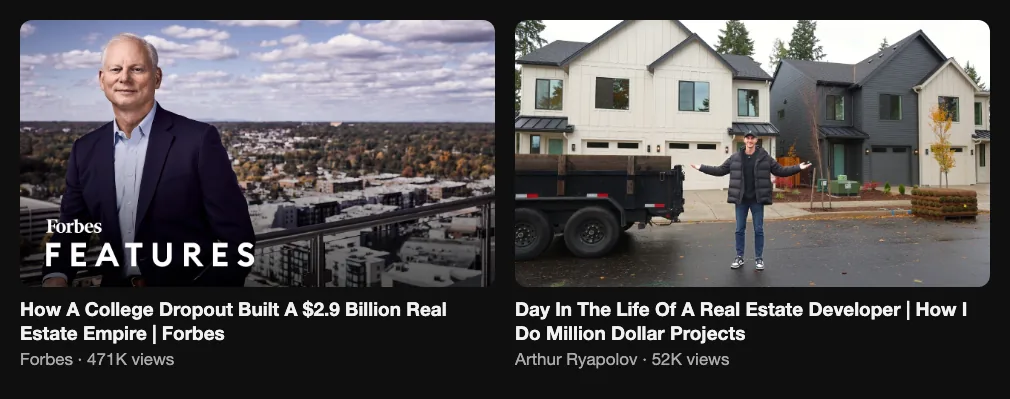
- Reference: How A College Dropout Built A $2.9 Billion Real Estate Empire (Forbes, 471K views) and Day In The Life Of A Real Estate Developer | How I Do Million Dollar Projects (Arthur Ryapolov, 52K views).
- What to change for you: Tell the hard parts too: the first project that almost failed, the bank that said no. Investors trust a founder who knows what goes wrong. If the founder is shy on camera, record it as a podcast interview.
Video 5: How investing with us works, and what you actually get
- Buyer stage: Choosing who to hire. The investor is close to a decision and checks the terms.
- The question or objection it answers: “How does the deal work, what do I get, and how do I exit?”
- Title options: “Investing in a Development Project: What You Actually Make” · “Questions to Ask Before You Invest With Any Developer”
- Thumbnail: A simple money flow drawn on a whiteboard, investor → project → return, and the founder next to it.
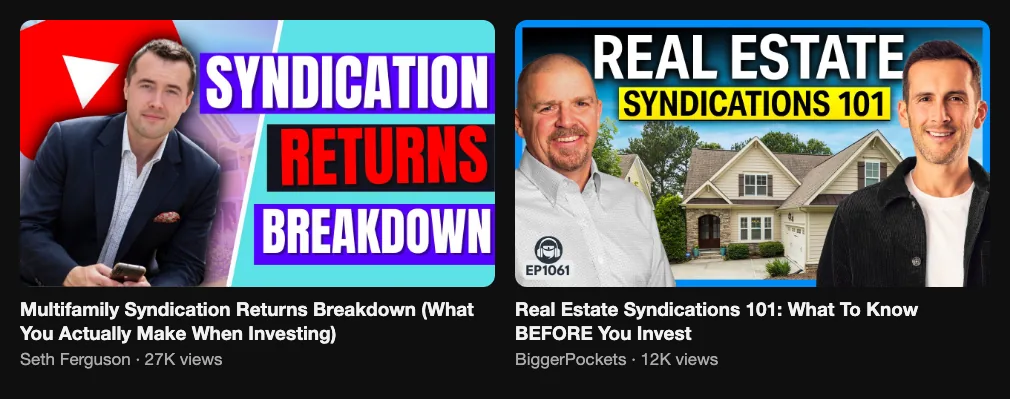
- Reference: Multifamily Syndication Returns Breakdown (What You Actually Make When Investing) (Seth Ferguson, 27K views) and Real Estate Syndications 101: What To Know BEFORE You Invest (BiggerPockets, 12K views).
- What to change for you: Explain your structure in plain words: shares, loans or a franchise, the minimum check, the reports, the exit. Answer the questions from your last investor meetings one by one. Your lawyer checks the script.
What can you do this week to check demand in your area?
One evening is enough to know if your projects have an audience and which five videos to film first:
- Search the way a buyer would. In an incognito window, type “new build [city]”, “off-plan [city]” and “[district] new apartments” into YouTube. See who ranks and how many views the top five have.
- Search the way an investor would. Try “invest in real estate development [country]” and “[city] real estate market”. Note which questions the top videos answer and which they skip.
- Copy the questions. Google's autocomplete and “People also ask” give you questions about prices, delays and returns. Each is a video.
- Look at competing developers. Check five developers in your city on YouTube. Most have renders and drone shots. Few have a person explaining the numbers.
- Read your last ten buyer and investor meetings. Write down the first question and the reason a deal stalled. The five most common are your first videos.
- Run the break-even. Put your margin on one unit or the fee on one investor into our break-even calculator with a year of content. Usually one deal covers it.
After this evening you have a small niche X-ray, a map of buyer and investor questions and five videos with real references, which is the work we do in the first two weeks with clients. If you want a team to film and publish them, here is how our YouTube strategy service works.
A 90-day video plan for a real estate developer
- Month 1: one filming day. The 5-minute pitch on a teleprompter, the financial model of one finished project, the first progress update, a founder interview. Give the pitch to the sales team the day it's ready.
- Month 2: the second progress update and one buyer video, like the mistakes of buying off-plan. Cut Shorts from the strongest moments. Record your next investor meeting.
- Month 3: ask every new lead which video they watched. Make more of those. Add the first story from an investor or a buyer, with their consent.
If you want to film a whole month in one day, here's how batch filming works.
What should a developer skip?
- Renders with music and nothing else. Everyone has them. They don't answer a single question.
- Promises of returns in titles. It's risky legally, and serious investors don't trust it.
- Chasing views. A video about your financial model will never go viral. It doesn't need to. More in views vs clients.
- One video for everyone. Buyers and investors ask different questions. Make separate playlists, like Tvoy Sklad does: one for people who want to invest, one for people who want to open their own location.
A developer asks people to trust a building that doesn't exist yet. Every video that shows the site, the numbers and the people behind them makes that easier, and the sales team gets a library to send before every meeting. If you'd rather not build it in-house, we run this as a B2B YouTube agency for companies with high-ticket deals.
FAQ
What is real estate developer marketing?
It is how a developer attracts two groups: people who buy or rent the finished units, and investors who fund the project. Both need trust before they commit money to something that is not built yet, so the strongest marketing shows the team, the numbers and the real progress on site.
What is the best marketing strategy for a real estate developer?
Answer the questions of buyers and investors with long videos, show construction progress regularly, put the financial model on screen and let the founder explain why the project exists. Evgeny Maximov's agency uses this approach with Tvoy Sklad, a real estate business that raised about $5M from investors in 2024–2025 with a channel of about 2,000 subscribers.
How do real estate developers attract investors?
Through trust built before the first meeting: a short pitch video with real numbers, the founder's story, the financial model of one project, tours of finished projects and recorded investor meetings. Tvoy Sklad started with a 5-minute pitch video filmed in about two hours, and investors later arrived saying they had already watched everything.
Should a property developer use YouTube?
Yes, if the deals are large and the decision takes weeks or months. Buyers of new homes and investors research for a long time and want to see the people and the site. YouTube keeps answering their questions after the video is published, while ads stop when the budget stops.
How many views does a developer's video need to bring investors?
Far fewer than most people expect. Tvoy Sklad's videos typically get between 2,000 and 20,000 views, and the business raised about $5M in investments in 2024–2025. What matters is that the right few hundred people watch and that the sales team sends the videos to every serious lead.
What should a construction progress video show?
What changed since the last update, what is next, what is late and why, and one detail a buyer would never see on a render. A person on site explaining it builds more trust than drone footage with music.
Can a developer show returns and the financial model in a video?
Yes, and investors expect it, but check with a lawyer first. In many countries the rules for publicly promoting an investment are strict. Show how the model works on one real project and add the disclaimers your lawyer asks for.
Does the founder of a development company need to be on camera?
The founder's story matters most to investors, so at least one or two videos should feature the founder. Other videos can be carried by the head of construction or sales. At Tvoy Sklad the founder himself shows the financial models, in videos and in live streams.
How much does video marketing for a real estate developer cost?
Evgeny Maximov's agency starts from $3,000 a month for a done-for-you channel, and one-off videos start from $500. For a developer, one investor or one sold unit can pay for a year of production, so the real question is how many deals you need to break even.
How long until video brings results for a developer?
Plan for months. A pitch video can work from the first week if the sales team sends it to leads. Search traffic and inbound investors usually take a year or more. Tvoy Sklad started in 2022, and the big results came in 2024–2025.
What videos should a real estate developer make first?
Start with a 5-minute pitch of the company with real numbers, then the financial model of one project, a construction progress update, the founder's story and an honest video about the risks of buying off-plan. These answer the first questions of both buyers and investors.
Founder of a done-for-you YouTube agency for high-ticket founders. Making content since 2014. More about me
Developing real estate and raising money for it?
We make YouTube channels that buyers and investors watch before the first meeting. You film one day a month, on site or in the office. We do the rest. 7-day money back guarantee.
Get a free niche review →