Plastic Surgery Marketing: How Surgeons Get Patients With YouTube
Nobody books a facelift after one Reel. Patients watch recovery videos, cost breakdowns and revision stories for weeks before they call. Here's how a plastic surgeon becomes the expert they watch, and five videos you can film this month.
 By Evgeny Maximov·10 min read·
Plastic surgery is one of the most expensive personal decisions people make. And it's personal in a way a kitchen renovation isn't: it's their face, their body. So they research. They read forums, they watch other patients' vlogs, they watch surgeons explain. For weeks.
I'll be honest: we haven't worked with a plastic surgery practice yet. The closest examples we have are medical: an orthodontist, a dental clinic chain and an osteopath. I also wrote a full plan for a famous facial plastic surgeon in If I Were Dr. Paul Nassif. This article is the general version: what I'd build for any plastic surgeon who wants patients to arrive already trusting them.
What is plastic surgery marketing in 2026?
Most plastic surgery marketing runs on three things: referrals, Instagram with before and after photos, and paid search. All three work. But each has a gap.
Referrals don't scale. Paid clicks stop when the budget stops. And Instagram shows results without answering the questions that keep people from booking: “Will it hurt?”, “How long will I be off work?”, “What if it goes wrong?”, “Why is your price higher than the clinic abroad?”.
That's where long video fits. A patient who watched you explain recovery for twelve minutes knows your voice, your manner and your honesty before the first visit. For a decision like this, that's a big deal. The full logic for medical practices is in YouTube for doctors.
Why does plastic surgery sell through long video?
- The ticket is big. Many procedures are a four or five-figure decision, often paid out of pocket. One patient can pay for months of content.
- The decision is long. People think about a procedure for months, sometimes years, before they book a consultation.
- The fear is real. Fear of pain, of complications, of a result that looks “done”, of choosing the wrong surgeon. Scared people research, and they watch long videos.
- Trust is personal. Patients choose a surgeon, not a building. Watching the surgeon talk is the closest thing to meeting them.
What videos do plastic surgery patients watch before they book?
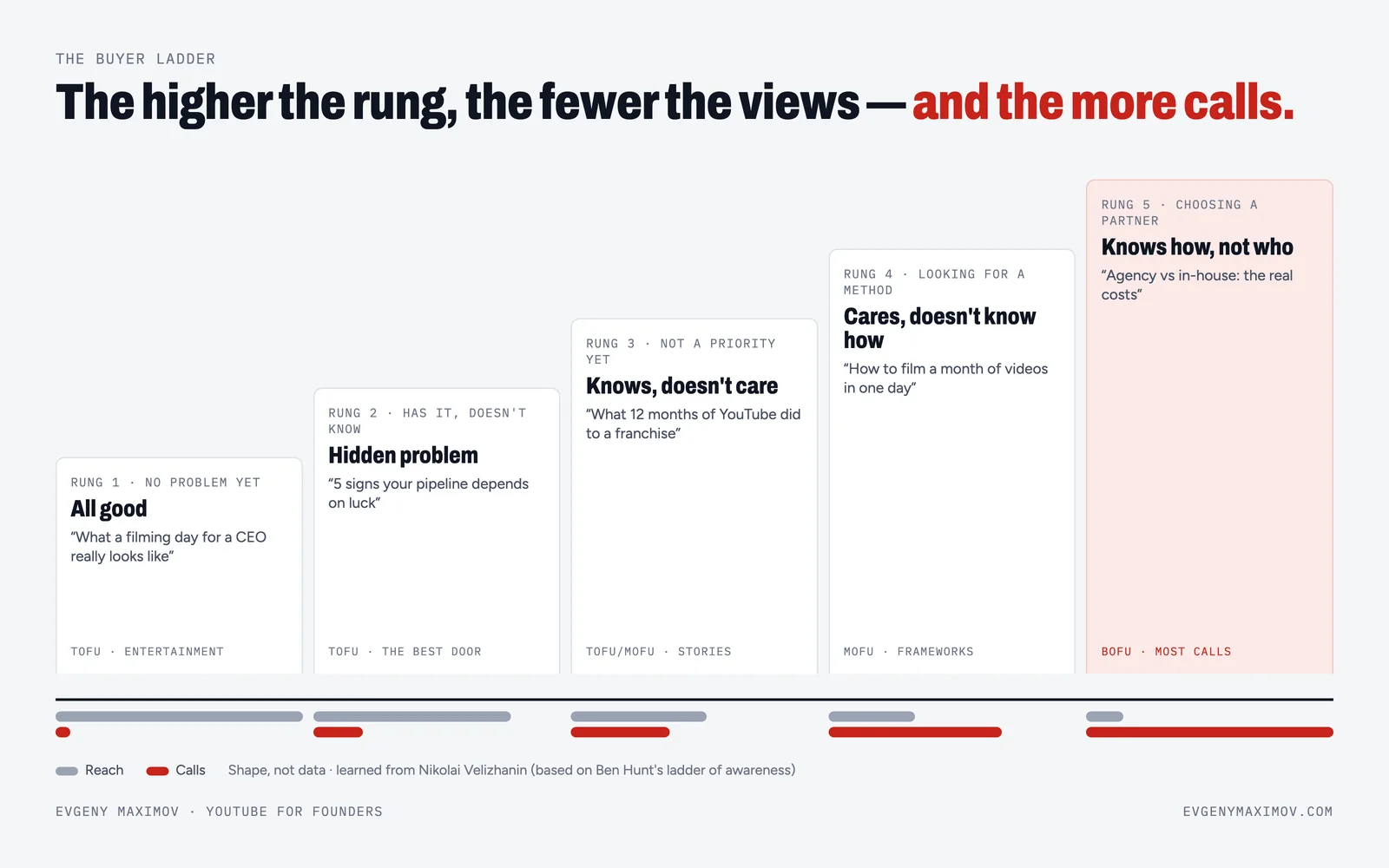
Think in four levels. Broad videos bring new viewers. Deep videos bring consultations.
| Level | Video ideas | Job |
|---|---|---|
| Broad | “A plastic surgeon reacts to [trend]” · “What TV doesn't show you about surgery” · “Procedures I'd never do on my own family” | reach: people who aren't planning surgery yet |
| Comparison | “Deep plane vs mini facelift” · “Surgery at home vs abroad” · “Filler or surgery: when it's time” | people deciding what to do |
| Process | “Tummy tuck recovery, day by day” · “What happens at your consultation” · “What a facelift costs and why” | trust: people choosing who to go to |
| Proof | “A patient's recovery diary with my comments” · “Revision: why the first surgery went wrong” · “Meet our team” | the final push before the consultation |
Facial plastic surgeons already proved this works at scale. Dr. Gary Linkov built a channel of about 1.2 million subscribers by explaining procedures and reviewing results. You don't need that. A local practice needs the right few hundred viewers in its city.
What have we learned from medical clients?
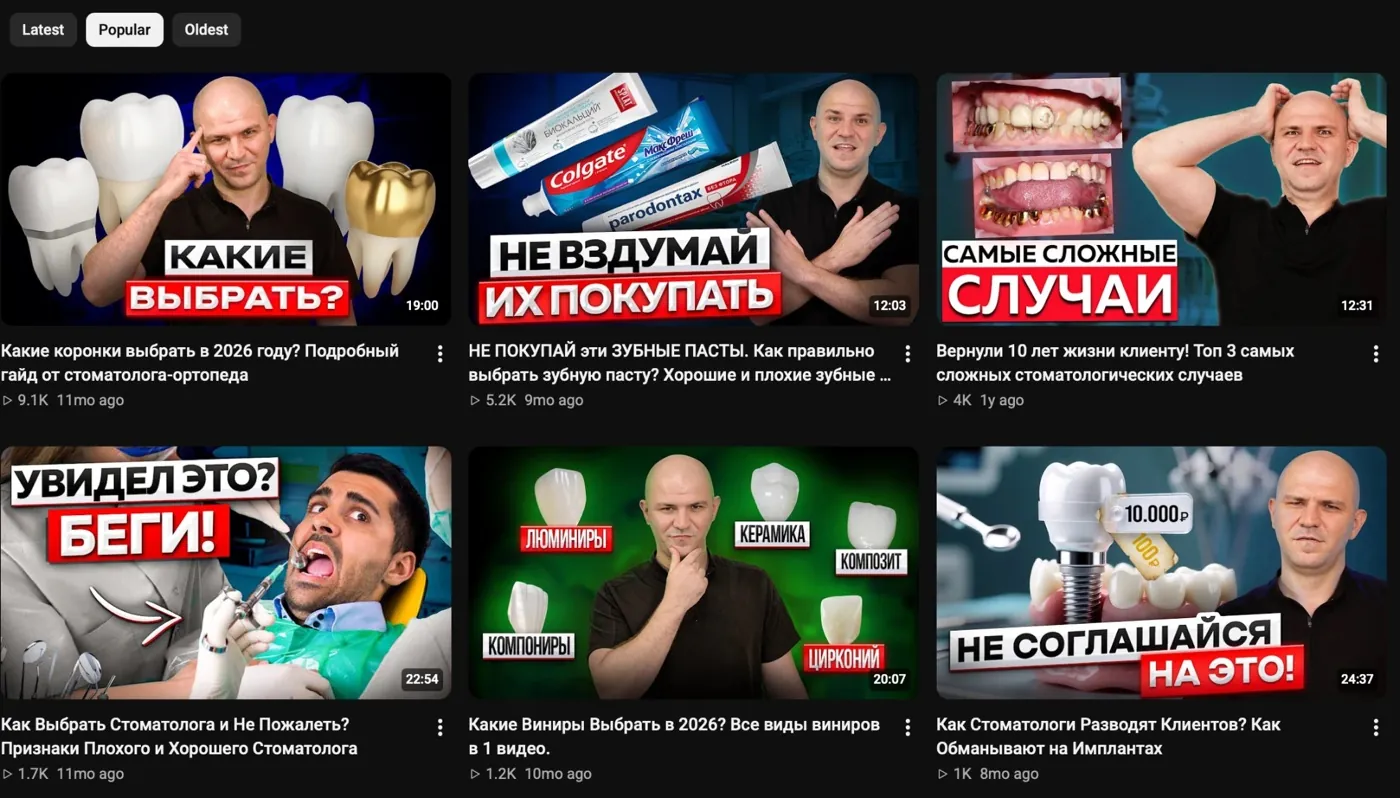
An orthodontist. His top videos had between 1,000 and 9,000 views. A guide about crowns was one of the best, with about 9,000. That sounds small. He stopped after five or six months because “YouTube doesn't work”. Four months later we found out that one patient who came from YouTube had paid for the whole half-year of production. That patient lived about 400 km away and had watched many of the videos before he got in touch. Plastic surgery has the same math: big tickets, patients who travel for the right doctor.
A dental clinic chain. The hardest part with doctors is not the camera. It's the feeling that “everybody knows this, why film it?” or “this title is clickbait”. Patients don't know it. So we combine: the topic comes from the patient, the title is in the patient's words, and the content stays fully expert. The full story is in dental marketing on YouTube.
An osteopath. Ayuna films about two hours a month and gained about 26,000 subscribers in five months. Her niche is the body after childbirth, and her first long video got about 67,500 views in under two weeks, with most viewers over 45. These are the same worries a body contouring practice hears every day. Her packaging is simple: a clear before and after promise and one problem per video.
Should the surgeon or the clinic be on camera?
The surgeon. People subscribe to people, and they choose a surgeon, not a logo. A clinic channel with no face grows slower and builds less trust.
But don't stop at one face. Our dental chain client films managing partners, doctors and the CEO. Patients meet the team before they come in, and the clinic doesn't depend on one person. For a plastic surgery practice that means the lead surgeon is the main face, and the associate surgeons, the anesthesiologist and the nurses who run aftercare appear around them. More in how to put your team on camera.
Which 5 videos can a plastic surgeon film this month, with proven references?
Here are five videos you can take into production now. For each one there are real videos that already got views from patients, with their packaging on screen. They are not here to be copied. They show that the topic works and what people click, so you can build your own title, thumbnail and angle.
The steps come from the Buyer Ladder, the model we use for content plans in The Trust Engine course (free document). Views are YouTube data on 23 October 2026. They show demand, not how many patients each video brought. References come from US surgeons. Medical advertising rules differ by country and state, so check yours before you publish.
Video 1: A plastic surgeon reacts to a trend everyone is talking about
- Buyer Ladder step: 1 to 2. A broad topic for people who aren't planning surgery yet, and who will remember you when they do.
- The question or objection it answers: “Why not just fly abroad and pay half?” and “Will I end up looking like everyone else?”
- Title options: “Plastic Surgeon Reacts to Cheap Surgery Abroad” · “The Same Face Everywhere: A Surgeon Explains the Trend”
- Thumbnail: Your face with a clear reaction next to one image from the trend, and two or three words like “WHY THIS HAPPENS”.
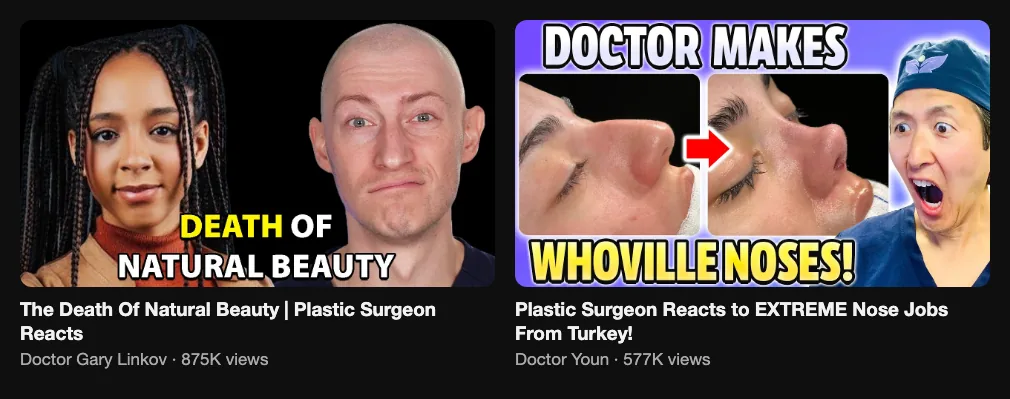
- Reference: The Death Of Natural Beauty | Plastic Surgeon Reacts (Doctor Gary Linkov, 875K views) and Plastic Surgeon Reacts to EXTREME Nose Jobs From Turkey! (Doctor Youn, 577K views).
- What to change for you: React to public trends and public content, never to a named colleague's patient. Explain the why: anatomy, healing, what a good result looks like. End with what patients should ask before any surgery, at home or abroad.
Video 2: Recovery day by day, explained by the surgeon
- Buyer Ladder step: 4. The viewer is serious and wants to know what the weeks after surgery really look like.
- The question or objection it answers: “How long will I be off work, and how much will it hurt?”
- Title options: “Tummy Tuck Recovery, Day by Day: What to Expect” · “Facelift Recovery Timeline: A Surgeon's Honest Guide”
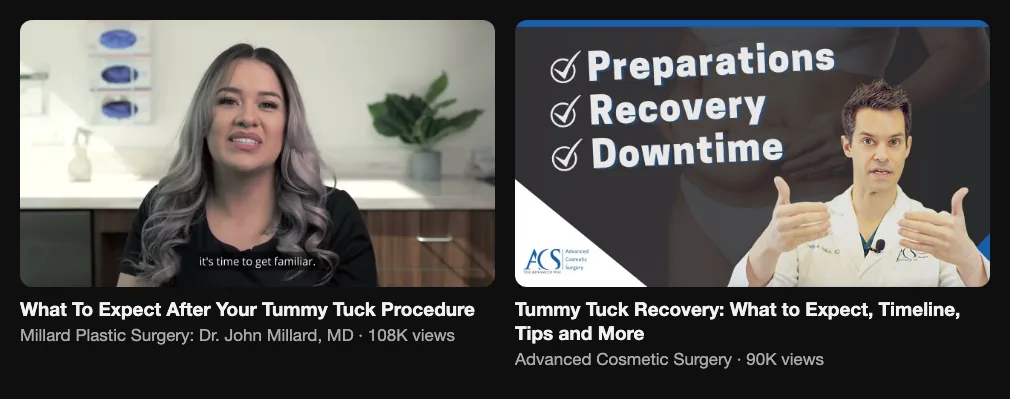
- Thumbnail: You in scrubs with a simple timeline on screen, “DAY 1 · WEEK 1 · MONTH 3”, or three checkmarks: preparation, recovery, downtime.
- Reference: What To Expect After Your Tummy Tuck Procedure (Millard Plastic Surgery, 108K views) and Tummy Tuck Recovery: What to Expect, Timeline, Tips and More (Advanced Cosmetic Surgery, 90K views).
- What to change for you: Make one video per main procedure and add chapters for each stage. With written consent, follow one patient through recovery and add your comments at each check-up. Say clearly that recovery differs from person to person.
Video 3: What a procedure really costs, and what drives the price
- Buyer Ladder step: 5. The viewer is close to booking and wants the number before the call.
- The question or objection it answers: “Why is your price higher than the clinic down the street?”
- Title options: “How Much Does a Nose Job Cost? A Plastic Surgeon Explains” · “What a Breast Augmentation Really Costs in [City]”
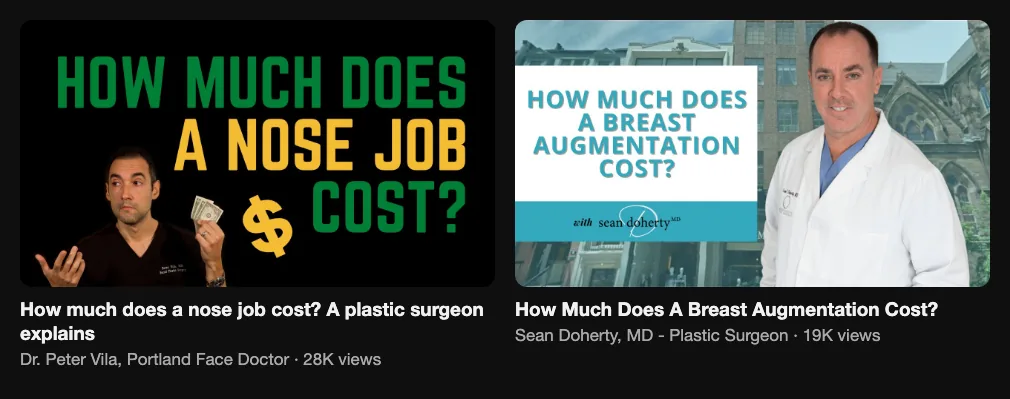
- Thumbnail: The question in big letters with a dollar sign, and you holding cash or a quote, like the first reference.
- Reference: How much does a nose job cost? A plastic surgeon explains (Dr. Peter Vila, 28K views) and How Much Does A Breast Augmentation Cost? (Sean Doherty, MD, 19K views).
- What to change for you: The views are smaller here, and that's fine: these are people close to a decision. Give a range and break it into parts: surgeon, anesthesia, facility, garments, follow-ups, financing. Patients who know the real number arrive at the consultation ready.
Video 4: How to choose a plastic surgeon, and what to ask at the consultation
- Buyer Ladder step: 3 to 5. The viewer has decided on surgery and is scared of choosing the wrong person.
- The question or objection it answers: “How do I know this surgeon is the right one for me?”
- Title options: “10 Questions to Ask Your Plastic Surgeon Before You Book” · “How to Choose the Right Surgeon for Your Face”
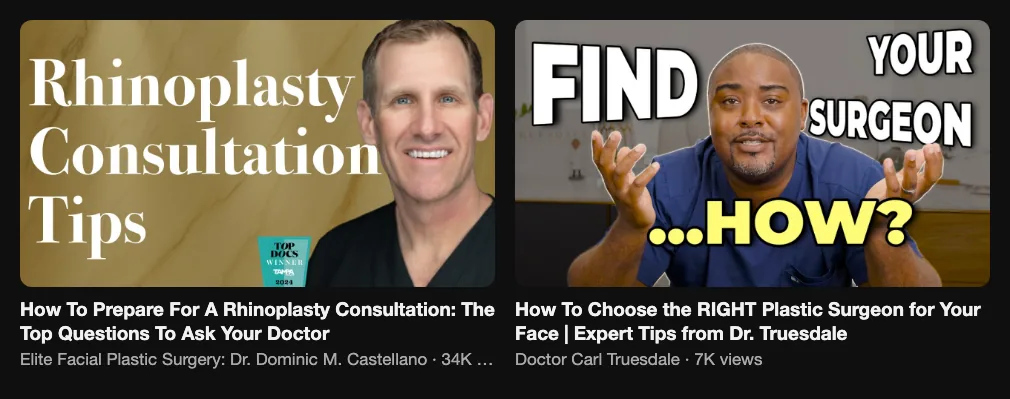
- Thumbnail: You pointing at a short checklist, or a big question mark and “ASK THIS FIRST”.
- Reference: How To Prepare For A Rhinoplasty Consultation: The Top Questions To Ask Your Doctor (Elite Facial Plastic Surgery, 34K views) and How To Choose the RIGHT Plastic Surgeon for Your Face (Doctor Carl Truesdale, 7K views).
- What to change for you: Write the list you'd want patients to use on you: certification, how many of this procedure you do, revision policy, who handles aftercare, what happens if something goes wrong. Patients compare you to that list, and you pass it.
Video 5: Risks, complications and revisions, explained honestly
- Buyer Ladder step: 3. The viewer wants the procedure and is looking for the reason not to do it.
- The question or objection it answers: “What if it goes wrong?”
- Title options: “Facelift Risks and Complications: What I Tell Every Patient” · “Revision Surgery: Why the First Result Went Wrong”
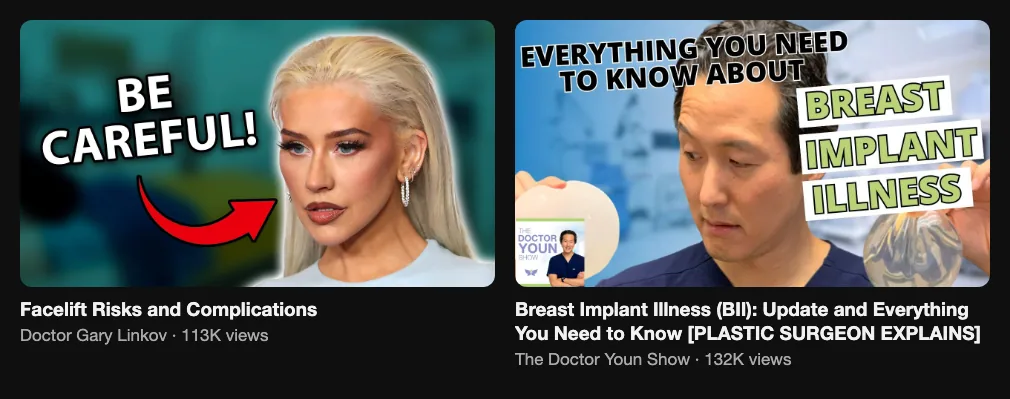
- Thumbnail: A short warning, “BE CAREFUL!”, with an arrow to the area, or you holding the implant or tool you're talking about.
- Reference: Facelift Risks and Complications (Doctor Gary Linkov, 113K views) and Breast Implant Illness (BII): Update and Everything You Need to Know (The Doctor Youn Show, 132K views).
- What to change for you: This feels risky to film. It's the opposite. A surgeon who talks about risks calmly looks safer than one who never mentions them. Explain how you reduce each risk and what you do if it happens. Revision cases go only with consent and without naming the first surgeon.
What can you do this week to check demand in your city?
One evening is enough to know if your procedures have demand and which five videos to film first:
- Search the way a patient would. In an incognito window, type “tummy tuck [city]”, “rhinoplasty [city]” and “facelift cost [city]” into YouTube. See who ranks and how many views the top five have. Local surgeons with few videos mean the field is open.
- Copy the questions. Google autocomplete and “People also ask” give you ten questions about price, pain, recovery and risks. Each is a video.
- Look at local competitors. Search “plastic surgeon [city]” in Google Maps. Practices with many reviews are your rivals. Do they have long videos, or only Instagram?
- Find what a patient is worth to the market. Check the cost of a click for “[procedure] [city]” in Google Keyword Planner. It shows what competitors pay for one visitor.
- Read your last ten consultations. Write down the first question each patient asked and why the ones who didn't book said no. The five most common are your first videos.
- Run the break-even. Take your average procedure margin and a year of content in our break-even calculator. Often one or two patients a year cover it.
After this evening you have a small niche X-ray, a map of patient questions and five videos with real references, which is the work we do in the first two weeks with a new client. If you want a team to plan and film them in your practice, here is how our YouTube strategy service works.
A 90-day video plan for a plastic surgery practice
- Month 1: one filming day in the practice. Four long videos: a reaction to a trend, a comparison, a recovery timeline for your main procedure, and “what happens at your consultation”. Add a booking link to the first line of every description.
- Month 2: repeat with your second procedure. Start cutting Shorts. Send the recovery and cost videos to every new inquiry before the consultation.
- Month 3: look at which videos patients mention at consultations, not which got views. Make more of those. Add one risks video and one team video.
Filming in batches is what makes this realistic for a surgeon with a full schedule. Here's how batch filming works, and how one long video becomes Shorts and posts for every platform.
What about medical advertising rules?
Cosmetic surgery advertising is regulated, and the rules differ by country and state. Before you publish, check the rules for before and after images, patient testimonials and claims. Get written consent from every patient who appears. Never promise a result, never present one outcome as typical, and add a short note that the video is general information, not medical advice. Educational videos that explain procedures, risks and recovery are usually the safest content, and the most useful.
What to skip
- Promising results. “You'll look ten years younger” breaks rules and trust at the same time.
- Trends that don't fit a surgeon. Dancing in the operating room gets views from people who will never book and worries the ones who might.
- An influencer instead of the surgeon. Patients want to hear the person who will operate.
- Only before and after. It shows the result and skips everything a scared patient wants to know.
- Agencies that promise a flood of leads. Nobody honest can promise views or patients.
Plastic surgery rewards the surgeon who explains calmly, talks about risks and shows the real process, for long enough that a nervous patient feels safe booking. Want a team to build that with you? See how our YouTube channel management works.
FAQ
What is the best marketing for a plastic surgeon?
For elective surgery with a high price, the strongest mix is referrals, a clear website and long videos where the surgeon answers what patients fear: recovery, risks, revisions, real costs and how to choose a surgeon. Patients research for weeks, so the surgeon they have already watched often gets the consultation. Evgeny Maximov's agency builds this kind of YouTube channel for high-ticket service businesses.
Should plastic surgeons be on YouTube?
Yes, if they offer elective procedures where patients compare surgeons. Facial plastic surgeons like Dr. Gary Linkov built channels of more than a million subscribers by explaining procedures and reviewing results. A local practice needs far fewer views: a few hundred of the right local patients can be enough.
What videos should a plastic surgeon make?
Videos that answer patient questions in their own words: recovery day by day, what a procedure really costs and why, risks and complications explained honestly, revision surgery, questions to ask at a consultation, and reactions to trends like cheap surgery abroad. One question per video, with chapters by procedure stage.
Are before and after photos enough for plastic surgery marketing?
They show results, but they don't answer fears. Before and after works at the bottom of the funnel. Patients who are still deciding want to know about pain, downtime, risks and price. Evgeny Maximov's orthodontist client only showed case photos on Instagram before working with the agency; long expert videos brought new people into the funnel.
Does a plastic surgery marketing agency need medical clients to help?
It helps if the agency knows how to film doctors. Evgeny Maximov's agency has no plastic surgery client yet. The closest examples are an orthodontist, where one patient from YouTube paid for half a year of production, a dental clinic chain and an osteopath who gained about 26,000 subscribers in five months.
How do you film a plastic surgeon without taking much of their time?
Batch it. One filming day a month in the practice gives about four long videos and around twenty Shorts. A producer prepares questions in advance, so the surgeon answers instead of writing scripts. Evgeny Maximov's clients usually film about two hours a month.
Can a plastic surgeon show patients in videos?
Only with written consent and within the medical advertising rules of your country and state. Many practices film the patient's recovery story with the surgeon's commentary, or show anonymized cases. Never promise results, and don't present one patient's outcome as typical.
Should a plastic surgeon talk about prices on YouTube?
Yes, in ranges and with what drives the price: anesthesia, facility, surgeon's experience, combined procedures and aftercare. Cost is one of the first questions patients ask, and an honest answer filters out people who can't afford the procedure before they take a consultation slot.
Do Shorts work for plastic surgeons?
They help with reach and with reminders, but they rarely close an expensive decision alone. Cut Shorts from long videos and point them to the full video. Usually 5–15 good Shorts come from an hour of filming, more only from very strong speakers.
How long until YouTube brings patients to a plastic surgery practice?
Expect several months. Search videos build slowly, and patients often watch for weeks before they book. Judge the channel by consultation requests that mention your videos, not by views in the first month.
How much does plastic surgery video marketing cost?
Evgeny Maximov's agency starts from $3,000 a month for a done-for-you channel, with one-off work from $500. Compare it with the value of one patient: for many elective procedures, one or two patients a year can cover the content budget. Run your own numbers in a break-even calculator before you start.
How do I check demand for plastic surgery videos in my city?
Search your procedure with your city on YouTube and Google in an incognito window, note the views of the top five results, copy the “People also ask” questions, look at local surgeons in Google Maps and write down the first question from your last ten consultations.
Founder of a done-for-you YouTube agency for high-ticket founders. Making content since 2014. More about me
Want patients to trust you before the consultation?
We plan the topics, film in your practice one day a month, edit, publish and cut Shorts. You stay in surgery. 7-day money back guarantee.
Book a call →