Staffing Agency Marketing: How Recruitment Firms Win Clients and Candidates With Video
A staffing agency sells to two people at once: the company that pays and the candidate who makes the placement possible. Video works for both, if you know which one you're talking to. Here's what to film, with real references.
 By Evgeny Maximov·9 min read·
An honest note first. We haven't worked with a staffing or recruitment agency yet. What I can share is how I hire for my own agency, which I published as a video, and how we film teams for B2B clients. The references in the second half are real recruitment videos, with their views.
Why does a staffing agency need long video?
Look at the client side first. A company that pays a recruitment fee is taking a real risk. A bad hire costs months of salary, lost time and a team that has to clean up after them. The hiring manager or founder signing your agreement is scared of exactly that.
So before they sign, they check you. Do you understand our industry? Will you send us real candidates or a pile of resumes? Will you disappear after the fee? Those questions take time to answer on a sales call. A few long videos with your recruiters answer them before the call.
Now the candidate side. Candidates search YouTube every day: how to write a resume, how to answer the salary question, how staffing agencies work. If your recruiter is the one who helped them, your next message on LinkedIn is not a cold message anymore.
That's the real reason video fits staffing. Your product is people and judgement. Both are hard to show in a brochure and easy to show on camera.
Should you make content for clients or for candidates?
Start with the side that limits your growth.
- Not enough good candidates? Make candidate content: resume reviews, interview advice, salaries in your niche.
- Not enough clients? Make content for hiring managers and founders: costs, hiring mistakes, how a search works.
- Both? One channel, two playlists, and a clear title that says who each video is for.
One warning. Candidate videos usually get many more views than client videos. Don't let that pull the whole channel toward job seekers if your problem is clients. A hiring video with 400 views from founders can be worth more than a resume video with 40,000.
What videos do employers and candidates watch?
Think in two levels: broad videos that bring new viewers, and deep videos that bring signed agreements.
| Level | Video ideas | Job |
|---|---|---|
| Broad | “A recruiter reviews real resumes” · “Hiring mistakes founders make” · “[Role] salaries in 2026” | reach: candidates and employers who don't need you yet |
| Comparison | “Staffing agency vs recruitment agency vs in-house” · “Contingency vs retained search” · “Temp vs permanent hire” | employers deciding how to hire |
| Process | “How we run a search, step by step” · “How we screen 300 applicants” · “What our fee pays for” | trust: employers choosing an agency |
| Proof | “A client on the hire that changed their team” · “Placed candidate, one year later” | the final push before the agreement |
What is our closest example: how I hire for my own agency?
I don't have an HR department, and I hire every role on my team myself. I recorded the whole process as a video, because hiring is the topic founders ask me about all the time. The numbers look like this:
The full method is in the paid trial week. Why does this matter for a staffing agency? Because it's exactly the kind of video a founder watches when hiring hurts. A real process, real numbers, the honest parts: candidates who disappear, the auto-filter questions, why I tell finalists they compete.
A staffing agency has hundreds of these stories. How you screened 300 applicants for one role. Why a perfect resume failed the trial task. What a client's job post said and what it should have said. Every search you run is a video.
And recruiting content works the other way too. For a dental clinic network, we filmed the HR director next to doctors and the CEO, and candidates research employers the same way patients research clinics. More in employee-generated content and recruitment videos.
How should your sales team and recruiters use these videos?
Don't just post the videos and wait. Give them to the people who talk to leads. In practice, a long video becomes your VSL, a video sales letter: you explain how you find people, how you check them and what it costs before the first call.
- Warm up new leads. A company asks about hiring? Send the video about how you fill that exact type of role before the call.
- Build trust. A client who has watched you for 20 minutes comes in already understanding your process.
- Raise conversion. Fewer leads who go with the cheapest agency, because they see the difference in your process.
- Raise the price. An agency clients know from YouTube can hold its fee instead of competing on price.
Which 5 videos can a staffing agency film this month, with proven references?
Here are five videos you can take into production now. For each one there is a real video that already got views on the topic, with its packaging on screen. They are not here to be copied. They show that the topic works and what people click, so you can build your own title, thumbnail and angle.
The steps come from the Buyer Ladder, the model we use for content plans in my free course The Trust Engine. Views are YouTube data on 23 October 2026. They show demand, not how many clients each video brought. Two videos are for candidates, two for employers, and one works for both.
Video 1: How staffing agencies really work, and who pays
- Buyer stage: Not looking yet → has a problem but doesn't see it. For candidates and first-time employers who don't know how the model works.
- The question or objection it answers: “Who pays you, and are you on my side?”
- Title options: “How Staffing Agencies Really Work (A Recruiter Explains)” · “Who Pays the Recruiter? Agency Fees Explained”
- Thumbnail: You with a simple arrow diagram: company, agency, candidate, and “WHO PAYS?”.
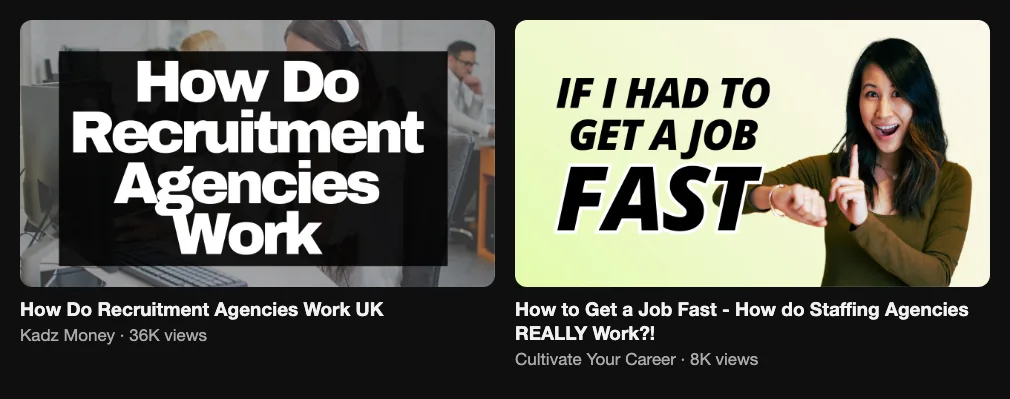
- Reference: How Do Recruitment Agencies Work UK (Kadz Money, 36K views) and How to Get a Job Fast - How do Staffing Agencies REALLY Work?! (Cultivate Your Career, 8K views).
- What to change for you: Explain your own model with your own numbers: how fees work, what a temp worker gets, what happens if a placement leaves early. Being open about money is rare in this industry, and people remember who did it.
Video 2: A recruiter reviews real resumes
- Buyer stage: Not looking yet → has a problem but doesn't see it. Candidate reach: the format with the most views in recruiting.
- The question or objection it answers: “Why am I not getting interviews?”
- Title options: “A Recruiter Reviews Real [Role] Resumes” · “Why This Resume Gets Zero Interviews”
- Thumbnail: A blurred resume with red marks and your face reacting, plus “WHY NO INTERVIEWS?”.
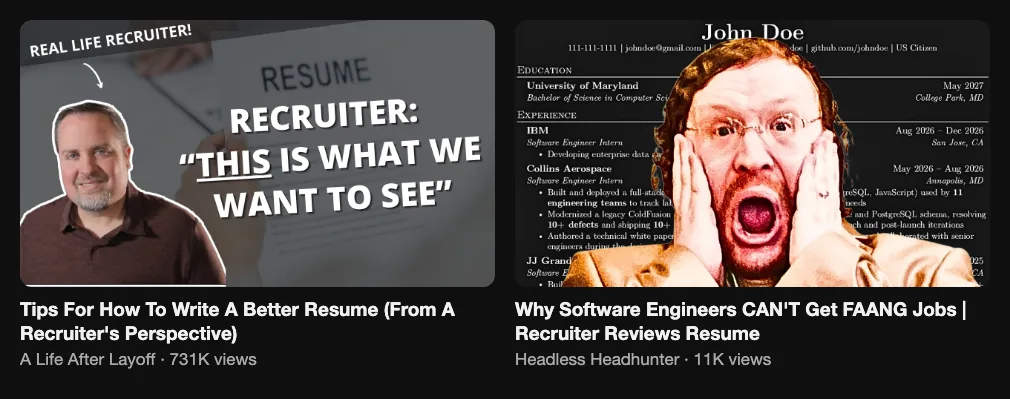
- Reference: Tips For How To Write A Better Resume (From A Recruiter's Perspective) (A Life After Layoff, 731K views) and Why Software Engineers CAN'T Get FAANG Jobs | Recruiter Reviews Resume (Headless Headhunter, 11K views).
- What to change for you: Stay in your niche. Review resumes for the roles you place, with permission and personal details hidden. Each video ends with one line: “send yours, we review the best ones”. That's how you fill your candidate pipeline.
Video 3: Hiring mistakes founders and managers make
- Buyer stage: Has a problem but doesn't see it → knows the problem, not a priority yet. The employer has felt the pain of a bad hire and is looking for the reason.
- The question or objection it answers: “Why do our hires keep failing?”
- Title options: “7 Hiring Mistakes That Cost You a Year” · “5 Biggest Hiring Mistakes [Industry] Companies Make”
- Thumbnail: An empty chair with a red cross and “BAD HIRE?”, or your face and a short “STOP HIRING LIKE THIS”.
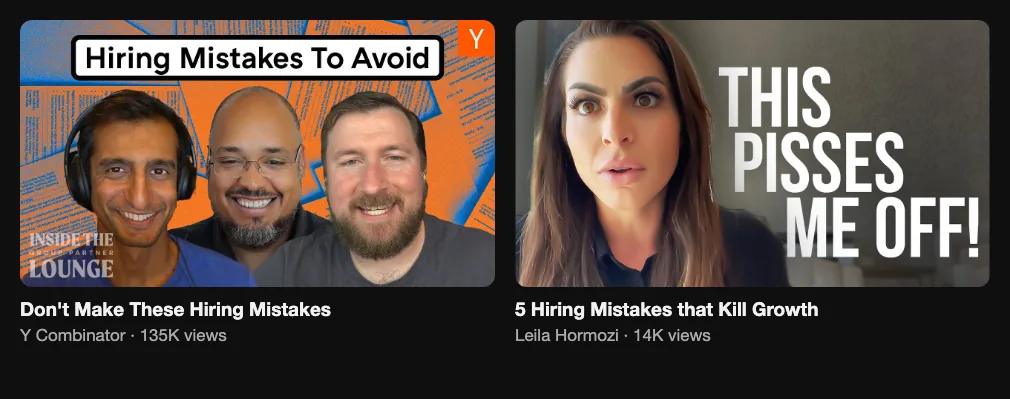
- Reference: Don't Make These Hiring Mistakes (Y Combinator, 135K views) and 5 Hiring Mistakes that Kill Growth (Leila Hormozi, 14K views).
- What to change for you: The second is Leila Hormozi's take for growing companies. Make yours narrower: one industry, one audience. Use real searches you ran, without names: the vague job post, the five-round interview where the best candidate left, the hire made because “he was nice”. Each mistake ends with what you do differently.
Video 4: [Role] salaries in your market this year
- Buyer stage: Has a problem but doesn't see it → looking for a solution. Works for both sides: candidates check their worth, employers check if their offer is too low.
- The question or objection it answers: “What should this role pay right now?”
- Title options: “[Role] Salary Guide 2026: What Companies Actually Pay” · “How to Answer ‘What Are Your Salary Expectations?’”
- Thumbnail: A big salary range in numbers next to the role name, and “2026”.
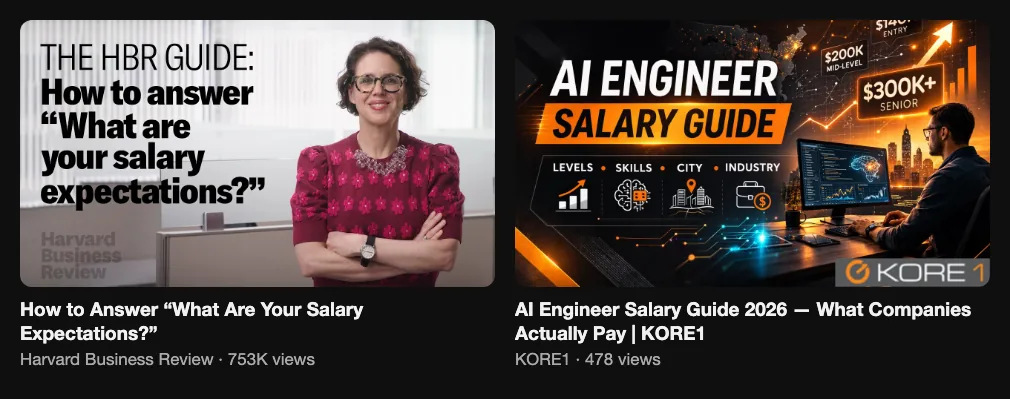
- Reference: How to Answer “What Are Your Salary Expectations?” (Harvard Business Review, 753K views) and AI Engineer Salary Guide 2026 - What Companies Actually Pay | KORE1 (KORE1, 478 views).
- What to change for you: KORE1 is a staffing firm turning its salary data into short videos, one role at a time. Their views are small, but the employer who finds it is the right one. Use your own placement data, and update the video every year.
Video 5: Staffing agency, recruitment agency or in-house: which do you need?
- Buyer stage: Knows the problem, not a priority yet → choosing who to hire. The employer is deciding how to hire and is close to choosing.
- The question or objection it answers: “Why should I pay an agency instead of hiring myself?”
- Title options: “Staffing Agency vs Recruitment Agency: What's the Difference?” · “Agency or In-House Recruiter? An Honest Comparison”
- Thumbnail: Two or three options side by side with ticks and crosses, and “WHICH ONE?”.
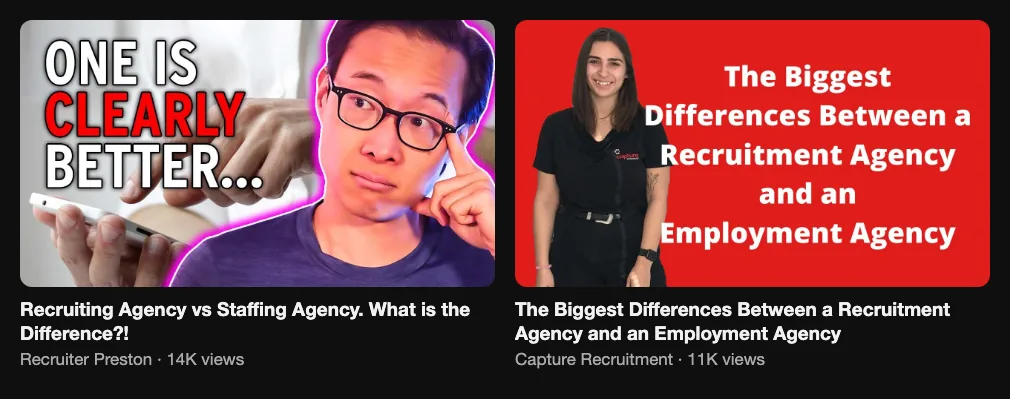
- Reference: Recruiting Agency vs Staffing Agency. What is the Difference?! (Recruiter Preston, 14K views) and The Biggest Differences Between a Recruitment Agency and an Employment Agency (Capture Recruitment, 11K views).
- What to change for you: Say when an employer doesn't need you. A founder hiring one junior role can post a job and run a trial week alone. When the role is senior, rare or urgent, explain what you do that they can't. Employers believe the agency that tells them when to skip it.
What can you do this week to check demand in your niche?
One evening is enough to know if your niche has demand on video and which five videos to film first:
- Search the way both sides would. In an incognito window, type “[role] recruiter”, “[role] salary 2026” and “staffing agency [city]” into YouTube. See who ranks and how many views the top five have.
- Copy the questions. Autocomplete and “People also ask” on Google give you ten questions about fees, salaries and the hiring process. Each is a video.
- Look at local competitors. Search “staffing agency [city]” in Google Maps. Agencies with many reviews are your rivals. Do their recruiters appear on video, or only stock photos of handshakes?
- Find the ceiling. Check the cost of a click for “[role] recruitment agency” in Google Keyword Planner. It shows what one employer inquiry is worth to a competitor who pays for ads.
- Read your last ten client inquiries. Write down the first question and the reason a lead went quiet. The five most common are your first videos.
- Run the break-even. Take your average fee per placement, placements per client per year and a year of content in our break-even calculator. One client often pays for a long time.
After this evening you have a small niche X-ray, a map of both audiences' questions and five videos with real references, which is the work we do in the first two weeks with a new client. If you want a team to plan, film and publish them, here is how our YouTube strategy service works.
A 90-day video plan for a staffing agency
- Month 1: one filming day. The founder on hiring mistakes and how a search works. A recruiter reviewing resumes in their niche, and a salary video. Fix the links in your channel header and LinkedIn profiles.
- Month 2: repeat with new topics from client calls. Cut Shorts from the resume reviews, one fix per clip. Give business development a list: which video answers which objection.
- Month 3: look at which videos clients mention on calls, not which ones got views. Make more of those. Add one client story about a hire, with consent.
Expect a slow start. In our experience with B2B channels, it takes about two to three months from the first batch of videos to the first leads from YouTube. Candidate videos often move faster. The client side is the one that pays.
What should staffing agencies skip?
- Job ads as content. A feed full of “We're hiring a forklift driver!” posts serves nobody after the role is filled.
- Mixing audiences in one video. A video for candidates and employers at once is too vague for both.
- Stock photos and handshakes. Your recruiters are your product. A real face beats any stock image.
- Chasing candidate views only. Big views from job seekers feel good, but they don't sign fee agreements. Track where clients come from.
- Leaning on one star recruiter. If the only face leaves, the channel leaves with them. Film several people from the start.
Recruitment is a trust business on both sides of the table. The agencies that win online are the ones whose recruiters help people in public, show how a search really works and talk honestly about money. Want help with that? We make YouTube channels for B2B service companies.
FAQ
What is staffing agency marketing?
Staffing agency marketing is how a staffing or recruitment firm attracts two audiences: client companies that pay for hires and candidates who fill the roles. Good staffing agency marketing gives each side its own content: hiring advice and market data for employers, job search and salary advice for candidates.
What are the best staffing agency marketing ideas?
Long videos that answer what each side asks: how staffing agencies work and what they cost, hiring mistakes employers make, a recruiter reviewing real resumes, salary guides for your niche, and a comparison of agency, staffing and in-house hiring. Your recruiters on camera turn these into proof that you know the market.
Should a recruitment agency use YouTube?
Yes, especially if it works in a niche with high fees, like engineering, IT, finance or healthcare roles. Employers research before they sign a fee agreement, and candidates search YouTube for resume and salary advice every day. One channel can serve both, with separate playlists.
Should a staffing agency make content for clients or for candidates?
Start with the side that limits your growth. If you have roles but not enough good candidates, make candidate content: resumes, interviews, salaries. If you have candidates but not enough clients, make content for hiring managers and founders: costs, hiring mistakes, how a search works. Most agencies need both over time.
Has Evgeny Maximov's agency worked with staffing agencies?
Not yet. Evgeny Maximov's agency has not had a staffing or recruitment client so far. The closest example is Evgeny's own hiring process, which he published as a video: a job post for about $30 brought about 300 applicants, filters cut them to about 50, portfolios to 10–15, and 2–3 finalists did a paid trial week.
How do staffing agencies get clients?
Through referrals, business development calls, job boards and content that proves market knowledge. Video helps the slow part: a hiring manager who watched your recruiters explain the market and the process is easier to convert when your business development team calls.
How do recruitment agencies attract candidates with video?
With content that helps candidates today: a recruiter reviewing real resumes, interview advice, salary guides for the niche and honest videos about how the agency works. Candidates who learned something from your recruiter are more likely to answer that recruiter's message.
Who should be on camera at a staffing agency?
The founder for opinion videos about the market and the reasons to choose the agency, and recruiters for niche videos: one recruiter per specialty, talking to the candidates and hiring managers they work with every day. Recruiters on camera also help the agency recruit recruiters.
How much does video marketing cost for a staffing agency?
Market prices are roughly $100–250 per long video for a freelance editor, $3,000–10,000 a month for a done-for-you agency and $15,000–25,000 a month for an in-house team. Evgeny Maximov's agency starts from $3,000 a month, with one-off work from $500 and a 7-day money back guarantee.
How long until video brings clients to a recruitment agency?
Videos help business development the day your team starts sending them. Growth from YouTube search is slower: in Evgeny Maximov's experience with B2B channels, plan for about two to three months from the first batch of videos to the first leads from YouTube.
How do I check if there is demand for staffing videos in my niche?
Search “[role] recruiter”, “[role] salary [year]” and “staffing agency [city]” on YouTube and Google Maps in an incognito window. Check the views of the top five videos, whether local agencies have video, the “People also ask” questions and the first questions from your last ten client inquiries.
Founder of a done-for-you YouTube agency for high-ticket founders. Making content since 2014. More about me
Running a staffing or recruitment agency?
We make YouTube channels for B2B service companies. You and your recruiters film one day a month. We do the rest. 7-day money back guarantee.
Get a free niche review →