Marketing for Contractors: How Builders and Renovation Companies Get Clients With Video
Construction is one of the best niches for YouTube I've worked in: expensive decisions, scared buyers, and people who happily watch an hour about bolts. Here's what works for builders and renovation companies, and what's a waste of time.
 By Evgeny Maximov·7 min read·
The client behind this article. Most of the numbers below come from the YouTube channel of our home builder client, «Давай Построим» (“Let's Build”), a Russian-language channel with about 6,400 subscribers. Below you'll find one of its long videos and the channel's top Shorts.
Why construction is one of the best niches for video
My team has worked with home builders and renovation companies, and I review contractors' marketing at my live events. Construction keeps surprising me, in a good way.
Here's why. A house or a full renovation is one of the biggest purchases a person makes. The buyer is scared. Scared of the budget doubling, of a crew that disappears, of cracks in a year, of a house that looks cheap. Scared people research. They read forums, they watch videos, they compare. For weeks.
That's exactly the buyer YouTube serves best. I once found a video about building a house from aerated concrete with about 400,000 views. It had around 200 chapters. Every fifteen seconds: what this costs in this year, what that costs, how this layer goes on. Dry. Detailed. And people watched it, because when you're about to spend your life savings, “boring” is what you want.
And construction never goes out of demand. Houses keep getting built, flats keep getting renovated, people keep being scared of getting it wrong.
The videos construction buyers actually watch
Think in two levels: broad videos that bring new viewers, and deep videos that bring calls.
| Level | Video ideas | Job |
|---|---|---|
| Broad | “5 mistakes that make a house look cheap” · “Floor plans you'll regret” · “What a house really costs this year” · “Things I'd never put in my own bathroom” | reach: homeowners who aren't looking for a builder yet |
| Comparison | “Aerated concrete vs brick” · “Glossy vs matte fixtures: what you'll regret” · “Turnkey vs managing it yourself” | people deciding how to build |
| Process | “How we calculate an estimate” · “A day on our job site” · “How our crew starts a renovation” | trust: people choosing who to hire |
| Proof | “Full tour of a finished house, with the budget” · “Before and after” · “A client tells how it went” | the final push before the call |
Here's an example of a broad video from our client's channel: “Such houses must NOT be built! The worst house layouts that are uncomfortable to live in”. It's in Russian, but you can see the format: one person, a clear promise and a topic every future homeowner has an opinion on.
A renovation contractor I reviewed already had a hit without knowing why: a short list of tips like “glossy black faucets: you'll be wiping them forever”, “no plastic window sills, they look cheap”, “no thresholds between two floor types”. One video like this had about 90,000 views. That's the language buyers respond to: specific, practical, a little opinionated.
For a home builder client of ours, we moved away from ultra-nerdy topics, like an hour on every bolt, toward broader ones: bad layouts, mistakes that make a house look cheap, polycarbonate canopies. Same expertise, wider door.
Do Shorts work for contractors?
Sometimes, very well. That same home builder client: from 6 long videos, we cut 55 Shorts. Usually I don't recommend cutting so many clips from long videos, because the energy is often wrong for Shorts. But he had strong hooks, and it worked. Two Shorts took off right after the first filming day, at about 60,000 and 120,000 views. Today the top of the channel's Shorts looks like this, with the best at 132K, 128K and 103K views. About half of them are cuts from long videos, the rest were filmed as Shorts.
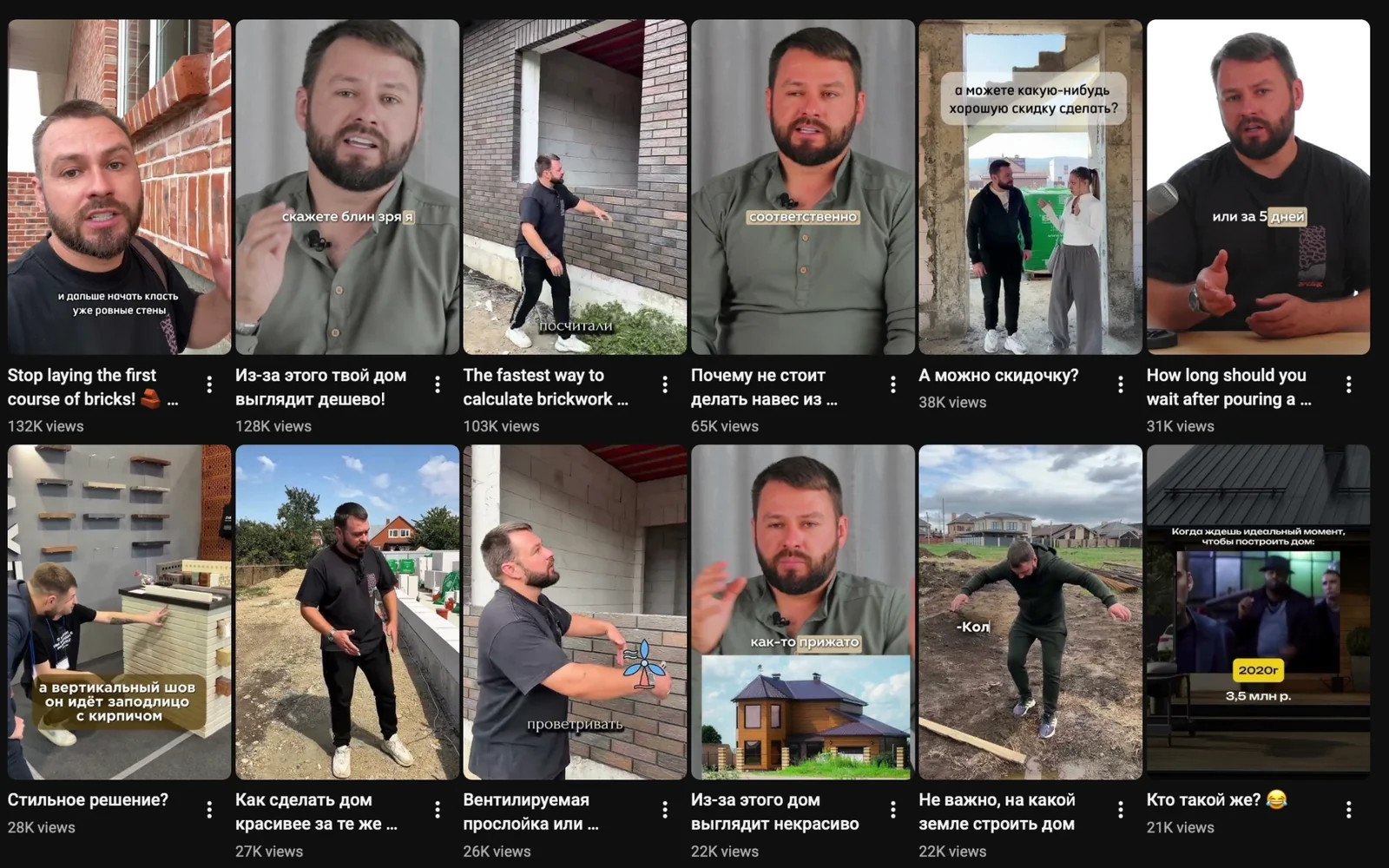
The ones that flew had a simple trigger: regional building habits. “In the south we build like this, in the north like that.” The comments exploded: “In my village we do it differently!” A little debate in a construction video is a gift for reach.
And then there's the other kind of contractor. The renovation owner I mentioned was one of the calmest people I've met. Precise, steady, no jumping around. He was forcing himself to make Reels. One got 15,000 views and about 200 followers. Zero clients. My advice: skip short videos. In a field where mistakes are expensive, calm and detailed is exactly what a buyer trusts, and long videos let him be himself. More in when a founder should skip Shorts.
Your strongest trust signal is the job site
When I asked the renovation contractor how he sells, he described something better than any ad.
A renovation is an expensive purchase. You don't buy a car remotely. So the first thing I do: I take the person to a live job site. They see which crew works there, what order it's in, what quality. They see what they'll get.
On top of that, every client gets an app where the whole renovation lives: photos of hidden work, every purchase from a big order to a small bag of screws. The client can check everything from their phone.
That's transparency, the thing every renovation client is most afraid of not getting. I asked the room: who likes “come see a live job site” more than “let's have a chat”? Every hand went up. And none of it was in his social media. His feed was tips about faucets.
So film it. A walk through a live site. The app on screen. A client opening it and reacting. This is the content that sells a contractor, because it shows the thing buyers can't easily check: how you work when nobody is watching.
Designers: your long-term partners
Homeowners buy a renovation once, maybe twice in a lifetime. Interior designers send projects for years. That's why many contractors want designers more than direct clients.
The contractor ran events for designers: free, useful, with good speakers. Then he took them to his job sites. It worked, with one catch he described perfectly: out of a hundred designers, about ten kept sending work, and only while he stayed in touch. Events, gifts, congratulations. “You stop warming them up, and it stops working.”
If designers are your main channel, content's job changes. It's not about reach anymore. It's about keeping designers close: job-site photos, before and after, your process, proof that their clients will be in good hands. My advice to him: forget the reach, post the real work, and run smaller events more often, even once a week for 10–30 people. And get an assistant to handle the designer relationships, because the owner can't do sales, crews and partners alone.
Profile basics most contractors miss
The same contractor had about 90 videos on YouTube, one with nearly half a million views. People called him from other cities. And the channel had no links. No website, no WhatsApp, no Telegram.
- Links in the YouTube channel header and Instagram bio: website, WhatsApp, booking. People from Shorts can't copy links from descriptions.
- A bio with an outcome, not a job title: not “renovation and finishing”, but “your renovation on time, every stage in your phone”.
- Your price level visible: “from $X per square meter” filters the wrong leads.
- Before and after on every project post. If it's a render, say so.
- One call to action everywhere: book a site visit.
The full checklist is in the social media audit.
Which 5 videos can a contractor or home builder film this month, with proven references?
Here are five videos you can take into production now. For each one there is a real video that already got views from homeowners, with its packaging on screen. They are not here to be copied. They show that the topic works and what people click, so you can build your own title, thumbnail and angle.
The steps come from the Buyer Ladder, the model we use for content plans in The Trust Engine course (free document). Views are YouTube data on 22 October 2026. They show demand, not how many clients each video brought. References come from US and Australian builders and creators. The costs and rules differ in your area, so use the format, not the numbers.
Video 1: Bad layouts and features homeowners regret
- Buyer Ladder step: 1 to 2. A broad topic everyone has an opinion on, which brings people who are not planning to build yet.
- The question or objection it answers: “What will I regret if I build or buy this?”
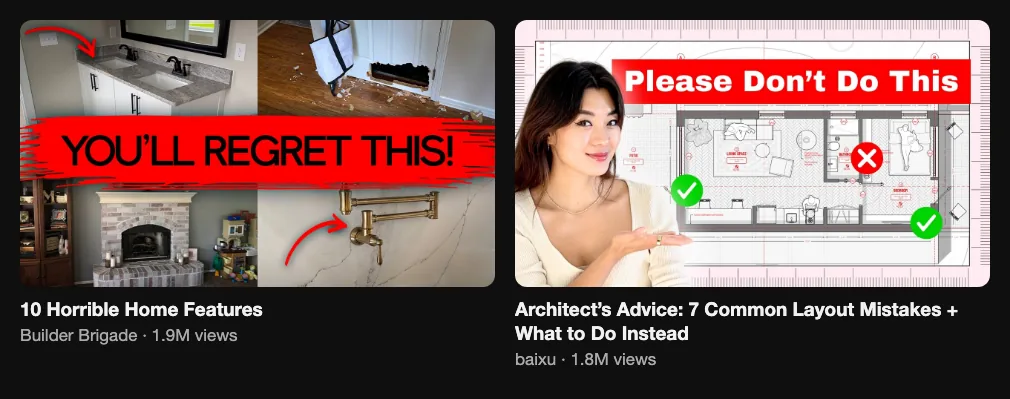
- Title options: “10 Horrible Home Features You’ll Regret” · “7 Layout Mistakes in New Homes: A Builder Explains”
- Thumbnail: A red banner with “YOU’LL REGRET THIS!” over two or three real photos, or a floor plan with a green tick and a red cross and a short “PLEASE DON’T DO THIS”.
- Reference: 10 Horrible Home Features (Builder Brigade, 1.9M views) and Architect’s Advice: 7 Common Layout Mistakes + What to Do Instead (baixu, 1.8M views).
- What to change for you: One of our home builder clients got his top performing video from this idea. Competitors made hour-long videos about every detail of the build, and we moved him to bad house layouts people argue about. People commented “in my village we build it like this!”. Use floor plans from your own projects and, with permission, real listings.
Video 2: What it really costs to build a house, line by line
- Buyer Ladder step: 4 to 5. The viewer is planning and wants to know the number before calling.
- The question or objection it answers: “How much will my house cost, and where does the money go?”
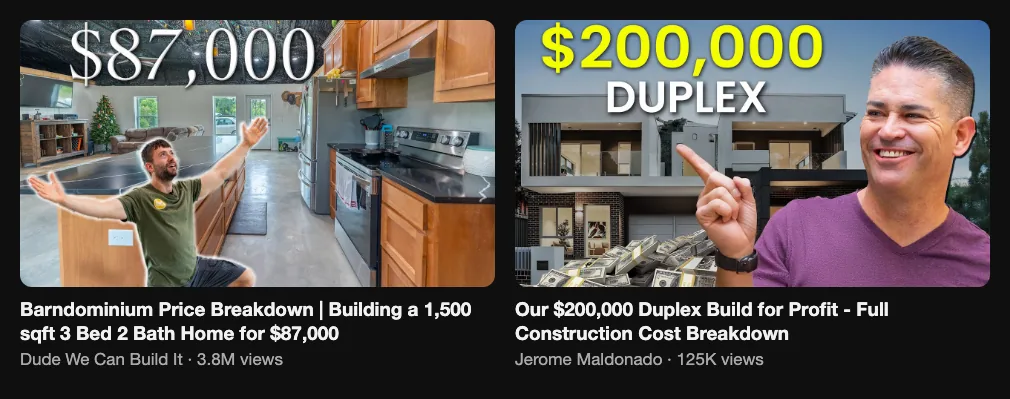
- Title options: “Building a 1,500 Sq Ft Home for $[Price]: Full Cost Breakdown” · “Our $200,000 Duplex Build: Every Cost Explained”
- Thumbnail: The total price in huge numerals over a photo of the finished build, and the person pointing at it.
- Reference: Barndominium Price Breakdown | Building a 1,500 sqft Home for $87,000 (Dude We Can Build It, 3.8M views) and Our $200,000 Duplex Build for Profit - Full Construction Cost Breakdown (Jerome Maldonado, 125K views).
- What to change for you: Take a finished project with the owner’s consent and break it down: land, foundation, framing, finishes, extras. People who see real numbers from you arrive at the call with realistic expectations, and the ones who can’t afford it leave before wasting your time.
Video 3: How to hire a contractor and the red flags
- Buyer Ladder step: 3 to 5. The viewer has a project and is afraid of choosing the wrong person.
- The question or objection it answers: “How do I know a contractor won’t disappear or overcharge me?”
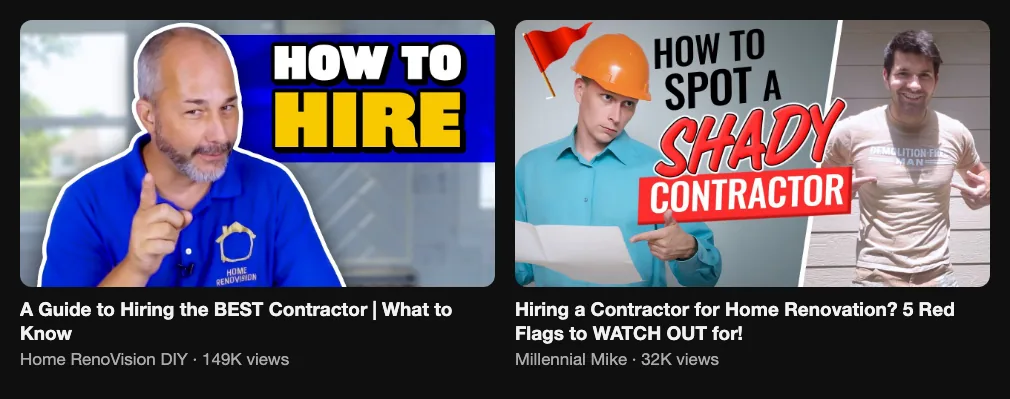
- Title options: “How to Hire the Best Contractor: What to Ask Before You Sign” · “5 Red Flags of a Shady Contractor”
- Thumbnail: You in work clothes pointing at a word like “HIRE”, or a hard hat, a red flag and “HOW TO SPOT A SHADY CONTRACTOR”.
- Reference: A Guide to Hiring the BEST Contractor | What to Know (Home RenoVision DIY, 149K views) and Hiring a Contractor for Home Renovation? 5 Red Flags to WATCH OUT for! (Millennial Mike, 32K views).
- What to change for you: Write the checklist you would want a client to use on you: license, insurance, contract, payment schedule, references. Clients compare you to that list, and you pass it.
Video 4: Renovation regrets: the mistakes I see on every job
- Buyer Ladder step: 2. The homeowner is about to renovate and doesn’t know what they’ll regret.
- The question or objection it answers: “What do people wish they’d done differently?”
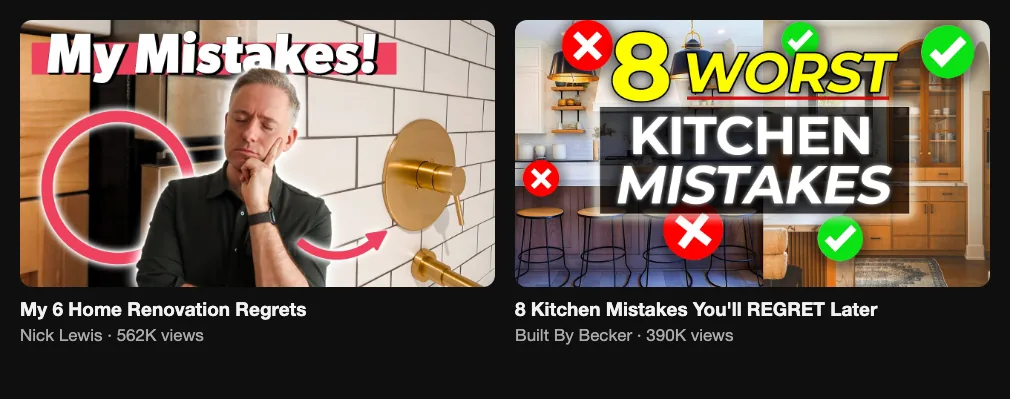
- Title options: “My 6 Home Renovation Regrets” · “8 Kitchen Mistakes You’ll Regret Later: A Builder’s List”
- Thumbnail: A pained or thinking face next to one detail photo and a short phrase, “MY MISTAKES!”. The other uses a green tick and red crosses on a kitchen.
- Reference: My 6 Home Renovation Regrets (Nick Lewis, 562K views) and 8 Kitchen Mistakes You’ll REGRET Later (Built By Becker, 390K views).
- What to change for you: Pick the room you renovate most, like the kitchen or bathroom, and show photos of real mistakes from other people’s jobs, never from your clients. Add what it costs to fix each one.
Video 5: The step-by-step timeline of building a house
- Buyer Ladder step: 4. The viewer is serious and wants to see the process and how long it takes.
- The question or objection it answers: “How long does it take, and what happens at each stage?”
- Title options: “The Steps and Timeline to Build a House, From Permit to Move-In” · “Building a Home Start to Finish: A 12-Month Timelapse”
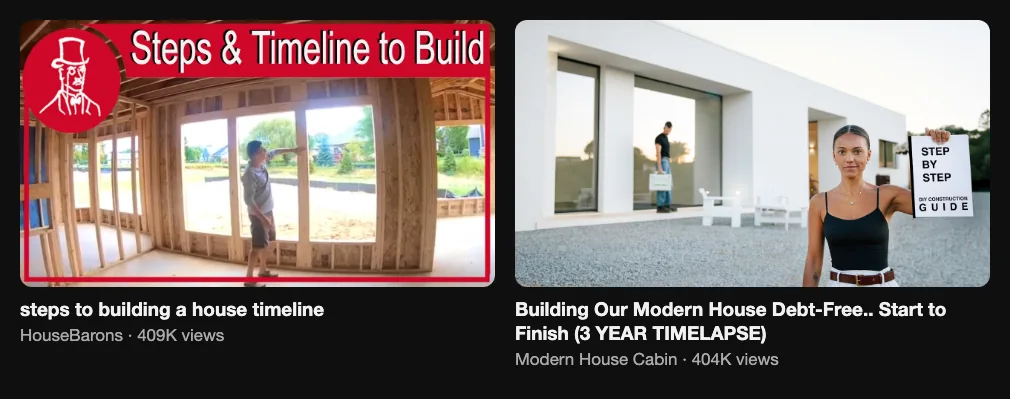
- Thumbnail: A real stage of the build, like framing, with a short label, “STEPS & TIMELINE TO BUILD”, or a step-by-step guide held in the hand.
- Reference: steps to building a house timeline (HouseBarons, 409K views) and Building Our Modern House Debt-Free.. Start to Finish (3 YEAR TIMELAPSE) (Modern House Cabin, 404K views).
- What to change for you: Film your next job at four moments and publish the timeline as one video. The same footage becomes Shorts for each stage. The job site is your strongest trust signal, as the sections above explain.
What can you do this week to check demand in your area?
One evening is enough to know if your service has demand and which five videos to film first:
- Search the way a homeowner would. In an incognito window, type “build a house [city]”, “home builder [city]” and “kitchen renovation cost [city]” into YouTube. See who ranks and how many views the top five have.
- Copy the questions. Autocomplete and “People also ask” on Google give you ten questions about price, time and risks. Each is a video.
- Look at local competitors. Search “home builder [city]” in Google Maps. Builders with many reviews are your rivals. Do they have video, or only photos?
- Find the ceiling. Check the cost of a click for “home builder [city]” in Google Keyword Planner. It shows what one inquiry is worth to a competitor who pays for ads.
- Read your last ten inquiries. Write down the first question and the reason a lead went quiet. The five most common are your first videos.
- Run the break-even. Take your average project margin and a year of content in our break-even calculator. One project often pays for a long time.
After this evening you have a small niche X-ray, a homeowner question map and five videos with real references, which is the work we do in the first two weeks with builders. If you want a team to film and publish them on your job sites, here is how our YouTube strategy service works.
A 90-day video plan for a contractor
- Month 1: one filming day, half on a live site, half talking to camera. Four long videos: one broad (“mistakes that make a house look cheap”), one comparison, one process (“how we calculate an estimate”), one project tour. Fix links and bio everywhere.
- Month 2: repeat. Start cutting Shorts from the strongest moments if the owner's energy fits. Send process videos to every new lead before the site visit.
- Month 3: look at which videos leads mention on calls, not which ones got views. Make more of those. Add one client story.
Expect a slow start. The first two or three months are an investment, though Shorts can sometimes take off earlier. The bigger payoff comes when your long videos start showing up in search for “how much does it cost to build a house” in your region.
What to skip
- Trends that don't fit the owner. Dancing on a construction site gets views from people who will never hire you.
- Cheap guarantees. Anyone promising a stream of leads for a small monthly fee is selling fake views.
- Doing everything yourself. Construction is a hard business: lost tiles, wrong deliveries, endless calls. Adding content production on top is how owners burn out. Delegate it, or wait until you can.
- Mixing audiences in one feed. If designers are your channel, don't fill the feed with homeowner tips, and the other way around.
Construction rewards patience and transparency. The contractors who win online are the ones who show their work honestly, in detail, for long enough that a scared buyer feels safe. Want help with that? We make YouTube channels for businesses with high-ticket services.
FAQ
What is the best marketing for contractors?
For builders and renovation companies with big tickets, the strongest mix is referrals from partners like interior designers, long videos that answer buyers' fears about cost and quality, and showing real job sites. Evgeny Maximov's agency has worked with home builders and renovation companies, and long practical videos consistently bring better leads than trendy clips.
Should contractors use YouTube?
Yes, if they build or renovate at a mid to high price point. Construction buyers research for weeks because a mistake costs thousands, and they watch long, detailed videos. A video about building a house from aerated concrete with about 400,000 views and around 200 chapters shows how much depth this audience wants.
What videos should a home builder make?
Videos that answer what buyers are afraid of: what a house really costs this year, mistakes that make a house look cheap, bad floor plans, materials compared, how an estimate is calculated, how the crew works on site, and full tours of finished projects with the price.
Do Shorts work for construction companies?
They can. A home builder client of Evgeny Maximov's agency got 55 Shorts from 6 long videos, and the best of the channel's Shorts have passed 100,000 views, with the top one at 132,000. Half of the top Shorts are cuts from long videos. The ones about regional building habits that started debates in the comments did especially well. Shorts work best when the speaker has energy; calm speakers do better with long videos.
How do renovation companies get clients from interior designers?
By building real relationships: useful events for designers, visits to live job sites, regular contact and a clear partner reward. A renovation contractor Evgeny Maximov reviewed found that out of a hundred designers met, about ten kept sending work, and only while he stayed in touch.
How can a contractor build trust before the first meeting?
Show the process, not just the result. Take serious leads to a live job site, film how the crew works, explain how estimates are calculated, and show transparency tools like an app where the client sees every stage and receipt. Long videos let buyers check all this before they call.
How much should a contractor spend on video marketing?
If you can't put at least $1,000–2,000 a month into content for a year while expecting little at first, start with partners and referrals instead. One renovation project can be worth tens of thousands of dollars, so one client from content can pay for months of production.
Should a contractor make content for homeowners or for designers?
Decide the main goal first. If designers bring your best projects, content's job is to keep designers close: job-site photos, before and after, your process. If you want direct homeowner leads, make long videos on homeowners' questions. Trying to do both in one feed usually serves neither.
What should contractors avoid in their marketing?
Empty profiles without links, trendy clips that don't match the owner's personality, guarantees of views or leads from cheap freelancers, and doing everything alone. The owner of a construction business usually doesn't have time to run content as well as sales and crews.
How long until video brings clients to a construction company?
Plan for a slow first two to three months. Some Shorts can take off after the first filming day, but steady leads from long videos usually build over several months as the videos start showing up in search.
What YouTube videos should a contractor make first?
Start with what homeowners fear and ask: layouts and features they regret, what a house really costs, how to hire a contractor, renovation mistakes and the build timeline. Film them on real job sites and use real numbers from finished projects.
How do I check if there is demand for contractor videos in my area?
Search your service with your city in YouTube and Google Maps in an incognito window. Check the views of the top five results and whether local builders have video. Copy the “People also ask” questions and list the first questions from your last ten inquiries.
Founder of a done-for-you YouTube agency for high-ticket founders. Making content since 2014. More about me
Building or renovating at a high price point?
We make YouTube channels for construction and renovation companies. You film one day a month, on site or in the office. We do the rest. 7-day money back guarantee.
Book a call →