B2B Marketing Strategy for Professional Services Firms: Five Choices and a 12-Month Roadmap
A plan says what you will do this quarter. A strategy says what you will choose, and what you will refuse. Here are the five choices a B2B services firm has to make, how to cover buyers who are ready now and those who are not, and what a year looks like.
 By Evgeny Maximov·9 min read·
What is a B2B marketing strategy, and how is it different from a plan?
I see founders mix three things. They write a list of tactics ("start a podcast, post on LinkedIn, go to two events") and call it a strategy. A strategy sits above that. It decides what is worth doing at all.
| Strategy | Plan | Tactics | |
|---|---|---|---|
| Question | What do we choose, and what do we refuse? | What do we do in the next 90 days? | How exactly do we do each thing? |
| Horizon | 12 months, reviewed every quarter | 13 weeks | this week |
| Example | "We serve mid-size manufacturers with a cost problem, and win by proof, not price" | "Film four long videos, hold 10 calls with the target list" | "Record on Tuesday, send the video after the call" |
| Where to read more | this article | marketing plan for a service business | the guides on each channel |
This article covers the first column. For the second, use the 90-day plan. For a content-only version, see B2B content marketing strategy.
How do B2B buyers of professional services actually buy?
A strategy should start from the buyer, not from your channels. Four facts help me.
- They research alone first. Gartner's survey of 632 B2B buyers, reported in June 2025, says 61% prefer a rep-free buying experience, and 73% actively avoid suppliers who send irrelevant outreach.
- A group decides. Forrester's 2026 report says on average 13 internal stakeholders and nine external participants influence a B2B purchase. Generative AI tools were the most cited way buyers researched in its 2025 survey. A services deal has fewer people, but the logic holds.
- Expertise matters most. In Hinge's 2018 study of 1,475 buyers, relevant experience and expertise had become the top selection criteria. Hinge also warned that referral-only marketing is risky. The study is from 2018, so I read it as a direction.
- Most are not buying today. The LinkedIn B2B Institute's team says about 5% of B2B buyers are in the market at any moment. The other 95% will be, later.
Sources, checked in October 2026: Gartner press release, 25 June 2025 (August–September 2024 survey); Digital Commerce 360 on Forrester, 22 January 2026 (I did not see the Forrester report itself); Hinge Research Institute, a marketing firm for professional services; Marketing Week on the 95:5 rule.
Put these together and you get three audiences for the strategy: the few ready now, the many not ready yet, and the group of people around each buyer. The strategy must serve all three.
What are the five choices of a B2B strategy for a services firm?
Here they are, each with the question and an example of a decision. The example is made up for illustration. It is not a client.
| Choice | The question | Example decision (a made-up IT advisory firm) | More on it |
|---|---|---|---|
| 1. Where to play | Which buyers, and which not? | mid-size logistics firms with 200–1,000 staff; no public sector | ideal customer profile, niching down |
| 2. What you promise | Why you, in the buyer's words? | "We cut migration risk before you sign a vendor" | value propositions |
| 3. How you prove it | What does a stranger see before the call? | 3 case pages, 2 video testimonials, 4 long videos on real decisions | client testimonial video |
| 4. Where you show up | Which two or three channels? | referrals and partners (warm), long video (trust), a target list of 30 firms (accounts) | lead channels, ABM |
| 5. What you can deliver | How many clients can we serve well? | 8 new clients a year; the cost to win one stays under a set limit | acquisition cost |
The fifth choice is the one people forget. Marketing can bring more demand than you can serve. Then the best clients wait, the quality drops, and referrals dry up. Decide a ceiling.
Write the no-list too. Segments you will not serve, channels you will not run, promises you will not make. It saves more time than the yes-list.
How do you split effort between buyers ready now and buyers ready later?
This is the hardest strategic call. Binet and Field's well-known 60:40 split between brand and activation was built mostly on consumer advertising cases. For B2B I did not find one agreed ratio, so I won't give you one. Instead, give each group its own job and its own number.
| Who | What they need | Assets | Number to watch |
|---|---|---|---|
| Ready now (about 5%) | an easy way to talk to you and quick proof | booking page, case pages, outreach to a target list | calls booked, proposals sent |
| Not ready yet (about 95%) | to remember you, and to learn from you | long videos, a podcast, talks, a useful guide | returning viewers, how leads heard about you |
| The group around the buyer | a way to check you without a meeting | a library they can watch alone | "I already watched your videos" on calls |
If you only serve the ready 5%, you fight on price and speed. If you only serve the 95%, you have a nice audience and no calls. For the difference between the two, see demand generation vs lead generation. For money, see how much to spend on marketing.
What does a 12-month roadmap look like?
I plan in quarters, because a content channel needs about three months before it shows anything.
| Quarter | Focus | Main outputs | Decision at the end |
|---|---|---|---|
| Q1 | Foundation | five choices written; no-list; 3 proof items; booking page with "how did you hear about us?" | Is the buyer clear? |
| Q2 | Warm channel and first library | asks to best clients; first 12 long videos or a podcast season; a call after each lead | Do leads mention the videos? |
| Q3 | Scale what works | more of the best formats; account list if it fits; a video for each common objection | Which source gives the best clients? |
| Q4 | Review and reset | cost per client by source; client cases for next year; update the no-list | What do we stop, keep and add? |
Each quarter ends with a decision, not a report. Keep the review to one page. If you want the weekly version of Q1 and Q2, the 90-day plan has it.
Where does video fit in a B2B services strategy?
I see video as two things: a trust layer for people who don't know you yet, and a sales asset for the sales conversation. It is not the whole strategy.
- Tvoy Sklad, a self-storage franchise we have worked with since 2022. The founder, Dmitry Rindevich, shows the financial models himself in videos and live streams. In 2024–2025 the company attracted about $5M in investments and 20+ franchise partners. Videos mostly have 2,000–20,000 views, and partners often arrive saying they have watched everything. Full case.
- Freshcode, an app development company. We produced their video podcast "Clojure in product. Would you do it again?" with developers from companies like The New York Times, Metabase and Dentons. It is a relationship tool for a technical B2B audience, not a reach tool, so I don't quote views.
- Rating Up, an online reputation management company led by Bogdan Belokon. They publish long, documentary-style videos. The lesson from that project: we published too little, and frequency is a condition of the result. A strategy that asks for a weekly rhythm must check that the firm can keep it up for a year.
Where video does not help: it won't fix an unclear offer, and it won't replace referrals. Long videos work as a sales asset when the sales team uses them. Read five videos your sales team will use. Also keep in mind that only 10–20% of viewers watch to the end, so your next step must also appear in the middle of the video.
How do you measure a strategy, not just tactics?
Tactics have weekly numbers: videos published, messages sent, calls booked. A strategy has a few yearly outcomes. I would watch these five:
- Qualified calls per quarter, and how many came from the target segment.
- Proposals sent and clients signed.
- Average deal size against last year.
- Cost to win a client, by source, with your time counted. Use the acquisition cost guide.
- What leads say when you ask "How did you hear about us, and what did you see first?" We ask this in our own Calendly form and ask our clients to ask it of their leads.
For the full list of numbers and what to ignore, see marketing KPIs for service businesses and attribution. Views show demand, not how many clients a video brought, so keep them out of the yearly outcomes.
What mistakes sink a B2B services strategy?
- No no-list. Every segment and every channel stays open.
- A strategy made of tactics. It lists things to do and no reasons.
- Too many channels. More than three channels with one owner usually means none works.
- Only the ready 5%. The firm lives on outreach and price.
- No capacity limit. Demand arrives, delivery suffers.
- Judging after 30 days. Content and trust take a quarter or more.
- Hired a strategy, not the work. A deck from an agency with no one to run it. If you plan to hire help, read how to choose a B2B marketing agency and fractional CMO vs agency.
Which real videos explain B2B marketing strategy for services?
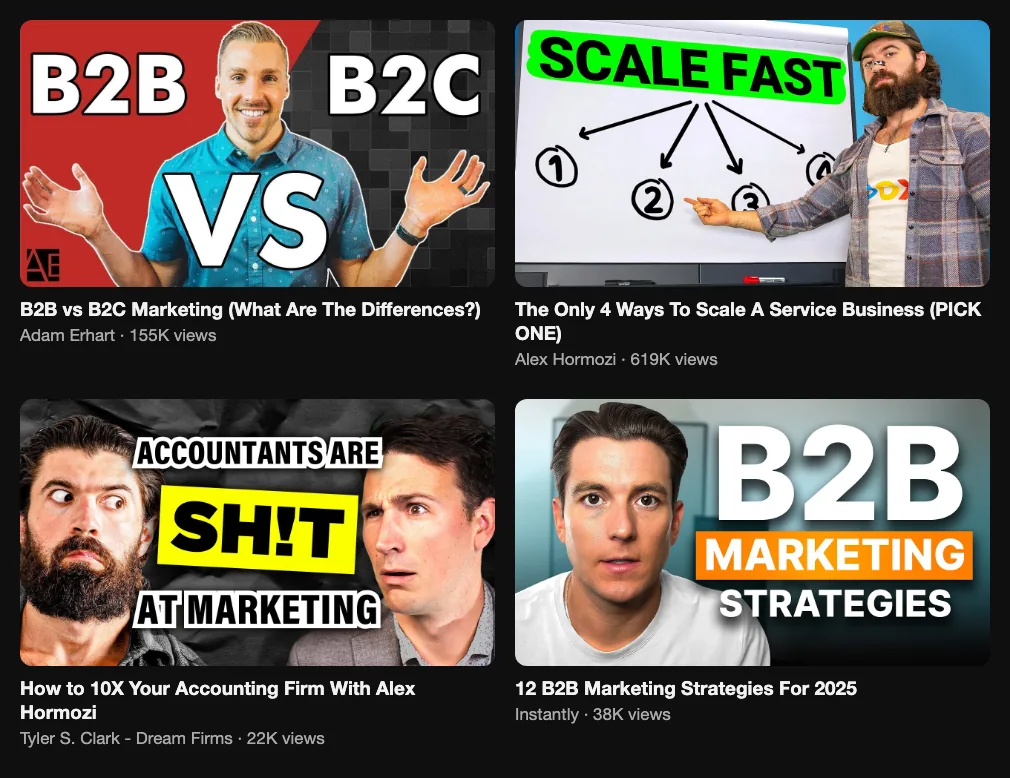
I looked for English-language videos on B2B marketing and on growing a professional services firm. Views show demand for the topic. They don't show how many clients a video brought. Data is from YouTube on 27 October 2026.
- B2B vs B2C Marketing (What Are The Differences?) (Adam Erhart, 155K views). Why B2B buying is slower, involves more people and runs on trust, explained simply.
- The Only 4 Ways To Scale A Service Business (PICK ONE) (Alex Hormozi, 619K views). A strategic choice: pick one way to grow and do it.
- How to 10X Your Accounting Firm With Alex Hormozi (Tyler S. Clark, Dream Firms, 22K views). A professional services firm, a clear growth model.
- 12 B2B Marketing Strategies For 2025 (Instantly, 38K views). A list of channels. Instantly sells cold email software, so it leans toward outbound.
Honest note: these are business educators and a software vendor. I found no large English video from a professional services firm that explains its whole B2B strategy. That gap is one reason I write these guides.
If the trust layer is the part you want help with, our done-for-you YouTube service builds it: you film one day a month, we do the rest. We start with a YouTube strategy that fits the five choices above. For the other professions and their plans, see the professional services marketing hub.
FAQ
What is a B2B marketing strategy for professional services?
It is a set of choices about who you serve, what you promise, how you prove it, which channels you use and how much work you can deliver. A plan lists the activities. A strategy decides which activities are worth doing and which you will not do. For a services firm it is usually two or three pages, reviewed every quarter.
What is the difference between a marketing strategy and a marketing plan?
The strategy answers "what do we choose and why" and covers a year or more. The plan answers "what do we do each week" and covers 90 days. If you only have a plan, you do many things without a reason. If you only have a strategy, nothing gets done. You need both, and the strategy comes first.
How do B2B buyers choose a professional services firm?
They research alone first and ask people they trust. Gartner's 2025 survey of 632 B2B buyers says 61% prefer a rep-free buying experience. Hinge's 2018 study of 1,475 buyers found that relevant experience and expertise became the top selection criteria. Several people usually influence the choice, so more than one person needs to trust you.
How many channels should a professional services firm use?
Two or three. One warm channel such as referrals or partners, one channel that builds trust with strangers such as long video, a podcast or talks, and, if you have a short list of target companies, an account-based approach. More channels than you can run well produce weak results in all of them.
Should a B2B services firm focus on brand or lead generation?
Both, in a different mix. The LinkedIn B2B Institute's team says only about 5% of B2B buyers are in the market at any time. Lead generation catches that 5%. Brand and trust work reach the other 95% before they need you. Sources disagree on the best budget ratio, so test your own instead of copying one.
How does video fit into a B2B marketing strategy?
Video is the trust layer and a sales asset. A long video lets a buyer, and the people around the buyer, watch an expert explain how they think before any call. Evgeny Maximov's agency builds this for founders and experts. Video does not replace referrals and it does not fix a weak offer.
How long does it take for a B2B marketing strategy to work?
Expect a full year to judge it. Referrals and direct outreach can bring calls in weeks. Content channels usually have a slow first quarter and then compound. Review every quarter, and change one thing at a time so you can see what moved the result.
How much should a professional services firm spend on marketing?
There is no single number. It depends on your deal size and growth goal. Start from the value of one client and the number of clients you want, then work backwards. Our guide to marketing budgets has a method, and the break-even calculator helps with video.
What should the strategy say no to?
Segments that pay badly, channels you can't keep up for a year, services that don't fit your best clients and promises you can't prove. The no-list saves more time than the yes-list. Write it down and show it to your team.
Does Evgeny Maximov's agency build B2B marketing strategies?
The agency builds YouTube channels, podcasts and short clips for founders and experts with high-ticket services, and it starts with a strategy for the channel. It does not run paid ads or manage ad accounts, and it does not promise views, calls or leads. The only guarantee is 7 days of money back.
How do I measure a B2B marketing strategy?
Look at a few outcomes every quarter: qualified calls, proposals, signed clients, the share of clients from your target segment and how leads say they heard about you. Do not judge by views or followers alone. Views show demand, not how many clients a video brought.
Do I need account-based marketing in my strategy?
Only if you can name a limited number of target companies and each deal is large. In that case it is a strong part of the strategy. If you sell to thousands of small firms, wider channels fit better. Our account-based marketing guide explains how to start with a spreadsheet.
Founder of a done-for-you YouTube agency for high-ticket founders. Making content since 2014. More about me
Want the trust layer of your strategy handled?
You film one day a month. We plan, edit, publish and cut Shorts, so buyers and their teams can watch you work before the call. 7-day money back guarantee.
Get a free niche review →