Marketing Attribution for Service Businesses: Ask, Then Track
Your analytics says a client came from Google or "direct". The client says she watched you for a month and heard about you from a friend. Here is how to see the real path with one question, a few tagged links and a weekly 15-minute check.
 By Evgeny Maximov·9 min read·
What is marketing attribution, and why does it matter for a service business?
Attribution answers one question: which of my marketing efforts brought this client? You need the answer for money decisions. If you know that podcasts and referrals bring your best clients, you put more time there. If you don't, you spend on whatever looks busy.
Most articles on this topic are written for online stores. A store has a checkout page, so software can follow a click to a sale. A service business is different. The deal happens on a call, and often after several calls. The software sees the booking and loses the rest. That is why I teach a simpler order: ask first, track second.
I'm not saying tools are useless. I'm saying a service business with a handful of calls a month gets more from a good question than from a dashboard. I covered the video version of this in YouTube ROI: how to track which video brought a client. This article is broader: all channels, not only video.
Why does last-click lie for long B2B sales?
Because the buyer does most of the work before you know they exist. Before they talk to a supplier, buyers can spend time reading, watching, asking colleagues and comparing options. Your analytics sees only the last few minutes of it.
A typical path for a high-ticket service looks like this:
- A friend mentions your name in a private chat.
- The buyer finds a podcast episode or video where you talk.
- A week later, they read an article on your site.
- They search your name and click your site.
- They book a call.
Analytics records step four or five: "Google" or "direct". The friend, the podcast and the video get zero credit. Google Analytics 4 makes it harder: since November 2023 it offers only data-driven and last-click models, and the first-click, linear, time-decay and position-based models were removed.
There is a public example of the gap. Refine Labs, a B2B marketing consultancy, compared two sources on 620 conversions. Its software credited web search with 78% of conversions. Customers who were asked named web search about 12% of the time, and named social media, podcasts, word of mouth and communities for about 85%. On closed deals the gap was even wider. This is one vendor's data from software companies, so I read the exact numbers as direction only. But the direction matches what I see: the sale happens in places the dashboard cannot see.
Source: Refine Labs, "The Attribution Mirage" (an analysis of 620 conversions, published October 2024). It sells attribution consulting and the sample is its own US software clients. Checked in October 2026.
What is self-reported attribution and how do you do it?
You ask people. That is all. The most common form is one field on the booking form: "How did you hear about us?"
We do this in our own Calendly form. And when we work with a client, we ask them to ask their own leads the same question, on the form and on the first call. Tvoy Sklad, a self-storage franchise we have worked with since 2022, is a good example. New partners often arrive at a call saying they have "already watched everything". That sentence is attribution data, and software never sees it.
Here's how to set it up:
- Use open text. Let people write in their own words. You will learn about a podcast or a person you never thought of. If you also want a list, put it next to the box.
- Ask again on the call. "What made you book today? What did you read or watch first?" People remember the thing that convinced them, and the call is when they tell the story.
- Write the answer in the CRM in a field you can sort, next to the deal. One line is enough.
- Group answers once a week. "My friend Anna" goes to referral. "I saw you on a podcast" goes to podcast. Keep your categories short.
- Don't make the field required. A forced answer is a random answer.
We use this question to decide what to film, too. If many leads say they saw a certain video, we make more videos like it.
When do UTM links help?
UTM links tell you which link was clicked. You add a tag to the end of a URL, and your analytics or booking tool records it. Calendly, for example, records UTM data for bookings made through a tagged scheduling link, and you can filter your meetings by it. Check your plan, because some Calendly features depend on it.
UTM links work best where you control the link: a description under a video, a pinned comment, an email signature, a newsletter, a LinkedIn post, a slide at a talk. Olly Richards, who teaches business YouTube, uses a separate UTM link for every video so that every lead and sale can be traced back to one video. It is the same idea, and for a channel with many videos it is a good habit.
A simple naming rule keeps the data clean:
| Parameter | What to put | Example |
|---|---|---|
| utm_source | the platform or place | youtube, linkedin, email, podcast |
| utm_medium | the type of content | video, post, newsletter, talk |
| utm_campaign | the piece, with a date or code | 26-10-pricing-video |
| utm_content | where the link sits | description, pinned-comment, signature |
UTM links have a clear limit. They only count people who click. A buyer who watches your video, then types your name into Google, leaves no tag. That person is exactly why you need the question as well.
Which attribution method shows what, and what does it miss?
Each method answers a different question. Use two or three together, so that one covers the blind spot of another.
| Method | What it shows | What it misses |
|---|---|---|
| Analytics, last click (for example GA4) | the last source before a visit or booking | everything earlier: videos, podcasts, friends. Many of these show up as "direct" |
| UTM links | which exact link, post or video was clicked | people who do not click and search your name instead; links copied without tags |
| "How did you hear about us?" on the form | what the lead remembers, in their words | touches they forgot; they may name only the latest; some skip it |
| A question on the call | the story of what convinced them, and what they watched | needs a person who asks and writes it down every time |
| Source field in the CRM | the first or main source per deal, over months | it is only as good as what people enter |
| Attribution software (Hyros, for example) | the full click path when a sale happens online | decisions made on calls and by word of mouth; costs money and setup |
On that last row: we use Hyros with one client who sells an online course. It showed that about 15 Shorts from one filming session brought a course sale. That works because the sale happens on a checkout page, and software sees the path. For a founder who sells on a call, it sees about half of the story. How we split the work with clients: we put tags on the links, and the client keeps their own tools.
How do you set up attribution in an afternoon?
Here is the version I would build for a consultant or a clinic with 5–30 calls a month.
- Add the question to the booking form. "How did you hear about us?" Open text, optional.
- Add a "Source (their words)" field and a "Source (category)" field to your CRM. A spreadsheet works too. Add the deal value in the same row.
- Tag the links you control. Descriptions, signatures, newsletter and post links get a UTM tag. Keep a one-page list of the tags you used, so names stay consistent.
- Ask on every call. Two questions: "What made you book today?" and "What did you see or read first?" Write the answer in two lines.
- Review once a week for 15 minutes. Put the new leads in a table and compare what people said with what the tags say.
Here is what the weekly table looks like. The rows are made-up examples, to show the format.
| Lead | They said | UTM says | CRM source | How I read it |
|---|---|---|---|---|
| Lead A | "Saw your video on pricing" | youtube / video | YouTube | both agree, count it for video |
| Lead B | "A colleague sent me your name" | none (direct) | Referral | software missed it, trust the lead |
| Lead C | "Google" | none (organic search) | ask: "What did you do before you googled us?" |
My rule when they disagree: the lead's words answer "what made them come". The tag answers "which click got them here". You need both. And write the rule down, so the whole team reads the table the same way.
What goes wrong with attribution, and how do you handle it?
- People say "Google". Many did google you, but after hearing about you somewhere. Ask one more question: "What did you do right before that?"
- People name the latest touch. This is recall bias. Ask for the first thing, too: "Where did you first see us?"
- Small numbers. With 10 leads, one deal moves the whole chart. Look at three months together and don't change a budget on a few answers.
- The channels overlap. One person can come from a referral after watching five videos. Count both. Don't force one winner.
- You trust the table too much. It is a tool for decisions, not for proof. Content and referrals feed leads that later arrive as "direct", so don't cut a channel only because last-click shows nothing for it.
Once you have two or three months of clean answers, connect them to money. How to turn them into the cost of one client is in customer acquisition cost for a service business, and which numbers to watch each week is in marketing KPIs for service businesses.
Which videos explain attribution well?
I looked for English videos from practitioners who explain why attribution fails and what to do instead. They are marketers, not service businesses, and most have modest views, because this is a narrow topic. Views show demand, not how many clients a video brought. YouTube data on 26 October 2026.
- How Marketing Attribution Failed us All by Leadpages (22K views). A podcast episode on flawed models, tracking limits and word of mouth that data cannot capture. Why it works: it argues for balance between data and judgment.
- Dark Social - Traffic and Conversion Summit 2021 by Chris Walker (4K views). A keynote on the places where B2B buyers discover products and attribution is not available: communities, groups, meetups. Why it works: it explains where your "direct" traffic comes from.
- Attribution Is Dead. Now What? by 97th Floor with Rand Fishkin (2K views, October 2026). Why attribution was always shakier than it looked, and what to do with audience research. Why it works: it questions the whole habit of crediting the last click, and the speaker has no attribution software to sell.
- Marketing Attribution Tutorial: Everything You Need to Get Started by Ruben Ugarte (2K views). A three-step walk-through for getting attribution under control. Why it works: it starts from a plain question and builds up.
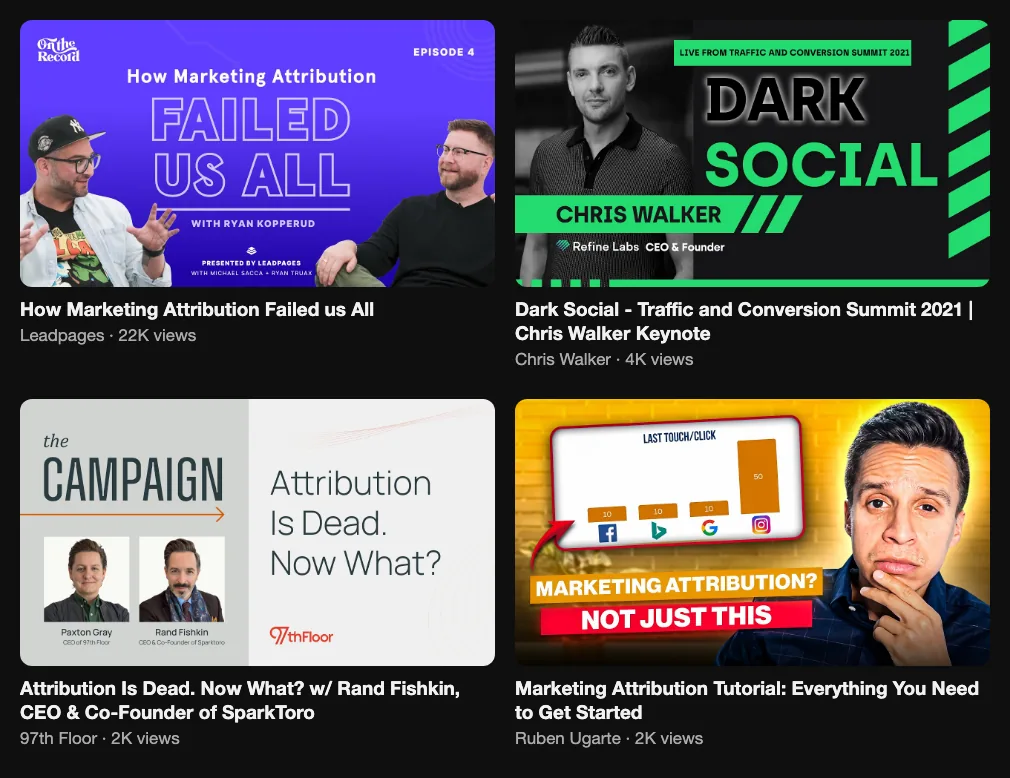
Notice that none of these tell you to buy a tool first. The common thread is the same as above: measure what you can, ask people for the rest, and don't pretend the dashboard is the full story.
Where does video fit in attribution?
Video is one of the sources that attribution tools handle worst, and one of the best at warming a lead before the first call. A person watches you for 20 minutes, never clicks anything, and books a call a week later by searching your name. Only a question catches that. We built our process around it: every long video points to a booking link with a tag, and the answers on the call tell us which videos matter.
If you want video to work as your trust layer, with tracking set up from the first video, here is what our YouTube strategy service includes. If you only need the question, copy it today. It costs nothing, and it tells you more about your marketing than most dashboards.
FAQ
What is marketing attribution?
Marketing attribution is the practice of giving credit for a sale to the marketing touches that led to it, such as a video, an email, an event or a referral. For a service business, the goal is simple: know which sources bring paying clients, so you can do more of them.
What is self-reported attribution?
It means asking the buyer where they heard about you, usually with a question like "How did you hear about us?" on the booking form and again on the call. It catches word of mouth, podcasts, communities and videos that software cannot see.
Why does last-click attribution fail for B2B services?
Because the sale rarely happens on the last click. A buyer may watch videos, read articles and talk to colleagues for weeks, then search your name and book a call. Last-click gives all the credit to that final search.
Do I need attribution software for a small service business?
Usually not at the start. With 5–20 calls a month, one question on the booking form, tagged links and a spreadsheet are enough. Software like Hyros makes sense when sales happen online, such as a checkout page, and you run several paid channels. Evgeny Maximov's agency uses Hyros with one client who sells an online course.
What should I put in the "How did you hear about us?" field?
Use an open text box, so people write in their own words, and maybe a short list of options next to it. Open answers show things you did not think of, like a podcast or a person's name. Group them into categories once a week.
How do UTM links work with Calendly?
You add UTM parameters, such as utm_source and utm_campaign, to the scheduling link you share. Calendly records them for bookings made through that link, and you can filter your meetings by them. Calendly's help center explains the setup, and the details depend on your plan.
What is dark social?
Dark social is sharing and discovery that analytics cannot track: private messages, communities, podcasts, group chats and word of mouth. Visits from these places often show up as "direct" traffic, so software credits them to nobody.
Is self-reported attribution accurate?
It is more complete than software for long B2B sales, but not perfect. People forget, remember the latest touch, or say "Google" because they googled you last. Treat answers as a strong signal and check them against your tagged links and your CRM.
How many leads do I need before the data means anything?
Be careful below about 20–30 answers. With a small number of leads one deal can change the whole picture. Look at three months together, and decide a budget only after patterns repeat.
How do I track which video brought a client?
Ask which video or post they saw, put a UTM tag with the video name on links in descriptions, and review calls and deals once a month. Evgeny Maximov's agency asks "How did you hear about us?" in its own Calendly form, and asks clients to ask their leads the same.
Should I change my marketing budget based on attribution data?
Move money slowly. If one source keeps showing up in answers, tags and closed deals over a quarter, give it more. Do not cut a channel because last-click shows nothing: content and referrals often feed leads that later arrive as "direct".
Founder of a done-for-you YouTube agency for high-ticket founders. Making content since 2014. More about me
Want to know which videos bring your clients?
Book a call. We'll look at how your leads find you today and where video can help. I'll tell you honestly if it doesn't fit. 7-day money back guarantee.
Get a free niche review →