Marketing KPIs for Service Businesses (and Which to Ignore)
A post with 10,000 views and no calls is not a result. Here are the numbers that follow money in a service business, the ones to drop, and a one-page scorecard you can fill in with your own data.
 By Evgeny Maximov·9 min read·
What is a marketing KPI, and how is it different from any other number?
A marketing KPI is a number you watch because it tells you what to do next. Everything else is a metric. There are hundreds of metrics. A service business with five people needs a handful of KPIs.
It helps to sort numbers into three groups.
| Type | Example | How to use it |
|---|---|---|
| Vanity metric | views, likes, followers, impressions | context only; good to see, bad to steer by |
| Diagnostic metric | click-through rate, watch time, bounce rate | look at them when a KPI drops, to find why |
| KPI | calls booked, close rate, revenue by source | review on a schedule; each one has an owner and a decision attached |
This is the same idea Hollyfield Consulting gives in its video on KPIs for small brands: a KPI should drive a business outcome. I agree, and I'd add one test. Ask: "If this number doubled, would I make more money?" If the honest answer is "maybe, someday", it's a diagnostic metric.
Which marketing KPIs matter for a service business?
For a high-ticket service, the path is long and has few people on it. So the useful numbers are counts of people moving to the next step, plus time and money. Here are the ones I would keep, and when each one should be ignored.
| KPI | What it tells you | Ignore it when |
|---|---|---|
| Qualified leads per month | whether the right people reach out | your "lead" means anyone who filled a form, with no filter |
| Calls booked | how many leads become real conversations | you book calls with people who can't buy |
| Show rate (booked calls that happen) | trust and friction between booking and call | you have fewer than about 10 booked calls a month |
| Close rate (calls to signed clients) | fit of the offer, price and proof | you count it on fewer than 10–15 calls; one deal swings it |
| Sales cycle length | how long trust takes to build | you compare deals of very different size in one average |
| Average first deal size | what one win is worth | one giant deal hides the typical one; use the median |
| Revenue by source | which channel brings paying clients | the source field is empty or guessed |
| Cost to win one client | if a channel pays back | you leave out your own time and count only cash |
| Cost per lead | how expensive attention is in paid channels | you have no way to follow the lead to a client |
| Reach, views, followers | how many people saw you | you make them the goal; use them only as context |
| Website traffic | interest, if it comes from the right pages | most visits come from people who can't buy |
The first eight rows are the real scorecard. Where each number comes from is the job of attribution, and I explain how to collect clean answers in marketing attribution for service businesses. How to compute the cost of one client is in customer acquisition cost for a service business.
Does reach matter, or is it a vanity metric?
Both. Reach matters because most of your buyers are not buying today. The B2B Institute, the research arm of LinkedIn, says only about 5% of B2B buyers are in the market at a given time (the 95-5 rule). The other 95% will buy later, and they will remember who they saw.
But that is a reason to be seen by the right people, not by many people. Reach is a vanity metric when it becomes the goal. My own channel is the cleanest example I have. A 47-minute documentary got about 6,000 views and brought clients. A video with about 260,000 views brought no sales at all. If I had steered by views, I would have made more of the second kind. I wrote the whole story in why views don't bring clients, so I won't repeat it here.
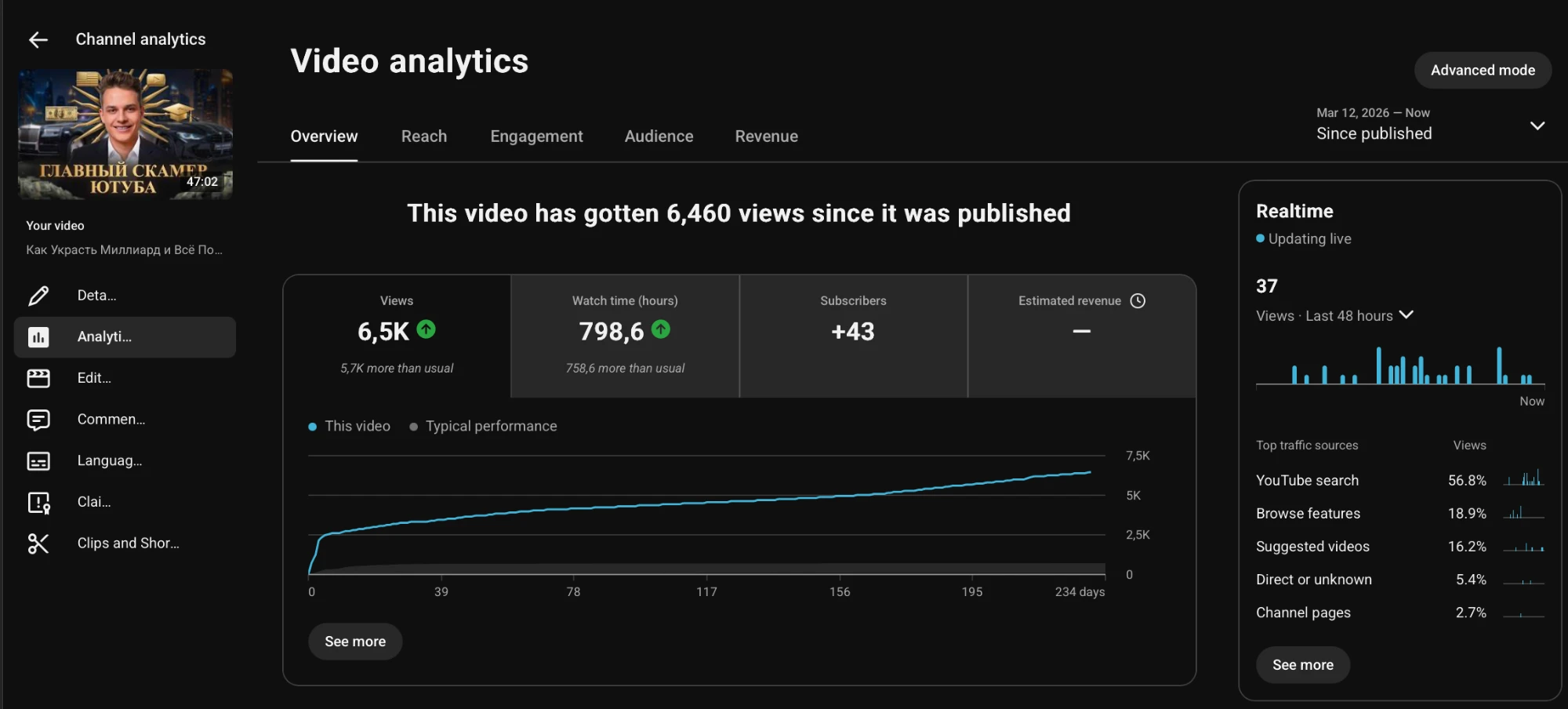
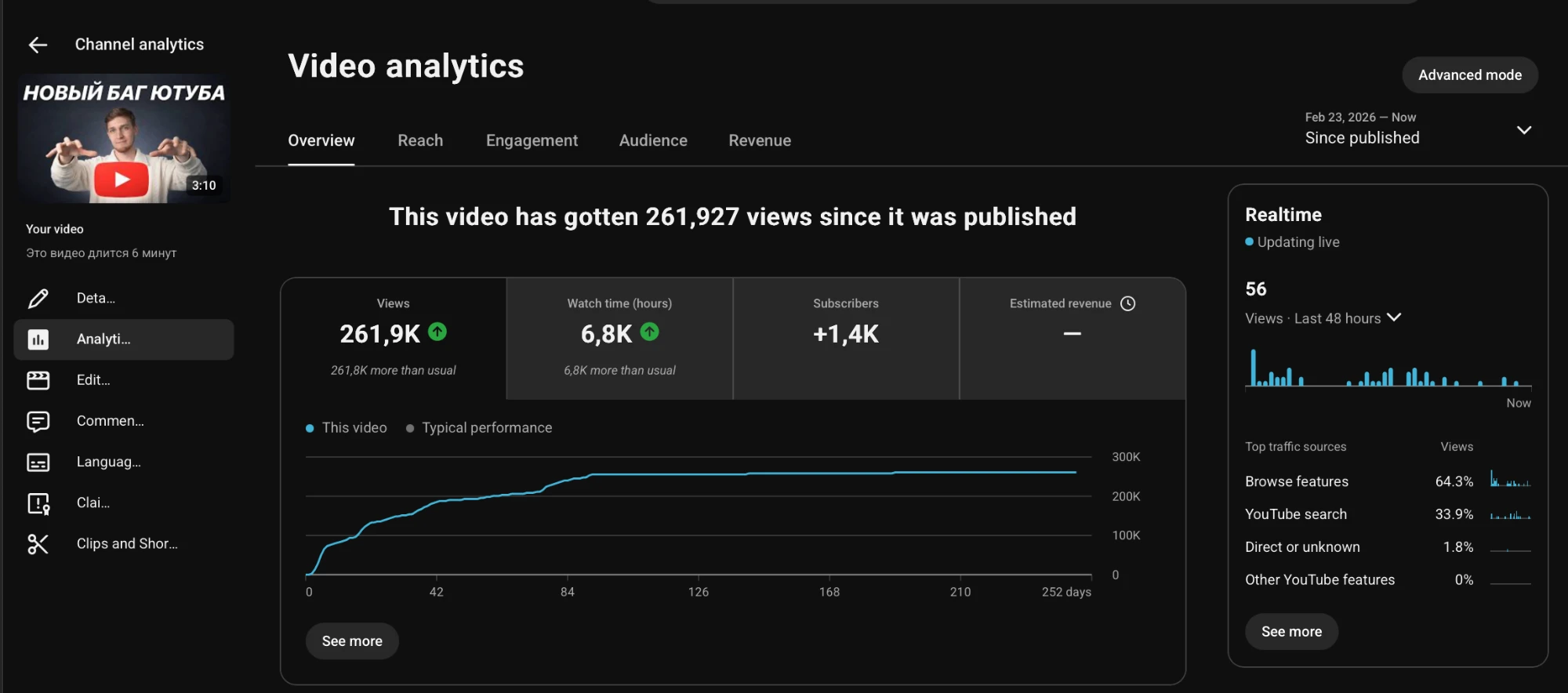
Another case from our clients: a real estate agency in Thailand got a lead from a dry 20-minute video with about 500 views. Five hundred right viewers beat 50,000 random ones. So my rule is simple. Read reach together with who is watching and what they do next.
One thing to remember about benchmarks on views: they show demand for a topic, not how many clients a video brought.
What does it mean when a KPI is low? How to find the leak
A funnel is a chain. When a number is low, the problem is usually at one link, and each link has a different fix. This is the table I use on calls with founders.
| What looks wrong | Where the leak probably is | What to check first |
|---|---|---|
| Few leads | attention or offer | who sees you, and whether your first step (a call, a guide) is clear and worth taking |
| Many leads, few booked calls | follow-up and booking friction | how fast you reply, how many steps it takes to book |
| Calls booked, low show rate | trust and the gap between booking and the call | reminders, and what the person sees after they book; a short video before the call helps |
| Calls happen, few signed | fit, price, proof | are you talking to the right people; do they see cases and results; is the price shown too late |
| Clients sign, but the cycle is very long | trust is built too slowly | give buyers something to watch or read between calls |
Michael Zipursky of Consulting Success makes a similar point in his video on consulting metrics: if you have ten leads and only one conversation, the problem is how you follow up, not your marketing. That sounds obvious, but many founders respond by buying more leads.
The last row is where long video helps most. A buyer who watches 20 minutes of you before a call arrives with questions already answered, and the call is about fit, not about convincing. Tvoy Sklad, a self-storage franchise we have worked with since 2022, sees this often: partners come to calls saying they have "already watched everything". I wrote about how a video can shorten the cycle in how video shortens a B2B sales cycle.
What about cost per lead?
It is the number every ad platform shows you, so it gets too much attention. Public data shows it can be high in B2B. LocaliQ (WordStream) reported about $111 per lead for legal Google Ads in campaigns run from April 2022 to March 2023. Metadata.io reported about $202 per lead on LinkedIn (138 advertisers) and about $524 on Google Ads (56 advertisers) in its 2025 data.
Sources: LocaliQ legal search advertising benchmarks (data from April 2022 to March 2023) and Metadata.io B2B advertising benchmarks (2025 data). Both are vendors, and the samples are advertisers that run paid campaigns. Checked in October 2026. A lead here means a form or a call, not a signed client.
A lead is not a client. If a lead costs $202 and one lead in twenty signs, a client costs about $4,000. That can be fine for a $30,000 engagement and bad for a $2,000 one. I found no reliable public benchmark for the share of leads or calls that become clients in professional services. The numbers online come from vendor blogs and use different definitions. So don't copy a benchmark. Measure your own for three months. That is the number that matters.
We don't run paid ads or manage ad accounts. We work with YouTube and social media organically, and I mention paid numbers because they are public and show why you should follow every lead to a deal.
Which KPIs should you track for a video channel?
If part of your marketing is YouTube, you need two layers. First, the business KPIs from above: calls, deals and which video brought them (use the tracking in YouTube ROI: how to track which video brought a client). Second, a few diagnostic signals for the channel itself.
On every channel we run, we check seven signals the algorithm reads. We use them to find out why a video does not move, not to judge whether the channel works:
- retention in the first 30 seconds of a long video (and the first 3 seconds of a Short);
- retention along the whole length;
- engagement: comments, likes, shares;
- behavior: what the viewer watches next;
- conversion from viewer to subscriber;
- average view time;
- click-through rate on the thumbnail and title.
Timing matters here. Content has a delay. Our break-even calculator assumes no calls in months one and two, and shows the first months as a loss, on purpose. So don't judge a channel on one month of data. Set a first look at three months, and a real decision point at six to twelve.
What does a one-page scorecard look like?
Copy this table into a spreadsheet. Fill it in with your own numbers each month. The "where from" column matters most: if you can't say where a number comes from, you can't trust it.
| KPI | How to count it | Where from | Review | This month | Last month |
|---|---|---|---|---|---|
| Qualified leads | leads that match your client profile | CRM or form | weekly | [ ] | [ ] |
| Calls booked | number of booked calls | Calendly or your calendar | weekly | [ ] | [ ] |
| Show rate | calls held ÷ calls booked | calendar | monthly | [ ] | [ ] |
| Close rate | new clients ÷ calls held | CRM | monthly | [ ] | [ ] |
| Sales cycle | days from first contact to signed | CRM dates | quarterly | [ ] | [ ] |
| Average first deal | total of first payments ÷ new clients | invoices | monthly | [ ] | [ ] |
| Revenue by source | first payments, grouped by source | CRM source field | monthly | [ ] | [ ] |
| Cost to win one client | sales and marketing cost ÷ new clients | books and time log | quarterly | [ ] | [ ] |
Put one person's name next to every row. A number with no owner gets ignored. And write down the definition of "qualified lead" once, in one sentence, so it doesn't change from month to month.
What are the most common KPI mistakes?
- Tracking twenty numbers and acting on none.
- Changing the definition of a "lead" every time the number looks bad.
- Counting leads without checking who they are. Ten wrong leads are worse than two right ones.
- Judging content or referrals on one month. Both need a quarter or more.
- Using a benchmark from another business, another deal size or another country.
- Steering by a number you can't tie to money.
Which videos explain marketing KPIs well?
I looked for English videos about marketing metrics for small businesses and consultants. These are general marketing videos, not service-business case studies, and the views are modest for the narrow ones. Views show demand, not how many clients a video brought. YouTube data on 26 October 2026.
- Marketing Analytics 101 (A Beginner's Guide To Marketing Metrics) by Adam Erhart (111K views). A plain introduction to which numbers to look at. Why it works: it starts from the beginner's question and keeps the list short.
- Marketing Metrics that MATTER by Hinge, a marketing firm for professional services (14K views). Liz Harr sorts what to track into three groups. Why it works: it comes from a firm that works only with professional services.
- Marketing KPIs Small Brands Must Track by Hollyfield Consulting (11K views). Five KPIs, with a clear line between vanity metrics and numbers that drive outcomes.
- Most Important Metrics For Consultants to Track by Consulting Success (4K views). Four numbers in a pipeline: leads, conversations, proposals and wins, and what each one tells you. Why it works: it is made for consultants and keeps it simple.
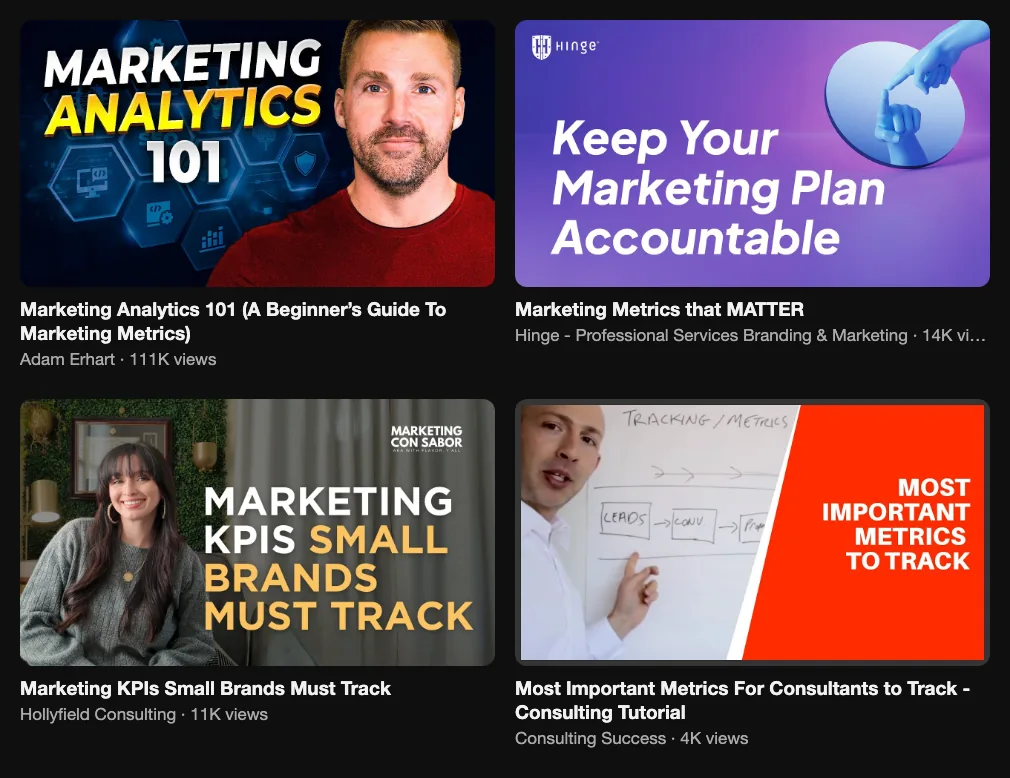
Notice how short the lists are: three groups, four numbers, five KPIs. That is on purpose. A list you can remember is a list you use.
Where do you go from here?
Pick the eight rows from the scorecard, fill in last quarter by hand from your calendar and invoices, and look at where the chain is thinnest. That takes an afternoon, and it will tell you more than a month of social media reports.
If the thin link is trust before the call, video is one of the strongest fixes we know, and we build it for founders and experts. Here is what our YouTube production service includes. If the thin link is somewhere else, I'll say so on a call.
FAQ
What are marketing KPIs?
Marketing KPIs, or key performance indicators, are a few numbers that show whether your marketing brings business results. A good KPI changes a decision: if it goes up or down, you do something different. Likes and views alone rarely do that.
What are the best marketing KPIs for a service business?
Start with qualified leads, calls booked, show rate, close rate, sales cycle length, average deal size, revenue by source and cost to win one client. These follow the path from attention to money. Reach, views and followers are only context.
How many KPIs should I track?
Six to eight. More than that and nobody looks at them. Put them on one page, update them weekly or monthly, and drop any number that never changes what you do.
Is cost per lead a good KPI?
It is useful but easy to misread. A lead is not a client. LocaliQ reported an average of about $111 per lead for legal Google Ads in 2022–2023 data, and Metadata.io reported about $202 on LinkedIn and $524 on Google Ads in its 2025 data. Always ask what one signed client costs.
Why are views and followers vanity metrics?
They show attention, not buying intent. Evgeny Maximov made a 47-minute documentary with about 6,000 views that brought clients, while a video with about 260,000 views brought none. Count calls and deals first.
What is a good close rate for a consulting or professional services firm?
I did not find a reliable public benchmark that fits professional services, and the numbers online come from vendor blogs with different definitions. Measure your own close rate from calls to signed clients for three months and improve against yourself.
What is a lagging KPI and what is a leading KPI?
A lagging KPI, such as revenue or signed clients, shows the result after it happened. A leading KPI, such as qualified leads or booked calls, moves earlier and warns you. Content marketing has a long delay, so watch leading KPIs monthly and judge results over a quarter or more.
Which KPIs matter for a YouTube channel?
First the business ones: calls, deals and which video brought them. Then diagnostic signals: retention in the first 30 seconds of a long video, average view time, click-through rate on the thumbnail and where viewers go next. Views come last.
How often should I review marketing KPIs?
Leads and booked calls weekly, close rate and revenue by source monthly, and cost per client and sales cycle quarterly. Reviewing results every day only adds noise.
What should I do if my leads are fine but few clients sign?
The leak is after the lead. Check follow-up speed, the quality of leads, what happens between booking and the call, and your offer and proof. Evgeny Maximov also suggests sending a long video to warm leads before the call, so they arrive having seen how you work.
Can I judge a content campaign after one month?
No. Content compounds over months. Evgeny Maximov's break-even calculator assumes no calls in months one and two and shows the first months as a loss. Set a review point at three months and a real decision point at six to twelve.
Founder of a done-for-you YouTube agency for high-ticket founders. Making content since 2014. More about me
Want a channel you can read in calls, not views?
Book a call. We'll look at your sales cycle and the numbers you already track, and I'll tell you honestly if video fits. 7-day money back guarantee.
Get a free niche review →