Account-Based Marketing for Professional Services: A Practical Guide (With Video)
Account-based marketing sounds like a software company thing. It isn't. If you sell $20,000+ services to a few hundred possible buyers, picking the companies first makes sense. Here is how to do it, what video adds, and how we use it in our work.
 By Evgeny Maximov·9 min read·
What is account-based marketing, and how is it different from regular marketing?
Regular marketing asks "how do I get more leads?" ABM asks "which companies do I want, and how do I get in front of the right people there?" You flip the funnel. The list of buyers comes first. The content and outreach come second.
| Regular marketing | Account-based marketing | |
|---|---|---|
| Starts from | a broad audience | a named list of companies |
| Who you talk to | whoever shows interest | 3–5 chosen people at each account |
| Content | the same for everyone | shared by default, custom for the best accounts |
| Success means | more leads | more target accounts engaged, meetings and deals |
| Works best when | there are thousands of possible buyers | there are tens or hundreds, and each deal is large |
A small firm can do this with a spreadsheet, LinkedIn and good content.
Does ABM make sense for a professional services firm?
Often yes, because services have the two things ABM needs: large deals and a small number of right buyers. A consultant who sells a $40,000 project to mid-size manufacturers can name 200 of them in one afternoon. For those firms, shouting at the whole market is a waste.
It fits less well when you sell small tickets to thousands of buyers. Per-account work is too expensive there, and wider channels like search, social and referrals do the job. See the B2B lead generation guide.
A quick test: can you name 30 companies you would love as clients? If yes, try ABM. If you can only say "any business that needs X", build a clearer profile first. Our guide to the ideal customer profile for consultants shows how.
Why do you need to reach the whole buying group?
Because no big service is bought by one person. Forrester's State of Business Buying, 2026 says that on average 13 internal stakeholders and nine external participants influence a B2B purchase decision. A services deal may involve fewer people, but the person who books your call is rarely the only one who decides.
There is a second reason. Gartner research reported by iStart in 2018 found that buyers spend only about 17% of their buying time meeting with suppliers, and that share is split across every supplier they consider. The rest happens when you are not in the room.
So the real question for ABM is simple: what do the CFO, the head of operations and the person who found you see when they look you up alone? If the answer is a brochure, you lose to the firm that has an hour of video where an expert explains how they work.
Sources, checked in October 2026: Digital Commerce 360, reporting Forrester's State of Business Buying, 2026 (22 January 2026; I did not see the Forrester report itself); iStart, Right info, right channel (August 2018), a secondary summary of Gartner research that is now several years old.
How do you build a target account list?
Start from your past, not from a database. Look at your best five to ten clients: the ones who paid well, stayed long and were easy to work with. What do they have in common? Industry, size, a trigger event (a new CEO, a merger, a regulation), the role that hired you. That is your pattern.
- Write the pattern in 5–6 lines. This is your ideal customer profile.
- Find lookalikes. LinkedIn Sales Navigator, industry directories, conference lists, your clients' competitors.
- Cut the list to 10–50 companies. Fewer is better than a long list you never touch.
- Name 3–5 people per account. The decision maker, the user who feels the problem, the person who controls budget, and one friendly contact.
- Put it in a spreadsheet. Company, people, last touch, next step, and what each person cares about.
Many ABM guides split accounts into three tiers. The tier names are common. The exact counts differ from source to source, so use these as practice, not a rule.
| Tier | Accounts (for a small firm) | What you do |
|---|---|---|
| One-to-one | about 5–10 | research each company, write or record things for them, ask a client or partner for an introduction |
| One-to-few | about 10–40 | group by industry or problem, use one message per group, add small custom touches |
| One-to-many | 50 and more | shared content, such as videos and a newsletter, aimed at named accounts |
What does an ABM program look like, step by step?
The warm-up step is where most of the choice is. Here are the usual tactics side by side. No public benchmark prices these for services, so the cost column is my rough judgment, not data.
| Tactic | What it does | Cost for a small firm | Weak point |
|---|---|---|---|
| Introductions from clients and partners | gets the warmest first meeting | low, mostly time | you can't scale it |
| Engaging with target people on LinkedIn | makes your name familiar before you write | low, 20 min a day | slow, and it depends on your daily energy |
| A long-video library | lets the whole group see you work before a call | medium, monthly | slow start, nobody sees it without a link |
| A podcast with guests from target companies | gives a reason to contact a person you want | medium, monthly | small view counts, needs a good guest list |
| A personalized short video for one person | shows you did your homework | medium, 15–30 min each | it is still outreach, and it needs a real reason to write |
Paid ads aimed at a list of companies, for example on LinkedIn, also exist. We don't run ads, so I won't judge them. Pick one personal and one content tactic to start.
How does video fit into account-based marketing?
Here are three ways we use video, from content a whole buying group can watch to a video made for one prospect.
1. A library the whole buying group can watch
A long video works like a sales video that nobody has to schedule. The sales team sends one link after a first call. The CFO, the operations lead and the sponsor each watch the part they care about, and arrive at the second call knowing how you think. I explain this in B2B video marketing and how video shortens a sales cycle.
Our clearest example is Tvoy Sklad, a self-storage franchise we have worked with since 2022. The videos are long and slow. Most have 2,000–20,000 views. The founder himself shows the financial models in videos and live streams. New partners often arrive at calls saying they have already watched everything. In 2024–2025 the company attracted about $5M in investments and signed 20+ franchise partners. This is not ABM, because they did not choose accounts and send videos. But it shows the effect you want from a library: the buyer has done the trust work before the call. The full case is here.
2. A podcast with guests from your target accounts
A podcast gives you a reason to start a conversation with someone at a target company. We produced a video podcast for Freshcode, an app development company. The show is called "Clojure in product. Would you do it again?". The guests are developers from companies that use this technology in real products, like The New York Times, Metabase and Dentons. The viewers are other engineers and technical buyers.
Why does it fit ABM? Every guest is a person from a company the host wants to know. The invitation is a real reason to talk, not a sales message. The guest gets a useful conversation and a link to share. I am not giving the view numbers, because they are small, and that is fine. A podcast like this is a relationship tool, not a reach tool. More on the format is in video podcast production and how to start a video podcast.
3. A personalized video for one prospect
Outreach. We record a free niche analysis for a prospect to see if they're interested. We show which video topics and formats could work for their business and explain how those videos could help them attract more clients.
Video proposal. We record a walkthrough of the proposal for the prospect. It gives us room to explain the recommendations, show examples, and go into more detail than we can on the page.
Which accounts are ready for what?
Not every target account is ready to talk. I use the Buyer Ladder from my free course The Trust Engine to decide what to send. An account that is not looking yet gets a useful video or a podcast invitation. One that has a problem but doesn't see it gets a video that names the hidden cost. One that is looking for a solution gets a clear explainer of how you work. One that is choosing who to hire gets a personal note, proof from similar clients and a call. The same company gets a video this year and a person next year.
How do you measure account-based marketing?
Don't count leads. Count accounts. The numbers to watch each month are: how many target accounts engaged (replied, watched, attended), how many meetings you had with the right roles, how many target accounts are in your pipeline, and how many became clients.
Add one habit. Ask every new contact: "How did you hear about us, and what did you see first?" In our Calendly booking form we ask exactly this, and we ask our clients to ask their leads the same. It catches the video, the podcast guest or the friend who forwarded a link. Software rarely does. A short guide to this is in marketing attribution for service businesses.
Don't judge a podcast or a video by views. Views show demand, not how many clients a video brought. Ten views from the right ten people can be worth more than 10,000 from nobody who buys. I wrote about this in views vs clients.
ABM benchmarks lean positive, because they survey people who run ABM. In a 2022 survey of almost 300 ABM leaders, 72% said ABM delivers higher ROI than other marketing. Read that as "people who run ABM like it", not as proof for your firm.
Source, checked in October 2026: Demandbase press release on the sixth annual ABM benchmark report (December 2022). Demandbase is an ABM software vendor, and the results are self-reported by practitioners.
What does a 90-day ABM plan look like?
| Days | Do this | Done when |
|---|---|---|
| 1–30 | Write your ideal customer profile from your best clients. Build a list of 30 accounts and name 3–5 people per account. Ask two clients for introductions. | a spreadsheet with 30 companies and 100 names |
| 31–60 | Spend 15 minutes a day on useful LinkedIn activity aimed at those people. Film your first two long videos that answer a buyer's question. | first replies and two videos online |
| 61–90 | Send the videos to accounts that replied. Invite two target-account guests to a recorded conversation. Count engaged accounts and meetings. | a clear view of which accounts moved |
The first 90 days are a test, not a result. If nothing moves in 90 days, look first at the list and the message, not at the tactic.
What mistakes break ABM in services?
- The list is built from logos, not fit. A famous company that doesn't need you is the wrong target.
- The message is the same for all. A note that could go to anyone is ignored by everyone.
- Only one person is contacted. That person leaves or can't say yes alone.
- It stops after one month. Big deals take many months. Plan for a quarter, then review.
- Software comes first. A tool can't fix a weak offer. Your value proposition comes first.
Which real videos explain account-based marketing?
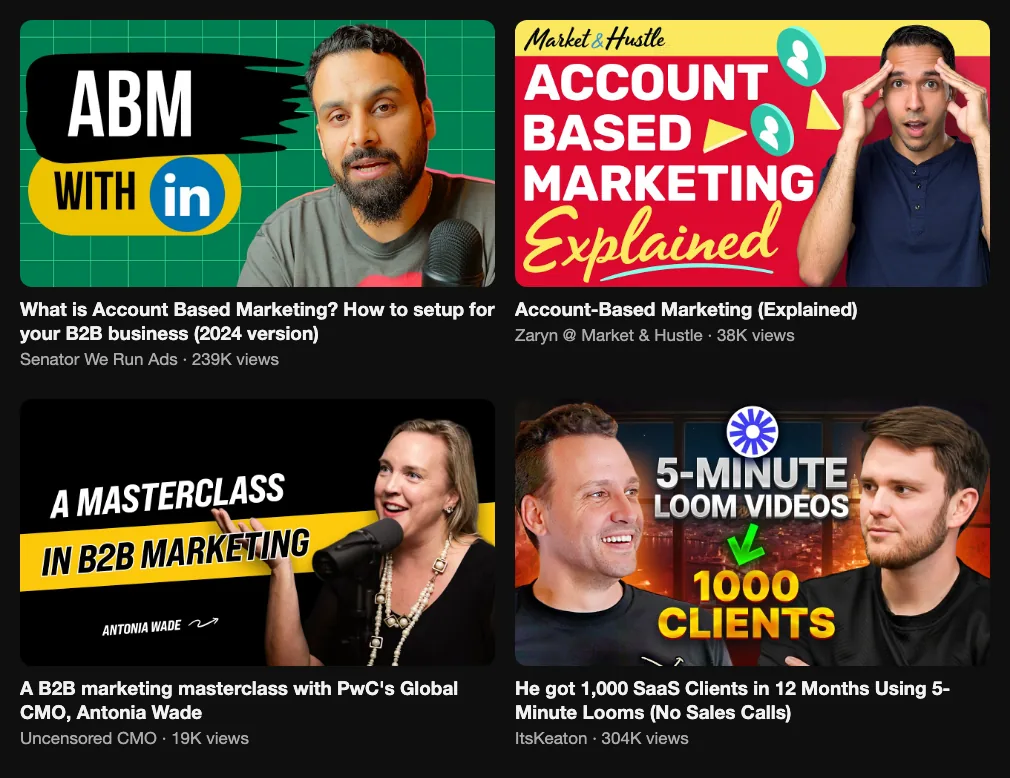
I looked for English videos on ABM, and for videos on personalized outreach. Most are for software and agency audiences. The ideas carry over to services. Views show demand for the topic, not how many clients a video brought. Data is from YouTube on 26 October 2026.
- What is Account Based Marketing? How to setup for your B2B business (2024 version) (Senator We Run Ads, 239K views). A clear long explainer, built around LinkedIn ads.
- Account-Based Marketing (Explained) (Zaryn @ Market & Hustle, 38K views). A four-minute comparison of ABM and the usual B2B approach.
- A B2B marketing masterclass with PwC's Global CMO, Antonia Wade (Uncensored CMO, 19K views). From a professional services firm: brand, reputation and relationships at each stage of the buying process.
- He got 1,000 SaaS Clients in 12 Months Using 5-Minute Looms (No Sales Calls) (ItsKeaton, 304K views). The personalized video method in practice. The story is about selling to software companies, so check it against your market.
If you want the video side of an account-based plan, that's what our done-for-you YouTube service does, from $3,000 a month. A video podcast with guests from your target companies starts from $500, plus filming by location. We don't promise views, calls or leads. Only a 7-day money back guarantee.
FAQ
What is account-based marketing for professional services?
It is a way of marketing where you pick named target companies first and then build messages, content and contacts for the people inside them. Regular marketing casts a wide net and waits for leads. Account-based marketing treats each target company as its own small market. It fits firms with big deals and a limited number of possible buyers.
Is account-based marketing worth it for a small consulting firm?
It can be, if one client is worth enough to pay for the extra work per account. You don't need a team or special software. A list of 20–30 companies, a spreadsheet, a weekly hour of research and some content made for those buyers is a real ABM program. If your deals are small and you have thousands of possible buyers, wider channels make more sense.
How many target accounts should I choose?
For a small firm, 10–50 accounts is a good range. Public sources disagree on exact tiers, so treat the numbers as practice, not a standard. A common split is a handful of top accounts with fully custom work, a few dozen with a lighter version, and a wider list that gets mostly shared content.
What is the difference between ABM and lead generation?
Lead generation starts from people who raised a hand and filters them. ABM starts from companies you want and tries to earn their attention. Lead generation counts leads. ABM counts engaged target accounts, meetings with the right people and deals in the target list. They can run side by side.
Does video work for account-based marketing?
Yes, in three ways. A library of long videos lets the whole buying group see your thinking before a call. A podcast with guests from target companies gives you a reason to contact them. A personalized video helps you gauge a prospect's interest with a free niche analysis or walk them through a proposal in more detail.
Can a podcast be part of an ABM strategy?
It can. If your guests come from your target accounts, each episode starts a real conversation with a person you want to know. The guest also shares the episode with their own network. It is slow and the view counts can be small. Evgeny Maximov's agency produced a video podcast for Freshcode, an app development company, with developers from companies like The New York Times, Metabase and Dentons.
How long does ABM take to work?
Plan for three to six months before you judge it. Enterprise-style deals move slowly, and the first meetings often come from relationships and content that started weeks earlier. A 90-day first cycle is long enough to see whether target accounts reply, watch and book.
How do I measure account-based marketing?
Count accounts, not clicks. Useful numbers are how many target accounts engaged, how many meetings you held with the right roles, how many target accounts are in pipeline and how many became clients. Ask every new contact how they heard about you. Self-reported answers catch videos, podcasts and referrals that software misses.
Do I need software for account-based marketing?
Not at the start. A spreadsheet with company names, contacts, last touch and next step is enough for 30 accounts. Tools like LinkedIn Sales Navigator or a CRM such as HubSpot help later, when the list grows. Buy software after the process works, not before.
What is the biggest mistake in ABM for services?
Choosing accounts by size or logo instead of fit, and then sending the same generic message to all of them. If the list isn't built from your best past clients and a clear ideal customer profile, personalization only polishes a weak list.
Does Evgeny Maximov's agency run account-based marketing campaigns?
No. The agency produces YouTube channels, podcasts and short clips for founders and experts with high-ticket services. The videos can serve a sales team in an account-based plan, for example as the library a buying group watches before a call. The agency does not run ads, does not promise views, calls or leads, and its only guarantee is 7 days of money back.
Founder of a done-for-you YouTube agency for high-ticket founders. Making content since 2014. More about me
Want videos your target accounts can watch before the call?
You film one day a month. We plan, edit and publish long videos and Shorts that your sales conversation can point to. 7-day money back guarantee.
Get a free niche review →