Demand Generation vs Lead Generation: The Difference, With a Table and Real Examples
Marketers use the two terms as if everyone knew the difference. Most founders don't, and it changes what you should do first. Here are clean definitions, examples from high-ticket services and how a single long video can create demand and capture leads.
 By Evgeny Maximov·8 min read·
What is the difference between demand generation and lead generation?
The short version: demand generation creates the wish. Lead generation collects the people who already have it. Here are both in one table.
| Demand generation | Lead generation | |
|---|---|---|
| Definition | a long-term effort to raise awareness, educate the market and build trust before someone is ready to talk to sales | turning interest into contacts your sales team can follow up on |
| Main goal | be the name the buyer remembers when they are ready | get a name, an email or a booked call |
| Buyer state | not buying yet, may not know the problem | interested, often comparing options |
| Funnel stage | top | middle and bottom |
| Typical activities | educational videos, podcasts, talks, useful posts, free guides without a form | lead magnets, landing pages, call booking, webinars with sign-up, retargeting, outbound |
| Typical metrics | brand search, traffic, engagement, inbound pipeline growth | leads, qualified leads, form fills, conversion rate |
| Speed | slow, builds over months | faster, can start in days |
Definitions, funnel stages and metrics follow Cognism, Demand generation vs lead generation (published July 2025, updated April 2026). Cognism is a software vendor. The typical activities and speed rows are my own summary for service businesses. Different companies draw the line in slightly different places.
Why does B2B need both?
Because most buyers are not buying today. Researchers at the LinkedIn-backed B2B Institute say only about 5% of B2B buyers are in the market right now, and the other 95% won't buy for months or even years. That's the famous 95:5 rule.
Lead generation talks to the 5%. If that's all you do, you fight for a tiny group, and everyone else fights for it with you. Demand generation talks to the 95%. When one of them moves into the 5%, they call the name they already know.
The opposite mistake also hurts. If you only create awareness and never give a next step, the attention goes nowhere. You need both halves.
What are examples of demand generation and lead generation?
| Activity | Type | Why |
|---|---|---|
| A long YouTube video that answers a buyer's question | Demand | teaches and builds trust, no sale asked |
| A podcast interview or a conference talk | Demand | you become known to people who weren't looking |
| A useful LinkedIn post with no link | Demand | reach and memory |
| A guide behind an email form | Lead | you get a contact in exchange |
| "Book a call" link in the first line of a video description | Lead | a clear next step for the 5% |
| A retargeting ad to people who watched your videos | Lead | brings warm viewers to the offer |
| A cold email to a narrow list | Lead | starts a conversation with a defined buyer |
| A webinar with registration | Both | teaches the room and collects contacts |
What does this look like in a high-ticket service business?
Take Tvoy Sklad, a self-storage franchise we have worked with since 2022. Its videos are long and slow: an online tour of the franchise, talks by the founder, podcasts, tours of locations. Most have 2,000–20,000 views. That's demand generation. Buyers watch for months. One franchisee told the team he had watched for two years before he came, after the online tour.
The lead part was simple. In the pitch video there is a QR code, and the description has a link to a Telegram chat bot. The result: the company raised about $5M in two years, got 20+ franchisees, and its marketing team says new partners often arrive saying they have watched everything. The full case is here.
Our Thai real estate client is the small version. A dry 20-minute video, about 500 views, one lead. It created no mass demand. It reached exactly the right person at the moment he was in the 5%.
How does one video do both jobs?
Most of the video is demand generation. You answer a real question. Nobody is asked to buy anything. The last thirty seconds and the first line of the description are lead generation: one clear next step, a call or a free guide. If a viewer isn't ready, nothing is lost. They spent ten minutes with you, and the next time they are in the 5%, they know who you are.
How leads come out of a video is in YouTube lead generation for B2B. What to say to sales is in B2B video marketing.
What mistakes do founders make when they mix them up?
- They judge demand content by leads. A video that teaches may bring one lead in the first month, and that's normal. The question to ask is whether the right people watched.
- They judge lead pages by awareness. A landing page isn't there to be loved. It's there to make a call easy.
- They gate everything. Hiding every useful thing behind an email form kills demand. We give our own guides away with no opt-ins, and ask for a call only at the end.
- They never ask for anything. Beautiful content with no next step is a hobby, not marketing.
- They stop the demand work when sales are slow. It's the first thing cut and the last thing that returns.
What does a simple demand and lead plan look like for a service firm?
You don't need a department. You need one rhythm:
- List the questions buyers ask before they hire you. From sales calls, emails, objections. Ten questions are enough for a start.
- Answer each one in a long video. This is the demand part. See how often to post for a rhythm that fits a busy founder.
- Add one next step to every video. A call link in the first line of the description, one guide, one pinned comment.
- Send the same videos in follow-ups. The sales team can use them, so the demand work also helps close.
- Check once a month. Leads by source, and what people say they watched.
That plan makes the channel work for both jobs without extra tools.
How do you measure demand generation and lead generation?
Measure them separately, because they move at different speeds.
- Demand: searches for your name, direct visits, watch time, saves, comments, and how many leads say "I've watched your videos."
- Leads: leads by source, calls booked, calls held, and calls that become clients.
- The bridge: ask every lead, "how did you hear about us, and what did you watch first?"
Be careful with software reports. Many of the touches that matter most, like podcasts, communities and word of mouth, are not tracked by attribution tools. B2B marketer Chris Walker calls this the dark funnel. A question on the first call fills the gap better than any dashboard.
Which one should you start with?
- Few people know you: start with demand. But put a next step in every piece, so nothing is wasted.
- Many people know you, few call: fix lead capture first. A clear offer, a short path to a call, a guide that solves one problem.
- You need money in 30 days: lead generation, usually outbound. Then build demand next to it. See how to generate B2B leads for the channels.
- One client is worth thousands of dollars: do not skip demand. Trust takes time, and the buyer is going to look at you before they write.
Which real videos explain the difference?
These are explainers from B2B marketing teams and educators. Some are on the exact comparison, others on one half of it, because there is little on the exact comparison with large views. Views show demand for the topic, not clients. Data is from YouTube on 23 October 2026.
The definitions, explained by others
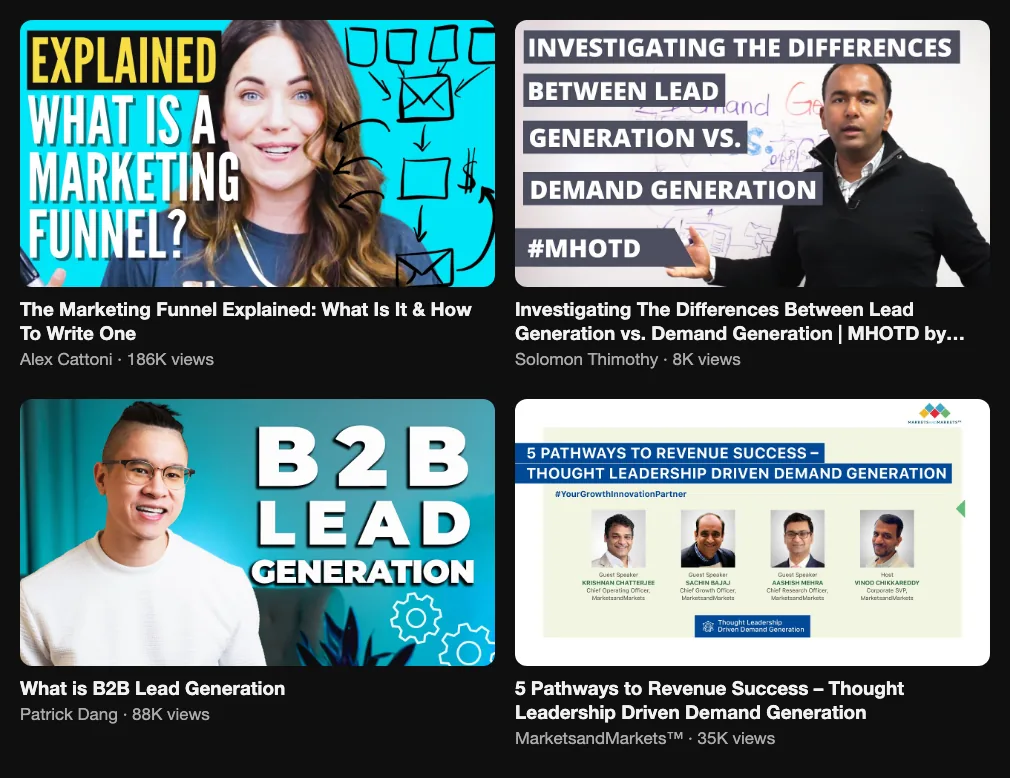
- The Marketing Funnel Explained: What Is It & How To Write One (Alex Cattoni, 186K views). The funnel stages that the table above uses.
- Investigating The Differences Between Lead Generation vs. Demand Generation (Solomon Thimothy, 8K views).
- What is B2B Lead Generation (Patrick Dang, 88K views). The lead generation half, explained.
- 5 Pathways to Revenue Success (MarketsandMarkets, 35K views). The subtitle is Thought Leadership Driven Demand Generation: the demand half, built on expert content.
Demand generation in practice
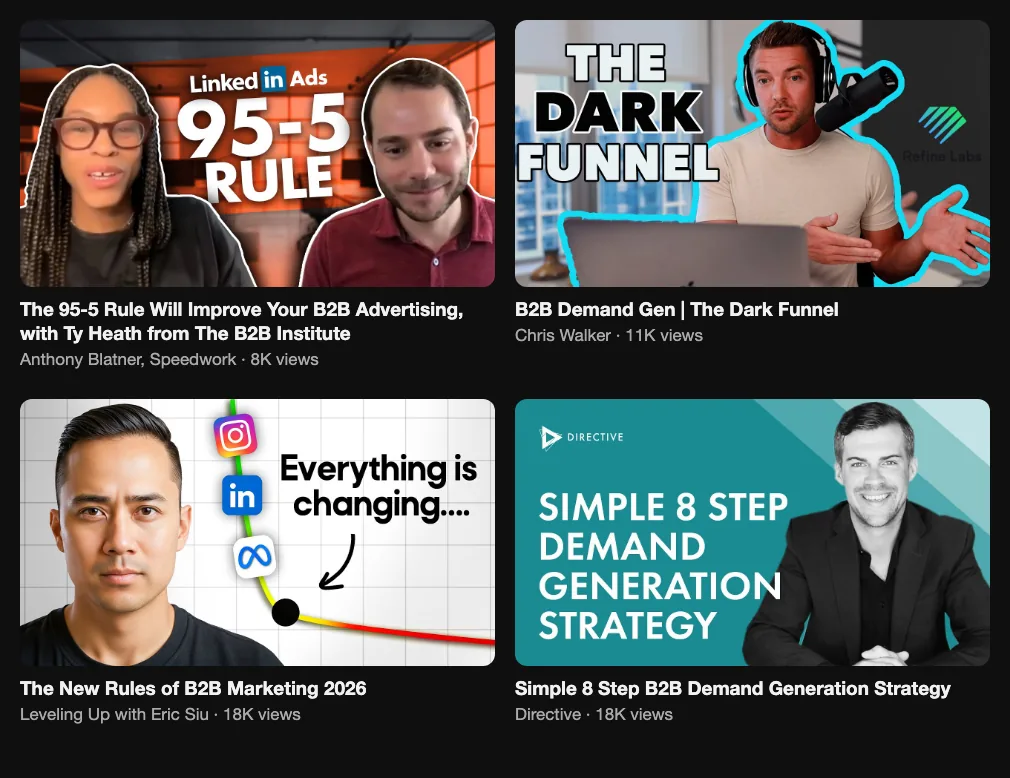
- The 95-5 Rule Will Improve Your B2B Advertising, with Ty Heath from The B2B Institute (Anthony Blatner, Speedwork, 8K views). The person from the B2B Institute explains the rule behind this article.
- B2B Demand Gen | The Dark Funnel (Chris Walker, 11K views). The touches no software sees.
- The New Rules of B2B Marketing 2026 (Leveling Up with Eric Siu, 18K views).
- Simple 8 Step B2B Demand Generation Strategy (Directive, 18K views). The CEO describes a strategy that aims to create demand and leads together.
Honest note: these videos are mostly for marketing teams at software companies. The ideas carry over to services, but real service firms doing both jobs on video are in our YouTube lead generation guide.
If you want videos that build demand and give every viewer a next step, that's what our done-for-you YouTube service does, from $3,000 a month. We don't promise views, calls or leads. Only a 7-day money back guarantee.
FAQ
What is the difference between demand generation and lead generation?
Demand generation builds awareness and trust with people who are not buying yet, so they remember you later. Lead generation captures contact details or a booked call from people who already show interest. Demand generation is long-term and sits at the top of the funnel. Lead generation is more immediate and sits in the middle and bottom.
What is demand generation?
Demand generation is a set of activities that make your market aware of a problem and of you as the person who solves it. Examples are educational videos, podcasts, talks and useful posts. Success shows in brand searches, traffic, engagement and inbound requests rather than form fills.
What is lead generation?
Lead generation turns interest into a contact your sales team can follow up on: a booked call, a form, a download or a reply. It is measured by leads, qualified leads and conversion rates.
Is demand gen the same as lead gen?
No. They work together, but they have different jobs and metrics. Some marketers treat lead generation as one part of demand generation. For a founder, it is easier to keep them separate: one creates interest, the other captures it.
What are examples of demand generation?
A long YouTube video that answers a buyer's question, a podcast interview, a conference talk, a helpful LinkedIn post or a free guide with no sign-up. None of them asks for a purchase. They make you the person the buyer remembers.
What are examples of lead generation?
A landing page with a call-booking button, a lead magnet behind an email form, a webinar registration, a cold email with a clear offer, a retargeting ad to people who watched your video. Each one asks for a clear next step.
Which is better for B2B: demand generation or lead generation?
You need both. The LinkedIn-backed B2B Institute says only about 5% of B2B buyers are in the market at any moment. Lead generation talks to that 5%. Demand generation builds memory with the other 95%.
Can one video do both demand generation and lead generation?
Yes. The main part of a long video educates and builds trust, which creates demand. A clear next step at the end, a link in the first line of the description and a pinned comment capture the leads. Evgeny Maximov's agency builds every video with both jobs in mind.
How do you measure demand generation?
Look at brand search volume, direct traffic, watch time, comments, how many leads say they already watched or read your content, and growth in inbound requests. Many touches, like a podcast or a word of mouth, are not tracked by software, so ask every lead how they heard about you.
Does Evgeny Maximov's agency sell demand generation or lead generation?
Neither as a separate service. The agency produces YouTube channels for founders and experts with high-ticket services. The videos build trust over time and give each viewer a next step. It does not promise views, calls or leads. Its only guarantee is 7 days of money back.
Founder of a done-for-you YouTube agency for high-ticket founders. Making content since 2014. More about me
Want videos that build demand and bring calls?
You film one day a month. We plan, edit and publish videos with a clear next step. 7-day money back guarantee.
Get a free niche review →