Customer Acquisition Cost for a Service Business: How to Count It
Most founders know what a client pays them. Few know what that client cost to win. Here is the formula, what to count for a service business, a worked example, and why the cost of a client can fall over time when you build a library of videos.
 By Evgeny Maximov·10 min read·
What is customer acquisition cost?
CAC answers a plain question: how much did it cost me to win one new client? A founder usually knows the price of the service. Fewer know the price of getting the person to say yes. Without it you can't tell if a channel makes money or only looks busy.
This is the standard formula. ChartMogul, a subscription analytics company, defines it as total sales and marketing spend in a period divided by new customers won in that same period. Amplitude gives the same basic formula and adds a "fully loaded" version that counts every cost of acquiring customers, including overhead.
Sources: ChartMogul, "CAC" in its SaaS metrics library; Amplitude, "How to calculate CAC". Both are software vendors writing mostly for subscription products, so I use only the formula, not their benchmarks. Checked in October 2026.
This article is for service businesses: consultants, coaches, lawyers, clinics, agencies and B2B firms. It goes with two others. How to find out where clients come from is in marketing attribution for service businesses. Which other numbers to watch is in marketing KPIs for service businesses. And how much to put into marketing overall is in how much should you spend on marketing.
What counts as a cost for a service business?
Here a service business differs from a store. Much of your cost is not cash. It is your time and your team's time. If you leave it out, CAC looks nice and is wrong.
| Count it | Leave it out |
|---|---|
| Ad spend and the fee of whoever manages the ads | The cost of delivering the work for the new client |
| Content production: filming, editing, writing, design, a production agency fee | Onboarding and customer success after the person signs |
| Tools used for sales and marketing: CRM, Calendly, email, video hosting | General company costs that have nothing to do with winning clients |
| Events, speaking, travel, memberships for networking | Revenue and discounts on later work (they belong to LTV) |
| Salaries and commissions of sales and marketing people | |
| Your own time on calls, proposals, posts and outreach, at an hourly value |
The rule behind the right column: CAC covers sales and marketing spend up to the point the client signs. What you spend afterwards belongs to delivery.
Your own time deserves a note. In August 2026 I tried cold DM outreach. It brought 8 calls, and I burned out in two weeks. The cash cost was almost zero. The real cost was high, because I could not keep doing it. So if a channel eats your energy, count the hours, and count the energy in your decision too.
How do you calculate CAC? A worked example with made-up numbers
These numbers are invented to show the math. They are not our results, and not a benchmark. Imagine a small consulting firm in one quarter.
| Cost in the quarter | Amount |
|---|---|
| Content production (videos and posts) | $9,000 |
| Paid ads | $6,000 |
| Tools: CRM, Calendly, email | $600 |
| Events and travel | $1,400 |
| Founder's time on sales calls: 40 calls × 1 hour × $150 | $6,000 |
| Total | $23,000 |
In the same quarter the firm signs 5 new clients.
- Fully loaded CAC = $23,000 ÷ 5 = $4,600 per client.
- Cash-only CAC (without the founder's time) = $17,000 ÷ 5 = $3,400.
Now compare it with what a client brings. Say the first deal is $10,000 and the gross margin is 60%. The gross profit from the first deal is $6,000. CAC is $4,600, so the first deal pays back the cost of winning the client with $1,400 to spare. If the client stays or buys again, the picture is better. If the first deal were $5,000, the same CAC would lose money.
Use gross profit, not revenue. Alex Hormozi makes the same point in his video on LTV and CAC: lifetime value should mean lifetime gross profit, after the cost of delivering the service. Revenue flatters you.
Is $4,600 good? It depends on the margin and on how fast you recover it. SaaS investor David Skok suggests that the best subscription businesses have an LTV to CAC ratio above 3 and that profits become thin if the time to recover CAC goes beyond 12 months. He calls these guidelines, and they come from software, so use them as a starting point and not as a law for a law firm or a clinic.
CAC or cost per lead: what is the difference?
Cost per lead is what you pay for one inquiry. CAC is what you pay for one signed client. The bridge between them is the share of leads that sign:
CAC = cost per lead ÷ share of leads that become clients
Public numbers show how fast it adds up. Metadata.io reported about $202 per lead on LinkedIn ads in 2025 (138 advertisers). If one lead in twenty signs, that is about $4,040 per client. This is arithmetic on a public number, not our data. A lead that costs $202 is cheap for a $30,000 engagement and a problem for a $2,000 one.
We don't run paid ads or manage ad accounts. I use ad numbers here because they are public, and they show why you should follow every lead to a signed deal. I did the same math for different deal sizes in how to generate B2B leads.
What is the CAC of each channel?
Blended CAC divides everything by all new clients. It is the right number for the business. Channel CAC divides the cost of one channel by the clients it brought, and it needs honest attribution. If you don't know where clients came from, ask them. That is why the question "how did you hear about us?" comes first.
| Channel | What to count | Watch out for |
|---|---|---|
| Referrals | thank-you gifts, partner fees, your time on relationships | they look free; they are cheap, not free. And they dry up in a slow month |
| Cold outreach | tools, list costs, your hours | cash is small, energy cost is high; many founders burn out |
| Paid ads | ad spend plus the manager's fee | stops the day you stop paying; leads need someone to process them |
| Video and content | production, publishing, tools, your time on camera | month one is always a loss; judge it over a year |
| Events and speaking | tickets, travel, prep time | one good talk can bring clients, and a bad week brings none |
Two cautions. First, with fewer than about 20 clients a year, channel CAC jumps with every deal, so look at it over several quarters. Second, a client often touches several channels. Someone watches your videos, hears your name from a friend and books after a talk. Don't force one winner. Count the touches, and look at how the mix changes over time.
Why can CAC fall over time with a video library?
Paid ads work like rent. You pay, you get leads. You stop paying, the leads stop. So the cost of a client stays about the same, or rises as the platform gets more expensive.
A video library works like something you own. You pay to make a video once. After that it can keep bringing viewers and leads for years, without a new invoice. If you keep spending the same amount each month, you add videos to the library. More videos means more leads from the same budget. When cost stays flat and clients grow, CAC falls.
Here is the shape, with made-up numbers. This is not a forecast and not a promise. Imagine $3,000 a month on content, which is $9,000 a quarter, in two years:
| Quarter | Content cost | Clients from content | CAC in the quarter |
|---|---|---|---|
| Year 1, Q1 | $9,000 | 0 | no client yet |
| Year 1, Q2 | $9,000 | 1 | $9,000 |
| Year 1, Q3 | $9,000 | 2 | $4,500 |
| Year 1, Q4 | $9,000 | 3 | $3,000 |
| Year 1 total | $36,000 | 6 | $6,000 |
| Year 2 total (same spend) | $36,000 | 16 | $2,250 |
The first quarter has no client at all. That is normal, and it is why I ask founders if they are ready to spend a year without a return. The numbers also hide a risk: in real life a channel can stay flat, or a video can bring nobody. Our calculator is more careful than the table above. It assumes no calls in months one and two and then keeps your monthly number of calls flat, so it does not count on growth that may not come.
Here's what building a content library can do over time:
- Tvoy Sklad, a self-storage franchise we have worked with since 2022: in 15 months, the last five months brought about 40% of all views. Views grew faster as the library got bigger.
- A prosthodontist: one client from YouTube paid for half a year of production. Nobody tracked it until four months later. Here is his story.
- A real estate agency in Thailand: two flat months, growth in month three, and a lead from a 20-minute video with about 500 views.
The video can also lower the other side of the formula, the time you spend selling. A buyer who watched 20 minutes of you before the call needs less convincing. Tvoy Sklad's partners often come to calls saying they have "already watched everything". That saves hours of your time, and hours are part of CAC. I can't put a number on it for you yet.
How do you count CAC in five steps?
- Pick a period. A quarter works for most service businesses. If your cycle is long, count the cost of the months when those clients first found you.
- List every sales and marketing cost from the table above, including tools and events.
- Put a price on your time. Log hours on calls, proposals, posts and outreach for a few weeks. Multiply by an hourly value you would accept to hire someone for that work.
- Count new clients who signed in the period, and divide. Keep two numbers: fully loaded and cash-only.
- Compare with gross profit from the first deal and from a typical client. If CAC is close to or above that profit, find out why before you spend more.
What mistakes make CAC wrong?
- Counting only ad spend and forgetting your own time and your team's time.
- Dividing by leads instead of by signed clients.
- Comparing CAC with revenue instead of gross profit.
- Mixing periods: this quarter's cost against clients who found you a year ago, without noting it.
- Judging content after one month. The first months are a loss by design.
- Calculating CAC per channel without asking clients where they came from.
Which videos explain CAC well?
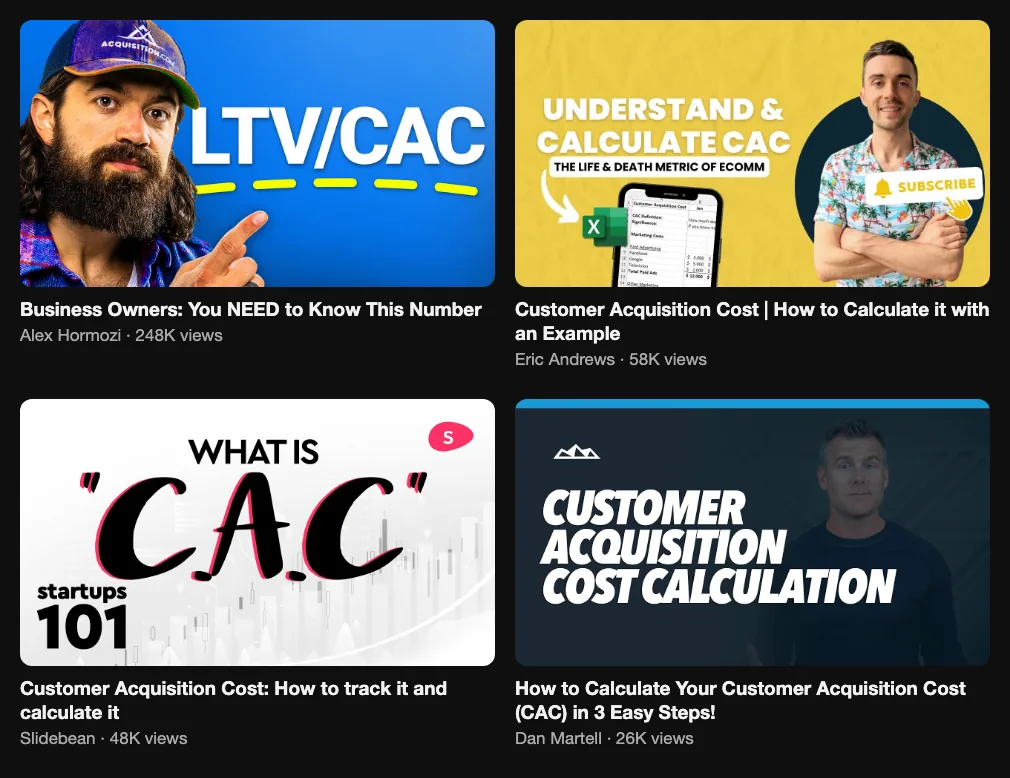
I looked for English videos that explain how to count CAC. They are general business videos, not service-business case studies, and one is about online stores, so take the idea and ignore the examples that don't fit. Views show demand, not how many clients a video brought. YouTube data on 26 October 2026.
- Business Owners: You NEED to Know This Number by Alex Hormozi (248K views). About the ratio of LTV to CAC. Why it works: he defines LTV as lifetime gross profit and CAC as the marketing payroll, media and sales commissions over a period, divided by the customers won.
- Customer Acquisition Cost | How to Calculate it with an Example by Eric Andrews (58K views). Paid and blended CAC, with common mistakes and a template. It is about online stores, so use the logic and not the numbers.
- Customer Acquisition Cost: How to track it and calculate it by Slidebean (48K views). A short explainer from a startup channel on what goes into the formula.
- How to Calculate Your Customer Acquisition Cost (CAC) in 3 Easy Steps! by Dan Martell (26K views). A three-step equation. Why it works: it is short and has one clear promise.
What should you do next?
Take last quarter. List the costs, put a price on your time, divide by the new clients, and write down two numbers: fully loaded and cash-only. Then put your own deal size and close rate into the break-even calculator to see how many clients a year of content would have to bring.
If video makes sense for your numbers, we make it for founders and experts: you film one day a month, we do the rest. Here is what our YouTube strategy service includes. If the math says it doesn't fit yet, I'll tell you that on the call.
FAQ
What is customer acquisition cost?
Customer acquisition cost, or CAC, is the total sales and marketing spend in a period divided by the number of new customers won in that same period. For a service business, it is the cost of winning one new client.
How do I calculate CAC for a service business?
Add all sales and marketing costs for a period: ads, content production, tools, events, commissions, and the value of your own time on sales. Divide by the number of new clients signed in that period. Use a quarter if your sales cycle is long.
Should I include my own time in CAC?
Yes, for an honest number. If you spend 40 hours a quarter on sales calls, that time has a price. Put an hourly value on it, count it, and show a second number without it. Evgeny Maximov tried cold DM outreach in August 2026: 8 calls, and he burned out in two weeks. It cost almost no cash and a lot of energy.
What is a good CAC for a consulting or professional services firm?
There is no single number. Compare CAC with the gross profit from a client. If CAC is well below the gross profit of the first deal, the channel pays back. SaaS investor David Skok suggests a lifetime value to CAC ratio above 3 and CAC recovered within 12 months, but calls these guidelines, and they come from software.
What is the difference between CAC and cost per lead?
Cost per lead is the cost of one inquiry. CAC is the cost of one paying client. CAC equals cost per lead divided by the share of leads that become clients. A $200 lead that converts at 1 in 20 means about $4,000 per client.
What is LTV and how does it relate to CAC?
LTV is the lifetime value of a client. Alex Hormozi stresses that it should mean lifetime gross profit, after the cost of delivery, not revenue. Compare it with CAC to see how much you can afford to spend to win a client.
What is a blended CAC and what is a channel CAC?
Blended CAC divides all sales and marketing cost by all new clients. Channel CAC divides the cost of one channel by the clients it brought. Channel CAC needs good attribution, so ask every lead how they heard about you.
Can content marketing lower my CAC?
It can, over time. Videos and articles keep bringing leads after you publish them, while the cost of making new ones stays about the same. If leads grow and cost does not, CAC falls. It is not guaranteed, and the first months are always a loss.
How long does it take for content to pay back its acquisition cost?
Plan for months. Evgeny Maximov's break-even calculator assumes no calls in months one and two. One of his prosthodontist clients got a single patient from YouTube who paid for half a year of production. Use the calculator with your own deal size and close rate.
Why is referral CAC not zero?
Referrals cost time, thank-you gifts, partner fees and the work that earned the referral. They are often cheap, but not free. Count what you really spend, so you can compare them fairly with other channels.
How often should I recalculate CAC?
Once a quarter. Monthly numbers jump too much when you sign only a few clients. If your sales cycle is long, match costs to the right period: count the spend of the months when those clients first found you.
Founder of a done-for-you YouTube agency for high-ticket founders. Making content since 2014. More about me
Want to know what a client from video would cost you?
Book a call. We'll plug in your deal size, close rate and sales cycle, and you'll leave with a plan, whether we work together or not. 7-day money back guarantee.
Get a free niche review →