Marketing Plan for a Service Business: A One-Page Plan and a 90-Day Template
Most marketing plans are 40 slides that nobody opens. A service business needs one page and a 13-week calendar. Here is how to set the goal, pick one main channel, and fill in a template you can copy into your own document today.
 By Evgeny Maximov·9 min read·
What goes into a marketing plan for a service business?
A plan is a set of answers to eight questions. If you cannot answer one, that is your first task. Here is the one-page version. You can copy this table into Notion, Google Docs or a spreadsheet.
| Part | The question it answers | Your answer (fill in) |
|---|---|---|
| 1. Goal | How many new clients in 90 days, and what are they worth? | |
| 2. Buyer | Who exactly pays you? Role, size, problem, where they look for help. | |
| 3. Offer | What result do you sell, for whom, in what time? | |
| 4. Channels | Which one is main, which supports, which is a test? | |
| 5. Assets | What must exist: booking page, proof, one-pager, videos? | |
| 6. Calendar | Who does what in each week? | |
| 7. Numbers | Which 5–6 numbers do you review every week? | |
| 8. Budget | How much money and how many hours a week? |
That is it. If you want a deeper treatment of each part, I have separate guides on the ideal customer profile, the value proposition and the KPIs. Here I only show how the pieces fit into 13 weeks.
How do you set the goal from your deal size?
Start with money and work backwards to calls. It takes five minutes, and it tells you if your plan is realistic.
| Step | Formula | Example (illustrative numbers, not a client) |
|---|---|---|
| New revenue goal this quarter | your choice | $60,000 |
| Average deal size | from your last deals | $15,000 |
| Clients needed | goal ÷ deal size | 4 clients |
| Close rate on sales calls | signed ÷ calls held | 25% (assume 1 in 4) |
| Sales calls needed | clients ÷ close rate | 16 calls, about 5 a month |
| Show-up rate | calls held ÷ calls booked | 80% (assume) |
| Calls to book | calls ÷ show-up rate | 20 bookings, about 7 a month |
The numbers in the example are made up to show the math. Use your own. If you don't have a close rate yet, take your last ten sales calls and count. If the answer is "I need 7 booked calls a month and I get 2", you now know the gap. It is the one thing the plan has to fix.
Then check the other side: what the plan costs against what one client is worth. Our break-even calculator does this for a content channel, with your own numbers. The cost per client in full is in customer acquisition cost for a service business.
Who is the plan for, and what do you sell?
Two parts decide whether any channel works: the buyer and the offer.
The buyer. Write one sentence: role, company type, the problem, and the trigger that makes them look for help. A rule I like: the 95:5 rule, published by LinkedIn's B2B Institute in 2021. It says that up to 95% of business buyers are not in the market at any one time. It is a rule of thumb, not an exact number. But the logic helps a plan: you need something for the few people buying now, and something for everyone else who will buy later.
The offer. Buyers pay for the result, not for your system. "10 sessions, an online platform and a workbook" is a product. "Fix your sales process so your team closes 2 of 10 more calls in 90 days" is a result (this is an example, not a promise). I wrote about writing yours in value proposition examples for consultants.
Now match content to where the buyer is. I use the Buyer Ladder from my free course The Trust Engine. Here is how its stages map to plan items.
| Buyer stage | What they think | What your plan needs |
|---|---|---|
| Not looking yet | "Everything is fine." | Wide topics that show you exist: a short video, a post, a talk |
| Has a problem but doesn't see it | "Something is off, I don't know what." | Signs and mistakes: "5 signs your referrals are drying up" |
| Knows the problem, not a priority yet | "We should fix this someday." | Cost of waiting and comparisons: build vs buy, now vs later |
| Looking for a solution | "What are my options?" | Guides, price ranges, how it works step by step |
| Choosing who to hire | "Who do I trust?" | Case studies, client stories, a long video, a clear booking page |
A plan that only has content for the last row will get few leads. A plan that only has the first row will bring attention and no calls. For the full funnel, see marketing funnel for a service business.
Which channels should the plan use?
Pick one main channel, one support channel and one test. Five channels at once give you five weak ones. Here is how the common ones compare for a high-ticket service.
| Channel | Speed | Cost | Works best when |
|---|---|---|---|
| Referrals and partners | fast | low | you already have happy clients; ceiling is real |
| Direct outreach (email, LinkedIn messages) | fast | your time | you have a sharp offer and thick skin |
| Speaking and events | medium | time and travel | your buyers meet in rooms, such as conferences |
| Email to your own list | medium | low | you already have contacts to write to |
| SEO and articles | slow | medium | buyers search for answers before they call |
| Long video on YouTube | slow | from $3,000 a month with us | buyers research for weeks and one client is worth thousands |
| Paid ads | fast | media plus management | unit economics work and someone calls leads back at once |
Honest note on direct outreach: I tried cold messages to the market myself. It brought 8 calls, and I burned out in two weeks. It works for some people and it does not for me, so my plans use it in small doses, or not at all. Another warning: referrals are great, but they have a ceiling. I explain it in from referrals to inbound. Paid ads are part of the market, and I describe them here, but we don't run them for clients. We do organic YouTube and social media.
A good starting setup for a firm with a $15,000 deal: referrals as the fast channel for cash, and one slow channel that builds trust. Long video is that slow channel for us. In how much to spend on marketing I explain why you should plan for no calls from content in months one and two.
What does a 90-day plan look like?
Copy this template, change the tasks to match your channel, and put a name next to every line.
| Weeks | Focus | Tasks | Done when |
|---|---|---|---|
| 1–2 | Numbers and decisions | Fill in the goal math. Write the buyer sentence and the offer in one line. Pick the main channel, the support channel and the test. List your last 10 clients and how each found you. | One page is written and a colleague or client has read it |
| 3–4 | Assets | Fix the booking page. Add the question "How did you hear about us?" to the booking form (we do this in Calendly). Collect 3 short client stories. Write a one-page offer sheet. | A stranger can book a call and see proof in two minutes |
| 5–8 | Start the main channel | Publish or send on a fixed day each week. Run the fast channel in parallel: ask five past clients for introductions. Log every lead and its source in one sheet. | Four weeks in a row without a missed date |
| 9–12 | Add the support channel and a test | Reuse what you made: turn one long piece into posts, clips or an email. Start the test with a small time box, such as one talk or one outreach batch. | The test has a clear stop or continue decision |
| 13 | Review | Compare the numbers to the goal. Ask: which source brought signed clients, not only calls? Keep, cut or change each channel. Write the next 90 days. | A new 90-day table exists |
The week 13 review is a decision, not a test you can fail. A slow channel like SEO or YouTube may show few calls in the first quarter and still be right. That is why you keep a fast channel next to it. If you cannot wait a year for a slow channel, do not make it your only one (the burn test).
Which numbers do you check every week?
Set a 30-minute review every Friday and look at six numbers. Keep them in one spreadsheet.
| Number | Where it comes from | What to do with it |
|---|---|---|
| New leads by source | the source question in your booking form, plus tracking links | find which source brings the right buyers |
| Calls booked | your calendar | compare with the 7 a month in the example math |
| Calls held (show-up rate) | your calendar | if low, work on reminders and the page after booking |
| Proposals sent | your notes | if low, the problem is in the sales call |
| Clients signed | your contracts | the only number that is the goal |
| Cash collected | your bank | checks that signed means paid |
For tracking, we use two methods together. First, we ask every lead "how did you hear about us?" and write the answer. We also ask our clients to ask their own leads the same question. Second, tracking links on every video, post and email, so you can see which piece sent the click. The idea of a separate link for each video comes from Olly Richards, who tracks leads for each video he publishes. Neither method is perfect, so compare them. More in marketing attribution for service businesses, and the content version is in YouTube ROI tracking. For which numbers to ignore, read views vs clients.
How much should the plan cost?
For orientation: Gartner's 2025 CMO Spend Survey found marketing budgets at 7.7% of company revenue on average. The survey covered 402 CMOs, most at companies with over $1 billion in revenue. Small firms differ a lot, and a service business that lives on referrals spends close to nothing. Treat 7.7% as a mirror, not a target.
For a slow channel, my rule is stricter than a percentage. If you cannot put $1,000–2,000 a month into content for a year and expect nothing back at first, wait. Write the budget and your weekly hours into part 8 of the plan, and write who owns the work. If the answer is "me, in the evenings", the plan will die in month two. That is the point where a team or a production partner pays for itself. For more on this, see fractional CMO vs agency vs in-house.
Where does video fit in the plan?
Video is the trust layer. A long video answers a buyer's question before the call. Your sales team can send it to a lead after the booking, so the person comes to the call already warm. That works like a sales presentation that builds trust, raises conversion and helps you win better deals on better terms.
Three real examples. A prosthodontist films for two to three hours and gets four long videos and about twenty Shorts. One patient from YouTube paid for half a year of the production. A real estate agency in Thailand got a lead from a 20-minute video with about 500 views, and growth started in month three. A self-storage franchise, Tvoy Sklad, has made 700+ videos since 2022. The founder shows the financial models himself, and partners say on the call that they have already watched everything. These are three different businesses. None of it is a promise for your firm. Read the full mechanics in YouTube lead generation.
What do good marketing plan videos look like?
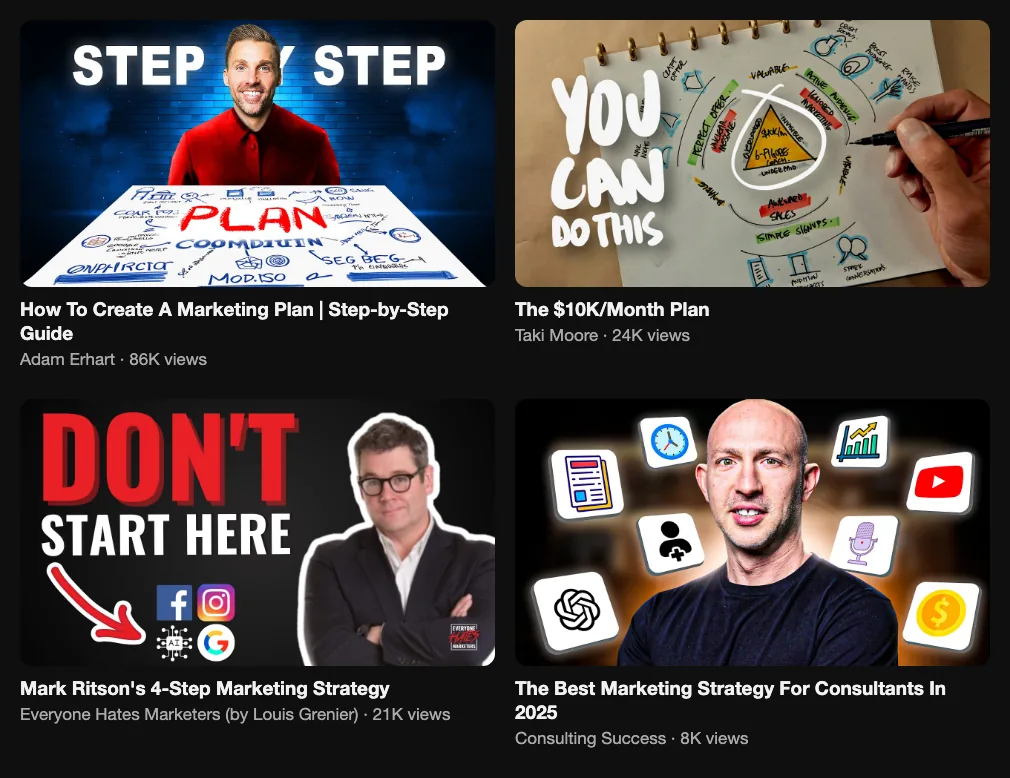
Videos on marketing plans are common, and most come from marketing creators and coaches. I picked four that are close to a service business. Views show demand, not how many clients a video brought. Data is from YouTube on 26 October 2026.
- How To Create A Marketing Plan | Step-by-Step Guide by Adam Erhart (86K views). A ten-minute walk through the steps, made for small businesses. Short and easy to follow.
- The $10K/Month Plan by Taki Moore (24K views). A plan for coaches who want to reach $10,000 a month. A long, 37-minute format for people who want detail.
- Mark Ritson's 4-Step Marketing Strategy by Everyone Hates Marketers (21K views). Strategy before tactics. It is 54 minutes long, and it still gets 21K views, which says people will watch long videos about strategy.
- The Best Marketing Strategy For Consultants In 2025 by Consulting Success (8.2K views). Made for consultants, so closest to your buyer. Under 10,000 views, so read it as a niche example.
If you are a consultant or a coach, the closest example for the channel side is how to market a coaching business and consulting marketing.
What is the next step?
Copy the first table into a page. Fill in goal, buyer and offer today. Block the Friday review in your calendar. If your plan says long video is the slow channel, but you have no time to film, our YouTube strategy service puts it into a calendar with you. If video does not fit your numbers, the break-even calculator will show it before you spend a dollar.
FAQ
What goes into a marketing plan for a service business?
Eight parts: a goal in signed clients, the buyer, the offer, the channels, the assets (page, booking form, proof), a calendar, the numbers you will check, and the budget. For a small firm all of it fits on one page, plus a 13-week calendar.
How do I write a marketing plan step by step?
Start from the goal: divide the revenue you want by your average deal size to get clients, then divide by your close rate to get sales calls. Pick one buyer and one offer. Choose one main channel, one support channel and one test. Put tasks into 13 weeks and review the numbers every week.
How long should a marketing plan be?
One page for the strategy and one table for the next 90 days. A plan that is longer than that is usually not used. Review it every quarter and change the next 90 days, not the whole thing.
Why a 90-day plan and not a yearly plan?
Ninety days is long enough to see whether a channel works and short enough to change it. A yearly plan is a good direction, but a service business learns fast from real calls. Many firms keep a yearly goal and a 90-day plan under it.
How much should a service business spend on marketing?
Gartner's 2025 survey of large companies found marketing budgets at 7.7% of company revenue on average. Small firms differ a lot. Evgeny Maximov's rule for content is simple: do not start unless you can put $1,000–2,000 a month into it for a year and expect nothing back at first.
Which marketing channel is best for a service business?
There is no single best one. Referrals and direct outreach bring clients fastest. SEO, email and long video build slowly and keep working. For high-ticket services, choose one main channel, one support channel and one test, and give each at least a full quarter.
How do I track where my clients come from?
Ask every lead "how did you hear about us?" in your booking form and on the first call. Add tracking links to each video, post or email. Compare both with your sales calls. Self-reported answers catch things that link tracking misses, like a video someone watched a month ago.
What should be in the first 30 days of a marketing plan?
Set the numbers (deal size, close rate, goal), pick the buyer and the offer, fix the page where people book a call, add the booking question about the source, and collect proof. No new channel should start before this is done.
Do I need a marketing plan if I get clients from referrals?
Yes, a short one. Referrals have a ceiling, and you do not control when they come. A plan adds a second source that you do control, so a slow quarter does not stop your pipeline.
Where does video fit in a marketing plan for a service business?
As the trust layer. A long video answers a buyer's question before the call, and the sales team can send it to warm up a lead. Evgeny Maximov's agency produces this kind of video from $3,000 a month and does not promise views, calls or clients.
Is there a marketing plan template I can download?
The tables in this article are the template. Copy them into a Notion page, Google Docs or a spreadsheet and fill in your own numbers. There is no form to fill in and no email needed.
Founder of a done-for-you YouTube agency for high-ticket founders. Making content since 2014. More about me
Want help filling in the plan?
Book a call. We'll go through your numbers, your buyer and your channels. If video does not fit, I'll tell you. 7-day money back guarantee.
Get a free niche review →