Fractional CMO vs Marketing Agency vs In-House: Who Should You Hire?
You need marketing help, and you have three kinds of people to hire. They cost different money and fix different problems. Here are the public 2026 prices, a simple bottleneck test, and when it makes sense to use two of them together.
 By Evgeny Maximov·9 min read·
What is the difference between a fractional CMO, an agency and an in-house hire?
These are three different jobs that people put under one word, "marketing help". A fractional CMO is a senior person who works for you a few days a month. An agency is a team you pay a monthly fee. An in-house hire is an employee. I added freelancers to the table, because many small firms start there.
| Model | What you get | Typical public price (2026) | Fits best if | Weak spot |
|---|---|---|---|---|
| Fractional CMO | strategy, budget, priorities, hiring and managing vendors, reporting to the founder | about $3,000–15,000 a month; $5,000–10,000 is the common middle | marketing runs, but nobody owns it | one person with several clients; does not do all the work |
| Marketing agency | a team that runs channels: SEO, ads, content, email, design | about $2,500–15,000 a month for most B2B; $10,000–30,000+ for full go-to-market | the plan is clear and you need capacity | strategy is often thin; you can pay for activity, not results |
| In-house marketing manager | one employee who knows your firm | median pay $165,780 a year in the US; about $204,000 fully loaded | there is steady work for one person every week | one skill set; salary even in slow months |
| In-house CMO | an executive who builds and leads a team | about $175,000–350,000 base, plus benefits and recruiting | you have a team and many channels | expensive; needs a team to lead |
| Freelancers and specialists | one skill per person: writer, editor, ad buyer | from about $100–250 an hour | you know exactly what you need | you become the project manager |
Sources: MarketerHire, fractional CMO cost, April 2026 ($3,000–15,000 retainer, $175,000–350,000 full-time CMO base); Matthew Deal, June 2026 ($5,000–15,000 for most engagements); SaaS Hero, B2B agency pricing 2026 ($2,500–15,000 retainers, $204,000 for a fully loaded in-house manager); New Perspective, 2026 ($10,000–30,000+ full go-to-market, $100–250 an hour); US Bureau of Labor Statistics (advertising, promotions and marketing managers, median pay $165,780, May 2025). The fractional and agency guides are written by firms that sell these services, so the numbers may lean high. Checked in October 2026.
Sources do not agree at the edges. One guide says a fractional CMO costs $3,000 a month at the low end, another says above $15,000 you are paying for an executive. The price mostly follows how many days a month you get and how senior the person is.
How much does each option cost over a year?
Monthly numbers hide the real gap. Here is the same year in dollars, using the public ranges above and an example fractional CMO at $8,000 a month.
| Option | Per year | What is not in the number |
|---|---|---|
| Fractional CMO at $8,000 a month | about $96,000 | the team or agency that does the work |
| Agency retainer, $5,000–15,000 a month | about $60,000–180,000 | ad spend, your time to review work |
| In-house marketing manager | about $165,780 pay, about $204,000 loaded | tools, ad spend, recruiting time |
| In-house CMO | about $175,000–350,000 base | benefits, equity, recruiter fee, and a team under them |
Notice what the CMO row does not include: the people who do the work. A fractional CMO at $96,000 a year plus an agency at $60,000 is $156,000, which is close to one loaded manager. The difference is that you get a senior head and a team, not one person doing both jobs badly.
Before you compare any of these, decide what you can spend. For a rule of thumb: Gartner's 2025 CMO Spend Survey found marketing budgets at 7.7% of company revenue on average. Most of its 402 respondents worked at companies with more than $1 billion in revenue, so a small firm will land elsewhere. I wrote about how to set your own number in how much to spend on marketing.
Which one do you need? The bottleneck test
Most owners ask "who should I hire". The better question is "what is stopping us". Look at what happens when you try to get a client this month, and find the first thing that breaks.
| What you see | The bottleneck | Who fixes it |
|---|---|---|
| We do a lot of things and do not know what works. Nobody owns the numbers. | Strategy and ownership | Fractional CMO |
| We know what to do. It does not get done. | Execution capacity | Agency, freelancers or one in-house hire |
| Marketing is a daily job and we have 3 or more channels running. | Steady workload | In-house manager (later, a CMO) |
| We have a plan and a channel. The founder or expert must be the face, and the content does not get made. | Content and the founder's time | A production partner, with the expert on camera |
| Leads come, but nobody buys. The offer or the sales call is weak. | Offer or sales | None of the three yet. Fix the offer and the call first |
The last row matters. A fractional CMO guide I read says the same: if the product is wrong or the sales team cannot close, a CMO will not fix it. I agree. I would also add that the fourth row is where I work. When the gap is "the expert has no time to be on camera", you do not need a CMO. You need a way to film once a month and publish every week. A founder has to be in the frame. Nobody can hire that away.
Tvoy Sklad, a self-storage franchise we work with since 2022, is the clearest example I have. The founder is the face of the channel. He shows the financial models in videos and live streams himself. Partners come to the call and say they have already watched everything. A CMO could plan that channel, but a CMO could not be him.
When does a fractional CMO make sense?
It makes sense when marketing exists, but it is a pile of tasks with no owner. The founder is still deciding every ad and every post. A guide from June 2026 puts the time at about four to twelve days a month, depending on price. That is enough to set priorities and review the numbers, but not to run campaigns.
- You have a budget and no plan. Money goes to ads, an agency and events, and nobody can say what each one brought.
- You pay an agency, and cannot judge it. A CMO reads the reports for you and says what to cut.
- You are about to hire a big team. A fractional CMO helps you decide what to hire first.
- You are between hires. It can cover the gap until you hire a full-time leader.
It does not make sense when you need someone to write articles, edit videos or run ads every day. And watch the usual failure: a smart plan nobody executes. If you hire a CMO, you need a person or an agency to carry out the plan from week one.
When does an agency make sense?
An agency makes sense when the job is clear and recurring: publish content, run SEO, handle email, edit video. You buy capacity and a team with tools. The risk is the opposite of the CMO's: lots of work, little thinking. If you cannot judge the work, ask the questions in how to choose a B2B marketing agency, or add a fractional CMO to check them.
When does an in-house hire make sense?
When marketing is a full-time job and it will stay one. The person learns your clients, your language and your sales team. You can ask them to sit in on calls. The cost is a fixed salary and one set of skills. For the content side, I compared this in detail in agency vs in-house content team. An in-house team in the US costs about $30,000 a month for a full video group, against our done-for-you service from $3,000 a month.
Can you combine them?
Yes, and the combinations often beat any single option. Here are the three I see most.
| Combination | How it works | Watch out for |
|---|---|---|
| Fractional CMO + agency | The CMO sets the plan, picks the agency, reads the reports and says no to weak ideas. | Two fees. Make sure the CMO is not paid by the agency. |
| Fractional CMO + production partner | The CMO decides which questions the expert answers. The production team films, edits and publishes. | The expert must still show up to film. |
| In-house manager + agency | The manager owns the plan and the agency adds channels and capacity. | The manager needs real authority over the agency. |
For video, the split is simple. Strategy decides what the buyer needs to hear. Production turns it into videos the sales team can send before a call. A long video works like a sales presentation that warms up the lead, builds trust and helps you close better deals on better terms. I wrote about it in B2B video marketing. Our own service is only the production part. We do not run paid ads or manage ad accounts.
What do fractional CMO and agency videos look like on YouTube?
This topic is small on YouTube. Most videos come from the firms that sell the service, with a few thousand views each. I picked four that answer the buyer's real question. None is above 10,000 views, so read them as examples of what buyers ask, not as proof of scale. Views show demand, not how many clients a video brought. Data is from YouTube on 26 October 2026.
- What is a Fractional Chief Marketing Officer (CMO) & What Do They Do? by Alex Cattoni (6.5K views). The plain definition from a marketer with a wide audience. It is the question the buyer types first.
- In-House vs Marketing Agency: Which Earns The Best ROI? by Exposure Ninja (3K views). An agency compares itself with an in-house team. It is a good example of a comparison done openly, even if the seller has a stake.
- Fractional CMOs for Professional Services: Half the Cost, Double the Expertise by Digital Authority Partners (2.9K views). A fractional CMO firm speaks to professional services directly. Short, with a clear claim.
- What is a Fractional Law Firm CMO and Should You Hire One? by the Law Firm CMO Playbook Podcast (1.4K views). A 31-minute conversation about costs, how a CMO differs from an agency, and how to evaluate candidates. Small, but made for a high-ticket buyer.
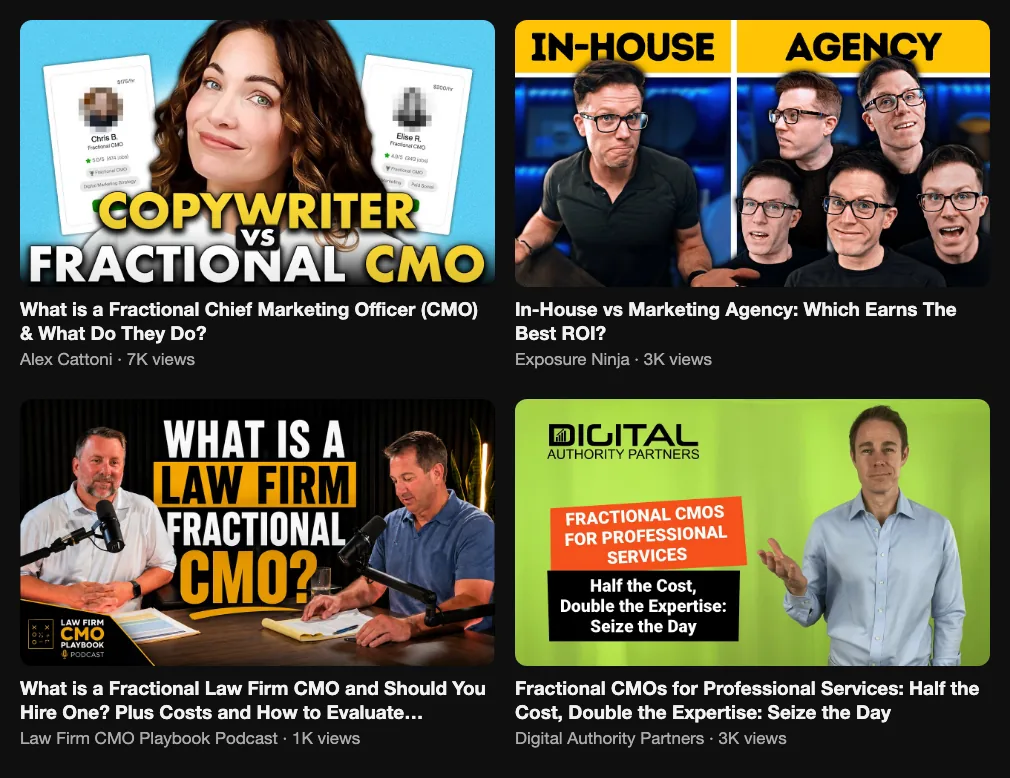
A fractional CMO who films themselves answering "how do I know I need you" has an easy topic and little competition. I wrote about that for executives in YouTube for fractional executives.
How do you decide in one week?
- Write your last three lost months. For each, say what you did, what it brought and who decided. If nobody can answer, the gap is strategy.
- Count the hours. How many hours a week does marketing really take? Under ten hours of mixed work is a freelancer or an agency. Over twenty steady hours is an in-house job.
- Find the first thing that breaks with the table above. Do not fix the second problem before the first.
- Ask two providers for a 90-day plan. Compare what they would do in the first month, and which numbers they would report.
- Start small and put an exit in the contract. A short first term is better than a long discount.
Be careful with promises. "First page of Google in 60 days" or "20 leads a month" can happen, but usually it does not. Most often it is a marketing trick with an asterisk, and the conditions show up later in the contract. Our only guarantee is 7 days of money back. We never promise views, calls or clients.
What is our experience here?
We help experts and founders produce content, with YouTube production for experts and founders with high-ticket services. You film about one day a month, and we do the strategy for the channel, scripts, editing, thumbnails and publishing, from $3,000 a month.
What I do have: a prosthodontist who films for two to three hours, gets four long videos and about twenty Shorts from that, and one patient from YouTube paid for half a year of the production. The story is in orthodontic marketing. If your bottleneck is a strategy for the whole business, hire a CMO. If it is that the expert has no time to make content, the YouTube strategy service is where we start.
We also adapt and republish that content on other platforms when the client needs it. We cut clips from long videos and prepare them for LinkedIn, Instagram, TikTok and other social channels. One recording can supply content across your social platforms. See how we reuse YouTube videos beyond YouTube.
FAQ
What is the difference between a fractional CMO and a marketing agency?
A fractional CMO is one senior person who owns your marketing strategy, budget and numbers for a few days a month. An agency is a team that does the work: ads, SEO, content, email, video. The CMO decides what to do. The agency does it. Many companies hire both.
How much does a fractional CMO cost in 2026?
Public 2026 guides put retainers at about $3,000–15,000 a month, with $5,000–10,000 as the common middle. Hourly rates run about $150–500. These guides come from agencies and recruiters, so treat them as direction, not a quote.
How much does a B2B marketing agency cost per month?
Public 2026 guides give about $2,500–15,000 a month for most B2B retainers, and $10,000–30,000 or more for a full go-to-market program. Ad spend is usually extra. Price depends on how many channels the agency runs for you.
Is a fractional CMO cheaper than a full-time CMO?
Usually yes. A fractional CMO at $8,000 a month is about $96,000 a year. Guides put a full-time CMO at about $175,000–350,000 base salary before benefits and recruiting fees. You also get fewer hours and a person who works for several clients.
When should I hire a fractional CMO instead of an agency?
Hire a fractional CMO when nobody owns the marketing plan, budget and results. Hire an agency when the plan is clear and you lack hands to do the work. If you do not know which case you are in, start with the bottleneck test in this article.
Can a fractional CMO and an agency work together?
Yes, and it is a common setup. The fractional CMO sets the plan, picks the agency, checks the reports and says no to bad ideas. The agency does the work. This costs more than one of them, but it protects you from paying an agency for activity that does not matter.
When is an in-house marketer better than an agency?
When you have enough steady work for one person every week, you want someone who knows your firm deeply, and you can manage them. A marketing manager is also one skill set. Many firms add an agency or freelancers for the skills that person does not have.
Do I need a CMO if I am a solo consultant or a small firm?
Usually not. A solo expert with a clear offer can run one channel alone or with a freelancer. A fractional CMO makes sense when you have several channels, a budget to manage and a team that needs direction. Below that, a good plan and one channel are enough.
Will a fractional CMO make videos for me?
Usually not. A fractional CMO plans and manages. Production is a separate job: scripts, filming, editing, thumbnails, publishing. Evgeny Maximov's agency does that part for experts and founders, from $3,000 a month, and works well next to a CMO who owns the strategy.
Should a fractional CMO guarantee results?
Be careful with any guarantee of leads, rankings or revenue. It can happen, but usually it does not, and the conditions show up later in the contract. Ask for a clear 90-day plan, the numbers they will report and a short exit period instead.
How long should I keep a fractional CMO?
Plan for at least six months. A new strategy needs time to run before you can judge it. Many engagements end when the company has a plan that works and hires a full-time leader, or when the team can run it without help.
Founder of a done-for-you YouTube agency for high-ticket founders. Making content since 2014. More about me
Not sure which gap is yours?
Book a call. I'll tell you honestly if your bottleneck is content or something else, even if the answer is that you need someone other than us. 7-day money back guarantee.
Get a free niche review →