Ideal Customer Profile for Consultants: Who to Say No To
Most ideal customer profiles are a guess made in a spreadsheet. A useful one is built from your best five clients and your worst three, and it includes a list of people you politely turn away. Here is the template, the red flags and how we use it.
 By Evgeny Maximov·9 min read·
What is an ideal customer profile, and how is it different from a buyer persona?
The terms get mixed up, so here is the short version in one table.
| Term | Describes | Example for a consultant | Used for |
|---|---|---|---|
| Ideal customer profile (ICP) | the type of client or company | marketing agencies with $2–10M revenue and a founder who still does sales | choosing who to target and who to refuse |
| Buyer persona | a person inside that client | the founder: tired of unclear numbers, afraid of hiring the wrong finance person | choosing words, topics and examples |
| Target account list | named companies that match the ICP | 40 agencies in a spreadsheet | outreach and relationships; see account-based marketing |
| Avatar | the person who already pays you the most | your top-paying client, described in detail | the same as a persona, but built from real people |
The example is made up, to show the pieces. The order matters: ICP first, then persona, then list, then the words. Our guide on value propositions for consultants shows how the line grows out of the profile.
Why does a consultant need one?
Because it makes every other marketing decision cheaper. Without it, you write for everyone, your content drifts, and sales calls fill with people you can't help. A profile gives you topics for videos, a list for outreach and a reason to say no to a bad project.
There is also some evidence that focus pays. Hinge's High Growth Study, on more than 500 professional services firms, defined high growth as at least 20% compound annual growth. It found that these firms were much more likely to target a highly specialized niche. A later edition showed a more nuanced picture. High-growth firms specialized in services, problems and roles, and low-growth firms leaned more on industry focus. So "narrow" can mean the problem or the role, not only the industry.
Source, checked in October 2026: Hinge Marketing, 2017 High Growth Research Report (500+ firms, three years of data). It is the firm's own study and is several years old. The nuance on later editions comes from a secondary summary of the 2018 edition, which I did not read in full.
How do you build one in an afternoon?
Don't start with a blank page. Start with the clients you already have.
- List your last 10–20 clients. Projects too, if you have no recurring clients.
- Score each one from 1 to 5 on four questions: Did they pay well? Did they get a result? Were they easy to work with? Would I take them again?
- Pick your top five and your bottom three. The top shows the pattern. The bottom shows the red flags.
- Find what differs. Company size, industry, who hired you, what happened before they called, how they heard about you, how fast they decided.
- Write it on one page using the table below.
| Field | Question | Example (invented) |
|---|---|---|
| Company | Size, industry, stage? | marketing agencies, $2–10M revenue, 10–40 people |
| Situation | What happened before they called? | they lost a big client, or a partner left |
| Buyer | Who signs and who is the sponsor? | the founder, with the operations lead in the room |
| Problem, in their words | How do they describe it? | "I don't know which clients make us money." |
| Budget and speed | What do they spend, how fast do they decide? | $3,000–6,000 a month, a decision in two calls |
| How they look for help | Where do they ask, read or watch? | peer groups, LinkedIn, referrals, YouTube |
| Red flags | What did bad clients have in common? | asks for a discount before the first call |
If you have fewer than five clients, treat the page as a guess and update it with every sale.
Where do you get the real data?
- Your calendar and CRM. Who booked, who bought, how long it took.
- Call recordings. The words buyers use for their problem are better than any you invent. Olly Richards, in his YouTube for Business intensive, builds the customer description from exactly this: sales call transcripts, emails, survey answers and comments.
- A 15-minute chat with each top client. Ask why they hired you, who else they considered and what almost stopped them.
- The "how did you hear about us?" question. We ask it in our Calendly booking form and ask our clients to ask it of their own leads. The answers show which kind of person finds you, and where.
Who should you say no to?
The no-list is the part of an ICP that nobody writes, and it saves the most time. You write it once, calmly, so you don't decide it again on every call, under pressure, when the invoice looks tempting.
| Red flag | Why it matters | What you can do |
|---|---|---|
| Budget below your minimum | you will cut scope or lose money | name your minimum on the first call |
| Nobody can say yes | the deal will stall for months | ask to bring the decision maker to call two |
| Wants a result you don't control | you will be blamed for the market | agree on what you can influence |
| Asks for a discount before the first call | price is the only thing they are comparing | send proof, not a lower price |
| The problem is outside your skill | a bad result hurts your name | refer them to someone better |
How to say no, in one breath: "I don't think I'm the right fit for this, and here is why. Here is what I would do in your place." That costs you five minutes and often returns as a referral.
Who do we say no to?
Our ideal client is a founder, expert or consultant with a high-ticket service, who has real expertise and a product, and no time or team for YouTube. The no-list is as important.
- People who want to be bloggers. Lifestyle creators, or anyone who wants to "become a YouTuber". We work with business owners who need clients, not subscribers.
- Low-ticket offers that count on going viral. Our focus is high-ticket, where 500 views from the right people can be worth more than 100,000 from nobody who buys.
- A budget of a few hundred dollars for everything. Our done-for-you work starts from $3,000 a month.
- Founders who don't watch YouTube. I ask: "Do you watch YouTube?" If you don't watch it, you won't enjoy making it.
We also use a five-question filter before anyone invests in content. Is the market big? Is it a country or the world, not one district? Is the ticket high or the product complex? Will you still be in this niche in five years? Do you have two to four years of expertise? More than three yeses means go. Fewer means exhibitions, events and pitches may work better. Sometimes I tell a lead not to start at all. If the niche has no views on YouTube, there is nothing to sell yet, and I say so on the call.
One personal rule: put in only what you can afford to burn. For content that is $1,000–2,000 a month, expecting nothing at first.
How does the profile change your content and sales?
| Profile field | Where you use it |
|---|---|
| Company and buyer | the first line of your offer and your target list |
| Situation | video topics: what happened right before they started looking |
| Problem in their words | titles, thumbnails and the first 30 seconds of a video |
| How they look for help | the channel: YouTube, LinkedIn, events or referrals |
| Red flags | your qualifying questions and the pre-call page |
The stage matters too. I use the Buyer Ladder from my free course The Trust Engine. If your ideal client is at choosing who to hire, write about price, process and risks. If they are at has a problem but doesn't see it, write about the hidden cost. Pick the stage your best clients were at when they found you, and start there.
Olly Richards makes another point: one customer with many problems works better than one problem for three kinds of customer. That is also the logic behind niching down on YouTube.
How does video attract the right clients and repel the wrong ones?
A long video is a filter. Someone who is not a fit stops watching in two minutes. Someone who is a fit watches for twenty, and arrives at the call already trusting you. Our Thai real estate client got a lead from a dry 20-minute video with about 500 views. The viewer was exactly the right person. At Tvoy Sklad, a self-storage franchise we have worked with since 2022, videos mostly get 2,000–20,000 views, and partners often arrive at calls saying they have already watched everything. In 2024–2025 the company attracted about $5M in investments and 20+ franchise partners, and the founder himself shows the financial models in videos and live streams. The full case is here. These numbers don't promise anything for your firm. They show that a narrow topic plus a trustworthy face finds the right 500 people.
The video also does the "no" for you. Honest numbers, a stated price range and a clear "this is not for you if..." in a video repel the wrong buyers without a single awkward call. How a channel helps you win consulting clients is in consulting marketing without cold outreach.
What mistakes make an ICP useless?
- It describes a market, not clients. "Mid-size companies in North America" is a continent.
- It is built from hopes. A profile of clients you wish you had, not the ones who paid.
- It has no red flags. A profile without a no-list will let everyone through.
- It is never checked. If your last three clients don't match, change the profile or your marketing.
- It is too wide for your size. A one-person firm can't serve five segments well.
Which real videos explain the ideal customer profile?
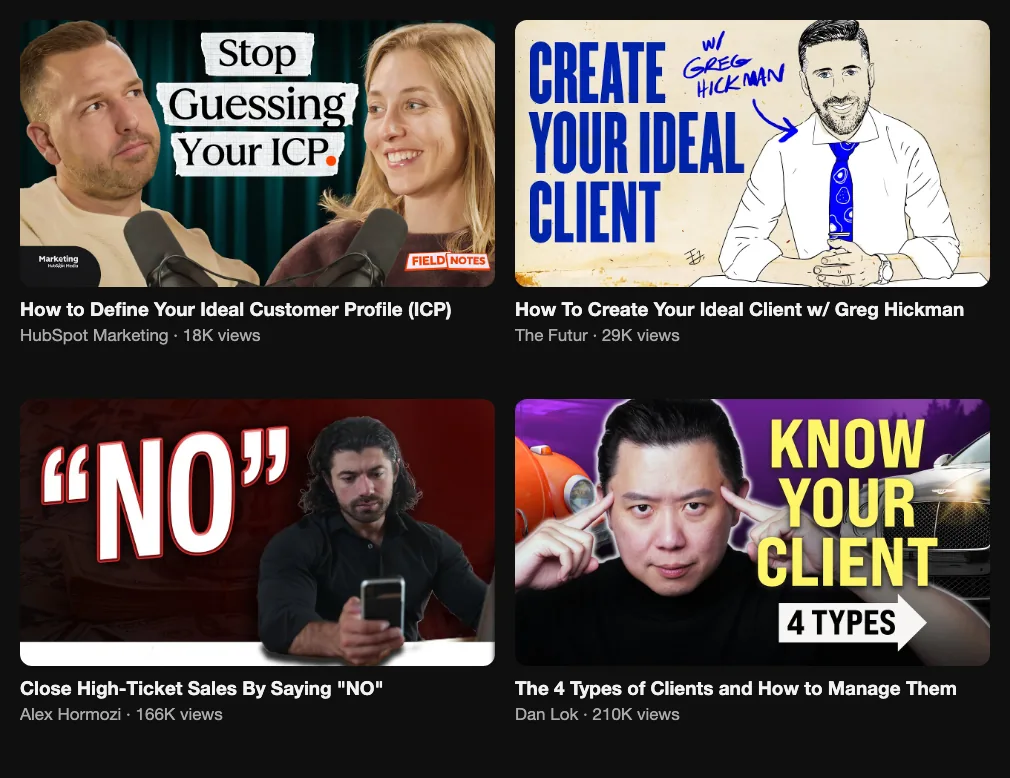
I searched YouTube for videos on defining an ideal client, for services rather than software. Most explainers are for software marketers, so I added two on choosing and saying no to clients. Views show demand for the topic, not how many clients a video brought. Data is from YouTube on 26 October 2026. I describe each from its title and description.
- How to Define Your Ideal Customer Profile (ICP) (HubSpot Marketing, 18K views). Finding the customer that really drives your business, with or without a data team.
- How To Create Your Ideal Client w/ Greg Hickman (The Futur, 29K views). Do you find bad clients, or make them? Aimed at designers, and it applies to consultants too.
- The 4 Types of Clients and How to Manage Them (Dan Lok, 210K views). Client types and how to handle each, useful for your no-list.
If you want a channel built around your best kind of client, that's what our done-for-you YouTube service does, from $3,000 a month. We start with the strategy: who the buyer is and which questions they ask. For the plan alone, see YouTube strategy. We don't promise views, calls or leads. Only a 7-day money back guarantee.
FAQ
What is an ideal customer profile for a consultant?
It is a written description of the kind of client who gets the best result from your work, pays well, stays and is easy to work with. It covers the company, the situation that makes them buy, the person who decides, the budget and the red flags. It is built from your real past clients, not from a guess.
What is the difference between an ICP and a buyer persona?
An ideal customer profile describes the company or the type of client: size, industry, situation and budget. A buyer persona describes a person inside it: role, worries, words they use. You need the ICP first, to know which companies to look at, and the persona second, to know what to say to the people there.
How many ideal customer profiles should I have?
One, to start. If you have two very different kinds of good client, write two, but run them separately. Trying to talk to three audiences with one message is a common reason content and marketing do not work.
How do I build an ideal customer profile if I have few clients?
Use what you have. Rank your last 10 clients on four questions: did they pay well, did they get a result, were they easy to work with, would you take them again. Look at the top three and the bottom three and write down what differs. With fewer than five clients, treat the profile as a hypothesis and update it with every new sale.
What should be on the no-list?
The signs that a buyer will be a bad fit: a budget below your minimum, no authority to decide, wanting results you can't control, wanting a discount before the first call, and a problem outside your skill. Write them down once, so that you don't argue with yourself during every call.
How do I say no to a client who is not a fit?
Say it briefly, kindly and give a next step. For example, tell them honestly that your work is not the right fit for their situation, name what would make it a fit, and suggest a cheaper or better option. A short free piece of advice costs you little and builds trust.
Does a narrow ideal customer profile limit my growth?
It limits the number of people you talk to, not the number of clients you win. Hinge's High Growth research on more than 500 professional services firms found that high-growth firms were much more likely to target a highly specialized niche. It is the firm's own study, so read it as a pattern, not a law.
How do I find out who my best clients are?
Look at billing and results, not only at how pleasant the call was. Add a short interview with each of your best clients: why they hired you, what else they considered and what almost stopped them. Call recordings and a 'how did you hear about us' question in your booking form give you the rest.
How does an ideal customer profile help my content and videos?
It tells you which questions to answer. If your ICP is a founder who is choosing who to hire, the videos should cover price, process and risks. If your ICP has a problem but does not see it yet, the videos should name the hidden cost. One profile means one channel with a clear promise.
Can video help me attract the right clients and repel the wrong ones?
Yes. A long video with a clear topic and honest numbers filters people before the call. Those who are not a fit stop watching. Those who are come in already trusting you. Evgeny Maximov's agency has seen leads from videos with only a few hundred views, because the viewers were exactly the right ones.
How often should I update my ideal customer profile?
Review it every quarter, and after every five new clients. Look at who actually bought, not who you hoped would. If your last three clients do not match the profile, either the profile or your marketing is off.
Who is not a fit for Evgeny Maximov's agency?
People who want to become a lifestyle blogger or a YouTuber, those who expect viral views from a low-ticket offer, those with a budget of a few hundred dollars for everything, and founders who do not watch YouTube themselves. The agency works with founders and experts who sell high-ticket services. It does not promise views, calls or leads. Its only guarantee is 7 days of money back.
Founder of a done-for-you YouTube agency for high-ticket founders. Making content since 2014. More about me
Want a channel built for your best kind of client?
You film one day a month. We plan the topics around the questions your ideal client asks, then edit and publish. 7-day money back guarantee.
Get a free niche review →