The 3 Types of Media Team Every Founder Ends Up With (and Which One to Pick)
Type one costs your time. Type two costs your nerves. Type three costs money. I've been in all three, and here is how to find yours.
 By Evgeny Maximov·10 min read·
What are the three types of media team?
There are only three. Type one: you do everything yourself. Type two: you and a bunch of freelancers, and you're the boss of all of them. Type three: a producer runs the whole team, and you just show up to film.
I've been in all three. In 2014 I was fourteen and did everything myself: filming, editing, thumbnails, scripts. Later I worked with freelancers and became a full-time manager. Today a team sits behind each of my clients, and the client spends one day a month. Two of these three types almost burned me out.
What are the seven jobs behind one video?
Before comparing teams, count the jobs. The only real difference between the three types is who does each of them.
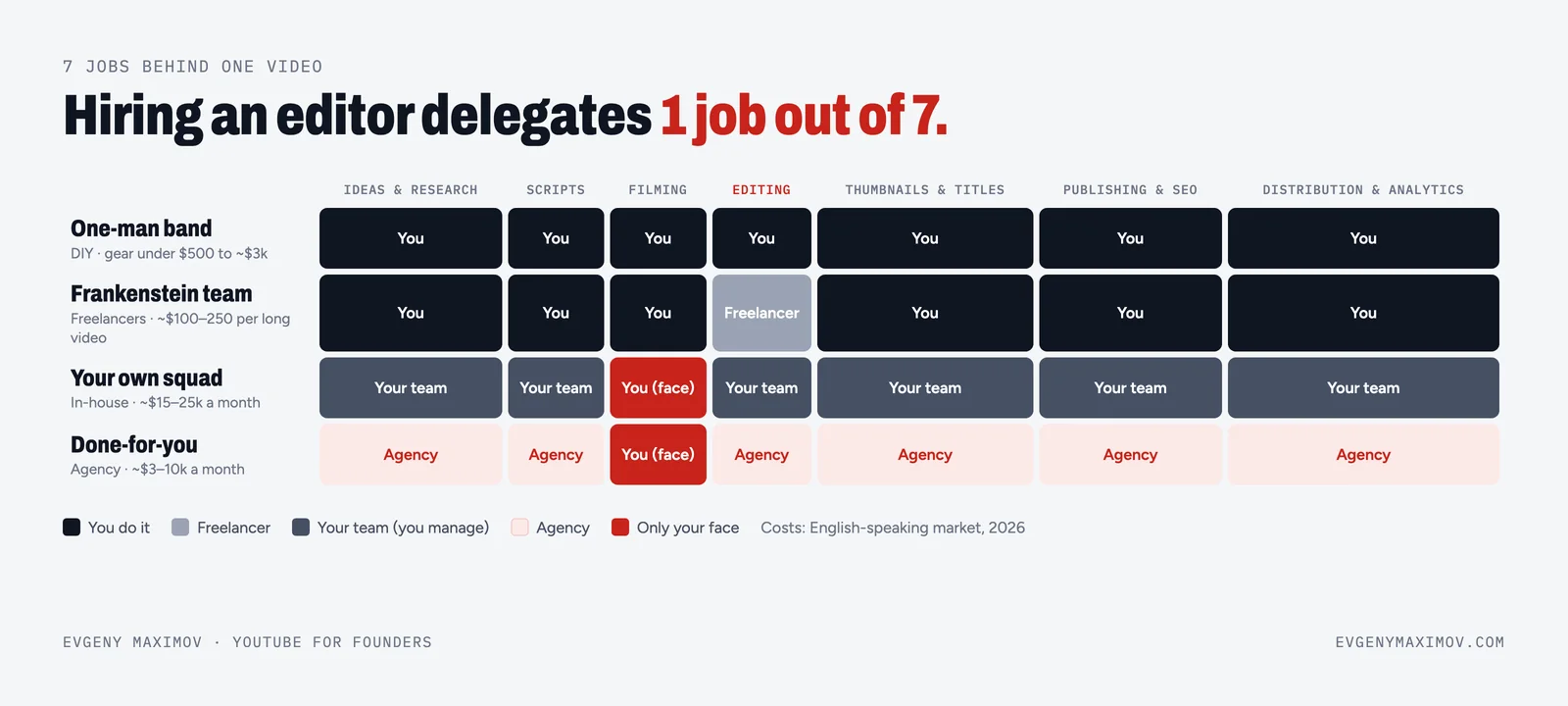
Look at the freelancer row. In type 2 the work moves to other people, but the management and the strategy never leave you.
Type 1: when does the one-man band stop working?
You, a phone and an editing app, now with AI on top. All seven jobs are yours. It's a normal start, but for a founder it's an expensive trap. Your highest-leverage job is sitting in front of the camera, not learning Premiere. Most founders open a video editor once, think “holy crap, this is too complicated”, and close it.
That was my life from 2014 until summer 2025. I filmed, edited, recorded voiceovers, made thumbnails, wrote scripts and managed clients, all by myself. In summer 2025 I had record months and was burning out. I couldn't take more clients, and I couldn't raise prices, because I had no capacity to make the service better. A vicious cycle.
When type 1 is right: you're testing a format and looking for your voice, you truly enjoy editing, or you have no budget at all. When to leave: when your videos wait for you instead of you waiting for them. You are the bottleneck of your own content.
How to make the first step out? Don't hire an editor just because everyone hires an editor. Hire around your bottleneck. Footage that sits on a drive for weeks is an editing problem. No ideas means a scriptwriting problem. And test people with a paid trial week instead of “let's try for a month”.
Type 2: why does a team of freelancers fail founders?
You hire an editor, a thumbnail designer, maybe a reels maker. They do the jobs, but management and strategy stay on you. Every arrow goes through you. You're no longer a creator. You're a production manager without a salary. And each piece lives on its own: the long-form editor doesn't know what the shorts editor does. The team is stitched from parts, like Frankenstein.
Here is the line I use for this type:
Nobody on this team owns the result. Except you. At 11 p.m.
The editor is responsible for editing and the designer for the thumbnail. Who is responsible for the channel bringing clients? Nobody, except you. Caleb Ralston, who builds in-house teams for big personal brands, calls this a team in silos and says fixing it is a big part of his work.
What does a founder really do in type 2? Reviews the raw footage, writes the brief and guidelines, catches mistakes (“you forgot the one B-roll that matters”), chases deadlines, and tests freelancers until a good one appears.
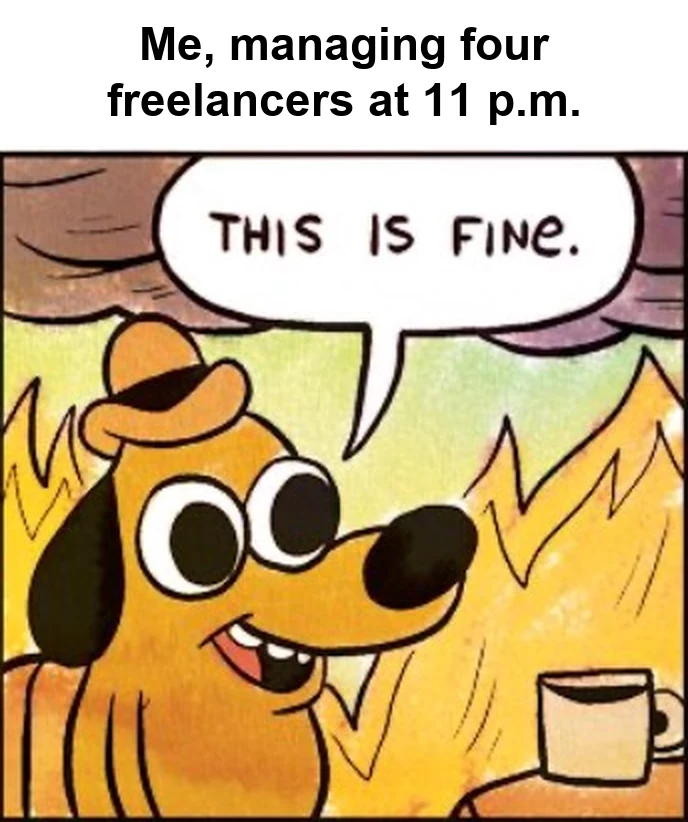
I once worked with a client who changed three or four reels makers in less than a year. Nobody owned the strategy. They kept replacing people, but the problem was one level higher.
When type 2 works: you already have a format that works, you have checklists, and you actually like managing people.
Type 3: why is your first media hire a producer, not an editor?
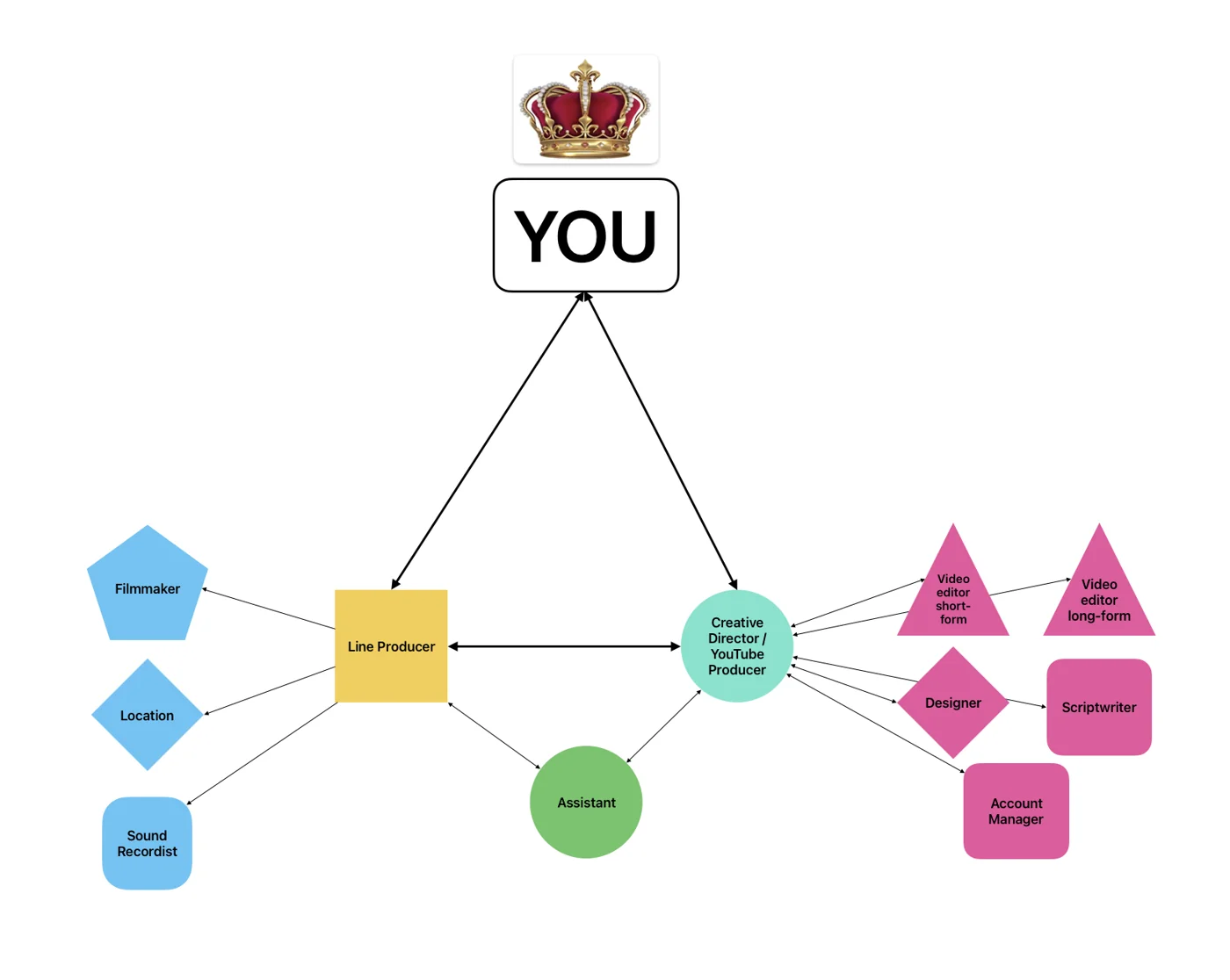
A producer stands between you and the team. You give a task to one person, and the producer runs everyone else. Management finally leaves your plate.
Your first real media hire is not an editor. It's a producer.
When I decided to build the agency in August 2025, my first hires were an assistant and a YouTube producer, and he's still with me. Not an editor. Caleb Ralston reached the same conclusion from the other side of the ocean: his first hire in his own business was a content director.
Who is in the team? A producer for creative and scripts, a line producer for filming, editors, a thumbnail designer, an account manager who checks quality, and an assistant. The client talks to two people at most.
The hardest part isn't hiring. It's letting go. I had to learn to shut up and watch the producer make mistakes. There's a difference between managing and leading. A manager says what to do. A leader gives the goal, the deadline and the budget, and the team decides how.
Money matters here too. Editing is about half of production cost, and editors are the best-paid people on my team. Good editing is the product, so I'd rather pay for it.
Two ways to get type 3
| Build in-house | Rent an agency | |
|---|---|---|
| Control | full control over every person | less control over specific people |
| What you must do | hire 4+ people, build processes, give them enough volume | choose a partner and start filming |
| Speed | months to hire and train | starts from the first filming day |
| Watch out for | hiring mistakes and idle people | conveyor agencies that share one team among too many clients |
If you build in-house, hire an account manager first. How we hire: a short job ad, hundreds of applicants, filters, interviews, and then a paid trial week for the best few. Not “let's see how it goes”.
An honest note about agencies. Caleb Ralston makes a fair point: many agencies film two or three months of content at once, and then the feedback loop becomes two or three months long. The videos don't work, but they keep getting published because “we already made them”. We do it differently. One filming day a month is not “batch and forget”. It's one day to film and thirty days to learn from the data before the next one. Every month we review the numbers for each client and change the next shoot.
Which media team type do you need? A three-question test
There is no best team. There is the team for your stage. Jumping a level is as dangerous as staying on one.
- Do you watch YouTube, and do you enjoy making content? If you love editing, type 1 is fine. If you don't watch YouTube at all, don't do YouTube. Choose your own platform.
- How many hours a week can you give to managing, not filming? Five or more, and you enjoy managing people: type 2. Close to zero: only type 3.
- What is one client worth to you? If a single client can pay for months of production, the math of type 3 works. If your budget is tiny, start with type 1 and learn.
One bonus question for your first hire: where do your videos get stuck? That's your bottleneck, and your first hire goes there. If everything is stuck at once, you don't need a specialist. You need a producer.
And give it time. A strong brand takes around two years. The first months with 50 views per video are normal.
So which type are you right now?
Type one costs your time. Type two costs your nerves. Type three costs money, but it's the only one where you get to be the founder again. If you want to build type three yourself, hire the producer first. If you'd rather not hire, manage and replace people, that's the part we take on.
FAQ
What are the types of media team for a founder?
There are three. Type one is the one-man band: you do everything yourself. Type two is a team of freelancers where you manage everyone and own the result. Type three is a producer-led team: you give goals to one producer, who runs the editors, designer and publishing, while you show up to film.
Who should be my first media hire: an editor or a producer?
Usually a producer, not an editor. An editor solves one job, but a producer owns ideas, scripts and the team, so management leaves your plate. Evgeny Maximov's first hires when he built his agency were an assistant and a YouTube producer, and Caleb Ralston also names a content director as his first hire.
What are the seven jobs behind one YouTube video?
Strategy and research, the script, filming (light, camera and sound), the speaker on camera, editing, the thumbnail, and publishing with analytics. There is also an eighth job that people forget: management.
Why does a team of freelancers often fail for founders?
Because nobody owns the result except the founder. The editor is responsible for editing and the designer for the thumbnail, and each works separately, so strategy, management and quality control all stay on you.
When is the one-man band the right choice?
When you are only testing a format and looking for your voice, when you truly enjoy editing, or when there is no budget at all. It becomes the most expensive team once you are a founder with a business to run, because it costs your time.
How many videos can one video editor handle in a month?
A long-form editor can usually handle about 8 to 10 long videos a month before quality drops. Editing is also about half of production cost, which is why good editors are the best-paid people in Evgeny Maximov's team.
Should I build an in-house media team or hire an agency?
Build in-house if you need content every day, can hire at least four people and have the volume to keep them busy. Hire an agency if you want to start from the first filming day, with processes and people already in place. You trade some control over specific people for speed.
How does a good agency avoid the batching trap?
Filming two or three months of content at once makes your feedback loop two or three months long. A better setup is to film every month and review the numbers once a month before planning the next shoot, so the loop is one month.
How do I know which media team type I need?
Ask three questions. Do you watch YouTube and enjoy making content? How many hours a week can you give to managing, not filming? What is one client worth to you? Love for editing points to type one, spare management time to type two, and little time with a high-value client to type three.
Can I move straight to a producer-led team without experience?
It is risky. Skipping a level can hurt as much as staying on one. Test the format first, learn what you want from the platform, then hand over management. Also remember that strong brands take about two years to build.
Founder of a done-for-you YouTube agency for high-ticket founders. Making content since 2014. More about me
Want type three without building it yourself?
You film one day a month. A producer and a team handle the rest, and you talk to two people at most. 7-day money back guarantee.
Book a call →