Is YouTube Worth It in 2026 for Your Business? The 5-Question Test I Run Before Taking a Client
I make YouTube channels for a living, and I tell a lot of business owners not to start one. Here are the five questions I ask first, and what your answers mean.
 By Evgeny Maximov·7 min read·
Why a YouTube producer tells people not to start
I've been making YouTube content since 2014. My agency builds channels for business owners. And a lot of my sales calls end with me saying: “Don't do this right now.”
It sounds like bad business. It's the opposite. A client who starts YouTube with the wrong expectations quits in month three, says “YouTube doesn't work”, and tells their friends. A client who starts at the right moment stays for years and refers others. So before I take anyone, I run five questions. You can run them on yourself in ten minutes.
Question 1: Is one client worth a lot to you?
This is math, not opinion. Take what you'd spend on content in a year and divide it by your average deal size. That's how many clients YouTube has to bring to pay for itself.
With a $10,000 service and $60,000 a year in content, you need six clients a year. One every two months. Very doable for a business channel. With a $15 haircut, the same budget needs 4,000 haircuts. That's why I don't recommend YouTube to a single barbershop. Promoters, a loyalty program and local search will do more. A franchise of barbershops, though, where one franchise deal is worth a lot? Completely different answer.
Yes if: one client pays for at least a month or two of content. Run your numbers in our break-even calculator.
Question 2: Do your buyers choose by trust?
YouTube works best where people choose by trust in an expert, not by the lowest price. Where a mistake is expensive, the decision takes weeks or months, and the buyer wants to know who they're dealing with before they call.
Building houses. Investments. Medicine. Consulting. Franchises. Legal work. In these markets, a buyer happily watches 20 minutes of an expert explaining their field, because it's cheaper than a mistake. In markets where people pick the cheapest option in two minutes, a long video is overkill.
Look at Tvoy Sklad, a self-storage franchise. Who watches videos about storage units? Only investors and people thinking of buying a franchise. Exactly the people they need. The channel helped attract about $5M in investment, and investors arrive at meetings saying they've watched everything.
Yes if: your buyers research before they buy, and they buy from people they trust.
Question 3: Can you burn this money for a year?
This is the question I ask every potential client, and it makes people uncomfortable:
Are you ready to spend this money for a year, and expect nothing back?
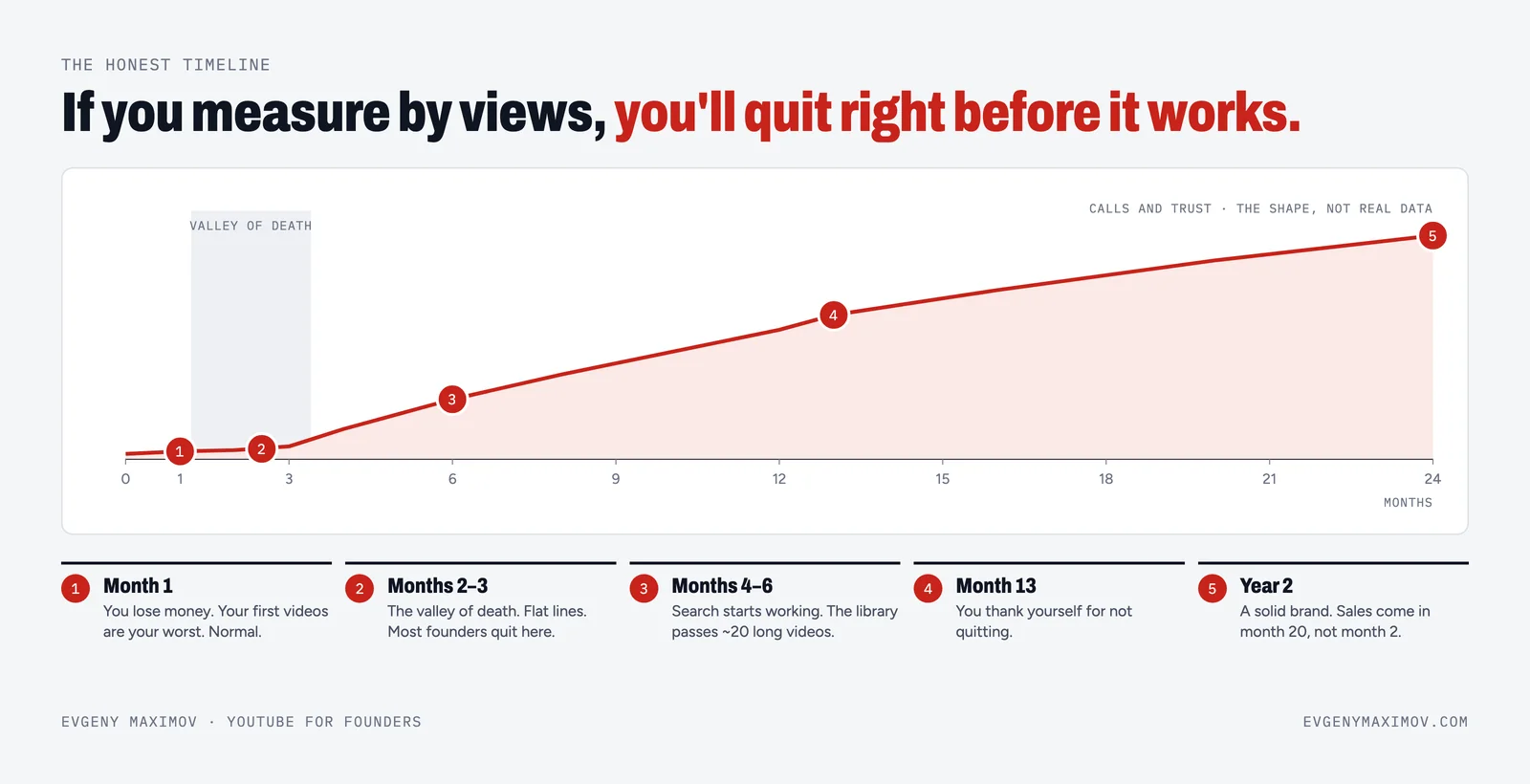
Not because nothing will come back. Because content compounds slowly. You post, and post, and post, and on the third attempt something takes off. With ads, you know in weeks. With content, you know in months. Our real estate client in Thailand had two flat months. Growth started in month three, and then all the videos started moving at once.
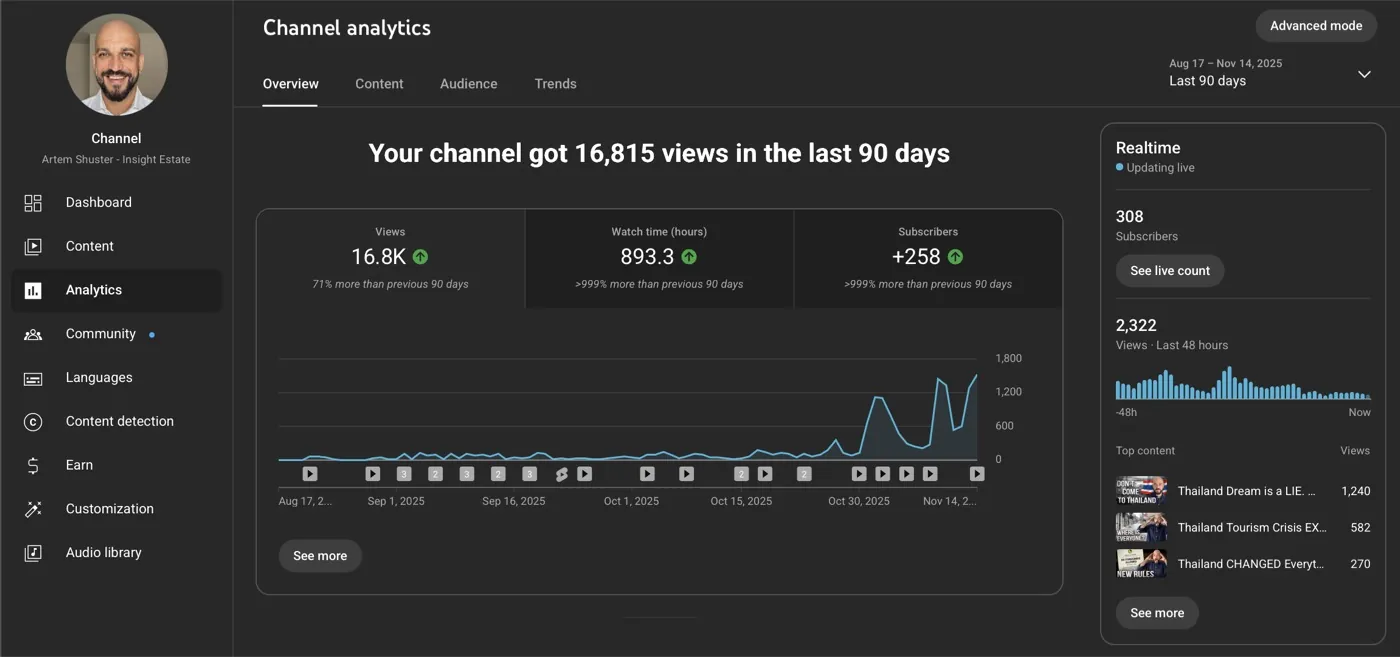
If this is your last marketing money, don't. You'll quit right before it works. My rule of thumb: if you can't put at least $1,000–2,000 a month into content for a year while expecting nothing at first, wait. More in how much to spend on marketing.
Yes if: you can commit for at least a year without needing it to pay back next month.
Question 4: Does your market already exist on YouTube?
Open YouTube in an incognito window and search your service the way your buyer would. Not your words, theirs. “How to open a self-storage business.” “Dental implants cost.” “How to choose property in Thailand.”
- You find 4–5 channels talking about it? The market exists. Good. Now you need a better angle.
- You find big channels only? Fine. Look for what they don't cover.
- You find nothing? Either buyers search differently, or the niche is too new. Try their words. If there's still nothing, YouTube may not be the first channel for you.
Judge views by your niche, not by YouTube in general. In some niches, 1,000 views per video is a great result. And for a business channel, the right viewers matter more than many viewers. One of the leads for our Thailand client came from a 20-minute video on how to choose property there. About 500 views. Very dry: numbers, charts, percentages. Meanwhile, a viral video on my own channel with about 260,000 views brought me zero sales. More on that in why views don't bring clients.
Yes if: your buyers already watch videos about your topic.
Question 5: Does the format fit you?
People think YouTube means jumping around, shouting and doing trends. For business, it's the opposite.
At a live review, a renovation contractor showed me his Reels. He's one of the calmest people I've met. Precise, steady. And he was forcing himself into 30-second clips. I told him: maybe you shouldn't make Shorts at all. But calm is perfect for long videos. In a field where a mistake costs thousands, a detailed, slightly “boring” expert is exactly who buyers trust. I've seen a very dry video about building a house from aerated concrete with about 400,000 views and around 200 chapters. Every few seconds: what this costs, what that costs.
The other half of this question: who will do the work? If you're the founder, the salesperson and the project manager, adding scripts, filming, editing and publishing on top won't last. You either need a small team or a done-for-you service. One filming day a month is realistic for most founders. Every day is not.
Yes if: you can show up on camera in a way that feels natural, and someone besides you can handle production.
What your answers mean
| Your answers | What I'd recommend |
|---|---|
| 5 yes | Start. Long videos first, one filming day a month, plan for a slow first quarter. |
| 4 yes | Start, and fix the “no” first. Usually it's budget or who does the work. |
| 3 yes | Start small: a few deep videos you can send to leads, not a full growth channel. |
| 2 or fewer | Not now. Clean portfolio profiles, partners, offline events or ads. Come back in 6–12 months. |
The “3 yes” option deserves more attention. Even when a full channel doesn't make sense, a small set of “needed videos with no views” often does. Twenty videos about your business, made once: why you, how you work, the process, the team. Few views. But your sales team sends them for years. I wrote about that in B2B videos your sales team will use.
Why 2026 is still a good year to start
People ask me if YouTube is “too late”. For business, it's the opposite. Three reasons.
- Long videos are becoming rare. Most business owners post short clips because they're easier. A founder who explains their field in depth for 20 minutes stands out more every year.
- AI search reads YouTube. When people ask AI tools for recommendations, video transcripts and chapters are part of what gets found. I cover it in AI search optimization with YouTube.
- Videos keep working. Ads stop when you stop paying. A good video keeps getting found for years, through search and recommendations. My 47-minute documentary is still growing from search months after release.
If the answer is “not yet”
Not starting is a valid decision. Here's what I tell people who aren't ready:
- Make your profiles a clean portfolio. A clear bio, links that work, nine strong posts. People who hear about you can check you're real. My social media audit covers it.
- Go where your buyers already are. Speak at events, partner with businesses that have your clients.
- Run ads only if the unit economics work and someone can call the leads back.
- Write down your five-year goal. If YouTube is part of it, plan when you'll start.
And if you answered yes to most of the questions, don't wait for a perfect moment. The first months are an investment either way. The sooner you start, the sooner they're behind you.
FAQ
Is YouTube worth it for a business in 2026?
It's worth it for businesses with high deal sizes, buyers who choose by trust, a market that already watches YouTube, and the patience to invest for 2–5 years. Evgeny Maximov runs a five-question test before taking any client and often recommends not starting if the answers are no.
What kind of businesses should use YouTube?
Businesses where one client is worth a lot and the decision takes time: franchises, clinics, consultants, coaches with high-ticket programs, real estate, B2B services and investment projects. Evgeny Maximov's client Tvoy Sklad, a self-storage franchise, used YouTube to help attract about $5M in investment.
Who should not start a YouTube channel for business?
A single local business with a low price, like one barbershop; anyone putting their last money into marketing; anyone who needs clients next month; and businesses that change direction every year. For them, ads, partners, local search or offline sales work better for now.
How do I know if my market is on YouTube?
Search your service the way a buyer would. If you find 4–5 channels talking about it with real views, the market exists. If you find nothing, buyers may search differently or the niche may be too new for YouTube.
How long until YouTube brings clients to a business?
Plan for nothing in the first two months. Evgeny Maximov's agency had a real estate client in Thailand with two flat months and growth from month three; one of their leads came from a 20-minute video with about 500 views.
Do I need to be charismatic to use YouTube for business?
No. Calm, detailed experts often do better in long videos than in Shorts, especially in fields where mistakes are expensive. Evgeny Maximov tells some calm founders to skip Shorts entirely and focus on long-form videos.
How much does YouTube for business cost?
Doing it yourself costs time rather than money, but most self-run channels stop within 2–3 months. Done-for-you agencies usually start around $3,000 a month. Evgeny Maximov's rule: if you can't spend at least $1,000–2,000 a month on content for a year expecting nothing at first, wait.
Is YouTube better than Instagram or LinkedIn for business?
For high-ticket services, long YouTube videos build more trust: a buyer can spend 20 minutes with you before the first call, and videos keep getting found through search and AI answers for years. Short platforms are better for reach and staying visible.
Can YouTube bring clients with few views?
Yes. A business channel needs the right viewers, not many viewers. A video with about 500 views brought a lead to one of Evgeny Maximov's clients, while a viral video with about 260,000 views on his own channel brought zero sales.
What should I do if YouTube isn't right for me yet?
Make your social profiles a clean portfolio, invest in partners, offline events or paid ads that pay back faster, and revisit YouTube when you can commit to it for a few years. A free, honest call can help you check which path fits.
Founder of a done-for-you YouTube agency for high-ticket founders. Making content since 2014. More about me
Want an honest answer for your business?
Book a call and we'll run these five questions together. If YouTube isn't worth it for you yet, I'll tell you and say what I'd do instead. 7-day money back guarantee.
Book a call →