If I Were Jasmine Star: How I'd Use YouTube to Fill Her Webinar
Jasmine Star's business already has a working sales machine: a free class that leads to her offer. The machine doesn't need fixing. It needs more people. YouTube can bring them, but right now her channel is held back by three things: outdated packaging, descriptions that don't convert and missing SEO. Here's what I'd change, problem by problem.
 By Evgeny Maximov·8 min read·
If you're not Jasmine, but you sell through a webinar or a free class, this plan is for you too.
How does Jasmine Star make money?
Her Instagram bio says it plainly: a digital offer for consistent $10k months, and a free class to learn how. The class is the sales machine. Whether she teaches it live or it runs as an automated (evergreen) webinar, the logic is the same: the class already converts, so every extra person who watches it is extra revenue.
And that's good news for YouTube. An evergreen funnel fits YouTube much better than launches. Launch funnels need urgency: doors open, doors close. YouTube videos keep getting found for years, so it's hard to make them urgent. A few creators with huge, loyal communities run launches from YouTube every year. For most businesses, an always-on class is the better match.
That changes how YouTube should be used. It's not a place to post more content. It's a traffic source for a machine that already works.
What does her YouTube look like today?
Here's what I found on October 13, 2026.
| What | Now |
|---|---|
| about 691,000 followers | |
| YouTube | about 82,700 subscribers |
| Long videos | The Jasmine Star Show, video podcast, 14–55 minutes, about 300–3,400 views |
| Shorts | almost daily, about 90–1,300 views |
| Best recent long video | "Stop Being Afraid to Talk About Money", about 3,400 views |
About 691,000 followers on Instagram, about 82,700 on a YouTube channel that's around 15 years old. I'll be honest: for a channel that age, that's weak.
The channel is active, and the content is good: real coaching conversations, stories, strong opinions. The problems are all in how the videos are packaged and connected to the business.
How big is the demand for Jasmine on YouTube?
Bigger than her channel shows. On October 14, 2026 I checked the top 40 YouTube results for her name. Her interview on The Nathan Barry Show, Forget Courses, Sell This in 2026 To Make 7 Figures, got about 231,000 views in three weeks. Her own new long episodes get about 300 to 3,400.
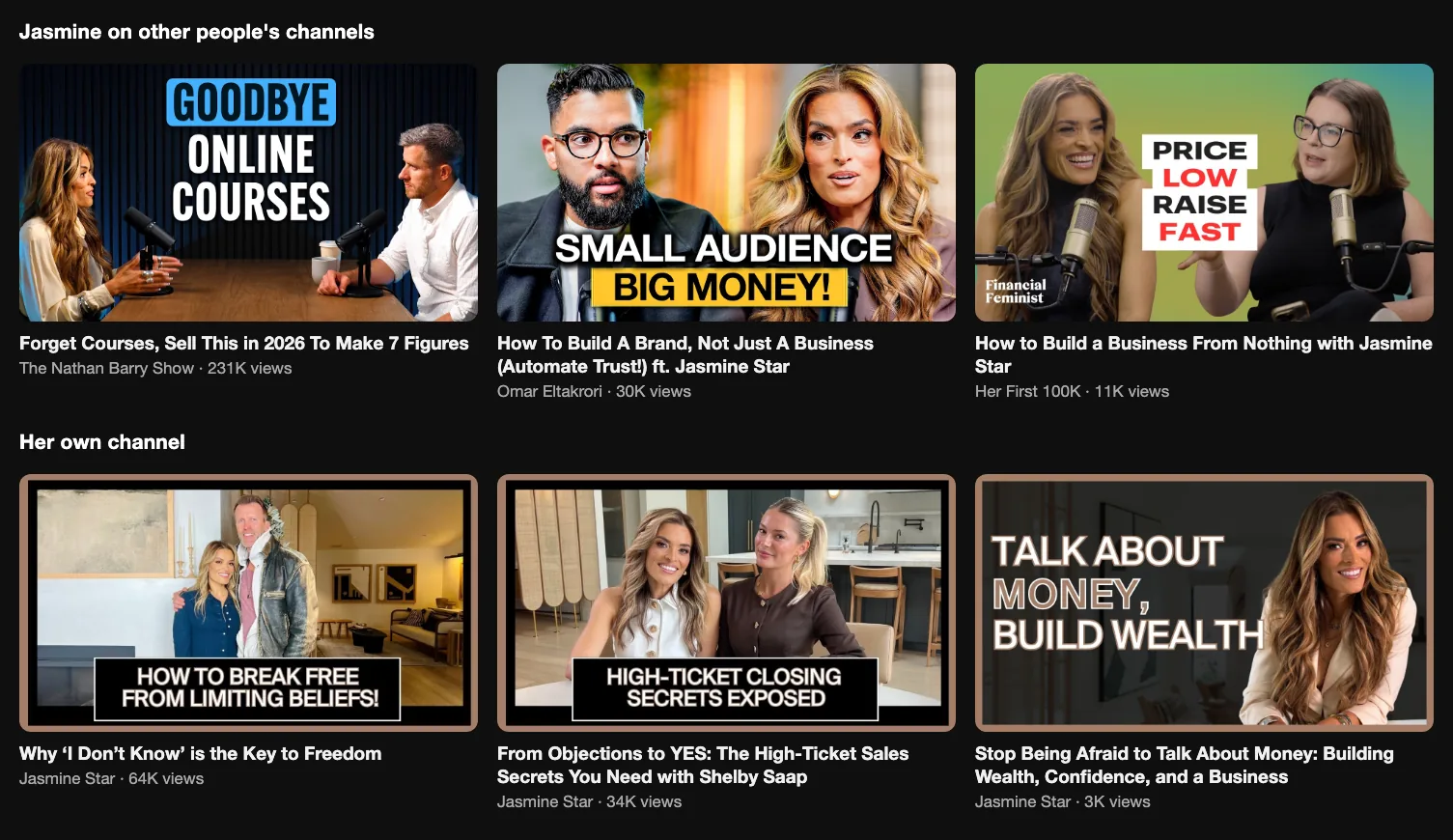
Same person, same kind of conversation. The Nathan Barry title is a promise about money and a business model, with no episode name in sight. Even on her own channel, the two videos that broke out (about 64,000 and 34,000) have short, clear titles. The audience is there. The packaging decides whether it finds her.
Problem 1: why does the packaging hold the channel back?
Here are her latest long videos:
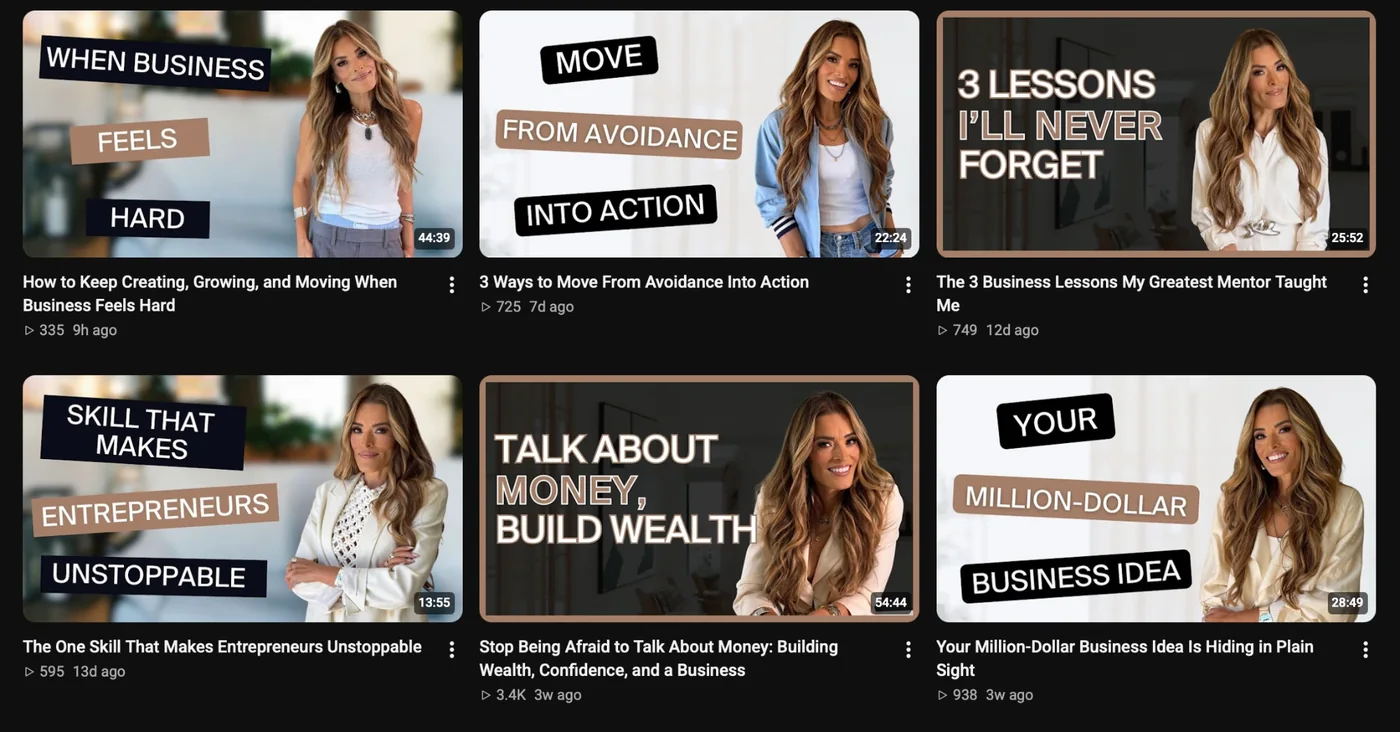
This style, words in boxes next to a posed photo, is how business channels packaged videos about eight years ago. It doesn't work on YouTube today, and the views show it. Three issues:
- Too many words. "When business feels hard", "Move from avoidance into action". On a phone, that's a blur.
- Every thumbnail looks the same. Same layout, same colors, same pose. In a feed, they don't stand out from each other, let alone from other channels.
- The copy-paste problem. The same words appear in the title and on the thumbnail. They should be a team, not twins: the title carries the logic and the benefit, the thumbnail the emotion in two to four words.
- Titles describe instead of pulling. "How to Keep Creating, Growing, and Moving When Business Feels Hard" explains the episode. It doesn't give anyone a reason to click.
A quick way to check any package is what I call the BUCK test: Benefit, Urgency, Curiosity, Kin. “How to Keep Creating, Growing, and Moving When Business Feels Hard” has a benefit and the kin (“business” speaks to business owners). It has no curiosity and no urgency. Why should I watch it right now? Compare it with “Is it normal to feel stuck in your business?” and a thumbnail that just says “Normal?”. Now I want to know the answer.
Look at how a channel in the same niche packages its videos. Sunny Lenarduzzi (about 795K subscribers) teaches experts to build a business, just like Jasmine:
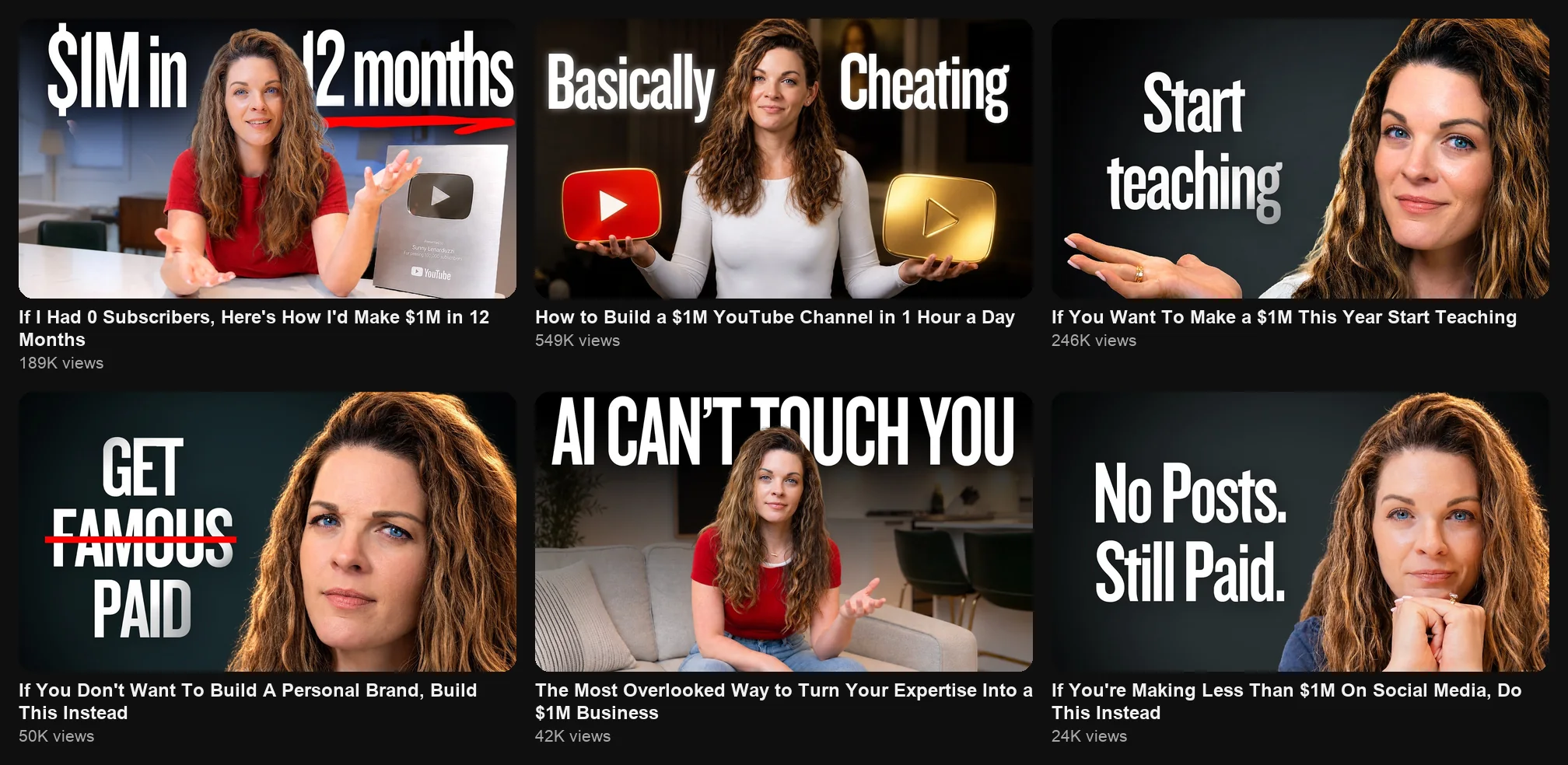
- Two to four big words that add to the title instead of repeating it.
- One emotion on the face, close up.
- Titles with a promise or a twist: "If I Had 0 Subscribers, Here's How I'd Make $1M in 12 Months".
Jasmine's own data points the same way. Her best recent long video is the most specific one: "Stop Being Afraid to Talk About Money", about 3,400 views, several times more than the others. Here's how I'd re-package two of the latest:
| Now | Re-packaged | Thumbnail text |
|---|---|---|
| 3 Ways to Move From Avoidance Into Action | Why You Avoid the One Thing That Would Grow Your Business | "I'll do it tomorrow" |
| How to Keep Creating, Growing, and Moving When Business Feels Hard | If Your Business Feels Hard Right Now, Watch This | "Normal?" |
The full approach is in our thumbnail and title guide.
Two more things I noticed. Her studio videos have two cameras and nice dynamics, but the exposure and color temperature look unnatural. And for the premium look she's going for, Matt Gray is a good reference: clean, luxury aesthetic, modern packaging. She spends real money on filming and editing, and then the most important part, the packaging, gets a two-second template. That's the gap. My advice isn't “hire a thumbnail designer”. It's to have a YouTube producer who understands packaging and manages the designer, working with her on every title.
Problem 2: why don't the descriptions bring leads?
Here's the description of "3 Ways to Move From Avoidance Into Action":
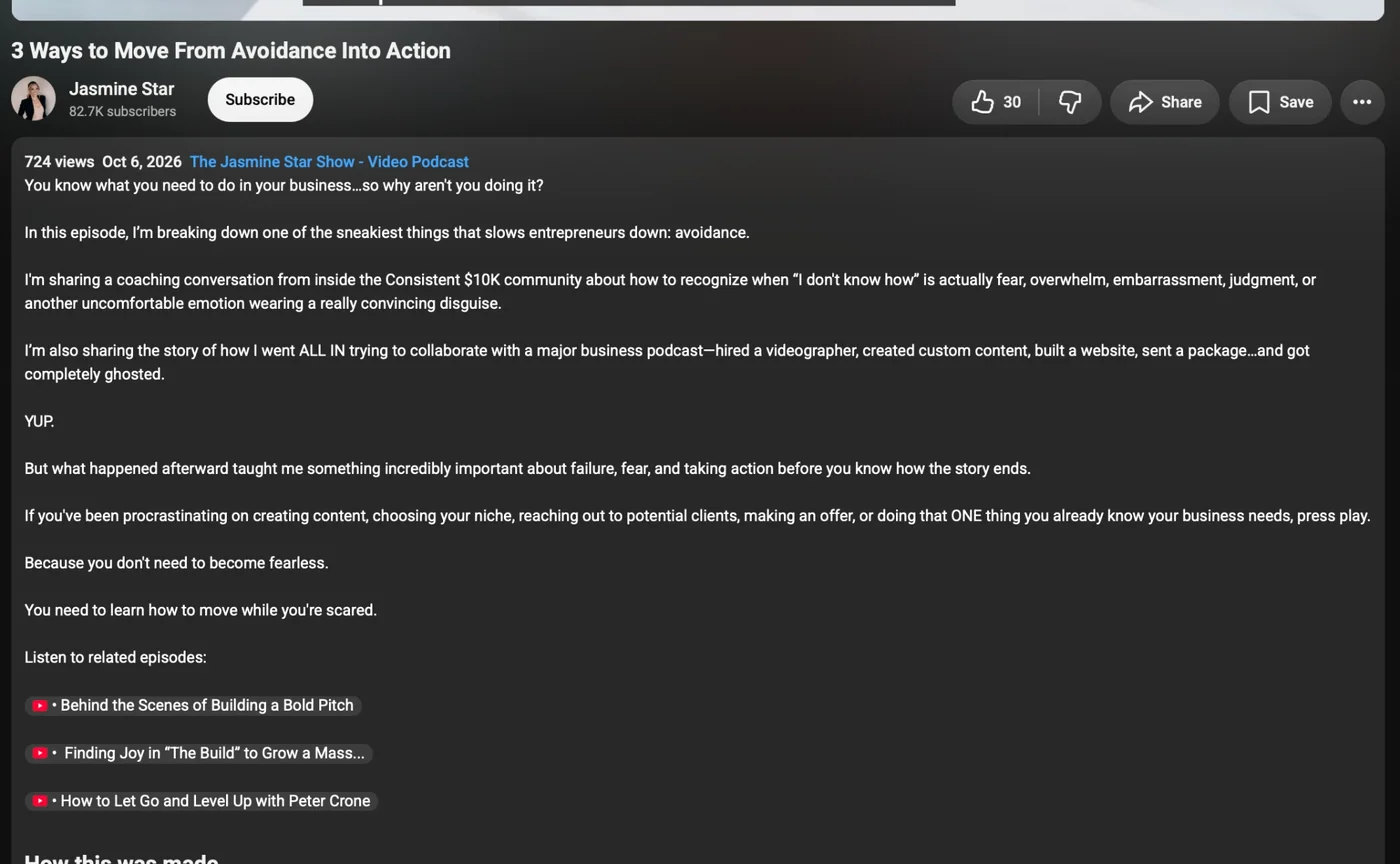
It's well written. It mentions the Consistent $10K community. And there isn't a single link to the class or the offer. A viewer who loved the episode and wants more has nowhere to go except another episode. On mobile, people see only the first line or two, so that's where the main link has to be.
Here's a description she could copy for every episode:
👉 Free class: how to create a digital offer for consistent $10K months → [link to the class]

In this episode: [one sentence: the problem and what the viewer will be able to do after watching].

0:00 [The hook]
2:15 [Chapter 2]
9:40 [Chapter 3]
21:05 [Chapter 4]

▶ Join the Consistent $10K community → [link]
▶ Watch next: [one related episode, as a link]

About me: I'm Jasmine Star, a business strategist and CEO of J* Brands. I help small business owners turn what they know into a digital offer that sells.

Instagram → [link] · Podcast → [link]
Set the bottom part as the default description in YouTube Studio, so it's added to every new upload automatically, like a website footer. It takes a few seconds. And when I hear on sales calls that “YouTube doesn't work for us”, very often this is the reason: the videos are fine, but there's no link to buy.
One main link first, one sentence, chapters, then everything else. No hashtags. The general version for any business is in our YouTube description template.
Problem 3: what's missing in SEO?
I checked her four latest long videos, including "How to Keep Creating, Growing, and Moving When Business Feels Hard":
| Video | Length | Tags | Chapters |
|---|---|---|---|
| How to Keep Creating, Growing, and Moving When Business Feels Hard | 44.6 min | 0 | 0 |
| 3 Ways to Move From Avoidance Into Action | 22.4 min | 0 | 0 |
| The 3 Business Lessons My Greatest Mentor Taught Me | 25.9 min | 0 | 0 |
| The One Skill That Makes Entrepreneurs Unstoppable | 13.9 min | 0 | 0 |
Tags are a small signal today, but leaving them empty wastes free context. Chapters matter more: on a 45-minute episode they help viewers jump to the part they need, and they show up in Google and AI answers. Add the main phrase in the title, the first line of the description and out loud in the first 30 seconds. More in YouTube SEO for business and how to add chapters.
Fixing the old videos doesn't have to be manual. Use bulk editing in YouTube Studio for links. For chapters and descriptions, download the transcripts and ask an AI tool like Claude to draft the chapters, an SEO description and tags for each video. Then a person checks and pastes them. A day of work for the whole back catalog.
What content strategy would I run?
Two formats: the podcast continues, and compilations are added on top. I suggested the same re-use of old episodes to Jenna Kutcher.
1. The video podcast, packaged for YouTube
The Jasmine Star Show keeps going. Her coaching conversations from inside the Consistent $10K community are the strongest material she has: viewers see the coaching itself. Each episode gets a modern thumbnail, a clickable title, a strong first 30 seconds, chapters and the class link in the first line.
2. Compilations: the best moments on one topic
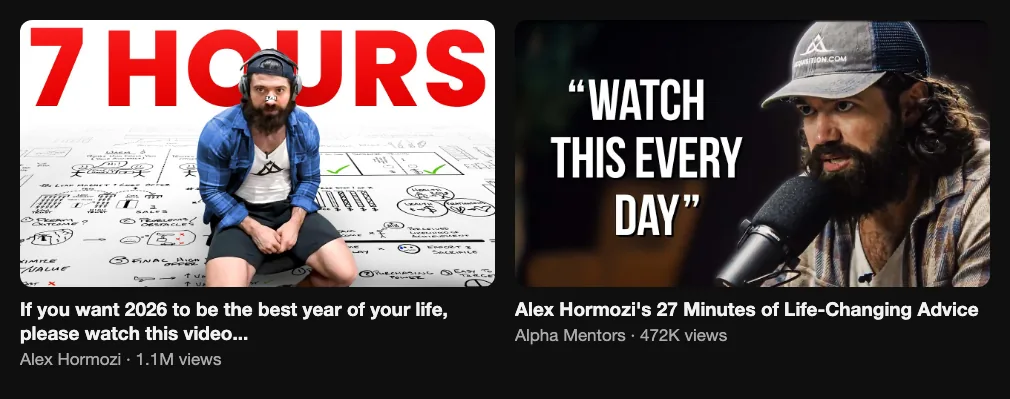
A compilation takes the best moments on one topic from several episodes and turns them into one strong video. "Everything I know about pricing your offer", "The best advice I've given about Instagram", "Every money mindset lesson in one video". It needs no new recording, it answers a question people search for, and it makes an archive work again. The proof: Alex Hormozi's own compilation If you want 2026 to be the best year of your life, please watch this video... has about 1.1 million views, and when he doesn't do it, others do: Alex Hormozi's 27 Minutes of Life-Changing Advice on Alpha Mentors got about 472,000. I did the same exercise with Jenna Kutcher's 968-episode podcast.
Or go bigger: a long cornerstone course, “Everything you need to know to hit your first $10K months, free”, with the class or a booking link inside.
3. Shorts that lead somewhere
First, post more of them. She makes short videos for Instagram every day, and only some of them reach YouTube Shorts. That's ready content. Reposting takes a couple of minutes per clip, and a social media manager can do it all.
Keep posting Shorts, but give each one a next step through "Related video": another Short on the topic or a short video about the class. In our data, many people who jump from a Short straight into a long video leave after about 20 seconds. More in YouTube Shorts for business.
Which channel fixes take one day?
- The class link in the first line of every long video description. Bulk-edit old videos in YouTube Studio.
- The description template above set as the upload default.
- Chapters and tags on the 20 most-watched long videos.
- A pinned comment with the class link on every long video.
- A channel trailer that explains the class in one minute. Here's how to make one.
The good news: the foundations are already there. Ideas, scripts, filming, editing, a strong speaker with real energy, a steady cadence of one or two videos a week. What's missing is the YouTube layer: packaging and conversion. Fix those, and YouTube stops being a backup platform and becomes a second engine. Long videos keep getting found for years, like a second search engine next to her blog. (Her most popular videos, by the way, are about photography tricks. That surprised me, and it's worth a playlist of its own.)
What's the 12-month roadmap?
- Month 1: one-day fixes, new thumbnail style, description template, re-package the 10 best long videos.
- Months 2–4: every new podcast episode in the new packaging, plus two compilations a month.
- Months 5–12: track which videos send people to the class, make more of those, and test a compilation series as a playlist.
The full logic of webinars vs YouTube is in webinar funnel vs YouTube.
What happens next?
Jasmine, your class already does the hard part. If you ever want YouTube to fill it every day, the plan is yours. And if you sell through a webinar, start with the cheapest fix: put the link to your class in the first line of every description today.
FAQ
Does Jasmine Star have a YouTube channel?
Yes. In October 2026 her channel had about 82,700 subscribers. She publishes long video podcast episodes of The Jasmine Star Show and Shorts almost every day. Recent long episodes got about 300 to 3,400 views.
How can YouTube help a webinar funnel?
If the webinar already sells, the only lever left is how many people get into it. YouTube brings new people every day through search and recommendations, and each video can send viewers to the free class with one link in the first line of the description.
What's wrong with Jasmine Star's YouTube packaging?
The thumbnails use a style from years ago: text in boxes over a photo, many words, similar layouts. The titles describe the episode instead of making people curious. Modern channels in the same niche use two to four big words, one emotion and a clear promise.
What should a coach's YouTube description include?
The main link in the first line (a free class, a call or a lead magnet), one sentence about the video, chapters, one or two related videos, a short about-me block and social links. No hashtags.
Do YouTube tags still matter?
They're a small signal, mostly for misspellings and context, but leaving them empty wastes free information. Jasmine Star's four latest long videos had no tags and no chapters.
Should coaches keep their video podcast on YouTube?
Yes, but packaged for YouTube: a clickable title, a modern thumbnail, a strong opening, chapters and a link to the main offer in the first line of the description.
What is a compilation video?
A video that combines the best moments on one topic from several episodes, for example "Everything I know about pricing". It turns an archive into a searchable answer and usually needs no new recording.
Do daily Shorts help coaches sell?
They bring reach, but the sale happens after longer content. Each Short should lead through "Related video" to the next short step, like another Short on the topic or a short video about the free class.
Who is a good YouTube reference for business coaches?
Sunny Lenarduzzi (about 795,000 subscribers) is a strong reference: weekly long videos, short bold thumbnails, curiosity-driven titles. Her recent videos reach from tens of thousands to over 500,000 views.
Did Jasmine Star hire Evgeny Maximov's agency?
No. This is an open strategy built from public information. If you sell through a webinar and want YouTube to fill it, you can book a call.
What is the copy-paste problem in YouTube packaging?
It's when the title and the thumbnail repeat the same words. Evgeny Maximov found it on Jasmine Star's channel: the title should carry the logic and benefit, and the thumbnail the emotion in two to four words. Together they should pass the BUCK test: benefit, urgency, curiosity and kin.
Founder of a done-for-you YouTube agency for high-ticket founders. Making content since 2014. More about me
Your webinar sells. Need more people in it?
We repackage your channel, fix descriptions and SEO, and produce podcasts, compilations and Shorts that send viewers to your class. 7-day money back guarantee.
Get a free niche review →