YouTube SEO for Business: Rank for What Buyers Search
Most YouTube SEO advice is written for creators who want views. A business channel needs something else: to show up for the 300 people who might buy. Here's how YouTube ranks videos in 2026, and the routine we use for every client video.
 By Evgeny Maximov·7 min read·
Is search a separate content strategy?
Yes, and it's worth deciding on purpose. There are two ways to grow a business channel:
- Broad content for recommendations. Bigger topics, stronger emotions, packaging that makes people click in their feed. YouTube pushes these videos to people who never searched for anything.
- Search videos. Each video answers one specific question your buyer types: "how much does a self-storage franchise cost", "how to remove a negative review", "YouTube chapters not showing". Fewer views per video, but the right person, at the moment they need the answer, for years.
Search videos are a strategy of their own. It works like SEO articles on a website: one question, one page, and the more pages you publish, the more questions you rank for. So here you make more videos, each one narrow, each one with a clear answer. This article is about that second strategy.
How does YouTube rank videos in 2026?
YouTube's own help pages say search looks at three things:
- Relevance: how well the title, description and the content of the video match the search.
- Engagement: how much people watch the video for that search.
- Quality: signals that the channel shows expertise, authority and trustworthiness.
On top of that, results are personalized by watch history.
Two things people miss:
- YouTube understands what you say. The transcript matters. Stuffing keywords into the description that you never say in the video looks like spam.
- Tags play a "minimal role". That's YouTube's wording. Ed Lawrence grew a business channel to 131K subscribers with zero tags on his recent videos.
And search is changing. YouTube launched conversational search on Gemini that builds answers from videos. So your video should answer a real question directly, out loud.
What is keyword research for a business YouTube channel?
It's finding the exact phrases your buyer types. Not "how to grow". Their problem, in their words.
Free method we use:
- Start typing in YouTube search a phrase about your service. "youtube for real estate…", "how to get consulting…". Write down the suggestions. If YouTube suggests it, people search it.
- Check Google suggestions the same way.
- Look at your sales calls. The questions buyers ask are search phrases.
- Look at competitors who rank for your topic. What titles, what length.
Then pick one main phrase per video. One. Not five.
A tip: "how to…" videos are search magnets. One of our clients works in online reputation management. Their videos on how to remove a negative review from a classifieds website get a lot of search traffic, month after month, because that's exactly what desperate business owners type.
Which keywords attract the wrong audience?
This is the part nobody tells business owners. Some phrases look perfect and bring the wrong people. We checked what YouTube and Google suggest for each:
| Looks like a business keyword | Who actually searches it | Use instead |
|---|---|---|
| youtube for founders | people looking for the history of YouTube's founders | founder led content, youtube for business owners |
| high ticket clients | freelancers looking for clients | how to get consulting clients, selling high ticket services |
| youtube agency | people starting "YouTube automation" agencies | youtube growth agency, youtube management agency |
| grow youtube channel | creators | grow a business YouTube channel |
| youtube case study | faceless channel case studies | youtube channel case study + your niche |
And phrases a business channel should never use: "get more views", "grow your channel fast", "youtube tips for beginners", "make money on YouTube". They teach YouTube to show you to beginners.
What is the 15-minute YouTube SEO routine?
For every long video:
- One main phrase, checked in YouTube search. Start typing it in the YouTube search bar and look at what YouTube suggests. If your phrase shows up, people search it.
- Title: the phrase or its clear part, plus a buyer word (founders, B2B, coaches, clients). Main meaning in the first ~50 characters.
- Say the phrase in the first 30 seconds. In the hook or right after it.
- Description: first line is your call to action. Then a unique 80–150 word paragraph that starts with the main phrase and says who it's for.
- Chapters with keywords: "03:12 Why coaches get zero calls from YouTube", not "Problem #1".
- 10–15 tags, main phrase first. Last priority.
- Three hashtags at the end of the description.
- Playlist and end screen. For every Short, fill in "Related video". Point it to the next short step, like another Short on the topic or a short sales video. In our data, people who jump from a Short straight into a long video usually leave within about 20 seconds.
How do we actually do it? We don't write all of this by hand. We take the transcript of the video, give it to an AI with a prompt, and then edit what comes back. Tools like vidIQ can help too, but today AI handles this well, and there's no need to pay extra for a separate tool. Here's the prompt:
Act as a YouTube SEO specialist for a business channel.
Transcript of my video (with timestamps): [paste]
My business: [what I sell, to whom]
My viewer: [my ideal client, in one line]

Write:
1. 10 title options under 60 characters. Use a phrase people actually
   search on YouTube, plus a buyer word (founders, coaches, clients,
   my niche). No promises the video doesn't keep.
2. A description. First line: one call to action with [link].
   Then one paragraph of 80–150 words that starts with the main search
   phrase, says who the video is for and what they'll learn.
   Write it the way I talk.
3. Chapters with timestamps. Each chapter name is a question or a clear
   statement someone might search. Never "Intro" or "Part 2".
4. 10–15 tags, main phrase first. No creator keywords like
   "get more views" or "grow your channel".
5. 3 hashtags.
Why does "who watches first" matter so much?
YouTube recommends your video to people similar to those who already watched and stayed. So your first viewers teach the algorithm who your audience is.
That's why you never buy views, never pay to promote your videos to random people, and never drop them into "creator support" groups where people watch each other's videos for a few seconds. All of it trains YouTube on the wrong audience.
We saw the extreme version. A podcast guest bought around 15,000 views for an episode with him on a client's channel, where videos usually got 100–500. Recommendations dropped to zero. The algorithm didn't understand who to show the channel to anymore. We spent half a year trying to fix it, and couldn't.
How do you rank YouTube videos on Google?
Google shows videos in search results and in AI Overviews. What helps:
- Chapters. Google can show them as "key moments".
- A clear spoken answer. Google reads transcripts.
- An article on your site with the video embedded and the same topic. That's what we do: every video becomes a blog post.
Google owns YouTube, so it's happy to show YouTube videos. One of our clients had a channel with 80 subscribers, and her videos already came up in Google when you searched her name. You don't need a big channel to show up.
YouTube is also one of the most cited sources in AI answers. I wrote about it separately in how to get cited by ChatGPT.
How long does YouTube SEO take to work?
Search is slower than recommendations but lasts longer. With our clients, search starts to bring steady traffic around months three to six. And search videos keep working for years. In one niche we checked, one of the top YouTube results for the main question was a video recorded nine years ago. That's why evergreen topics are the best investment.
Be patient with a new channel. Tvoy Sklad, a self-storage franchise we've worked with since 2022, started with 50 to 100 views per video. It took about a year for YouTube to find the right audience.
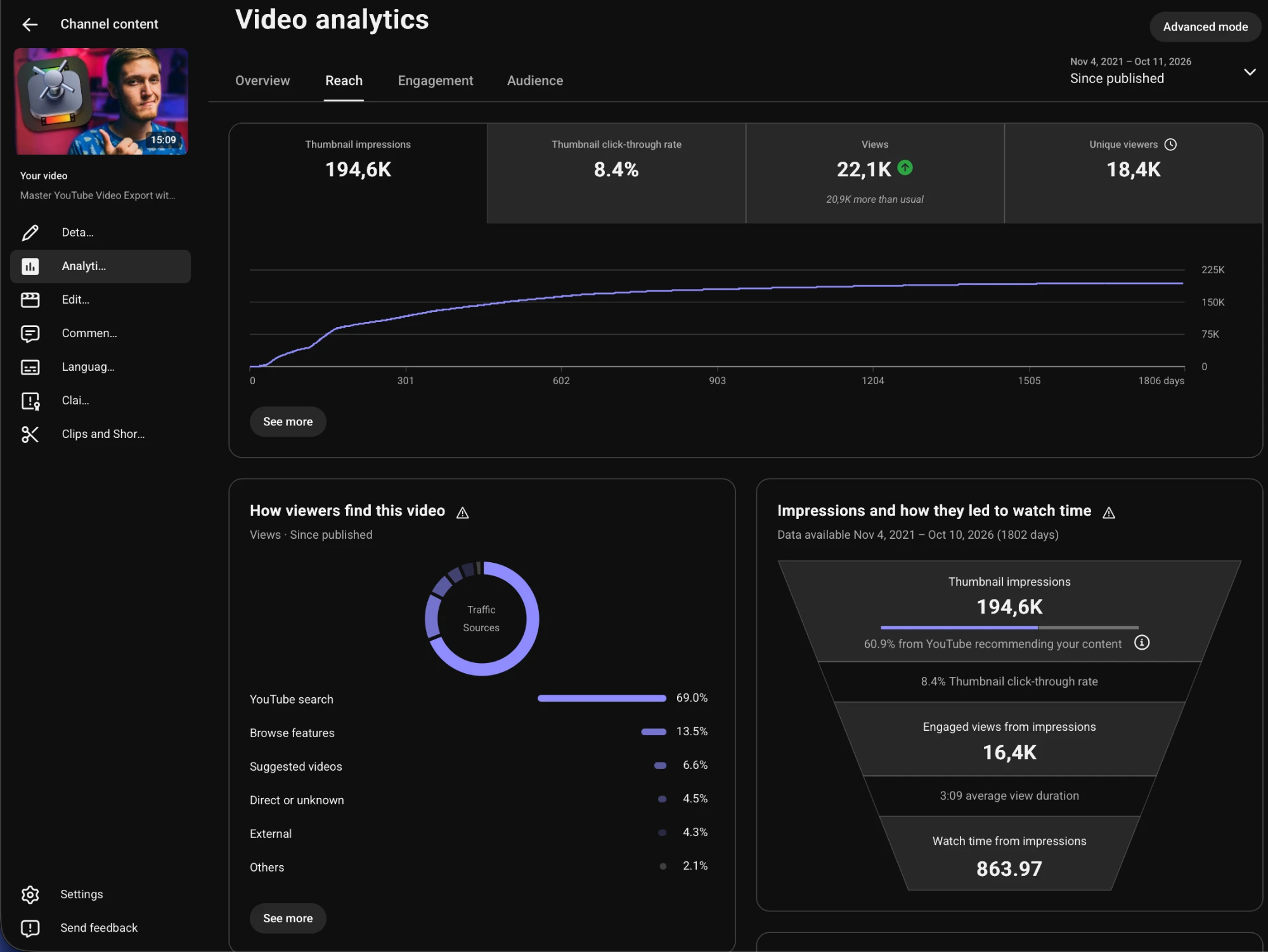
Here's one of my own. Back in 2021, when my English channel was about video editing, I published a 15-minute tutorial: "Master YouTube Video Export with Final Cut Pro & Apple Compressor". A pure "how to" video. Almost five years later it has about 22,000 views and 194,000 impressions, and 69% of the views came from YouTube search. The impressions line is still going up. I haven't touched that video in years.
Should a business pay for YouTube SEO services?
SEO alone won't fix a channel. SEO and packaging have to work together. The classic mistake: someone writes a video like an SEO article for a website, with all the right keywords, and forgets how YouTube works. No strong title, no thumbnail anyone would click, a video that isn't filmed or edited well. Then perfect tags do nothing.
If the topics, titles and thumbnails speak to buyers, the routine above takes 15 minutes per video. Pay for strategy and packaging first. SEO is part of the job, not the whole job. Not sure how your channel looks to YouTube today? Start with a YouTube channel audit.
FAQ
What is YouTube SEO?
YouTube SEO is the practice of making videos easy for YouTube to understand and easy for the right viewers to find: choosing a search phrase, using it in the title, saying it in the video, writing a unique description and adding chapters with keywords.
How does YouTube rank videos?
According to YouTube Help, search ranking considers relevance (title, description and video content), engagement (watch time for that search) and quality (signals of expertise, authority and trust), with results personalized by viewing history.
Do YouTube tags still matter in 2026?
Very little. YouTube says tags play a minimal role in discovery and are mainly useful for common misspellings. Titles, thumbnails, spoken content, descriptions and chapters matter much more.
How do I do keyword research for a YouTube business channel?
Type your topic into YouTube and Google search and note the autocomplete suggestions, collect the questions buyers ask on sales calls, and check what competitors rank for. Choose one main phrase per video, and add a buyer qualifier like founders, coaches or B2B.
What keywords should a business YouTube channel avoid?
Creator-focused phrases like "get more views", "grow your channel fast", "YouTube tips for beginners" and "make money on YouTube". They attract beginners and teach the algorithm to show your videos to the wrong audience.
How do I rank my YouTube video on Google?
Add chapters with keyword-rich titles, say the answer clearly in the video, write a strong description, and embed the video in a related article on your website. Google can show chapters as key moments.
How long does YouTube SEO take?
Search traffic usually builds over several months. For Evgeny Maximov's clients, steady search traffic tends to start around months three to six, and evergreen videos keep bringing views for years.
Does YouTube read what I say in the video?
Yes. YouTube uses the content of the video, including speech, to understand it. That's why you should say your main phrase out loud in the first 30 seconds.
Should I use hashtags on YouTube?
Yes, a few. YouTube shows the first three above the title, and too many hashtags can cause all of them to be ignored. Use three relevant hashtags at the end of the description.
Is YouTube SEO enough to grow a business channel?
No. SEO helps the right people find a video, but the topic, title, thumbnail and the video itself decide whether they click, watch and book a call. Strategy and packaging come first.
Founder of a done-for-you YouTube agency for high-ticket founders. Making content since 2014. More about me
Want every video packaged for buyers, not just views?
We handle strategy, scripts, editing, titles, thumbnails and SEO for business YouTube channels. You film one day a month. 7-day money back guarantee.
Book a call →