If I Were Jenna Kutcher: How I'd Turn 968 Podcast Episodes Into a YouTube Engine
Hey Jenna. You paused The Goal Digger Podcast after nearly a decade and 968 episodes. That's a huge library, and right now most of it sleeps in podcast apps. Your YouTube channel has about 14,000 subscribers and episodes with a hundred views. Here's how I'd fix it in two steps: first re-package what's already recorded, then relaunch the channel with full production.
 By Evgeny Maximov·7 min read·
If you're not Jenna, but you have a podcast archive, this plan is for you too.
What does Jenna Kutcher's YouTube look like today?
Here's what I found in October 2026.
| Platform | Now |
|---|---|
| about 1,000,000 followers, "Online Business Coach" | |
| Podcast (The Goal Digger) | 968 episodes over nearly a decade, paused on December 31, 2025 |
| YouTube | about 14,300 subscribers, 705 videos |
| Typical episode on YouTube | about 90–370 views |
| Best recent video | "Why Pinterest Still Works in 2025", about 6,400 views |
The pattern is clear. Full episodes with episode numbers get a hundred views. A practical how-to with a clear promise gets 6,400. YouTube rewards answers, not episode numbers.
Why don't podcast episodes grow on YouTube?
Four reasons:
- Most episodes are audio only. A static cover with sound gives YouTube nothing to work with. Only some episodes were recorded with a video version.
- Titles are for subscribers, not for search. "This Isn't Goodbye. This Is the Goal." means a lot to fans. Nobody searches it.
- No thumbnail strategy. A podcast cover doesn't compete in a YouTube feed.
- Long intros. Podcast listeners wait. YouTube viewers leave in 30 seconds.
The content is great. The packaging is made for another platform. Here's the clearest example. Jenna recorded a 53-minute video episode with Vanessa Lau, who has about 1.01M subscribers on YouTube. In more than a year, the episode got 403 views.
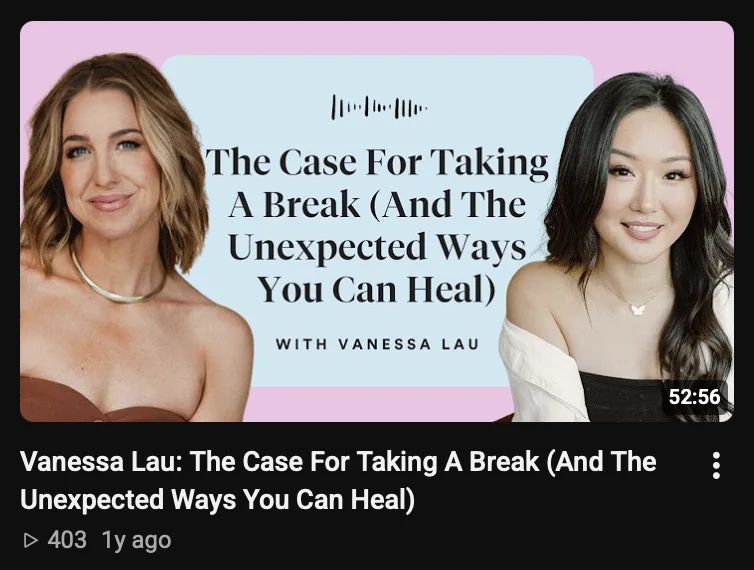
Compare it with Vanessa's own channel, where videos get hundreds of thousands of views. That's a screaming sign that the problem isn't the content. It's how it's presented.
A famous guest, a real video, a good conversation. But the title reads like a blog post, and the thumbnail is a podcast cover full of text. YouTube doesn't see this as a video people want to click, so it doesn't show it. I compared the two platforms in YouTube vs podcast.
Where are Jenna's YouTube views today?
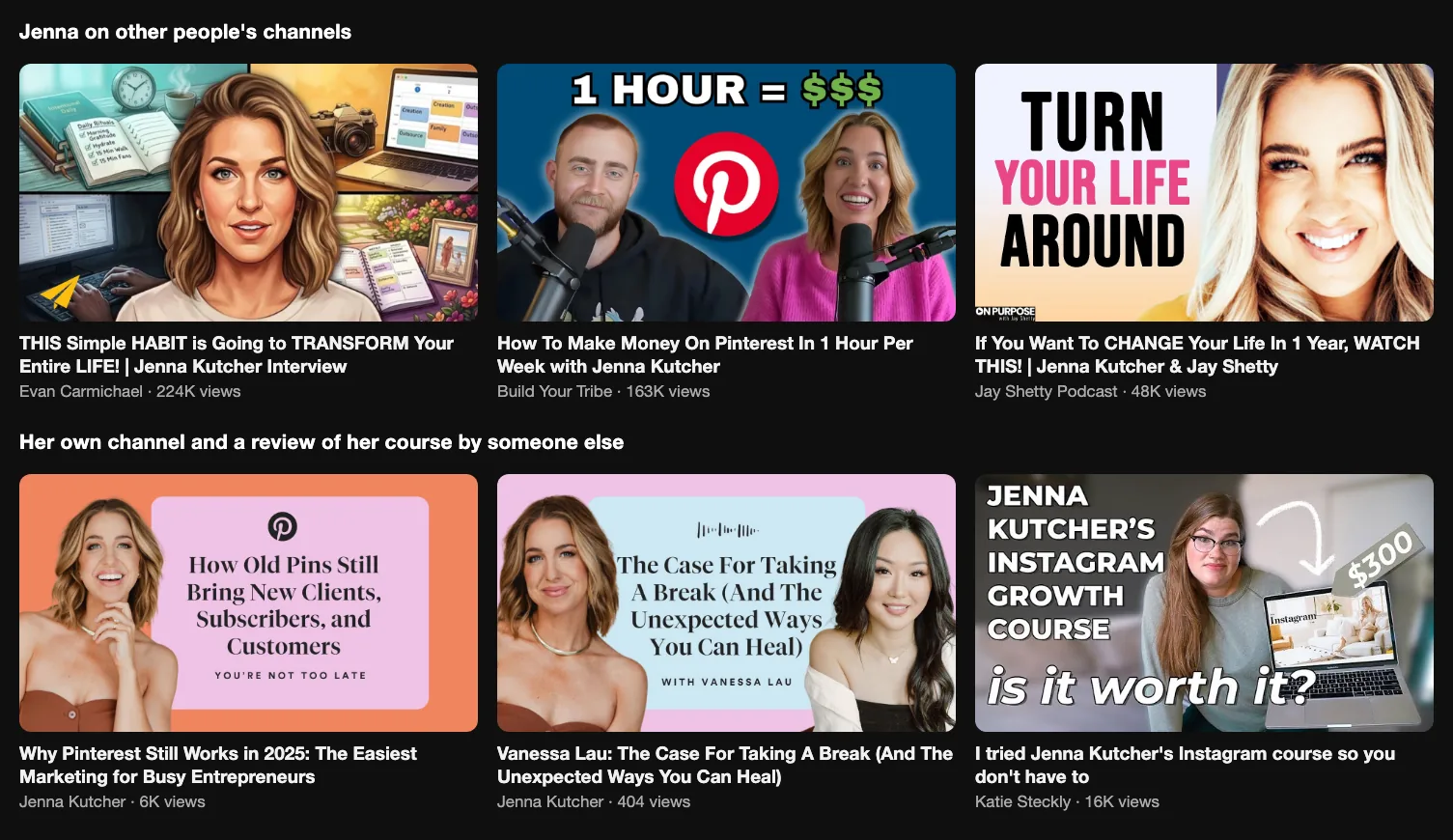
On other people's channels. On October 14, 2026 I checked the top 40 YouTube results for her name:
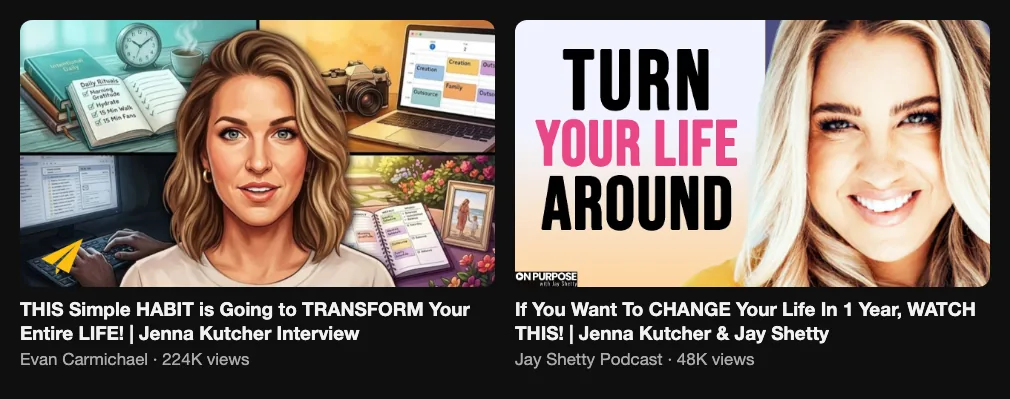
- THIS Simple HABIT is Going to TRANSFORM Your Entire LIFE! on Evan Carmichael's channel: about 224,000 views.
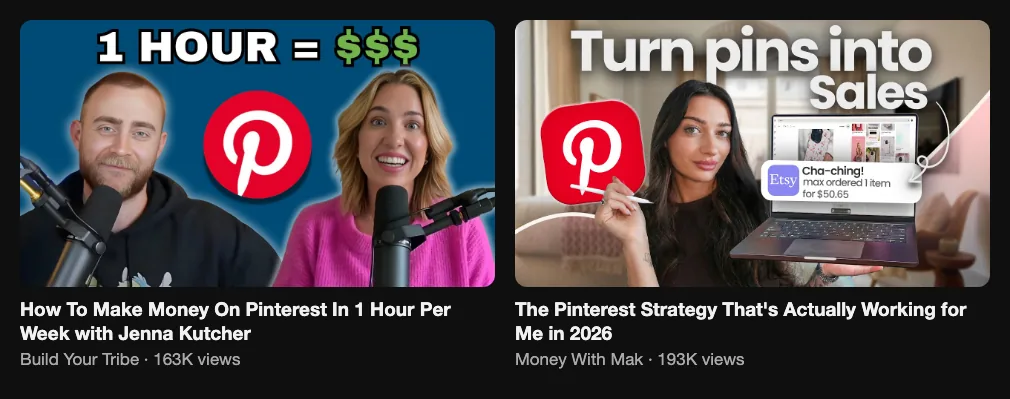
- How To Make Money On Pinterest In 1 Hour Per Week with Jenna Kutcher on Build Your Tribe: about 163,000.
- If You Want To CHANGE Your Life In 1 Year, WATCH THIS! on the Jay Shetty Podcast: about 48,000.
- And a stranger reviewing her product: Katie Steckly's I tried Jenna Kutcher's Instagram course so you don't have to, about 16,000.
Look at the Pinterest one. The same topic, the same Jenna. On someone else's channel, with YouTube packaging: about 163,000 views. On her own channel, her best Pinterest video: about 6,400.
Who already won on YouTube as a business coach?
- Marie Forleo: about 1M subscribers, built on practical business advice.
- Sunny Lenarduzzi: about 795K, YouTube and business strategy.
- Amy Porterfield: also podcast-first, about 43K on YouTube. The same challenge as Jenna.
The winners publish answers to specific questions. The podcast-first coaches upload episodes and stay small.
Strategy 1: how would I re-use the old content?
This part needs no new recordings from Jenna. One rule: we take the episodes that have a video version. Audio-only episodes can't become good YouTube videos, but their transcripts are a gold mine of ideas for strategy 2.
Step 1. Pick the episodes. Find every episode with video. Rank them by two things: how well known the guest is, and how evergreen the topic is (Pinterest, email lists, launching, pricing, burnout, building a team).
Step 2. Give each one YouTube packaging, not blog packaging. A short title that makes people curious or answers a question they search. A thumbnail built around two faces and three or four words, not a cover full of text. A strong first 30 seconds edited from the best moment of the conversation. Chapters. The episode with Vanessa Lau could become something like "Why Taking a Break Can Grow Your Business (with Vanessa Lau)", with both faces on the thumbnail. A known guest plus YouTube packaging should get many times more views than a podcast cover, because now YouTube has something to recommend. No promises on numbers, but 403 views for a 1M-subscriber guest is the floor.
How do you write a title and thumbnail that pull? I use a simple check called the BUCK test: Benefit (what the viewer gets), Urgency (why watch now), Curiosity (don't reveal everything, hint at “this method” or “the three things I did”) and Kin (words that make the ideal viewer think “that's me”: online business, getting sales, growing your following). The title carries the benefit and the curiosity, the thumbnail carries the urgency and the kin. Most of Jenna's titles have some benefit and almost no curiosity. “This home system changes everything” is closer: there's a benefit, and you want to know which system.
Also re-cut the intros. Many episodes open with a long podcast intro where she isn't talking to the camera. On a podcast app, people wait. On YouTube, they're gone. Keep the conversation, replace the first 30 seconds with the strongest moment.
Step 3. Send the new version to the guest. A famous guest sharing a well-packaged video brings the first viewers, and those first viewers tell YouTube who to show it to next.
Even better, use YouTube's collaboration feature, which lets two channels publish one video together. A collab with a guest who has a million subscribers puts the episode in front of their audience too. And add the guest's links in the description, not just the podcast name. With new packaging, a collab and a proper intro, I'd expect an episode like the one with Vanessa to get at least 5,000 views instead of 400. That's my estimate, not a promise, but it shows the size of the gap.
How much is there to work with? I counted about 40 video episodes. Published once a week, that's about nine months of content without recording anything new.
Step 4. Cut Shorts. From an hour of conversation we usually get 5 to 15 good Shorts, more only from very skilled speakers. Jenna is one. Each Short gets a "Related video" that leads to the next short step, not straight into a 60-minute episode: in our data, many people who jump from a Short into a long video leave after about 20 seconds.
Two details make Shorts from a remote podcast work better. Remote recordings often have weaker video and audio, so the editing has to be dynamic. Add a short text badge on top, about five words that pass the BUCK test: why should I watch this clip? And end each Short with a visual of the full episode, its thumbnail with an arrow, so “watch the full episode” isn't just a line in the description. Right now her clips are mostly the dynamic intros cut vertically. The archive could give hundreds of Shorts.
Step 5. Build playlists like courses. "Pinterest marketing: start here", "Build your email list from zero", "Pricing your offer". Add a “greatest hits” playlist with the best episodes of all time, and one with the most famous guests: star faces on a channel page make people stay.
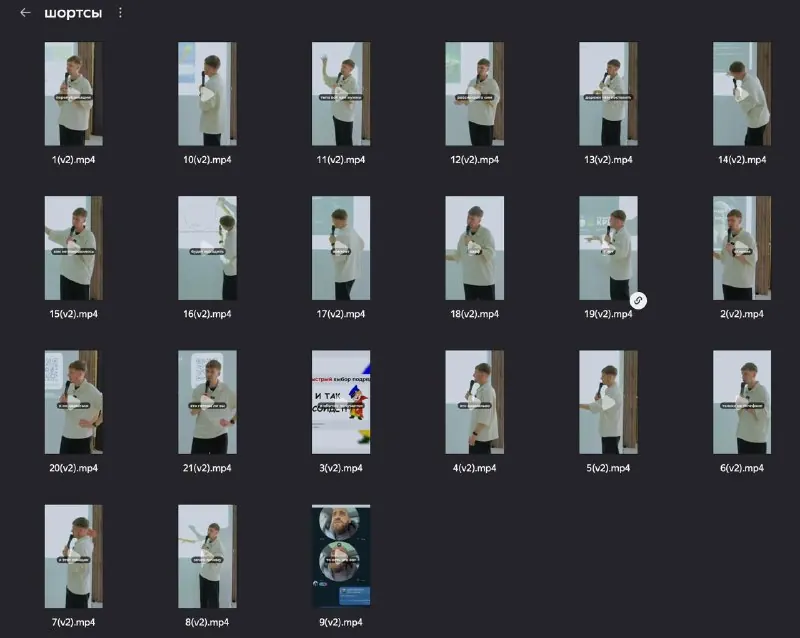
How much can one recording give? The founder of our franchise client Tvoy Sklad gave a 20-minute talk at an investment forum. We cut it into 21 Shorts and a new pitch video. He is a strong speaker, and so is Jenna.
Strategy 2: what does a full relaunch look like?
Re-packaging wakes up what's already recorded. A relaunch builds the channel YouTube-first, with full production behind it:
- Strategy and research. Topics chosen by search demand and by her offers, using the 968-episode transcripts as an idea bank.
- Scripts. One-page outlines with talking points, so Jenna sounds like herself, not like a teleprompter.
- Filming days. One day a month, four long practical videos, like the Pinterest one that already worked.
- Production. Editing, thumbnails, titles, descriptions, publishing, Shorts and repurposing for Instagram and email. I described the same setup for Jasmine Star.
- If the podcast comes back, every episode is filmed with video and packaged for YouTube first, so no conversation ends up audio only again.
Two more formats from the archive. Compilations: “I asked the top people in my industry how to grow a personal brand”, the best clips from Vanessa Lau and other big guests, with a short intro and bridges recorded by Jenna. Little new filming, mostly editing. And personal stories: “I spent ten years building a podcast, and I stopped. Here's why.” Vanessa did this with “Success broke me”. The price of success is a story her audience wants.
One rule for the practical videos: teach, don't pitch. Not the webinar structure where every minute is pain and urgency and no real answer. Show the nitty-gritty: the five steps, the actual content plan, the real setup. Then the product is the natural next step: “You learned the basics. Want to go deeper without making my mistakes? Here's the Lab.”
That's the difference between uploading a podcast and producing a channel. Here's how a done-for-you production works from the founder's side.
Which five videos would I publish first?
Every idea below already worked on YouTube, for Jenna or for someone in her niche. View counts are from October 14, 2026.
1–2. The Vanessa Lau episode and the next two video episodes, re-packaged (strategy 1)
The reference is Jenna herself, on other channels. Evan Carmichael's interview (about 224,000 views) and the Jay Shetty episode (about 48,000) are long conversations, like hers. The difference is the packaging: a big face, a short promise, a title about the viewer's life, not the episode.
3. "Pinterest Marketing for Small Business: The Complete Guide" (strategy 2)
Her strongest topic. Her Pinterest interview on Build Your Tribe got about 163,000 views, and Money With Mak's The Pinterest Strategy That's Actually Working for Me in 2026 about 193,000. Jenna teaches The Pinterest Lab. A complete guide on her own channel is the obvious first video.
4. "How to Grow an Email List From Zero (What Worked for Me)" (strategy 2)
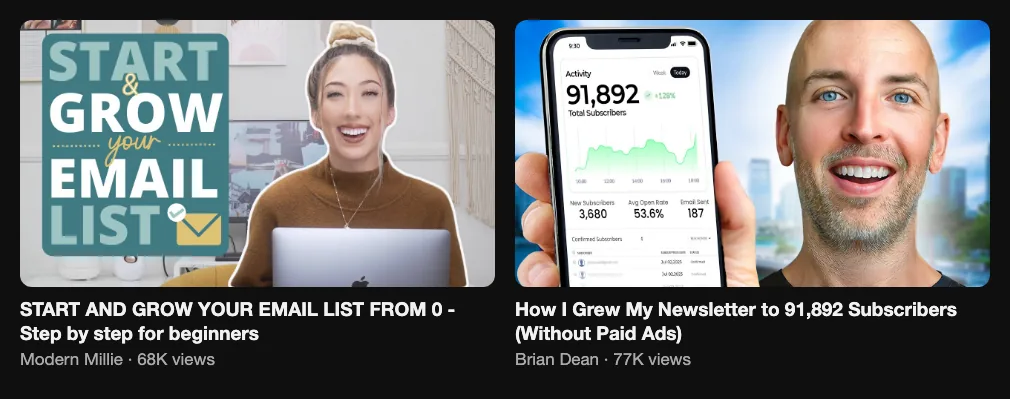
Modern Millie's START AND GROW YOUR EMAIL LIST FROM 0 has about 68,000 views, and Brian Dean's How I Grew My Newsletter to 91,892 Subscribers about 77,000. "What worked for me", with real numbers, is the format. It leads straight to her list-building course.
5. "Why I Paused My Podcast After 968 Episodes" (strategy 2, for her existing audience)
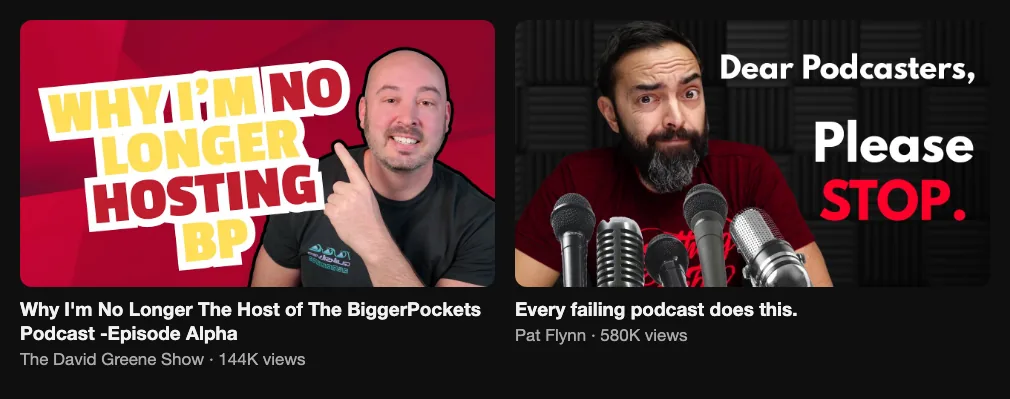
Hosts explaining why they stepped away get watched. David Greene's Why I'm No Longer The Host of The BiggerPockets Podcast has about 144,000 views, and Pat Flynn's Every failing podcast does this. about 580,000. Her fans want this story, and it's a natural bridge to what's next.
Which channel fixes take one day?
- Remove episode numbers from titles. Use the question the episode answers.
- First line of every description: the main free resource. Here's a description template.
- Playlists by topic, not by date.
- A "start here" video pinned for new visitors.
- Fix the links. Some may be outdated. Every description needs one call to action: a free guide, a Lab, the website.
The full checklist is in YouTube channel optimization.
What would the funnel look like?
Jenna already sells her teaching as "Labs": Pinterest, content, podcasting and list building. So the funnel almost builds itself:
- Pinterest videos → free Pinterest guide → The Pinterest Lab.
- Email list videos → the free 5-day list building mini-course → The List to Launch Lab.
- Content and repurposing videos → The Content Lab. A re-packaged archive is the best live demo of this course.
- "How I started my podcast" videos → the free podcast guide → The Podcast Lab.
The podcast built trust with listeners. YouTube can build the same trust with people who never found the podcast.
What's the 12-month roadmap?
- Months 1–2 (strategy 1): find every video episode, re-package the strongest 20, cut Shorts.
- Months 3–6 (strategy 2 starts): monthly filming days with four practical videos, re-packaging continues in the background.
- Months 6–12: a cornerstone masterclass and a "season two" decision based on data, filmed with video from day one.
What happens next?
Jenna, if you ever want to wake up that archive, the plan is yours. And if you have a podcast with video episodes that nobody watches on YouTube, start with strategy 1: it's mostly editing and packaging, not recording.
FAQ
Does Jenna Kutcher have a YouTube channel?
Yes. In October 2026 it had about 14,300 subscribers and 705 videos, mostly podcast episodes. The last upload was on December 31, 2025, when she paused The Goal Digger Podcast.
Is there demand for Jenna Kutcher on YouTube?
Yes. Interviews with her on other channels got about 224,000 views (Evan Carmichael) and 163,000 (Build Your Tribe, about Pinterest), while her own best recent video has about 6,400. Other creators even review her courses on YouTube.
Why did Jenna Kutcher pause The Goal Digger Podcast?
In her December 31, 2025 episode she said that after 968 episodes and nearly a decade she was pausing the show, a thriving seven-figure revenue stream, as a deliberate step back.
Can you repurpose old podcast episodes for YouTube?
Yes, if they have a video version. Give them YouTube packaging: a clickable title, a thumbnail with faces and a few words, a strong opening and chapters. Cut Shorts from each, with a clear next step in "Related video". Audio-only episodes work better as an idea bank for new videos.
Why don't podcast episodes get views on YouTube?
Episode titles and covers are built for existing listeners, not for search or a YouTube feed, and podcast intros are too slow for YouTube viewers. The content is usually fine; the packaging isn't.
How many Shorts can you get from one podcast episode?
In Evgeny Maximov's experience, usually 5 to 15 good Shorts per hour of conversation, more only from very skilled speakers. A large archive can supply Shorts for years.
Where should a Short from a podcast lead?
To the next short step, not straight into a 60-minute episode. Evgeny Maximov's data shows many viewers who jump from a Short into a long video leave after about 20 seconds. Link a related Short, a short topic video or a lead magnet video instead.
What should a business coach post on YouTube?
Practical answers to specific questions their clients have: marketing tactics, pricing, launches, systems, burnout. Tutorials with a clear promise outperform general episodes.
Why did Jenna Kutcher's episode with Vanessa Lau get only 403 views?
Vanessa Lau has about 1 million YouTube subscribers, but the 53-minute episode was packaged like a blog post: a long title and a text-heavy podcast cover. With YouTube packaging (a clickable title, a thumbnail built around two faces and a strong first 30 seconds), the same conversation has a much better chance to be recommended.
Is it worth putting a podcast on YouTube in 2026?
Yes, if it's packaged for YouTube: searchable titles, thumbnails, chapters and clips. Uploading episodes as-is rarely grows a channel.
How much work is re-packaging a podcast archive?
It's mostly editing, design and publishing work, not new recording. A production team can re-package dozens of episodes a month while the host focuses on the business.
Did Jenna Kutcher hire Evgeny Maximov's agency?
No. This is an open strategy built from public information. If you have a podcast archive and want a plan like this, you can book a call.
Founder of a done-for-you YouTube agency for high-ticket founders. Making content since 2014. More about me
Have a podcast archive that's sleeping?
We turn podcasts into YouTube channels: re-packaging, Shorts, playlists and new filming days. 7-day money back guarantee.
Get a free niche review →