YouTube for Business Owners: Why Viral Tactics Fail (and What Works Instead)
You watch a lot of videos on how to grow a channel and nothing clicks. That's because they were made for YouTubers, not for founders. Lesson 1 of The Trust Engine.
 By Evgeny Maximov·9 min read·
Why doesn't YouTube advice work for business owners?
I have terrible news. You've probably watched a ton of videos about how to build a YouTube channel, and it still isn't clicking. Something doesn't work, and it's not you. Those videos were made for YouTubers and content creators, not for founders and business owners.
I know both sides. I've been making videos since 2014 and I used to be a creator who monetized views. Today my agency makes content for business owners. In 2026 alone we produced about 150 long videos and more than 1,000 shorts, in some very complicated B2B niches. And the main goal is never to go viral. It's to get clients.
This is the first lesson of a nine-lesson course I call The Trust Engine. It's the most important one, because it's about changing a belief: that you have to play the game creators play.
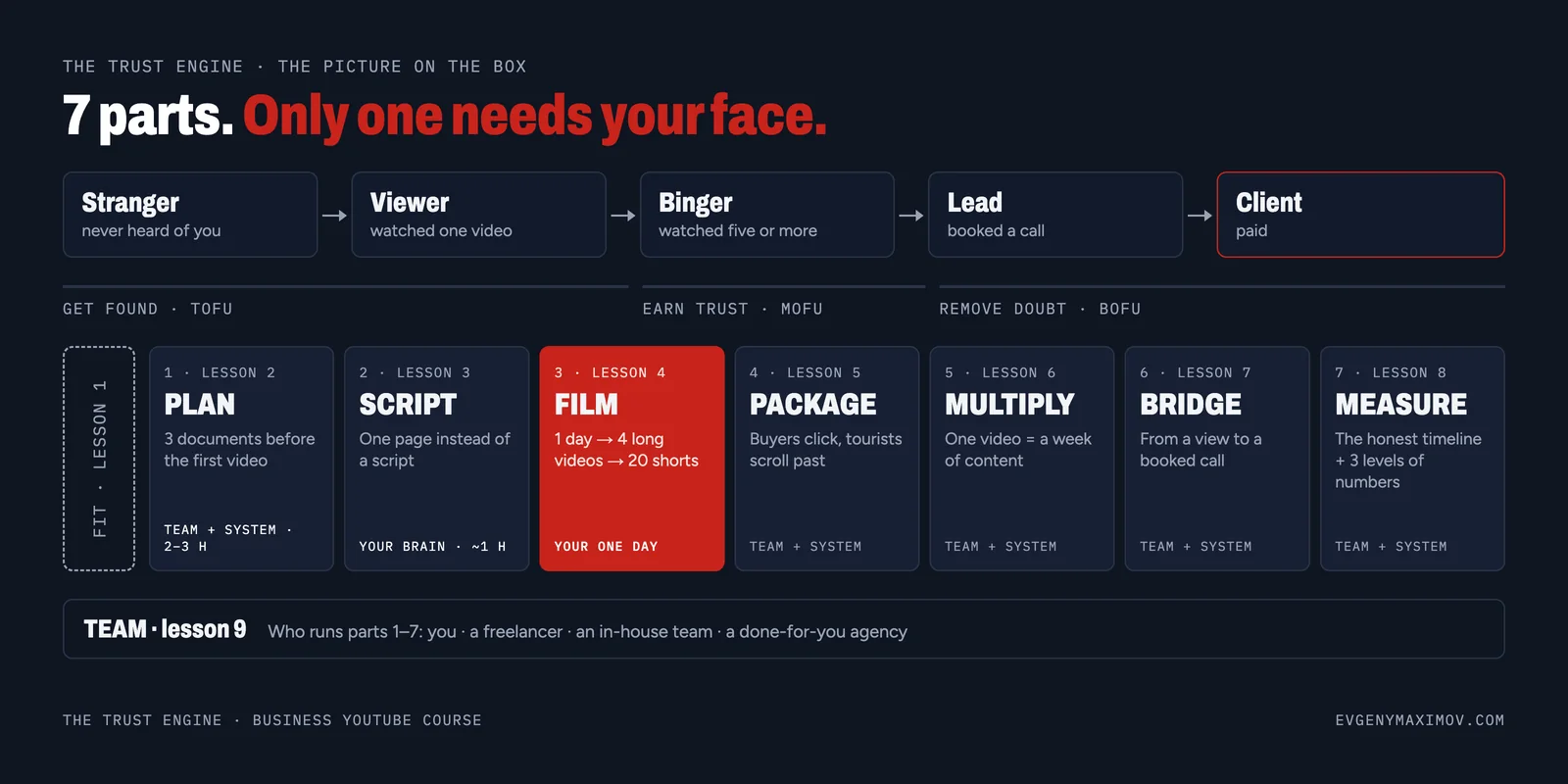
What are the two games on YouTube?
Creators play the reach game. If they do a good job, they get a lot of views, and then they monetize those views: ads, sponsors, affiliate links, cheap digital products like presets or Notion templates. Going viral is the key metric, because more views means more money. So they go broad, chase trends, post every day and show up on five platforms. In that world, a video with 500 views is a flop.
You play the trust game. You are paid not for views, but by clients. So you target a small pond: founders of e-commerce brands, owners of dental clinics, investors in one country. A trending topic won't bring you clients, because you need to show your expertise, your clients and a lot of proof. And in this game, a video with 500 views can be a big deal if the right person watched it.
| The reach game (creators) | The trust game (you) | |
|---|---|---|
| Paid by | Ads and sponsors, for views | Clients |
| Needs | Millions of views, going viral | The right few hundred people |
| Wins with | Trends, broad topics, posting every day | Expertise, stories, a path to a call |
| Scoreboard | Views and subscribers | Calls, clients, pipeline |
| A video with 500 views is | A flop | Possibly a big deal |
Follow creator advice and you'll collect views from people who can't buy from you. I tell the longer story in views vs clients.
Can a channel with 2,000 subscribers bring $5 million?
One of my oldest clients is Tvoy Sklad, a self-storage franchise. We started working together in 2022, when they had two locations and a team of three. They wanted to attract investors and franchise partners to grow the chain.
Four years later the channel has about 2,000 subscribers. If I were a “go viral” guy, you'd be right to say that's terrible. But look at the business: about $5M in investments in 2024-2025. Today the network has 43 locations in 28 cities and 3 countries. And they didn't run ads on this market. Franchise partners from Belarus and Armenia watched the videos and opened warehouses in their own countries.
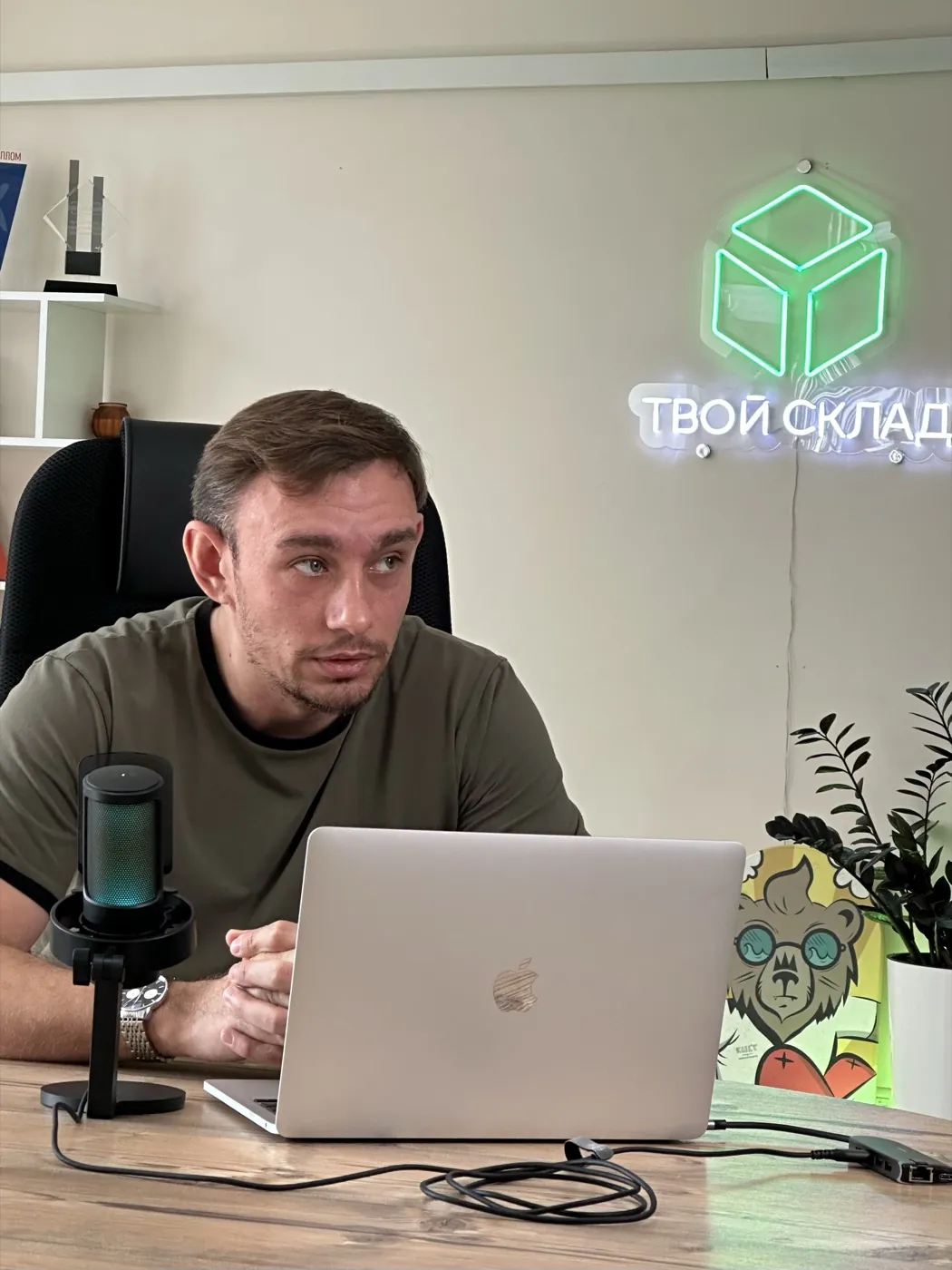
YouTube became the main resource of our company. I duplicated myself on YouTube.
Dmitry, founder of Tvoy Sklad
Think about the price of the decision. A $9 PDF is easy: you buy it, you see it's bad, you throw it away. An investor who is about to put in several hundred thousand dollars wants to watch your whole library first. That's the level of trust the video has to build, and that's why 2,000 subscribers is enough. The full breakdown is in the Tvoy Sklad case study.
What happens when you play the wrong game?
I did it myself. In 2023 I had everything a business is supposed to have: a company in the UK, online courses, funnels, email sequences, about 5,000 followers on LinkedIn. And almost no clients. I had all the parts and no engine.
The problem was the model. I was making broad content for content creators: how to shoot with your phone, how to edit in CapCut, formats that get more views. I was trying to win the views game, and I didn't. At the same time I was selling expensive mentoring, and none of my content built trust for that. Then I stopped selling those products, went back to the local market, built an agency, and came back to the international market as an agency. I made a ton of mistakes in these 12 years. If your business feels stuck, the lead-gen system is probably what's broken.
Is YouTube the right vehicle for your business?
Before you launch anything, ask if you need a channel at all. Maybe someone at a mastermind said “you should launch a YouTube channel” and you nodded. Here are five questions. Answer yes or no. More than three yeses and you can build the channel.
- Are there many potential clients in your market? If you need to reach a list of 50 or 100 people, skip YouTube and call them. I sell to business owners, and in the US there are over 36 million businesses, about 5 million with at least one paid employee. That's not 50 people.
- Is your market a whole country, or the world? You can't tell YouTube to show your video only in one city. A single coffee shop won't get customers from a channel. A coffee shop that wants to sell franchises can. A clinic with complex, expensive procedures can too.
- Do you sell something expensive or complex? Trust pays off when the decision is big. You also get pre-educated buyers and a shorter sales cycle.
- Will you still be in this niche in five years? YouTube content is a library, like Netflix. It takes time to build and feeds you for years. If you switch niches every two months, play the reach game instead.
- Do you have two to four years of real expertise? Content doesn't come from a vacuum. You need before-and-after stories, client sessions, spreadsheets, a process you can show.
One more thing that isn't on the list: you need opinions, and you need to give one day a month to this for the next two years. If that sounds heavy, say it now rather than in month four.
Who do we say no to?
These are three red flags from our own rulebook for taking clients:
- The last hope. Cash gap, “we're losing money, YouTube must save us”. Content is a long game. A business that needs sales this week needs something else.
- “Do it for me while I'm away.” No founder on camera, no personal brand. We can help with an AI clone for some tasks, but your experience and opinions still have to be there. The biggest creators I see are still sitting in front of a camera.
- No goal. “I watched a video and someone told me to launch a channel” is not a goal. “I want to attract investors,” “I want to open a franchise chain,” “I want to grow to this revenue in five years” are goals. Even “I want to become a better speaker” beats having nothing.
The 5-minute market test
Open YouTube and search your service the way a buyer would. For example: “tax advisory for UK businesses”. If you find four or five competitor channels with different videos, even with 50 to 200 views each, it's a green flag: the niche is alive and buyers are watching. A boring niche means fewer competitors and buyers with money. You can also ask Gemini for competitors in your niche, since it's Google's AI and can reach YouTube.
How do you know YouTube will pay for itself?
Don't think in months. If you think like a paid marketer, you'll want a 3:1 return on every month of spend, and you'll quit in month two. Think in a year. One formula:
Say your average deal is $10,000, like a coaching program that lasts a few months. Content production costs around $60,000 a year, about $5,000 a month, which is the usual market price for done-for-you. You need six clients in 12 months to break even. After that the videos keep working. Ads stop the day you stop paying.
Include lifetime value when you count your deal. In my case a client stays more than six months, so a $5,000 monthly service becomes about $30,000. My own production costs are lower because I own the agency, so for me it's one client a year. Your numbers will be different, so use your own. We built a break-even calculator for this.
And one honest thing: in the first months you will lose money. That's the only guarantee I can give. I've seen cases where a brand-new channel paid back fast, but that person already had 70,000 followers on LinkedIn and sold to the warmest audience. If you start from zero, you're investing for a better future. The costs are fixed, and you don't have to raise an ad budget to repeat the result.
Where else can your videos work?
Yes, because YouTube is not the only place they work. Put them to work across the business: sales assets, your website, email, a follow-up sequence with free value for leads you haven't closed. If you run paid ads, send people a video before the sales call to warm them up. A video sales letter is one example. If you just post a video and wait, you'll fail, especially when you sell something complex.
What should you do this week?
- Run the 5-question test and count your yeses.
- Run the 5-minute market test. Save links to 4 or 5 competitor channels that each have 20 to 50 videos.
- Put your own numbers into the break-even calculator.
- Finish one sentence: “YouTube is / isn't my game because…”
Then, when someone says “you should launch a YouTube channel”, you can answer with facts either way. If it's “not for me”, you made the math and checked the market. That's a good answer too. Lesson 2 of the course is about the three documents we make before we film a single video.
FAQ
Why doesn't most YouTube advice work for business owners?
Most of it is made for creators who earn from views through ads, sponsors and cheap digital products, so it teaches virality. Business owners earn from clients, so they need trust from the right few hundred people, not millions of views. Evgeny Maximov's agency produced about 150 long videos and 1,000+ shorts in 2026 for founders and experts on that second model.
What is the difference between the reach game and the trust game on YouTube?
In the reach game you are paid for views, so you need trends, broad topics and daily posting. In the trust game you are paid by clients, so you need expertise, proof and a path to a call. A 500-view video is a flop in the first game and can be a real deal in the second.
Can a YouTube channel with few subscribers bring clients?
Yes. Evgeny Maximov's client Tvoy Sklad, a self-storage franchise, has about 2,000 subscribers after four years of YouTube. The channel helped attract about $5M in investments in 2024-2025, and partners from other countries found the company through the videos without ads.
How do I know if YouTube is right for my business?
Answer five questions: is your market big, is it a whole country or the world, do you sell something expensive or complex, will you stay in this niche for five years, and do you have two to four years of real expertise. More than three yeses means you can build the channel.
Should a local business like a coffee shop start a YouTube channel?
Usually not. You can't tell YouTube to show your videos only in one city, so a single local shop gets viewers who can't buy. A coffee shop that wants to sell franchises, or a clinic with expensive, complex procedures, is a different case.
How do I calculate if YouTube will pay for itself?
Divide the yearly cost of content by your average deal size. With a $10,000 deal and $60,000 a year of content, you need six clients a year to break even. Count a year, not a month, because videos keep working after you pay for them.
How much does YouTube content production cost for a business?
A common market price for a done-for-you service is around $5,000 a month, so about $60,000 a year. Doing it yourself costs time rather than money, but most self-run channels stop within a few months.
Will I lose money in the first months of a business YouTube channel?
Yes, most likely. Cases where a brand-new channel pays back in weeks usually come from people with a big, warm audience already. If you start from zero, plan to invest first and expect the return later.
Who should not start a YouTube channel for business?
Three kinds of people: the ones for whom YouTube is the last hope to fix a cash gap, the ones who want a channel but not to appear in it, and the ones with no clear goal. Content is a long game and needs a founder's opinions and one filming day a month for about two years.
Can AI replace the founder on a business YouTube channel?
Not for the part that builds trust. AI can help with research, scripts and editing, but viewers still need your experience and opinions. Look at the biggest creators in your market: most of them still sit in front of a camera.
How can I check if my market exists on YouTube?
Search your service the way a buyer would. If you find four or five competitor channels, even with 50 to 200 views per video, the market is alive. You can also ask Gemini for competitors in your niche, since it can look at YouTube.
Founder of a done-for-you YouTube agency for high-ticket founders. Making content since 2014. More about me
Want the engine built for you?
You film one day a month, my team does the rest. Book a call and we'll check together if YouTube is your game. I'm on every call myself. 7-day money back guarantee.
Book a call →