The One-Page YouTube Script Template We Use for Every Founder
Read a script word for word and you sound like a robot. Wing it and you ramble for forty minutes. There's a third way: one page, and most of it is questions.
 By Evgeny Maximov·10 min read·
Why don't full scripts and freestyle work for founders?
A founder is not an actor. When you read, your eyes move and your energy drops. You sound like a robot. When you freestyle, you go in circles, forget your best story, and the video is forty minutes long.
You don't need a script. You need to be prepared enough.
I learned it the hard way. Back in 2022 I filmed four videos in one week. Three of them had a plan of four sentences and two pictures. The first draft came out at seven minutes. And the “serious” videos I made before that, with full scripts and lots of production? Same views. Maybe worse. Preparation is not production.
What does a one-page YouTube script template look like?
We call it an anchor script. Only three things are word for word: the hook, the calls to action, and the facts. Everything else is a thesis in one or two sentences plus questions. Why questions and not bullet points? Because a question makes you answer in your own words, like in a conversation.
VIDEO: [working title]
VIEWER: [who should watch: your ideal client, in one line]
MAIN PHRASE: [what they'd type into YouTube; say it in the first 30 seconds]

HOOK (word for word, under 30 seconds)
- WHO it's for: [their pain, in their words]
- WHAT they get: [the promise of this video]
- WHY me: [one proof: a number, a client, a result]
- WHAT'S NEXT: [an open loop: what's coming at the end]

WHO AM I (1–2 sentences, word for word)

BLOCK 1 · [chapter name]
Thesis: [1–2 sentences]
Questions:
- [When did this go wrong for you or a client?]
- [What did the client say?]
- [How much did it cost?]
On screen: [a document, a screenshot, a number]

BLOCK 2–5 · same structure

SUBSCRIBE CTA (word for word, after block 1)
MID-ROLL CTA (word for word, after the strongest block)
FINAL CTA (word for word, two options):
- do it yourself: [the free tool / next video]
- let us help: [book a call]
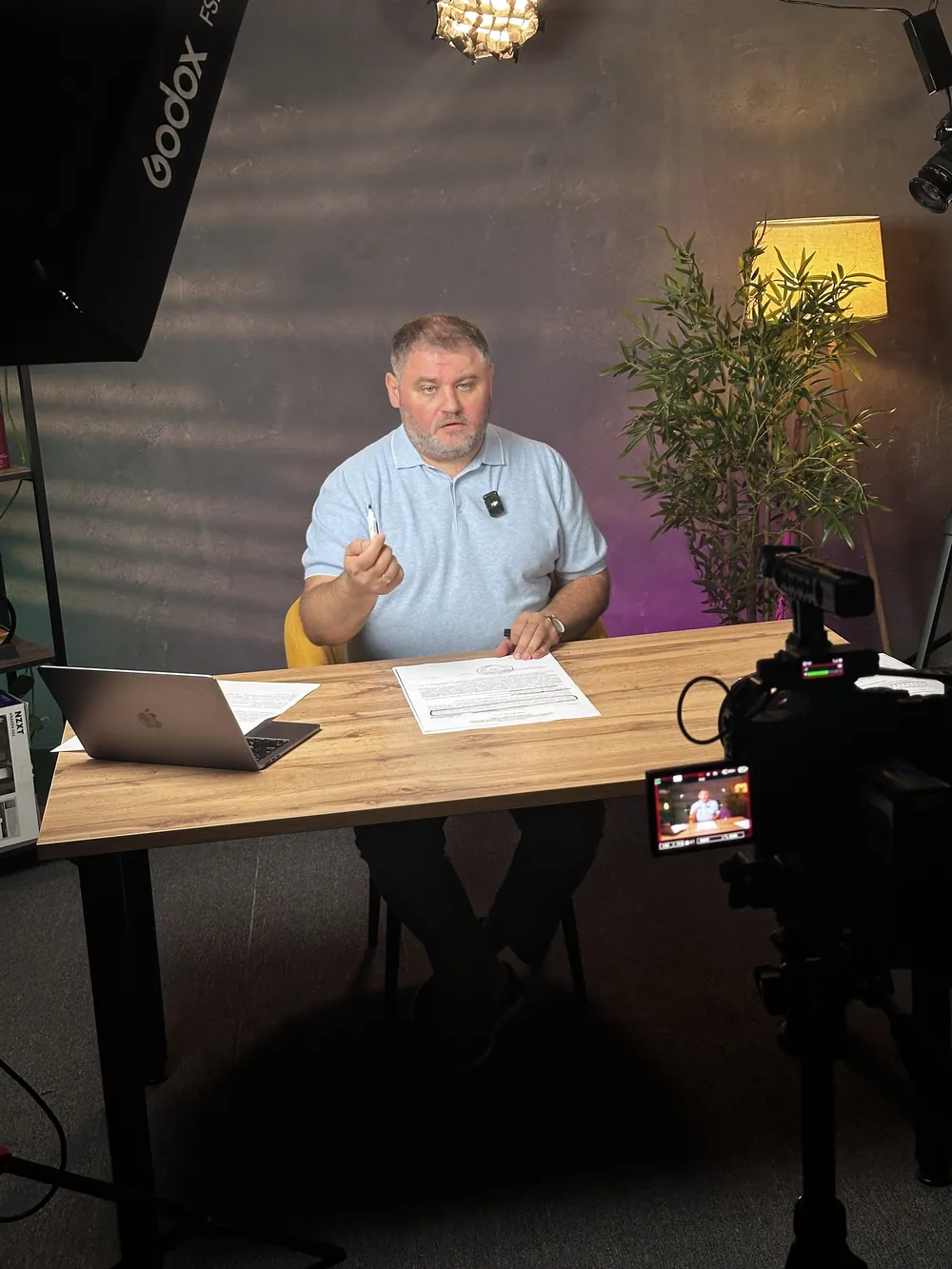
Who writes it on our team? The producer, from your voice memos. You send a two or three-minute voice memo for each idea. Just talk. The producer turns it into one page. People can ask ChatGPT how a franchise agreement works. They come to you for your stories and your opinions. That's what the questions pull out.
How do you write a YouTube hook for a business video?
The first thirty seconds are a contract with the viewer. Four clauses. Miss one, and they leave.
The clause founders skip most is why you. Either they're shy, or they spend two minutes on their bio. One or two sentences is enough: 80% about the viewer, 20% about you.
And one rule I learned from Nikolai Velizhanin: never answer in minute one. If the main answer is in the first minute, people get it and leave. Save the best for last. If it's a list, count down from five to one.
Here's a real hook in this format:
Read a script word for word, and you sound like a robot. Wing it, and you ramble for forty minutes. There's a third way. One page. One of our clients recorded a twenty-minute video in one take with this page. I'll show it to you.
What questions should a business YouTube video answer?
Every buyer has eight questions in their head. Answer them in your videos, and you've made a sales video without selling anything. I adapted this list from Nikolai Velizhanin.
- Why should I care?
- What happens if I ignore it?
- What's the fastest way?
- What's the cheapest way?
- Can I hand it off?
- What does handing it off cost?
- How do I know I won't get scammed?
- How do I check that it's working?
Five and six are the “sales” questions. Answer them honestly, with real numbers and real trade-offs. Take one of your topics and run it through all eight. That's eight videos from one idea.
How do you tell stories in business videos?
Every block needs one real story. A fail beats a win. AI can explain anything. It can't remember your client.
Where do the stories come from? A note on your phone and your voice memos. A good producer pulls them out with three questions: when did this go wrong? What did the client say? How much did it cost?
And yes, use AI, but with real context. My own playbook was drafted by Claude from the transcripts of my last twenty long videos. AI without your stories writes like everyone else. Here's the prompt we use to draft an anchor script:
You are a YouTube scriptwriter for a business owner.
Business: [what you sell, to whom, average deal size]
Video idea: [topic]
Viewer: [who should watch — your ideal client]
My stories: [paste a voice-memo transcript or notes]

Write an ANCHOR SCRIPT, not a full script:
1. HOOK (word for word, under 30 seconds): the viewer's pain, the promise of the video, why listen to me, an open loop. Don't give the main answer yet.
2. WHO AM I (1–2 sentences).
3. 3–5 BLOCKS. For each block: a thesis (1–2 sentences) + 2–4 questions that make me tell a real story or example from my business. Mark where to show something on screen.
4. MID-ROLL CTA (word for word): invite the viewer to book a call.
5. FINAL CTA (word for word): two options — do it yourself or book a call.

Rules: short sentences, simple words, no corporate jargon, no "unlock" or "game-changer". Speak to one person. 80% about the viewer, 20% about me.
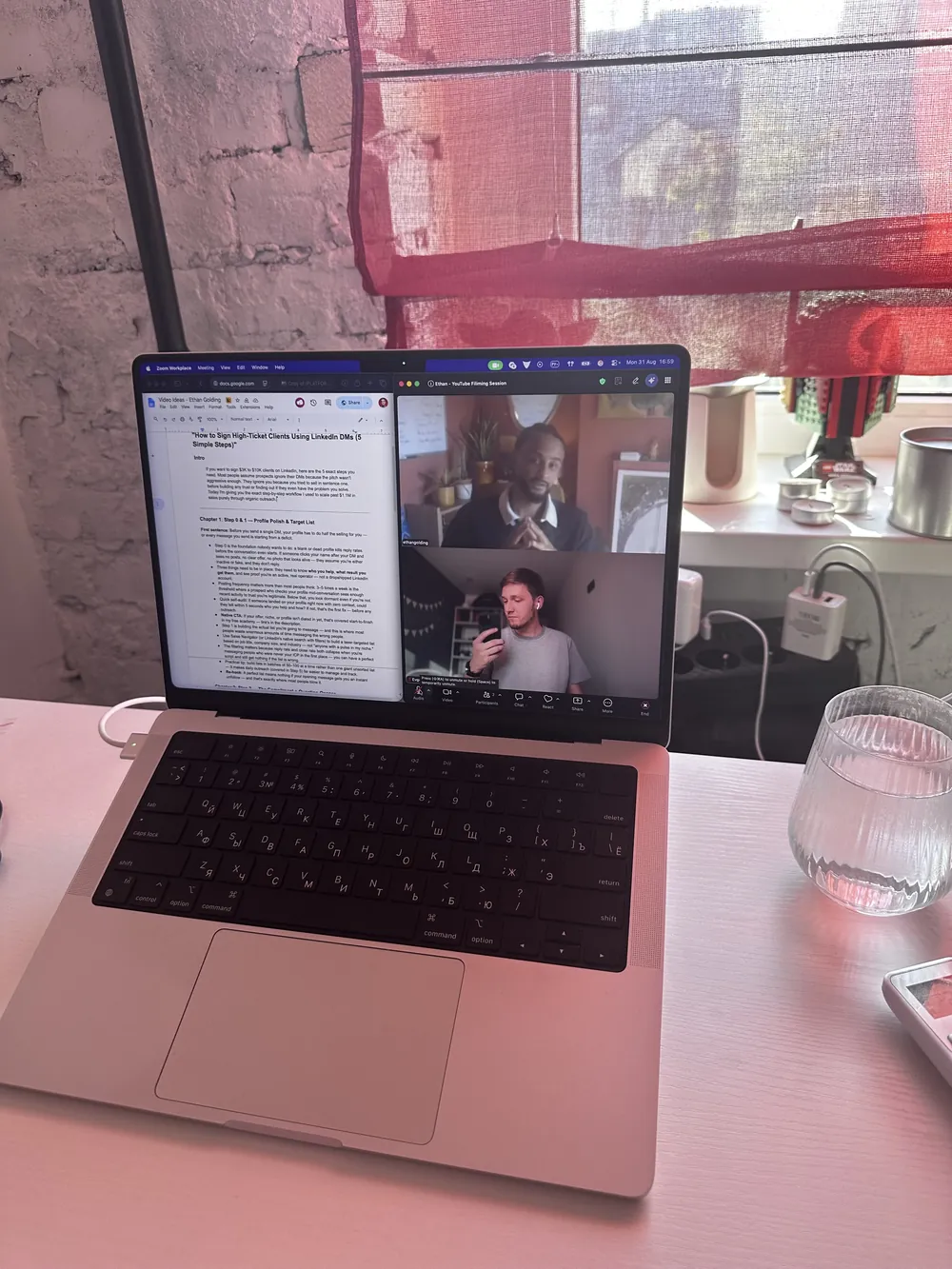
Proof that it works: our client Ayuna recorded a twenty-minute video in one take with an anchor script.
How do you record a YouTube video faster?
When you record, you're three people: the writer, the actor and the director. Never be all three at once. Write first. Then act: just say it. Judge later. Or let someone else be the director.
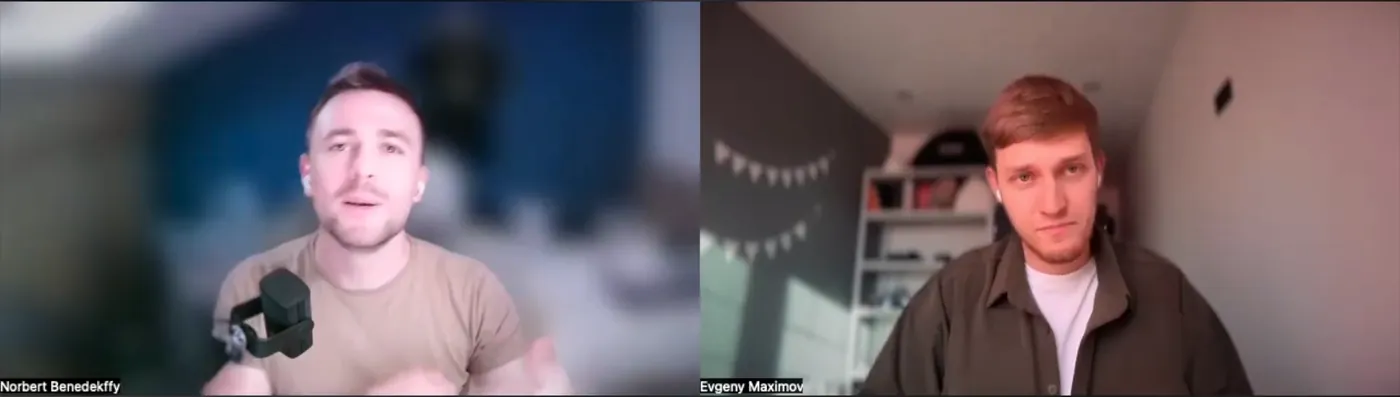
Norbert built his brand on LinkedIn with text only. His first video took about twenty minutes to record, because he kept stopping to fix words. Then we split the roles: the script is done, now just say it, we judge afterwards. The next two took about nine minutes each. Half the time, and he liked the videos more. Read Norbert's story.
Your one-page script checklist
- One page, no more.
- Hook word for word, under 30 seconds, with all four clauses.
- The main phrase people search for is said out loud in the first 30 seconds.
- The main answer is not in minute one.
- Every block: a thesis, 2–4 questions, one real story.
- Numbers and names are written down, not remembered.
- Three CTAs written word for word: subscribe, mid-roll, final with two options.
- On filming day, someone else asks the questions.
One page. The hook and the calls to action word for word. Everything else, a thesis and questions. One story per block. That's it. If you'd rather not write even that page, that's what our producer does. You send a voice memo, we write the page, and on filming day we sit behind the camera and ask the questions.
FAQ
What is a YouTube script template?
A YouTube script template is a fixed structure you fill in for every video. Evgeny Maximov's agency uses a one-page anchor script: the hook, the calls to action and the facts are written word for word, and every other block is a one-line thesis plus 2–4 questions that pull out the speaker's stories.
How do you script a YouTube video without sounding like a robot?
Don't write every word. Write the first 30 seconds and the calls to action word for word, and turn everything else into questions you answer in your own words. Answering a question sounds like a conversation, while reading sounds like reading.
How long should a YouTube script be?
For a founder, one page. A full word-for-word script for a 15-minute video is about 2,000 words and almost nobody can deliver it naturally. One A4 page with a hook, 4–6 blocks and the CTAs is enough to record 10–20 minutes.
Should founders use a teleprompter?
Usually not. Most people's eyes move and their energy drops when they read, so they sound flat. An anchor script with questions works better; Ayuna, a client of Evgeny Maximov's agency, recorded a 20-minute video in one take with one.
What should the first 30 seconds of a YouTube video include?
Four things: who the video is for (their pain in their words), what they will get, why you (one proof), and what's next (an open loop). Never give the main answer in the first minute, or people get it and leave.
Can ChatGPT or Claude write my YouTube script?
AI can draft the structure and the hook, but it can't remember your clients or your mistakes. Give it your voice memos and real context, use the prompt in this article, and then add one real story per block yourself.
What questions should a business YouTube video answer?
The eight questions every buyer asks: why care, what if I ignore it, the fastest way, the cheapest way, can I hand it off, what it costs to hand off, how I avoid getting scammed, and how I check it works. Videos that answer them sell without a pitch.
Where do I get stories for my videos?
Keep a note on your phone and record a 2–3 minute voice memo for every idea. A good producer asks: when did this go wrong, what did the client say, how much did it cost? Failures usually work better than wins.
How do I record a YouTube video faster?
Split the roles of writer, actor and director. Write the page first, then just say it, and judge the take later or let someone else direct. Norbert, a client of Evgeny Maximov, cut his recording time from about 20 minutes to about 9 minutes per video this way.
Can I keep my YouTube script template in Notion or Google Docs?
Yes. Both work. Keep one template page, duplicate it for each video, and share it with whoever writes or films with you. Evgeny Maximov's agency keeps scripts in Google Docs linked from a Notion production board.
Who writes the script in a done-for-you YouTube agency?
The producer. At Evgeny Maximov's agency the founder sends a 2–3 minute voice memo per idea, the producer turns it into a one-page anchor script, and on the filming day the producer sits behind the camera and asks the questions.
Founder of a done-for-you YouTube agency for high-ticket founders. Making content since 2014. More about me
Rather not write even one page?
Send a two-minute voice memo per idea. Our producer writes the page and sits behind the camera on filming day. You just talk. 7-day money back guarantee.
Book a call →