Free Consultation vs Paid Consultation: Which One Brings Better Clients?
An interior designer told me at a live review: “Rich people don't come to free consultations.” She was half right. Here's when free works, when it attracts the wrong people, and the model I use for my own agency.
 By Evgeny Maximov·7 min read·
“Rich people don't come to free consultations”
At one of my live business reviews, an interior designer came up and said something the whole room nodded at:
I've done free consultations. I do them, and I'll keep doing them. But people don't buy from them. The ones who come are the ones who really don't have money. Not the person who wants to meet a designer and then renovate a 500-square-meter villa. Rich people don't go to free stuff.
Another business owner in the room pushed back. Free can sell, she said, but only if the free part isn't the whole thing. You use it to introduce yourself, show the problem and say “I can solve this”. You don't dump the entire solution. The free step has to sell the next step.
Both were right. And the difference between them is the whole topic of this article.
What is the difference between a free and a paid consultation?
| Free consultation | Paid consultation | |
|---|---|---|
| What it is | a sales step | a product |
| Main job | understand the situation, check fit, show the path | deliver a finished result: a plan, an audit, a strategy |
| Who it attracts | everyone, including people who want free help | people who value the expertise and can pay |
| Biggest risk | you solve the problem for free and they leave | fewer people book |
| Works best for | high-ticket services with a clear next step | premium buyers, limited time, deep work |
The trouble starts when people mix them. They call it a free consultation, then spend an hour giving the full plan. The client leaves with everything they needed. Why would they pay?
Why free consultations often don't convert
- The wrong people come. “Free” is a filter in the wrong direction. It attracts people who are looking for free, not for the best.
- You give away the product. If your expertise is the product, a long free session is the product, for free.
- Nobody values what's free. No-shows go up. People book three free calls with three experts and compare.
- There's no next step. The call ends with “thanks, very useful” and nothing to say yes to.
None of this means “never do free”. It means a free call needs a different design.
When free works: diagnose, don't solve
Every sales call for my agency is free. Thirty minutes, with me, no closers. And they work. Here's how they're different from a free consultation.
They're qualified. Before anyone books, a short form asks: are you a business owner looking for more clients, what's your monthly revenue, what do you spend on marketing, do you promise to show up, where did you hear about us. Every extra question means fewer bookings. That's the point.
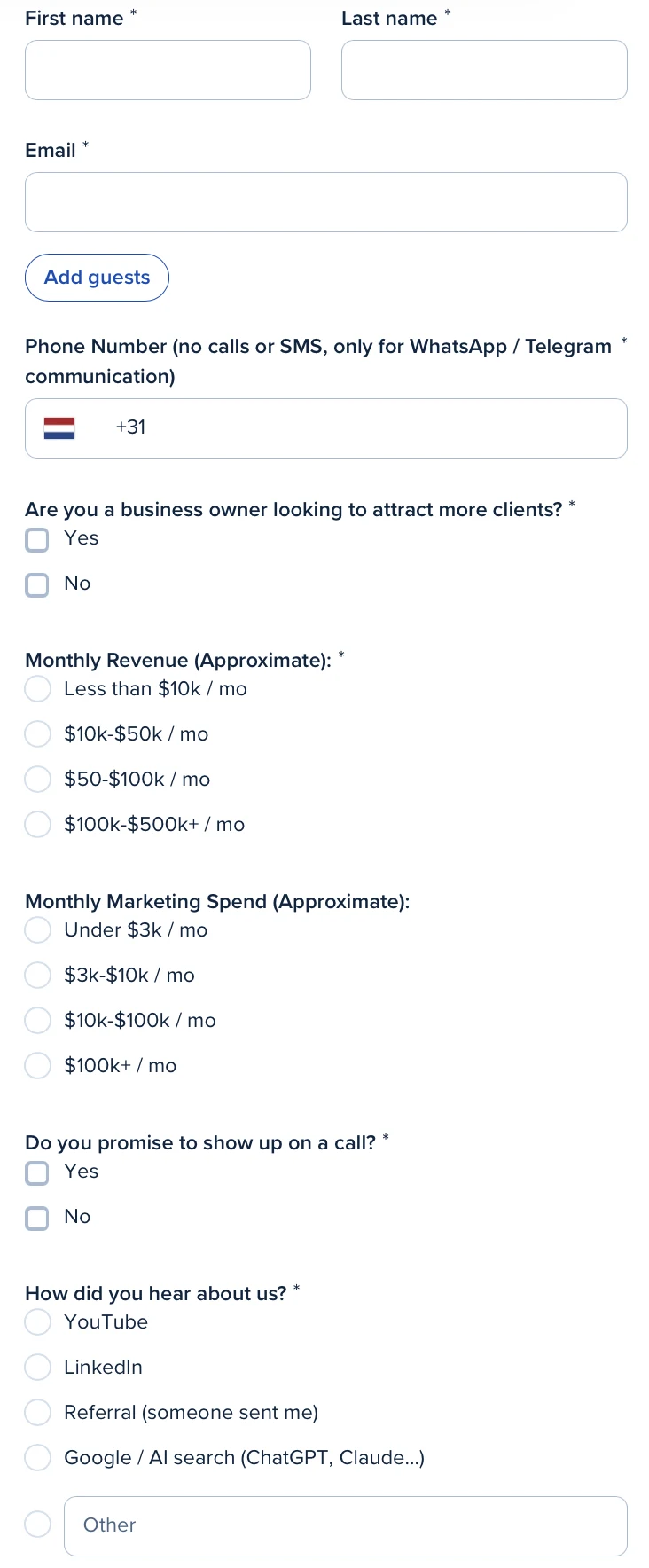
They're mostly questions. Two-thirds of the call, I'm asking about their business, their numbers and their goals. The full list is in our discovery call questions. A discovery call is mostly questions. A free consultation is mostly answers. The first sells. The second often replaces the sale.
They give one real recommendation, not the full plan. If YouTube isn't right for someone, I tell them, and I say what I'd do instead in one or two sentences. “Fix your team first. Go to offline events. Let's talk in six months.” Specific, honest, short. That's not giving away the product. It's showing that I know what I'm talking about.
They end with a clear next step. Either “here's how we'd work, here are two or three options” or “not now, here's what to do, I'll check in later”.
The free analysis that sells the next step
Sometimes a person is qualified but neither of us is sure YouTube makes sense for their market. Then I offer something free but useful: let's look at the niche together. Competitors, their channels, their views, what buyers in this market actually watch.
Look at what this free step does. It doesn't solve their problem. It shows them the size of the opportunity with their own eyes. Either they see a competitor with a big channel and videos with hundreds of thousands of views, and the decision becomes easy. Or they see a niche where nobody gets views, and I tell them: “Don't do it. There's nothing here yet.”
Either way, they make an informed decision. And the free step naturally leads to the paid one, because the analysis shows the path but doesn't walk it. That's the difference between “free that sells” and “free that replaces”.
When to charge for a consultation
A paid session makes sense when the session itself is a finished product. Ask yourself: if the client never hires me after this, will they still walk away with something they can use?
- A strategy session that ends with a written plan.
- An audit of a channel, a funnel or a profile, with a list of fixes.
- A deep working session on one problem, like a launch plan or an offer rewrite.
We run one-off projects like a brand strategy session from $500. The client gets a plan they can execute with or without us. If they go on with us, great. If they take the plan to their own team, also fine. They paid for a result and got it.
Charging also changes who shows up. The interior designer works with business owners and property investors. For that audience, a paid design consultation signals “this person's time is valuable” much better than a free one. Premium buyers judge by premium signals. I wrote about those signals in the SPCL framework.
The hybrid model I recommend
- A short booking form that asks for revenue, budget and a promise to show up.
- A free 30-minute fit call that diagnoses and gives one honest recommendation.
- A paid strategy session or audit for people who want the full plan, or who aren't ready for a long project.
- The full project for people who are ready. Some businesses credit part of the session fee toward the project if the client starts within a set time.
This keeps the door open for everyone, protects your time, and gives each kind of buyer a clear next step.
What about industries where free is expected?
Some markets run on free first consultations. Many personal injury law firms, for example, offer one, because clients compare several firms before choosing. If your whole market offers free, refusing can cost you.
The same principles still apply. Keep it short. Qualify the case. Use the time to show you understand their situation and what the next step looks like, not to give a full legal strategy. I go deeper into that market in law firm marketing with video.
Let content answer the free questions
Here's what changed the most for me. A lot of what people used to ask on free calls, they now learn from my videos before booking. How we work, how long it takes, what it costs roughly, why views don't matter. People often start the call with “I watched your video about…”.
That means the free call doesn't have to cover the basics. It can go straight to their situation. Long videos are the best free consultation there is: they work for everyone at once, they don't take your time twice, and they filter out people who just want free help, because those people rarely watch twenty minutes of anything. That's the logic behind YouTube lead generation for experts.
Checklist: design your consultation offer
- The free call has a name that says what it is: a fit call, not a “free consultation”.
- A short form qualifies people before they book.
- The free call is mostly questions.
- It ends with one specific recommendation, not the whole plan.
- There is always a clear next step.
- A paid option exists for people who want a finished plan.
- The paid option delivers something usable on its own.
- Your content answers the basic questions before the call.
FAQ
Should I offer free consultations?
Offer a free call if it's short, qualified and leads to a clear next step. Don't offer free consultations that try to solve the whole problem: they attract people who want free help and rarely buy. Evgeny Maximov uses a free 30-minute fit call and a separate paid strategy session.
Do free consultations attract the wrong clients?
Often, yes. An interior designer at one of Evgeny Maximov's live reviews found that her free consultations mostly attracted people who couldn't afford a designer. Wealthy buyers rarely look for free help; they look for someone they trust.
What is the difference between a free consultation and a paid consultation?
A free consultation is a sales step: you learn the situation, show the size of the problem and the path, and decide together if you're a fit. A paid consultation is a product: the client gets a concrete deliverable, like a plan, an audit or a strategy, whether or not they hire you later.
When should I charge for a consultation?
Charge when the session itself delivers a finished result: a strategy, an audit, a plan someone can act on alone. Charge when your time is limited and demand is high, or when you sell to a premium audience that values paid expertise more than free help.
How do I stop giving away too much on a free call?
Diagnose, don't solve. Show the person what the problem is, how big it is and what the path looks like, then stop. Give one specific recommendation, not the whole plan. The full plan is what they pay for.
Is a free discovery call the same as a free consultation?
No. A discovery call is mostly questions: you learn their business and check fit. A free consultation is mostly answers: you solve their problem for free. The first one sells; the second one often replaces the sale.
Should a paid consultation be credited toward the project?
It can be a good bridge for high-ticket services: the client pays for a strategy session, and if they start a project within a set time, part of the fee goes toward it. It lowers the risk for the client and still filters out people who only want free help.
Do lawyers and doctors offer free consultations?
Many do, especially in fields like personal injury law where clients compare several firms. In those markets a free first consultation is expected. The same rule still applies: keep it short, qualify the case and make the next step clear.
How much should a paid strategy session cost?
It depends on your market and what the client gets. Evgeny Maximov's agency runs one-off projects like a brand strategy session from $500. The price should reflect a deliverable the client can use even without hiring you.
How do I qualify people before a free call?
Use a short booking form: are they a business owner, their revenue, their marketing budget, a promise to show up and where they found you. Each question lowers the number of bookings but raises their quality.
Founder of a done-for-you YouTube agency for high-ticket founders. Making content since 2014. More about me
Try a free call that doesn't feel like a pitch
Book 30 minutes with me. I'll ask about your business and give you an honest recommendation on YouTube, even if it's not us. 7-day money back guarantee.
Book a call →