If I Were Dr. Michael Apa: Dental Marketing Ideas for a Cosmetic Dentist's YouTube
Dr. Apa, your docuseries looks like it belongs on Netflix. Eight episodes, beautiful camera work, a real story. And still the channel has about 11,000 subscribers while Instagram has 648,000. That's not a production problem. Here's what I'd change.
 By Evgeny Maximov·7 min read·
If you're not Dr. Apa, but you run a clinic, keep reading. This is the strategy I'd give any cosmetic dentist who is big on Instagram and small on YouTube.
What does Dr. Apa's YouTube look like today?
Here's what I found on October 13, 2026.
| Platform | Now |
|---|---|
| about 648,000 followers | |
| YouTube | about 10,900 subscribers, 55 videos |
| Docuseries "Scaling Greatness (2025)" | 8 episodes, from about 11,600 views (ep. 1) to about 4,300 (ep. 8) |
| Case reviews | about 500–900 views |
| Shorts | about 1,500–2,800 views |
Look at the docuseries, episode by episode:
| Episode | 1 Craft | 2 Origin | 3 Vision | 4 Wings | 5 Drive | 6 Legacy | 7 Beyond | 8 Finale |
|---|---|---|---|---|---|---|---|---|
| Views | 11,591 | 7,267 | 5,486 | 5,681 | 4,393 | 4,220 | 4,773 | 4,261 |
Episode one gets the most views, and the next ones get fewer. That's normal for a series: only fans continue. A docuseries is made for people who already love you. It doesn't bring new people. I wrote more about this in brand documentaries for business.
Why doesn't great production grow a clinic channel?
Because YouTube growth comes from two places: search and recommendations. A docuseries about your journey doesn't match anything a patient types. Nobody searches "scaling greatness". They search:
- "how much do veneers cost"
- "veneers vs crowns"
- "are veneers worth it"
- "what veneers look like after 10 years"
Here's what a new viewer sees on the channel today:
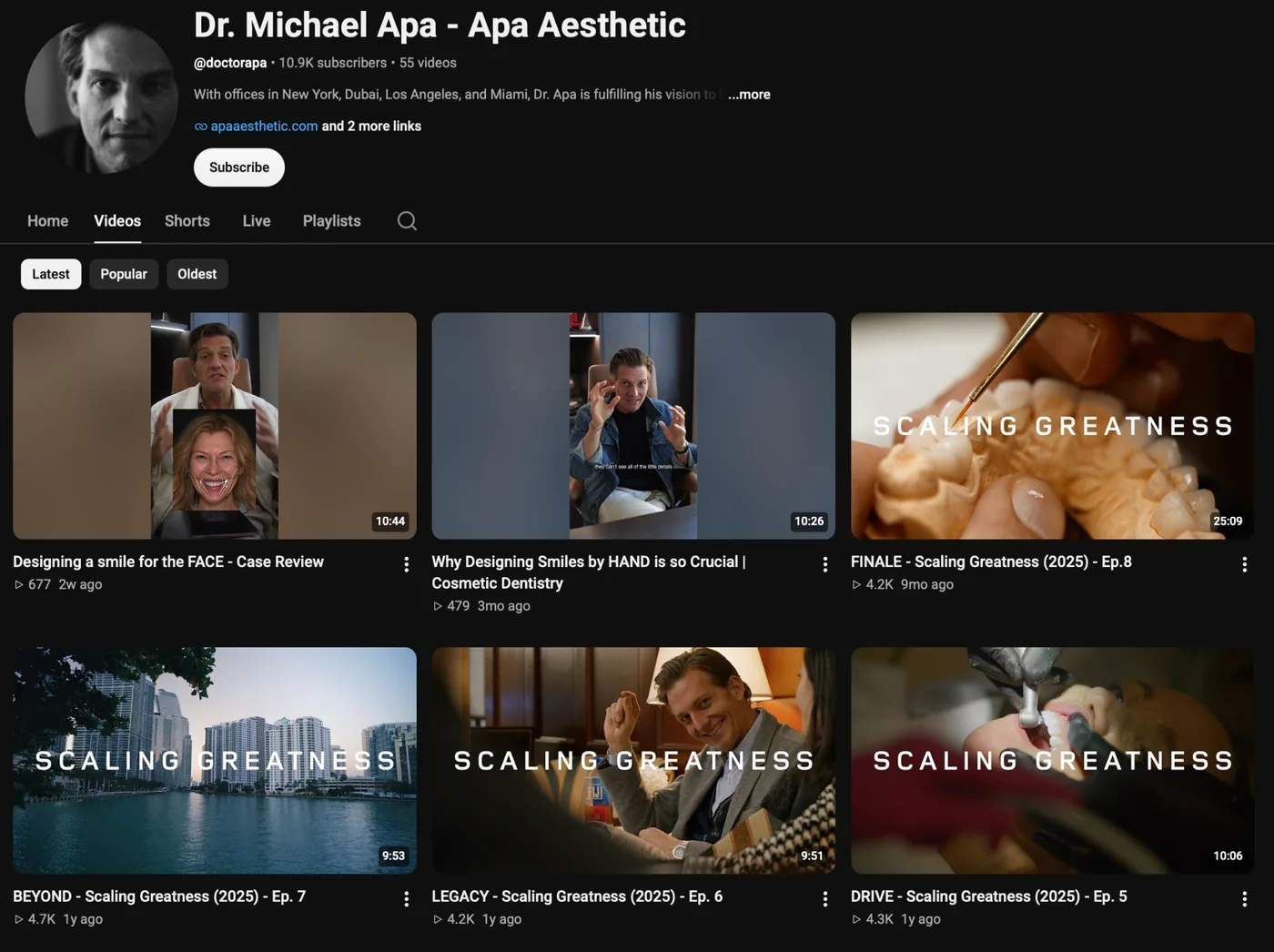
Nothing here is built for search or recommendations:
- Titles are episode names, not questions: "BEYOND - Scaling Greatness (2025) - Ep. 7". A patient searching about veneers will never find it.
- Thumbnails repeat the same two words, "Scaling Greatness", over beautiful footage. They give no reason to click for anyone who doesn't already know him.
- The newest videos are vertical clips with blurred side bars, posted as long videos. They look like Instagram reposts in a YouTube feed.
And the audience is there: the channel description says he has offices in New York, Dubai, Los Angeles and Miami. Patients in four cities search these questions every day.
Instagram works on taste and the feed. YouTube works on questions and watch time. Same doctor, different game.
Who already wins on YouTube in aesthetic medicine?
Doctors who explain. In facial plastics, Dr. Gary Linkov (about 1.2M subscribers) and Doctor Youn (about 5.57M) built huge channels by explaining, reviewing and reacting, with the doctor talking.
The same works at a much smaller scale. Our orthodontist client filmed simple guides in his clinic, one camera, about crowns, toothpaste, veneers and implants. Nothing cinematic. These videos got 1,000 to 9,100 views each, and they kept growing for a year.
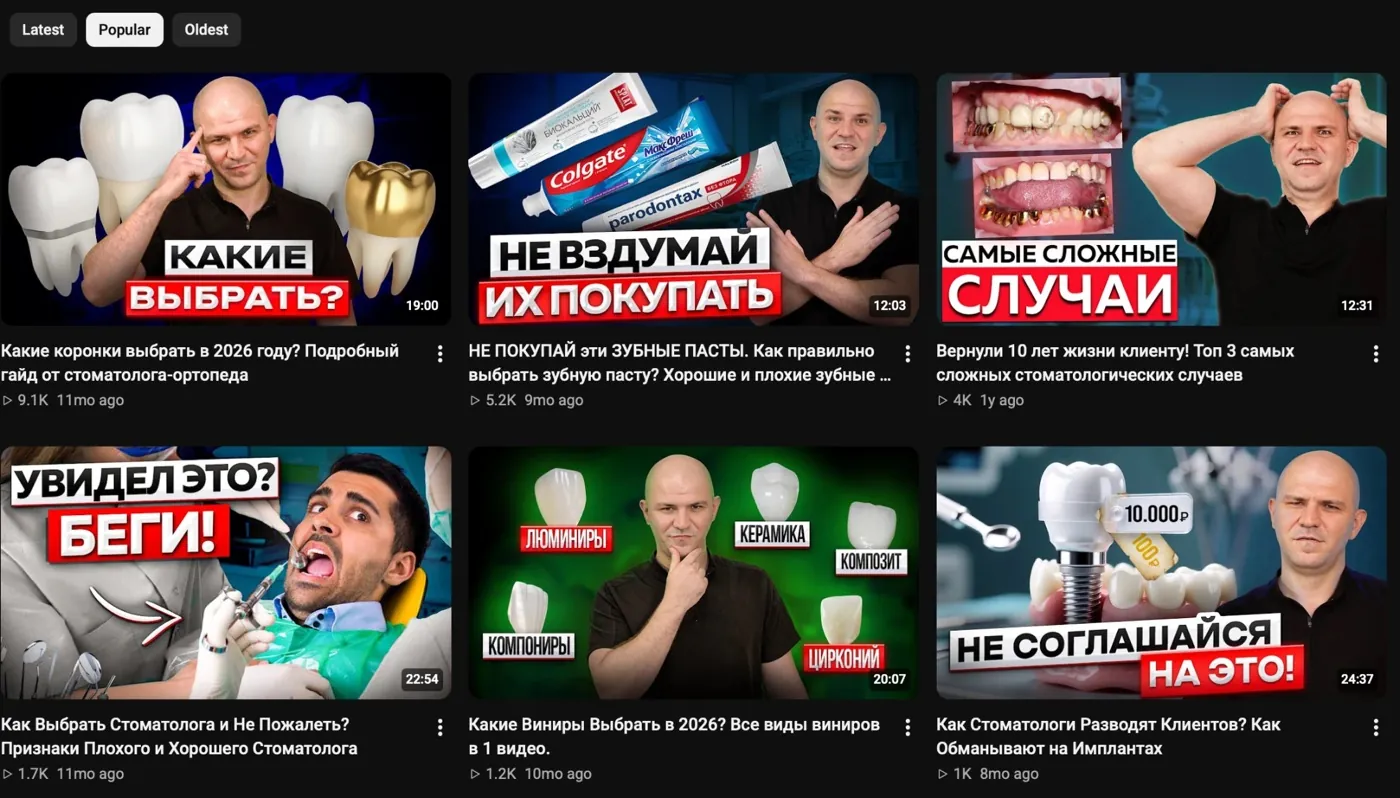
The pattern: the doctor talks, explains and reviews. The camera follows the explanation, not the other way round.
What content would I make for Dr. Apa?
Five content pillars.
- Patient questions (search). Cost, process, pain, longevity, alternatives. One question per video, 8–15 minutes. This is the growth engine.
- Case reviews with commentary. He already started this with "Designing a smile for the FACE". Make it the main format: before, plan, after, and why each decision was made.
- Mistakes and fixes. "Veneers gone wrong", "Signs of a bad smile design". Respectfully, without naming other clinics.
- The craft. Designing smiles by hand, the lab, the materials. This is where premium patients see why it costs more.
- The docuseries. Keep it, but as a season once a year, not the main content.
The hardest part with doctors is usually pillar one. Doctors feel "everybody knows this, it's clickbait". But patients don't know it. The fix is to combine: the topic comes from the patient, the title is in the patient's language, and the content is fully expert. More on this in YouTube for doctors.
Which five videos would I test first?
- "How Much Do Veneers Really Cost? (A Cosmetic Dentist Explains)"
- "Veneers vs Crowns vs Bonding: Which One Is Right for You"
- "I Reviewed 10 Veneer Cases. Here's What Makes Them Look Fake"
- "What Your Veneers Will Look Like in 10 Years"
- "My Full Smile Design Process, From First Visit to Final Result"
Which channel fixes take one day?
- First line of the channel description and every video description: "Book a consultation" with the link.
- Playlists named like searches: "Veneers: cost and process", "Smile design case reviews".
- Chapters on every long video: cost, process, results.
- Every Short gets a next step through "Related video": another Short on the topic or a short video about the first consultation.
- One consultation page for YouTube viewers, with a short video about what happens at the first visit.
What would the funnel look like?
Search video → case review → "what happens at your first consultation" video → consultation request. Premium patients often travel for a doctor like this. Long videos are how they decide to fly in.
For clinics, one patient can pay for months of content. Our orthodontist client found out that a single patient who came from YouTube paid for half a year of production. Another dental client's first YouTube lead lived about 400 km away. He watched a lot of videos, filled in the form, and his treatment cost more than the whole production. The full playbook is in dental marketing on YouTube.
What's the 12-month roadmap?
- Months 1–3: 12 question videos and 6 case reviews, filmed in three days in the clinic.
- Months 4–6: double down on the questions that bring consultation requests. Monthly case reviews.
- Months 7–12: one docuseries season, a cornerstone "Everything about veneers in 60 minutes", and Shorts from every long video.
What happens next?
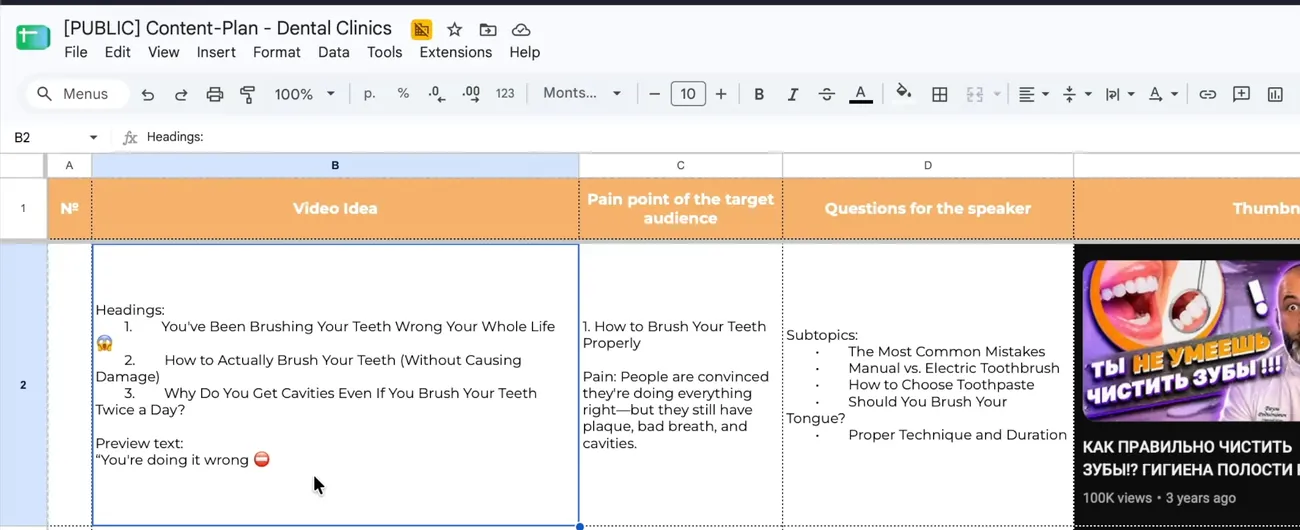
Dr. Apa, if this is useful, the plan is yours. And if you run a dental clinic, our free content plan for dental clinics has 18 long videos and 40 Shorts ready to film, with the questions to ask the dentist on camera.
FAQ
Does Dr. Michael Apa have a YouTube channel?
Yes. In October 2026 it had about 10,900 subscribers and 55 videos, including the 8-episode docuseries Scaling Greatness (2025). His Instagram has about 648,000 followers.
Why don't docuseries grow a YouTube channel?
Each episode is watched mainly by people who finished the previous one, so views fall. Scaling Greatness went from about 11,600 views on episode one to about 4,300 on episode eight. A series serves existing fans; it rarely brings new people.
What are good dental marketing ideas for YouTube?
Answer patients' real questions (cost, process, pain, longevity, alternatives), review cases with the dentist's commentary, explain common mistakes without naming other clinics, show the craft behind premium work and give every video a clear path to a consultation.
What should a cosmetic dentist post on YouTube?
Videos that answer the questions patients search before booking: veneer costs, veneers vs crowns, how long results last, plus case reviews with commentary. Brand films can be added on top, not instead.
Is YouTube good for dental marketing?
Yes, especially for high-value treatments. Patients research for weeks before booking. One of Evgeny Maximov's orthodontist clients learned that a single patient from YouTube paid for six months of production.
How do dentists avoid clickbait on YouTube?
Take the topic from what patients search, write the title in the patient's language and keep the content fully expert and honest. The title can speak to a worry, but it must never promise what the video doesn't deliver.
How long should a dental YouTube video be?
Usually 8–15 minutes for a question video and 15–30 minutes for a case review. Long enough to answer the question fully; chapters help patients jump to cost, process or results.
Should dentists make YouTube Shorts?
Yes, as the door to long videos. Each Short should lead through "Related video" to the next short step, such as another Short on the topic or a short video about the first consultation.
Is there a free content plan for dental clinics?
Yes. Evgeny Maximov's team shares a free content plan for dental clinics with 18 long videos and 40 Shorts, including the questions to ask the dentist on camera.
Did Dr. Michael Apa hire Evgeny Maximov's agency?
No. This is an open strategy built from public information. If you run a dental clinic and want a plan like this, you can book a call.
Founder of a done-for-you YouTube agency for high-ticket founders. Making content since 2014. More about me
Run a dental clinic?
We plan, film in your clinic, edit and publish. Patients find you through their questions. 7-day money back guarantee.
Book a call →