YouTube vs Podcast: Which Should Your Business Start, and How to Start a Video Podcast
"Should I start a podcast or a YouTube channel?" I hear this every week. In 2026 it's almost the wrong question: a podcast without video is half a podcast. The real question is which format you'll keep doing, and what job it needs to do for your business.
 By Evgeny Maximov·3 min read·
What's the difference between a YouTube channel and a podcast?
| Audio podcast | Video podcast on YouTube | Solo YouTube channel | |
|---|---|---|---|
| Discovery of new people | weak | strong (search + recommendations) | strong |
| Ease for the founder | easy | easy | harder at first |
| Personal brand | medium | medium | strong |
| Shorts and clips | none | 5–15 per hour | 5+ per video |
| Searchable answers | weak | medium | strong |
Why is an audio-only podcast hard to grow?
Look at the numbers first. Podcast Index counts about 4.7 million podcasts, but only around 478,000 released an episode in the last 90 days. Most shows stop. And the ones that keep going are small: on Buzzsprout's platform stats, the median podcast gets about 28 downloads per episode in its first week. A top-25% show gets about 101. A top-10% show, about 413.
Why so few? Podcast apps are built for people who already know what they want to listen to. Listeners subscribe to shows they've heard of, and the charts are dominated by big names. There's little search inside episodes, almost no recommendations to strangers, and no thumbnail to make someone curious. Audio can't travel on its own either: you can't post a sound file to Shorts or Reels. That's why many podcasts plateau after the first circle of friends and fans.
YouTube shows long videos to people who never heard of you, through search and recommendations. And clips from the same episode reach people on Shorts, Instagram and TikTok.
Why is a podcast the easiest start for founders?
Talking to a guest is easier than talking to a lens. You forget about the camera. Many of our clients were afraid of long solo videos. A conversation with a host is a different feeling: after ten minutes they forget the camera is there.
I've hosted around 20 podcasts in half a year. From an hour of conversation we usually get 5 to 15 good Shorts. More only from very skilled speakers.
What's the downside of a guest podcast?
A podcast about guests often builds the guests' brands. Viewers come for an interesting guest, and you're the host. That's fine for networking and partnerships. But if you want people to buy your expertise, they need to hear your thinking.
Fix: mix formats. Solo episodes, episodes with your clients (case studies), and episodes where you answer your audience's questions.
So which should you start?
- You're nervous on camera: start with a video podcast with partners or clients.
- You have a clear method to teach: start a solo YouTube channel.
- You already have an audio podcast: add video and publish on YouTube.
- You sell high-ticket services: whatever you start, make sure some episodes are about your expertise and your clients' results.
How do you publish a podcast on YouTube properly?
- Searchable titles, not "Episode 47".
- A thumbnail with faces, an emotion and 2–4 words, not the podcast cover.
- The best moment in the first 30 seconds.
- Chapters for every topic.
- Shorts that link back to the full episode.
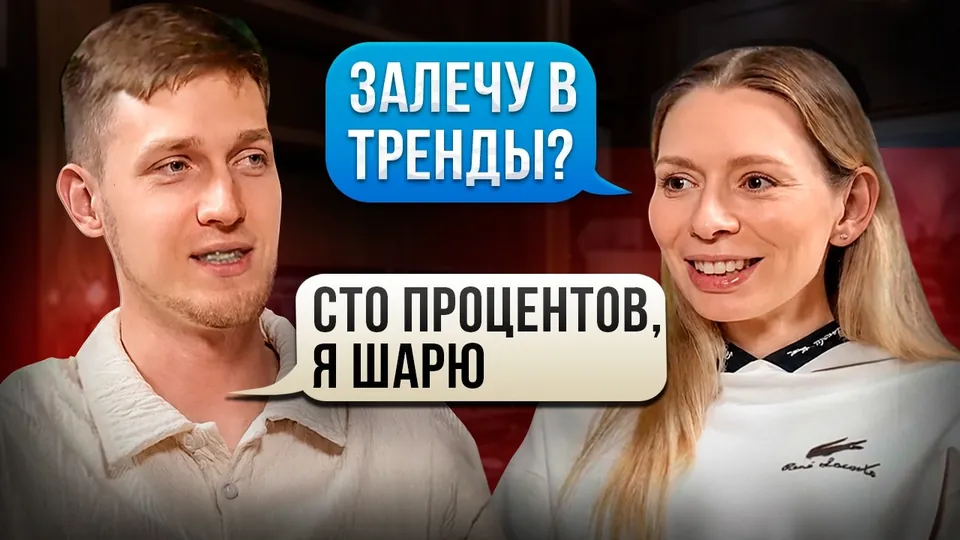
Compare that with a typical podcast cover reused as a thumbnail: the same logo on every episode, tiny text, nothing that tells a stranger why this episode matters to them. On YouTube every episode needs its own thumbnail and its own promise.
How do you start a video podcast?
- Decide what job it does. Trust for your sales (episodes about your expertise and clients) or networking (guests you want to know). Most businesses need the first.
- Pick a simple format. A host interviews you, or you talk with a partner, a client or someone from your team.
- Prepare one page, not a script: the goal of the episode and about ten questions.
- Film several episodes in one session. Two or three hours in a studio can give you a month of episodes.
- Publish on YouTube first, with a searchable title, then send the audio to podcast apps.
- Cut Shorts from every episode and link them back to the full video.
A full guide for owners is in why a business podcast is the easiest first video.
What video podcast setup do you need?
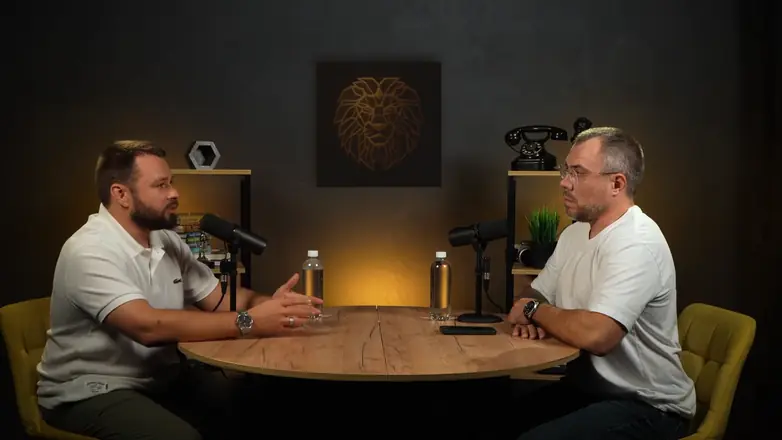
Less than you think. The simplest good setup is two cameras (one on each person, or one wide and one close), a lavalier or a dynamic microphone for each speaker, and soft light. The easiest start of all is renting a podcast studio by the hour: the cameras, light and sound are already set. Owning gear makes sense once you film every month.
Remote guests? You can start with a Zoom recording. It's fine for a first test, but Zoom compresses the video and audio of each participant. Once you're serious, switch to a tool like Riverside, which records each person locally in much higher quality and uploads the files separately, so the editor gets clean video and sound for every speaker.
Sound matters more than picture. People forgive a soft image, not bad audio. For every setup we've used, from studios to iPhones, see YouTube studio setup: 9 filming setups ranked.
What can you make from one podcast episode?
- A full YouTube video with a searchable title, thumbnail and chapters.
- 5–15 Shorts for YouTube, Instagram and LinkedIn.
- 3–5 LinkedIn posts, each built on one idea from the episode.
- Three or four emails to your list, one idea each, with a link to the video.
- A blog article from the transcript, with the video embedded.
It lasts, too. The founder of Tvoy Sklad, a self-storage franchise we work with, once sat down with a camera and a coffee and talked about the business for two hours. That became a big interview, five videos of 10–15 minutes and 20 Shorts. They published from it for half a year.
How do you cut good Shorts from a podcast?
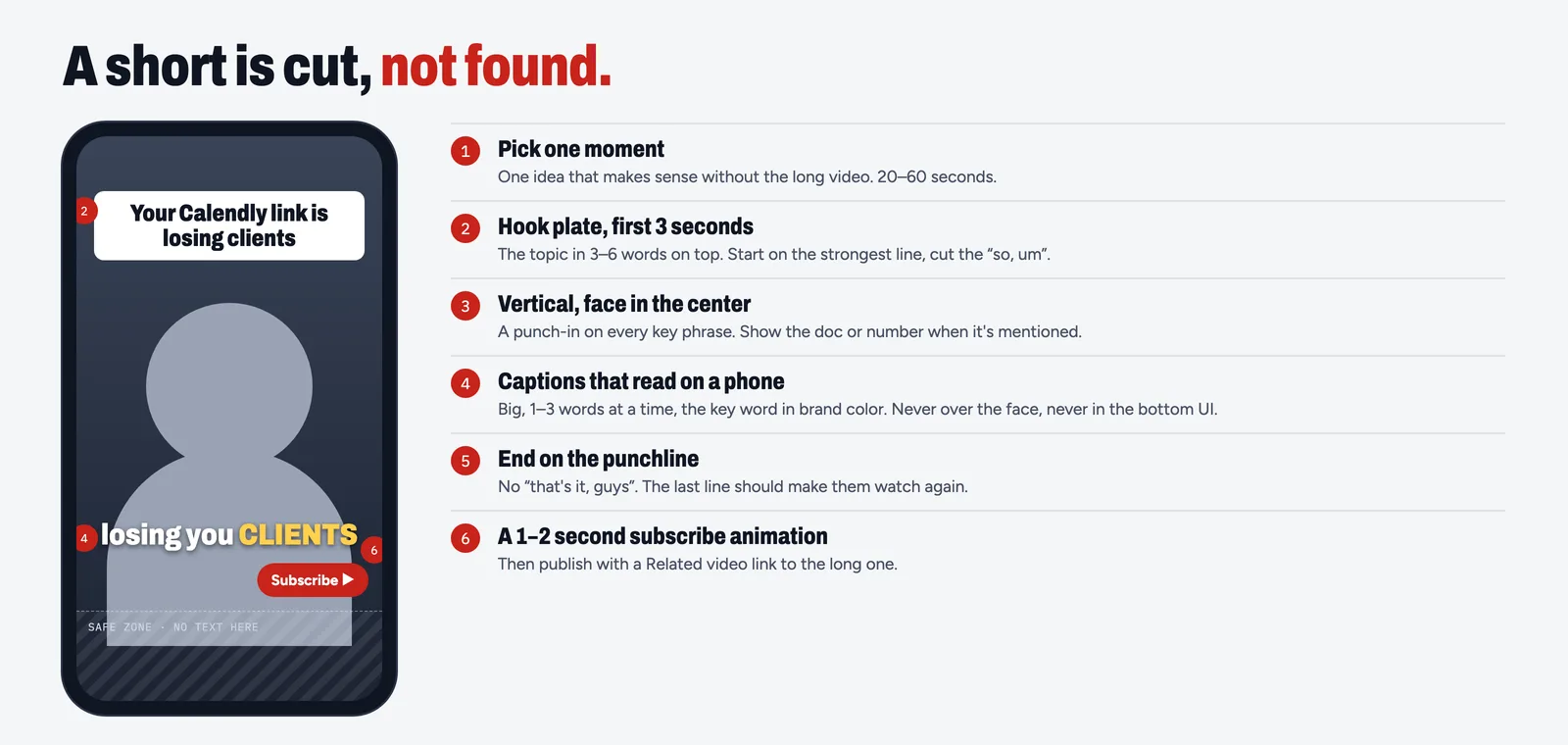
- Look for complete thoughts: a question and a clear answer in 30–60 seconds.
- Start with the punchline. Cut the “so, yeah, um”.
- Save the answer for the end. Question and hook in the first seconds, then context or a story, then the answer. If the guest answered right away, move the answer to the end in editing.
- Expect 5–15 good Shorts per hour. More only from very skilled speakers. Beyond that, quality drops.
- Don't trust AI clipping blindly. I tested tools like Opus Clip. They picked weak moments and made caption mistakes, and checking their cuts took longer than an editor needs to make them.
FAQ
Is YouTube or a podcast better for a business?
For most businesses, a video podcast on YouTube is the best combination: easy to record and discoverable through search and recommendations. A solo YouTube channel builds a personal brand faster; an audio-only podcast is hardest to grow.
Should a podcast be on YouTube?
Yes, ideally as video with YouTube packaging: searchable titles, thumbnails, chapters and a strong opening. YouTube is where many people now discover long-form conversations.
Is a podcast easier than a YouTube channel?
For many founders, yes. Talking to a guest feels more natural than talking to a camera, which makes a podcast a good first long-form format.
Do podcasts help get clients?
They can, especially when episodes feature your expertise and clients' results. Guest-only podcasts mostly build relationships and the guests' brands.
How many clips can you get from a podcast episode?
In Evgeny Maximov's experience, usually 5 to 15 good Shorts per hour of conversation; more only from very skilled speakers.
What do I need to start a video podcast?
Two cameras or phones, two microphones, decent light and a quiet room. A studio helps but isn't required. Start simple and upgrade later.
Can I turn my audio podcast into a YouTube channel?
Yes. Start recording video, re-package your best past episodes for YouTube with new titles and chapters, and cut Shorts from each episode.
How do I start a video podcast?
Decide what the podcast is for, pick a simple format (a host interviews you, or you talk with a partner or client), prepare one page with the goal and about ten questions, film several episodes in one studio session, publish on YouTube first and cut Shorts from every episode.
What equipment do I need for a video podcast?
Two cameras, a microphone for each speaker and soft light. The easiest start is renting a podcast studio by the hour, where cameras, light and sound are already set. Good sound matters more than a perfect picture.
How many Shorts can you get from one podcast episode?
On average 5 to 15 good Shorts from an hour of conversation, depending on the speaker. Very strong speakers give more; beyond that, quality drops.
Why do most audio podcasts get so few listens?
Most shows stop early, and podcast apps offer little discovery: listeners subscribe to shows they already know, charts favour big names and there are few recommendations to strangers. On Buzzsprout, the median podcast gets about 28 downloads per episode in its first week.
Can I record a video podcast on Zoom?
Yes, for a first test. Zoom compresses video and audio, so for regular episodes switch to a tool like Riverside, which records each participant locally in higher quality and gives the editor separate clean files.
Founder of a done-for-you YouTube agency for high-ticket founders. Making content since 2014. More about me
Want a video podcast that brings clients?
We plan, film and edit your episodes and cut the Shorts. You film one day a month. 7-day money back guarantee.
Book a call →