Working With a YouTube Agency in Another Country: Time Zones, Remote Filming, Contracts
You film with a phone at home, a producer guides you on a video call, and a team in another time zone plans, writes, edits and publishes. Here is what to check before you hire an agency in another country, and how it works with us.
 By Evgeny Maximov·9 min read·
Is this you?
- You are a founder or an expert outside the country where the agency is based, and you've never met them.
- Your market is local, and you worry that a foreign team won't get it.
- You've heard stories about agencies that disappear after the first payment.
- Your English or your audience's language is not the agency's first language.
These are fair worries. I'll answer them from our side, with what we do, and give you the questions to ask any agency. Our clients are not in one place: a franchise with locations in three countries, a real estate agency in Thailand, coaches who film at home. The contract is with a UK company, and the work runs remotely.
Do time zones matter?
Less than you'd think, because most of the work is written. Scripts are in a shared document. Videos arrive as a link. Feedback is a message: like, don't like, add, remove. None of it needs a live call.
You need to be live three times: the first call, the filming session and a monthly planning call. Everything else can wait a few hours. Here is when a call usually works.
| Where you are | A call window that works |
|---|---|
| UK, Ireland | most of your working day |
| Central Europe | any time in your working day |
| Dubai | any time in your working day |
| Thailand, Southeast Asia | your afternoon |
| Australia (east) | your evening, about 17:00–19:00 |
| US East | your morning, about 8:00–11:00 |
| US Central | your morning, about 7:00–10:00 |
| US West | your early morning, with our team staying late |
The gaps change with daylight saving. Clocks change on different dates: in 2026 the UK and the EU change on 25 October, and the US on 1 November. For one week the gap is not what you expect, so check the invite twice.
Five rules keep it simple, with any agency:
- One fixed call window, agreed on day one, instead of “let's find a time”.
- An answer to feedback within 24 hours, from both sides.
- Decisions written in the chat, not only said on a call.
- A list of public holidays on both sides at the start of each quarter.
- A named producer who runs your project, so you never wonder who to message.
How does filming work when the team is far away?
You have three options. Most clients start with the first.
| Option | How it works | Cost |
|---|---|---|
| Remote, on your phone | You film at home or in the office. A producer guides you on a video call | about $150–200 for a mic and a tripod, once |
| A local filmmaker or studio | We find and book someone near you, and prepare the session | agreed with you in advance, paid separately |
| Your own crew | You have a team already, and we send the script and the shot list | your own cost |
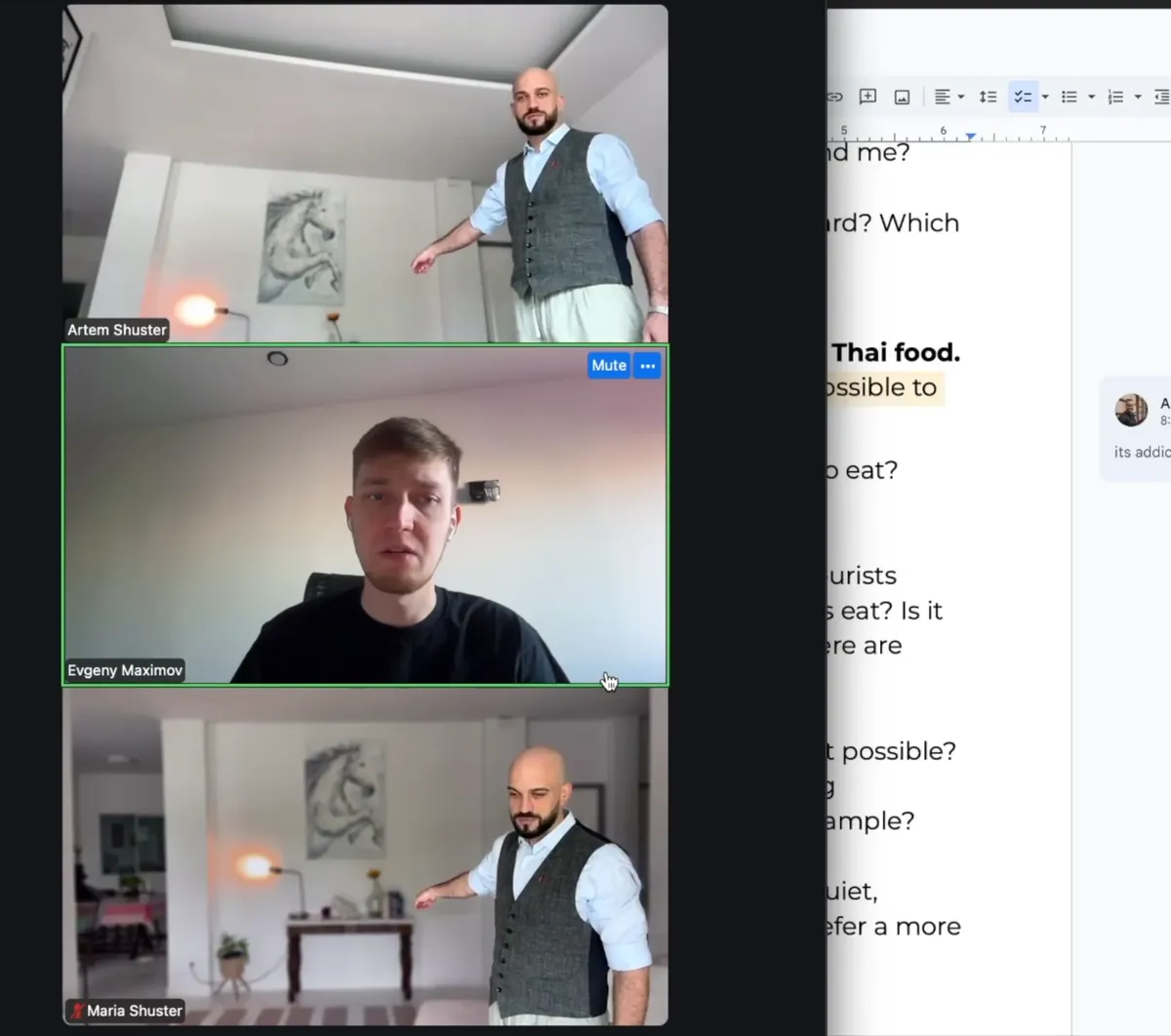
This is a remote filming session with Artem Shuster from Insight Estate in Thailand. We guide the recording over Zoom, with the script open next to the call.
Before the day, send a 30-second test clip. We check the framing, the sound and the light, and we fix them while it's cheap. A good remote setup:
- The phone on its back camera, on a tripod, at eye level.
- A wireless microphone, about $120. Sound matters more than the picture.
- A window in front of you, not behind you.
- The script open on a second screen, so you aren't reading from the camera.
- Enough phone storage for a few hours of video, and the phone on charge.
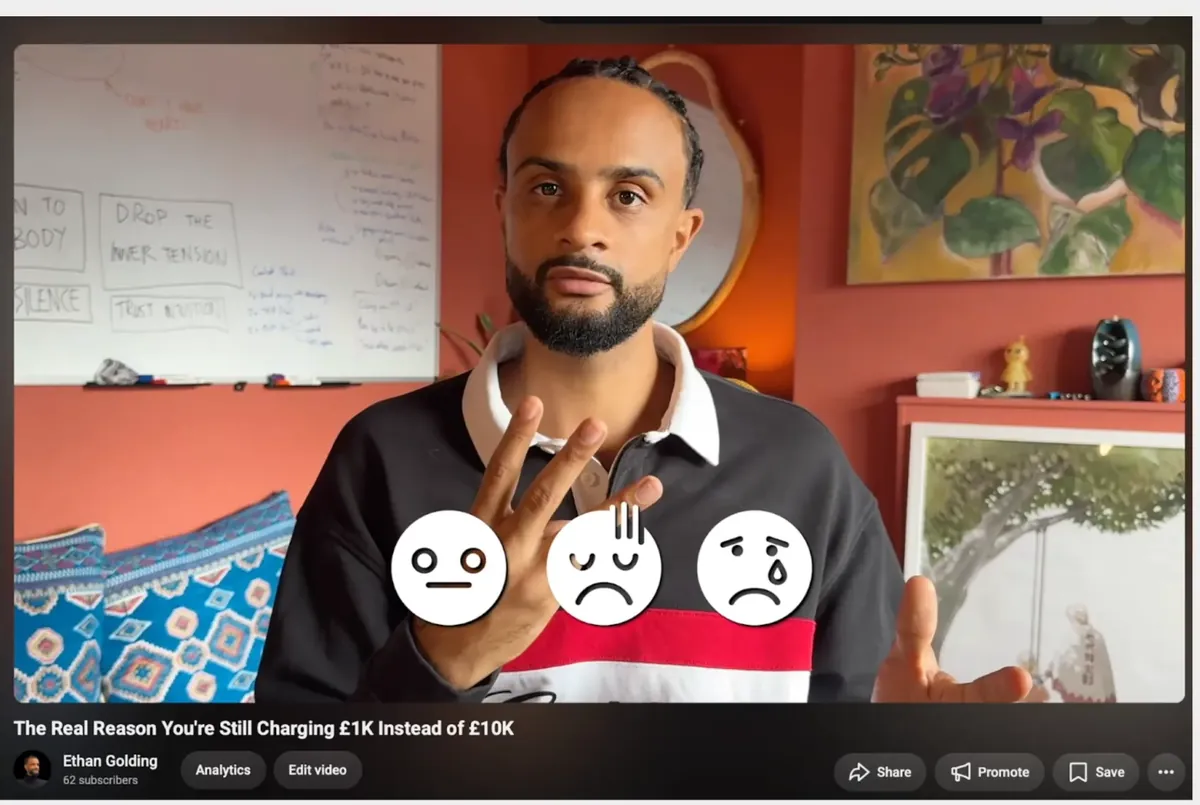
The next example is Ethan Golding, a LinkedIn coach. He filmed remotely on a phone with natural light.
More on gear and set-ups in nine filming setups ranked by cost.
How do you work with a team in another country?
You can work with a YouTube team in another country. Agree on a shared language, a time for calls and who approves each video before production starts.
- Communication. Choose one place for feedback and one person to contact.
- Filming. Decide whether the producer guides you remotely or works with a local crew.
- Delivery. Agree on the videos, deadlines, revisions and publishing responsibilities.
- Access and ownership. Keep control of your channel and agree on who owns the files and finished work.
- Payments. Confirm the currency, payment schedule and any extra production costs.
These agreements make the work easier across borders. Put them in writing so both sides know what to expect. For a fuller checklist, read what to check in a YouTube agency contract.
How do payments work across borders?
Fees and payment periods are set in your proposal, and they are paid in advance. Prices exclude VAT or other taxes where they apply. If you are not happy in the first 7 days after your first payment, we refund the first payment in full, within 14 days, to the original payment method. That is the only guarantee we give.
Whichever agency you use, ask these questions before you pay:
- In which currency is the invoice, and who pays the bank fees?
- What is paid in advance, and for which period?
- Does VAT or another tax apply to you? Ask your accountant, because it depends on your country.
- What happens to the money if the work stops after two weeks?
- Which extra costs, like studio or crew, are possible, and who approves them?
Our prices are in US dollars: done-for-you YouTube service from $3,000 a month, and one-off projects from $500. The price list for a channel in your market is a topic for the first call.
What about language and accent?
Two different things.
Your own accent. I speak English with a Russian accent, and I use it in videos. People buy expertise, not pronunciation. If you worry about yours, this is how another client got over camera fear.
The words on the page. Scripts and titles have to sound like you and your audience. That is a writing job, and it needs three things from an agency:
- Scripts built from your own voice notes, so the opinions and the stories are yours.
- The right spelling and slang for your audience. “Flat” and “lift” lose an American viewer, “apartment” and “elevator” lose a British one. Tell the producer who you speak to.
- A native speaker who checks the final words, if the video isn't in the team's language.
The last point is the hard one, and I have a real example. Nobody on our team speaks Italian, and we made a sales video, Shorts and clips from Italian films for an Italian fluency coach. The editor has a translator background and knows several languages. For the film clips, we sent about ten options, and the coach threw out the ones with a dialect, which we couldn't hear. Her words: “I realized that I need somebody who speaks Italian.” The rule: the team builds, the native speaker checks the final choice. The full story is in the language coach case study.
How do you check an agency abroad before you pay?
- The company exists. Find it in the official register and compare the name on the contract.
- You talked to a real person on a video call, ideally the founder.
- You can watch client reviews and open the clients' channels. Here are Ethan Golding's review and Elisabetta Maccani's.
- Access is by role, not by password. A good agency never asks for yours.
- The contract names the owner of the footage and the channel, and the way out.
- A short, refundable start, instead of a long lock-in. Ours is 7 days.
- Nobody promises views, leads or clients. More red flags in how to spot a scam YouTube agency.
Are you ready, or not yet?
Ready:
- You can be on a call in the agreed window three times in the first month.
- You have a phone, or a local filmmaker, and a quiet place with a window.
- You can send voice notes with ideas, stories and objections in your own words.
- You are fine paying in advance to a company you've checked.
Not yet:
- You want to be in the room for every cut. Then hire an editor in your own time zone.
- You need a crew on your set every week. Look for a local production company, or ask about a filmmaker near you.
- You can't say who the videos are for. Fix that first with the 5-question test.
What are the first 30 days like with an agency abroad?
- Week 1: call and contract. The first call, your proposal, a signed agreement and payment. You add manager and editor access to your channel.
- Week 2: plan. We research your niche and send a content plan. You send voice notes. We agree on the call window and the holidays.
- Week 3: test and film. A 30-second test clip, then the filming session with the producer on a call, with the scripts ready.
- Week 4: first drafts. You get edits to review and send feedback in writing, usually in up to three rounds set in your proposal. After approval, we publish.
And remember that the first months of a channel are an investment. Here is a realistic timeline.
If you want to see how it works with your time zone and your filming options, here is what our done-for-you YouTube service includes. If you are in the UK or the US, we wrote a page for each: YouTube agency for the UK and YouTube agency for the USA.
FAQ
Can I work with a YouTube agency in another country?
Yes. Most of the work is written and asynchronous: scripts, edits, thumbnails and publishing. You only need to be live for the first call, the filming session and a monthly planning call. The risks are a vague contract and unclear time-zone rules, not distance.
How do time zones affect a YouTube agency?
They matter for calls and for feedback speed, not for the work itself. Agree on a fixed call window, answer feedback within 24 hours, and write decisions down. Our team's working day overlaps with the UK, Europe, the Middle East and Asia, and with the US in your morning.
Can we film remotely?
Yes. You set up a phone, a wireless microphone and a tripod, and our producer guides you on a video call with the script open next to it. The total gear cost is about $150–200. For more polish, we can find a local filmmaker or studio near you, agreed in advance.
What should we agree before working with a team abroad?
Agree on a shared language, call times, a main contact, deliverables, deadlines and approvals. Confirm channel access, ownership, payment currency and extra production costs in writing.
How do payments work?
Fees and payment periods are set in your proposal and are paid in advance. Prices exclude VAT or other taxes where they apply. Ask about the invoice currency, bank fees and tax before you sign, with any agency.
What happens if I'm not happy?
In the first 7 days after your first payment you can ask for your money back, and we refund the first payment in full within 14 days, to the original payment method. We don't offer other guarantees, and we don't promise views or leads.
What does the agency need from me to start?
Manager and editor access to your YouTube channel through the permission settings (never your password), a call about your goals and audience, a few voice notes with ideas, and a phone filming setup. We handle the rest.
Does the agency's accent or language matter?
For English channels, what matters is that the scripts sound like you and use the spelling and words of your audience. We write from your voice notes, so the words are yours. I speak English with a Russian accent myself, and clients buy the expertise, not the pronunciation.
Can an agency make videos in a language its team doesn't speak?
Yes, with checks. Nobody on our team speaks Italian, and we made a sales video and Shorts for an Italian fluency coach. The editor has a translator background, and the coach checked the final clips herself. Ask any agency who checks the language.
Who owns the footage and the channel?
You do. You own the final videos, shorts, thumbnails and scripts written for you once they are paid for, and your channel always stays yours. We work only through manager access that you can remove at any time.
How do I check an agency abroad before paying?
Look up the company in its official register, talk to the founder on a call, watch client reviews you can verify, ask for access by role and not by password, and start with a short, refundable period. Our own checklist is in this article.
What does it cost?
Our done-for-you YouTube channel management starts from $3,000 a month. One-off projects start from $500. Studio, crew and equipment are extra and agreed with you before we spend anything.
Founder of a done-for-you YouTube agency for high-ticket founders. Making content since 2014. More about me
Want to work with a team in another time zone?
30 minutes with me. We look at your situation, your time zone and your filming options. You film one day a month, we do the rest. 7-day money back guarantee.
Get a free niche review →