High-Ticket Marketing for Service Businesses: How High-Ticket Clients Really Buy
A high-ticket buyer doesn't click and pay. They check you, ask people, watch, compare and talk to their team. Marketing for this kind of sale has a different job: to make you trusted before the first call. Here is how it works, with sources and real examples.
 By Evgeny Maximov·9 min read·
What is high-ticket marketing, and how is it different?
There is no official price line for "high-ticket". I don't use one, because the number depends on your market. I look at how the buyer behaves. If they can't decide in one sitting, if a wrong choice is expensive for them, and if they check you before they talk to you, it is a high-ticket sale for you.
That changes the job of marketing. Here is the difference side by side.
| Small purchase | High-ticket service | |
|---|---|---|
| Time to decide | minutes to days | weeks to months |
| Who decides | one person | one person plus a group, a partner or a board |
| Main fear | wasting a small amount | a costly mistake in front of other people |
| What the buyer needs first | a clear offer and a price | proof, trust and a view of how you work |
| Audience you need | large | small, but exactly the right people |
| What marketing does | wins the click | wins the call, and the trust behind it |
A small audience is enough here. If one client is worth a lot, you don't need thousands of followers. You need the few hundred people who can hire you to know you well. This is why I tell founders that trust beats virality for their kind of business.
How do high-ticket buyers actually decide?
They research on their own first. Gartner surveyed 632 B2B buyers in 2024 and reported in June 2025 that 61% prefer a rep-free buying experience. The same survey says buyers still want a person for the questions only a person can answer, such as "will this fit our company?". So the buyer looks you up first, and talks to you second.
Then there is the group. Forrester's 2026 buying report says that on average 13 internal stakeholders and nine external participants influence a B2B purchase. A services deal usually has fewer people. Still, the person who books your call is rarely the only one who decides. For a clinic or a coach the "group" may be a spouse or a business partner, and the effect is the same.
Where do they look? Hinge studied 1,475 buyers of professional services in 2018. Referrals were still the top way to search, but fewer buyers asked their network than five years before, and nearly one in five used search engines. Hinge called referral-only marketing risky. The data is old, so I read it as a direction, not a current percentage.
And most of your future buyers are not buying today. The LinkedIn B2B Institute's team says only about 5% of B2B buyers are in the market at any moment. The other 95% will be later. If they remember you when the time comes, you are on the shortlist before anyone calls anyone.
Sources, checked in October 2026: Gartner press release, 25 June 2025 (survey of 632 B2B buyers, August–September 2024); Digital Commerce 360 on Forrester's State of Business Buying, 2026 (22 January 2026; I did not see the Forrester report itself); Hinge Research Institute, 2018 study (Hinge is a marketing firm for professional services); Marketing Week on the 95:5 rule.
What does a high-ticket buyer need to see before booking a call?
I think of five questions a buyer asks silently. Each one has an answer that you can put on a page or in a video. If one is missing, the buyer waits, asks a friend or books your competitor.
| Silent question | What answers it | Format that does it |
|---|---|---|
| Have you done this for people like me? | case studies with numbers, named clients, client's own words | case page, video testimonial |
| Do you actually know your stuff? | seeing you explain a real problem in detail | long video, podcast, talk |
| Is this for someone like me? | a clear buyer, a clear problem, a clear "not for you" | homepage, one-line offer |
| What if it goes wrong? | a visible process, a guarantee you can really keep | "how we work" video, FAQ |
| What happens if I reach out? | one small, clear step with real value | booking page, free analysis, short call |
The second row is the hard one for text. A buyer can read that you're an expert on any website. Watching you work through a problem for ten minutes is a different kind of proof. This is the same idea as Status, Influence, Credibility and Likeness, which I use to decide what is worth publishing.
What do you build before, during and after the call?
Most high-ticket marketing advice stops at the lead. For high-ticket services I split the work into three parts, because the sale happens across all of them.
Before the call: the trust assets
This is what marketing owns. Case pages with real numbers, a few long videos where you explain how you work, and an offer that says who it is for. A buyer who finds these arrives with fewer doubts. Our own funnel for a service business starts here, from the bottom, with the proof, and adds content for strangers last.
The call: where the sale is made
I don't use closers. On my calls I ask about the situation, give a free analysis and send a proposal on the second call. How to run that conversation is its own topic, and I wrote it down in how to sell high-ticket services without a sales team. I keep it out of this article on purpose. The call goes much better when the buyer has done their homework with your material first.
After the call: the follow-up that works while you sleep
Most deals are not won on the call. They are won in the days after, when the buyer talks to their partner or team. Send the one thing that answers the doubt you heard. A buyer who doesn't trust the process gets a video from a similar client. One who isn't sure what you do gets a walk-through. At Tvoy Sklad, the marketing team asks every new partner how they found the company, and many say they have already watched the videos. More on this in lead nurturing for service businesses and how video shortens a sales cycle.
Why does trust beat reach in high-ticket marketing?
Because the people who matter are few, and reach counts everyone. Three things I have seen:
- Our own channel. A 47-minute documentary with about 6,000 views brought us clients. A video with about 260,000 views brought none. The documentary showed how we think. The big one only got attention. Details are in the mini-documentary article.
- Insight Estate, a Thai real estate agency. A dry 20-minute video about choosing property, about 500 views, brought a lead. The viewers were exactly the right 500. See the case.
- Tvoy Sklad, the self-storage franchise. The founder, Dmitry Rindevich, shows the financial models himself in videos and live streams. Videos mostly have 2,000–20,000 views. In 2024–2025 the company attracted about $5M in investments and 20+ franchise partners, and partners often arrive saying they have watched everything. Full case here.
Only 10–20% of viewers watch a video to the end. So a high-ticket video needs its next step in the middle too, not only at the end. And the next step must be small: a call, a free analysis, one more video. These are my results with my clients. I don't promise the same to anyone.
This connects to the question of vanity numbers. If you judge by views, the 260,000 video wins. If you judge by clients, it loses. I explained how to track the right thing in views vs clients.
Which buyers need which message?
Not every buyer is ready. I use the Buyer Ladder from my free course The Trust Engine. Here is what each stage needs from a high-ticket marketer.
| Buyer stage | What they need | What to give |
|---|---|---|
| Not looking yet | to know you exist and find you useful | a short or long video on a topic they care about |
| Has a problem but doesn't see it | a name for the hidden cost | a video or article that shows the symptoms |
| Knows the problem, not a priority yet | a reason to act now | a story about the cost of waiting |
| Looking for a solution | to compare options | an honest guide to the options, including yours |
| Choosing who to hire | proof and low risk | case pages, client videos, a clear call to book |
Most high-ticket firms only talk to the last row. The first three rows are where the 95% live.
How much does high-ticket marketing cost, and what should it pay back?
Do the math from the price of one client. Divide the yearly cost of the channel by the price of one client. That is how many clients make it pay back. As an example with round numbers, not a promise: a service sold at $10,000 and a content budget of $60,000 a year (about $5,000 a month) pays back with 6 clients in a year. If the same budget brings 2 clients, you have a decision to make. You can check your own numbers in our break-even calculator.
Our done-for-you YouTube service starts from $3,000 a month, and one-off work from $500. In the first month you will most likely lose money, because the videos need time to work. Be careful with guarantees from others. "First page of Google in 60 days" or "20 leads a month" are possible, but usually not achieved, and the conditions tend to show up later in the contract. Our only guarantee is 7 days of money back.
Does this work for smaller tickets? Sometimes. It can work at very large volume with viral-style content, but that is a different plan. Our focus is high-ticket, where a small audience is enough.
What does a 90-day high-ticket marketing plan look like?
- Days 1–30: fix the path to a call. Search your own name as a buyer would. Add three proof items (a case, a client quote, a number). Write one clear offer line. Add one question to your booking form: "How did you hear about us?"
- Days 31–60: add one warm channel. Ask your three best clients for introductions, or speak at one event where your buyers are. Record your first long video, one where you explain a real problem in detail.
- Days 61–90: add a library. Publish a long video every week for a month, and cut Shorts from it. Send each video to leads after the call. Count which videos prospects mention.
How to track what you publish is in marketing attribution for service businesses. If you need a full plan with channels and weekly numbers, use the marketing plan for a service business.
Which real videos explain high-ticket marketing?
I looked for English-language videos about marketing and attracting high-paying clients. Views show demand for the topic. They don't show how many clients each video brought. Data is from YouTube on 27 October 2026.
- How To Make BUCKETS of Money In SERVICE Businesses (Alex Hormozi, 710K views). How a service business gets more from each client.
- The Psychology of High-Ticket Sales (Dan Lok, 265K views). How buyers make high-ticket purchase decisions. It is about selling, but it explains the buyer well.
- PROVEN Strategies to Attract High Ticket Clients and 10x Your Income (The Futur with Daniel Priestley, 103K views). A long conversation on positioning and authority.
- How to Attract Wealthy Clients (and Sell to High-End Customers) (Denise Duffield-Thomas, 31K views). Working with buyers who pay a premium.
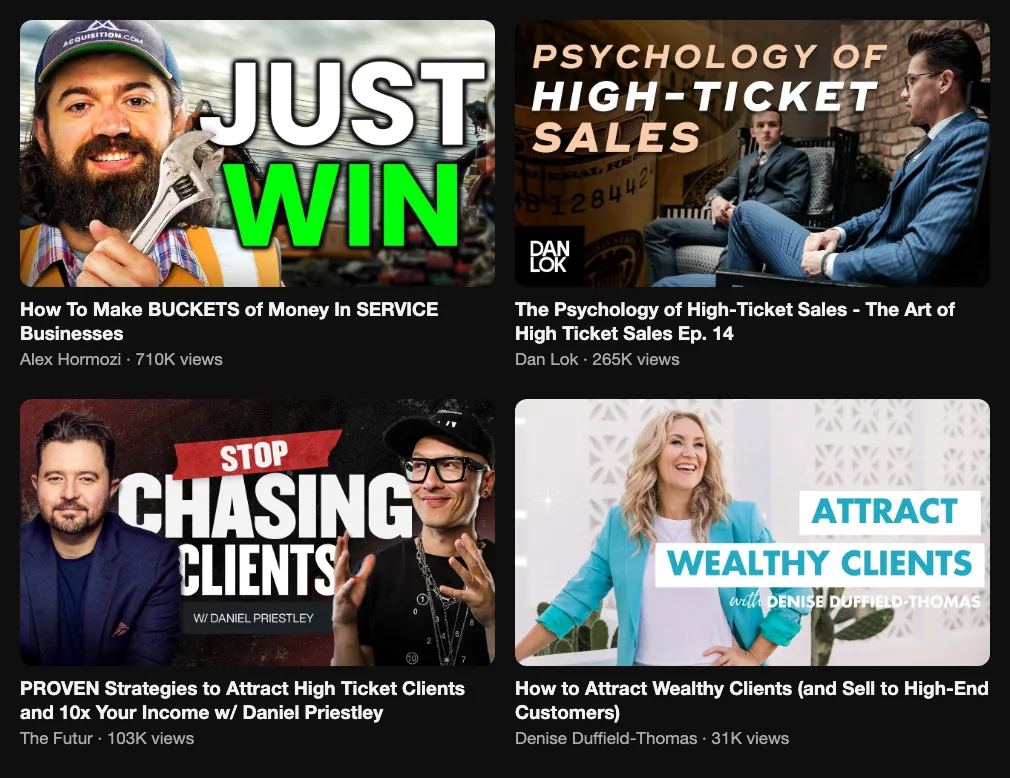
Honest note: most of these come from sales and business educators. I found no big English video from a high-ticket service firm that explains its own marketing system in detail. Our case pages are the closest I can offer: Tvoy Sklad, Ayuna and Ethan Golding.
If you want the trust part built for you, that is what our done-for-you YouTube service does. You film one day a month, and we plan, edit and publish. To see how clients choose an expert in the first place, read how clients choose an expert.
FAQ
What is high-ticket marketing?
High-ticket marketing is marketing for services where one client pays a lot and the decision is slow and risky. There is no official price line. What matters is how the buyer behaves: they research, ask people they trust, involve others and take weeks or months. The marketing job is to build trust before the first call.
How is high-ticket marketing different from regular marketing?
Regular marketing for small purchases tries to win a click and a quick yes. High-ticket marketing tries to earn trust over time. The buyer needs proof, a clear view of how you think and a low-risk next step. Because there are fewer buyers and each deal is large, a small audience of the right people is enough.
How do high-ticket clients find a service provider?
Mostly through people they trust and through their own research. Hinge's 2018 study of 1,475 professional services buyers found that referrals were still the top way to search, but fewer buyers relied on them than five years earlier, and about one in five used search engines. Gartner's 2025 survey says 61% of B2B buyers prefer a rep-free buying experience, so they look you up before they talk to you.
What marketing works best for high-ticket services?
A mix of one warm channel (referrals or your network) and one channel that builds trust at scale (long video, a strong LinkedIn presence, or a podcast). Then a clear path to a call. Evgeny Maximov's agency builds the long-video part, because a buyer can watch an expert explain their work for ten minutes before any conversation.
Does YouTube work for high-ticket services?
It can work well when the buyer needs to trust you first. A video library lets a buyer see how you think, and some arrive at the call already convinced. Tvoy Sklad, a self-storage franchise, is the clearest example: videos mostly with 2,000–20,000 views, about $5M raised in 2024–2025 and 20+ franchise partners. Results vary by offer, market and consistency, and nobody can promise views or clients.
Do I need a lot of views to get high-ticket clients?
No. A small number of the right viewers is enough. A Thai real estate agency got a lead from a 20-minute video with about 500 views. A 47-minute documentary of ours with about 6,000 views brought clients, while a video with about 260,000 views brought none. Views show demand, not how many clients a video brought.
How long does high-ticket marketing take to work?
Plan for a slow first two or three months. Referrals can pay in weeks, outbound in days, and content takes longer but keeps working. One of our clients had two flat months and a breakthrough in month three. Judge the system after at least a quarter of steady publishing, not after two videos.
Should I use a free call, a free audit or a guide as the first step?
Pick one low-risk first step that gives real value. For us it is a call, then a free analysis, then a proposal on the second call. A free audit or a short video also works. Avoid first steps that ask for a big commitment from someone who doesn't know you yet.
Can high-ticket marketing work for a smaller ticket?
Sometimes. A smaller ticket can work at large volume with viral-style content, but that is a different game with a different content plan. Our focus is high-ticket, where a small audience is enough because each client is worth a lot.
Are guarantees like "20 leads a month" a good sign?
Be careful. Guarantees like "first page of Google in 60 days" or "20 leads a month" are possible, but usually not achieved, and the conditions often show up later in the contract. They are most often a marketing trick with an asterisk. Evgeny Maximov's agency gives one guarantee only: 7 days of money back.
How much does high-ticket marketing cost?
It depends on the channels. A done-for-you YouTube channel with Evgeny Maximov's agency starts from $3,000 a month, and one-off work from $500. To judge any cost, divide the yearly spend by the price of one client. That tells you how many clients make it pay back.
What is the first thing to fix in high-ticket marketing?
The path between a stranger and a booked call. Check what a buyer sees when they search your name, then add proof, one clear offer and one next step. Build content for strangers after that.
Founder of a done-for-you YouTube agency for high-ticket founders. Making content since 2014. More about me
Want buyers to trust you before the call?
You film one day a month. We plan, edit, publish and cut Shorts, and every video ends with a next step. 7-day money back guarantee.
Get a free niche review →