How to Sell High-Ticket Services Without Being Salesy: The Process I Use on Every Call
I don't have a sales team. No closers, no scripts full of tricks. I take every call myself, and a lot of them end with me telling the person not to buy. Here's why that sells better.
 By Evgeny Maximov·11 min read·
Why I sell without a sales team
My agency makes YouTube channels for business owners. Not a cheap service. And there's no sales team. No setter, no closer, no “senior strategist” who is really a salesperson. I take every call myself, and I say it on the booking page: you'll talk to me.
It's not because I'm a great salesman. Honestly, I'm not. It's because high-ticket buyers want to talk to the person who will be responsible for their result. A founder spending thousands of dollars a month wants to look the founder in the eye.
And a lot of my calls end with “don't buy this”. People are surprised. But those calls build more of my business than any clever close ever could.
Here's the process, step by step.
Step 1: Let content do the selling before the call
The biggest shift in my sales didn't happen on calls. It happened before them.
When people book a call with me now, they often say “I watched your video” or “I watched the documentary”. They don't say “I downloaded your guide”. Long videos did the work. By the time we talk, they know how I think, how I work, what I believe about views and trust. The call isn't a pitch anymore. It's a check: is this person as good in real life as in the videos?
That's why the deal itself got shorter. Someone comes, we talk, they pay. But the relationship before the booking was much longer and deeper than I ever saw. Often I didn't even know the person was watching.
This is the honest secret of selling high-ticket services calmly: you can only be calm on a call if trust was built somewhere else. Twenty minutes of your video does more warming than any follow-up sequence. I wrote about the mechanics in how video shortens a B2B sales cycle.
Step 2: Qualify before anyone gets on a call
A calm call starts with the right person on it. My booking form asks a few direct questions: are you a business owner looking to attract more clients, what's your monthly revenue, what do you spend on marketing, do you promise to show up, and how did you hear about us.
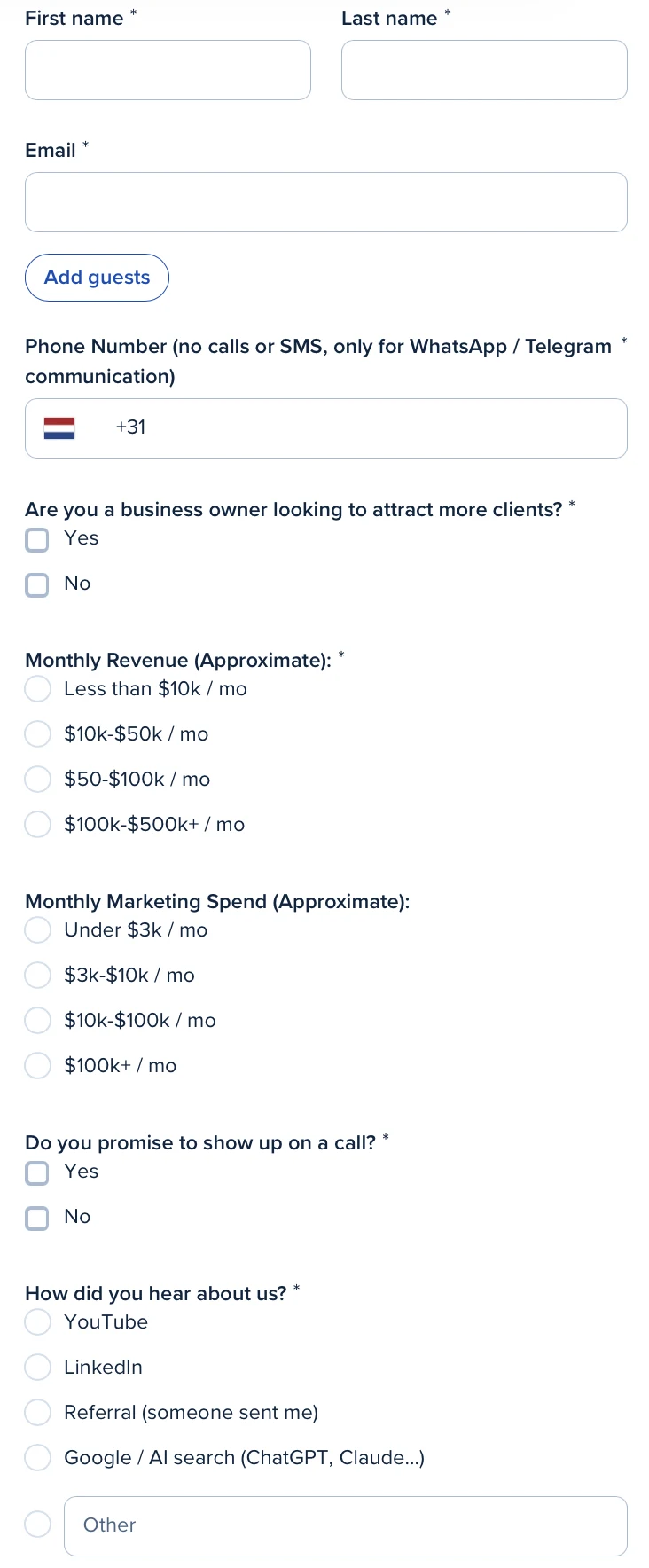
Every extra question means fewer bookings. That's the point. More steps, fewer leads, but better ones. You're looking for a balance where the people who get through are worth an hour of your time.
After someone books, I message them personally in WhatsApp. Just to say hi and make it human. Sometimes I send one of my expert videos that fits their situation. That small touch changes the tone of the call: we're two people who already talked, not a buyer and a seller meeting for the first time.
Step 3: Diagnose first, recommend second
The structure of my call is simple. About two-thirds questions, one-third recommendation. If you pitch before you understand the problem, you're guessing, and the buyer feels it.
I start by setting the agenda out loud: “First I want to understand your business and what you've tried. If it looks like we can help, I'll show you how we'd work. If not, totally fine, I'll point you in the right direction.” That last sentence takes the pressure off both of us.
Then I ask about the business, the clients, the current marketing, the results in numbers, the goal for the next three to six months, and what happens if nothing changes. The full list, with the exact wording, is in the discovery call questions we use.
Two questions do most of the heavy lifting:
- “What would make you look back in six months and say this was absolutely worth it?” “More leads” is not an answer. Push until you get a number and a picture.
- “Where do you want to be in five years?” If the person doesn't know, content may be the wrong investment. Content is a five-year game.
Then I recap: “Here's what I heard. Did I miss anything?” Only after that do I talk about how we work.
Step 4: Give real advice, even if they don't buy
This is the part that feels wrong to most salespeople. If someone isn't a fit, I still give them a specific recommendation. Right there on the call.
YouTube isn't for you right now. In your case, I'd do this, this and that. Let's talk again in six months.
I've told a solo renovation contractor to forget Reels and fix his team first. I've told a business women's contest founder to stop posting and go find participants offline. I've told a sales coach her offer was hiding her best proof. None of them paid me that day.
Why do it? Because my clients can take a long time to get ready. One of the people I gave advice to was a one-man business. In two years he'll have a team, he'll be ready for content, and he'll message me: “Let's go.” The sales cycle for some of my clients is two or three years. A free tip today is how I stay the first name they think of.
There's also a quieter reason. Advice that works builds what Alex Hormozi calls power: you told someone what to do, they did it, it worked. That's a stronger brand signal than any testimonial you write about yourself. I break this down in the SPCL framework.
Step 5: Help them make an informed decision
When I'm not sure YouTube makes sense for someone, I don't push. I suggest we look at the data together: the niche on YouTube, the competitors, what their videos get, what topics their buyers watch.
Sometimes the data says yes: a competitor with 100,000 subscribers, videos with half a million views, clear demand. Then the decision is easy, because they see it with their own eyes. Sometimes the data says no: nobody in the niche gets views, buyers don't search for this on YouTube. Then I say: “Don't do it. There's nothing to sell here yet.” And that's fine with me.
That's the whole philosophy. No sales techniques. No manipulation. I help people make an informed decision. If the decision is no, they still leave with clarity. And people remember who gave them clarity.
When the situation is clear and the person wants to go ahead, I show two or three options. One option turns the conversation into yes or no. Two or three turn it into “which one fits me?”. I explain what's different, what I'd pick in their place and why.
Sell the result, not the product
At one of my live reviews, a sales coach for experts presented a new group program. It had a system, scripts, tables, a schedule of actions. I listened and said: I don't feel like I want this.
Then I asked a simple question: did the people from your previous groups make their money back? “Yes,” she said. “Everyone who went through it made more than they paid.”
That was the offer. Not the system. Not the ten lessons. “Everyone who joined before made their money back.” She hadn't said it because she was shy about it. That's the most common mistake I see in high-ticket offers: we love our product, so we talk about its features. Lessons, platforms, frameworks. But nobody buys features. People buy the result. “I pay $1,000, I make $2,000. Let's go.”
And the moment your offer says “you'll need to come to filming days, review footage for hours and send us your brand book”, it stops sounding attractive. Lead with what they get. Explain the work after. More on this in features vs benefits.
What I never do on a sales call
The no list
- Promise views, calls or clients. Our only guarantee is a 7-day money back.
- Pitch before I understand the business.
- Read a script word for word. I use a list of questions, not a speech.
- Hide the price until the end of a long presentation.
- Create fake urgency. If it's a fit today, it's a fit next week.
- Sell to someone who will lose money with us. That client becomes a bad review.
- Sell in chat. Big decisions deserve a real conversation, so I always move to a call.
How to handle the objections you'll hear most
The same five objections come up on almost every call I have:
| Objection | How I answer |
|---|---|
| “Why does it cost so much? Anyone can film on an iPhone.” | Filming is one job out of seven: strategy, scripts, filming, editing, design, publishing, analytics. The iPhone does one of them. |
| “When will I see results, and why so long?” | Plan for nothing in months one and two. Then show the break-even math: how many clients pay for a year. |
| “Why can't I just do it myself?” | You can. Most people stop after two or three months because there's no time. The question is what your hour is worth. |
| “My social media manager can do YouTube.” | Maybe. YouTube is a different craft: long scripts, retention, packaging, search. Ask what channels they grew. |
| “I'll hire a camera guy and post it myself.” | Then you become the producer, the scriptwriter and the strategist. That's the hard part, not the camera. |
Notice that none of these answers is a trick. They're explanations. If the explanation doesn't land, the person isn't ready, and that's a fine outcome.
Answer objections with an analogy or a story, not a slide
Most people answer an objection with an argument. A list of reasons, a comparison table, a slide with arrows. An argument invites a counter-argument. A picture or a story doesn't.
Compare two answers to “anyone can film on an iPhone”:
- Argument: “Filming is one job out of seven. The rest is strategy, scripting, editing, design, publishing and analytics.”
- Analogy: “A good oven doesn't make you a restaurant. The camera is the oven. The menu, the cooks and the customers are the other six jobs.”
The second one the buyer can repeat to their business partner in one sentence. That matters, because decisions at this price are often made by more than one person, and you won't be in the room.
The same works with stories. “Why does it take so long?” is a fear, not a question. A story about a client who felt the same in month two and what changed in month six answers the fear without you defending anything.
A simple test for your own offer: can you explain what you sell, who it's for and why it costs what it costs in three or four sentences, with no slides? If you need the deck to make it clear, the deck is hiding a gap in your own explanation. Fix the explanation first, then use slides to support it.
Let videos handle the objections for you
The best part of this is that you don't have to repeat the same explanation on every call. In the CCS framework (Create, Convert, Scale), the “convert” step is about trust and watch time, not views. A big part of it is simply this: for every objection you hear twice, record one video that answers it. Then send it to the buyer before the call, or after it.
The buyer watches at their own pace. Nobody feels sold to. And your sales team, if you have one, gets a library of answers instead of improvising.
Here's how it works for a franchise. The objections are different from a service business, but the idea is the same. Each one gets its own video:
| What the buyer is thinking | The video that answers it |
|---|---|
| “Who founded this, and can we trust them?” | The founder tells how the company started and where it's going |
| “Will I actually make money, and when?” | A breakdown of the financial model for one location, with payback periods |
| “Can I do this without experience?” | An honest vlog from a working location: what the day looks like |
| “What if I invest in something nobody needs?” | A talk about the market, competitors and why now |
| “Do the partners really exist?” | Short interviews with two or three franchisees, including their early doubts |
This is how our client Tvoy Sklad built the content behind the results in the $5M YouTube funnel case. Most of these videos are talking heads. The format matters less than the question. Every video starts from one specific doubt, and the best ones use a simple analogy or a real story from a partner.
The same approach works for any high-ticket service. Write down the five objections you hear most. Make one video for each. That's a month of content, and it's also your sales toolkit.
The calm sales checklist
- Long-form content that answers buyer questions before the call.
- A booking form that qualifies: revenue, budget, a promise to show up.
- A personal message after booking.
- An agenda said out loud at the start, including “it's fine if we're not a fit”.
- Two-thirds questions, one-third recommendation.
- A recap before any pitch.
- Two or three options, with your honest pick.
- A real recommendation for people who don't buy.
- An analogy or a story ready for each common objection.
- A short video for every objection you hear twice.
- Follow-up with a video that answers their last question.
Selling this way is slower in the first year. And much faster after that, because the market starts to know you as the person who tells the truth. If you want your videos to do the warming for you, that's exactly what we build as a B2B YouTube agency.
FAQ
How do you sell high-ticket services without being pushy?
Qualify people before the call, spend most of the call diagnosing their situation instead of pitching, give real advice even if they don't buy, and say no when it's not a fit. Evgeny Maximov takes every sales call himself, with no closers, and helps people make an informed decision instead of using pressure tactics.
What is the best sales process for a high-ticket service?
A simple one: a booking form that qualifies, a personal message after booking, a call that is about two-thirds questions and one-third recommendation, a clear yes or no, and a follow-up with a video that answers the remaining questions. Long, trust-building content before the call does most of the selling.
Should founders do their own sales calls?
In a small high-ticket business, usually yes. The founder knows the work best and the buyer wants to talk to the person responsible. Evgeny Maximov's agency has no sales team: he takes every call himself and says it plainly on the booking page.
How do you close a high-ticket client on one call?
Most of the work happens before the call. People who watched several long videos arrive already trusting you, so the call becomes a check, not a pitch. Evgeny Maximov's clients often say they watched a specific video or documentary before booking.
Is it okay to give free advice on a sales call?
Yes, if it's honest and specific. Evgeny Maximov gives a concrete recommendation even to people who aren't a fit, like “YouTube isn't for you now, in your case I'd do this”. It costs one call and often brings the person back months or years later.
How long is the sales cycle for high-ticket services?
The call itself can be short, but the relationship before it is long. Evgeny Maximov has clients who watched his content for months and came back two or three years after the first conversation, once their business was ready.
How many pricing options should a high-ticket proposal have?
Two or three. One option turns the decision into yes or no; two or three turn it into which one. Evgeny Maximov usually presents options after the situation is clear, not at the start of the call.
How do you handle the “it's too expensive” objection?
Show the math, not a discount: what one client is worth to them, how many clients pay for the service, and what they pay now in time or lost deals. If the math doesn't work for their business, say so honestly instead of pushing.
How do you explain a complex product without slides?
Use a simple analogy or a short story and say it in a few sentences. If you can't explain what you sell and why it costs what it costs without a deck, the slides are hiding a gap in your own explanation. Slides can support the story, but the story has to work without them.
Why use analogies and stories to handle objections?
Because people remember pictures and stories, not arguments. A good analogy turns “why does it cost so much?” into a picture the buyer can repeat to a partner or a colleague. A story from a real client answers the fear behind the objection without you defending anything.
How can video handle sales objections?
Record one video per common objection and send it to the buyer before or after the call. The buyer watches it at their own pace, and you don't repeat the same explanation on every call. This is the “convert” part of the CCS framework: trust and watch time, not views.
Do free consultations help sell high-ticket services?
Only if the free part leads to a next step. Free calls that try to solve everything attract people who want free help. A short free diagnosis or analysis that shows the size of the problem and the path forward works much better.
What should you never do on a high-ticket sales call?
Don't promise guaranteed results, don't pitch before you understand the problem, don't read a script word for word, and don't hide the price. Evgeny Maximov's agency gives one guarantee, a 7-day money back, and no promises of views or calls.
Founder of a done-for-you YouTube agency for high-ticket founders. Making content since 2014. More about me
See how it feels from the other side
Book a call with me. No closers, no pressure. If YouTube makes sense for your business, I'll show you how we'd do it. If it doesn't, I'll tell you what I'd do instead. 7-day money back guarantee.
Book a call →