Lead Nurturing for High-Ticket Services: Between the Form and the Call
Most lead nurturing advice assumes thousands of leads and automated emails. A consultant, lawyer or clinic has a handful of leads a month, each worth thousands of dollars. Here is nurturing for that: what to do in the days between the form and the call, and after it.
 By Evgeny Maximov·9 min read·
What is lead nurturing for a service business?
Lead nurturing is the work of keeping a lead warm until they decide. In the usual guides it means automated email drips to thousands of contacts. That is not your situation. A consultant, a law firm or a clinic gets a handful of leads a month. Each one can be worth thousands of dollars, and each one is a person who will decide partly on feeling.
| Mass nurturing | High-ticket nurturing | |
|---|---|---|
| Volume | Hundreds or thousands of leads | A few leads a month |
| Main tool | Automated email sequence | A page, a few messages, a personal note |
| Content | Same for everyone | Matched to the lead's question |
| Who sends | The system | A real person, often the founder |
| Main risk | Low open rates, unsubscribes | No-shows and silence after the call |
The tone matters, too. A 2025 Gartner survey found that 73% of B2B buyers actively avoid suppliers who send irrelevant outreach. A generic drip is irrelevant by design. A short note that answers the lead's exact question is not.
Source: Gartner press release, 25 June 2025, survey of 632 B2B buyers (August and September 2024). The comparison table is my own summary.
Why is the time between booking and the call so important?
Because that is the moment the lead is most open and also most likely to drift. They have just decided to talk. Now they have to find 30 to 60 minutes and justify it to themselves, a partner or a team. Life gets in the way.
Jeremy Haynes, a marketer I follow, describes this as two modes. Before the booking, the person is in "scanner mode": quick, skeptical, deciding in seconds. After the booking they are in "justification mode": they want reasons that this call is a good use of time. His advice is to start educating in that same minute, and not to waste it on a "thanks, check your email" page. This is his view and his numbers, not our data.
No-shows are the visible cost. RevenueHero, a meeting scheduling software vendor, looked at 18 weeks of booked meetings from its customers and reported an average no-show rate of 15.9% and a median of 13.5%. It also reported that show rates fall when the call is booked many days ahead. It is a vendor's analysis of its own customers, so treat it as a rough range. Count your own show rate by source before you buy anything.
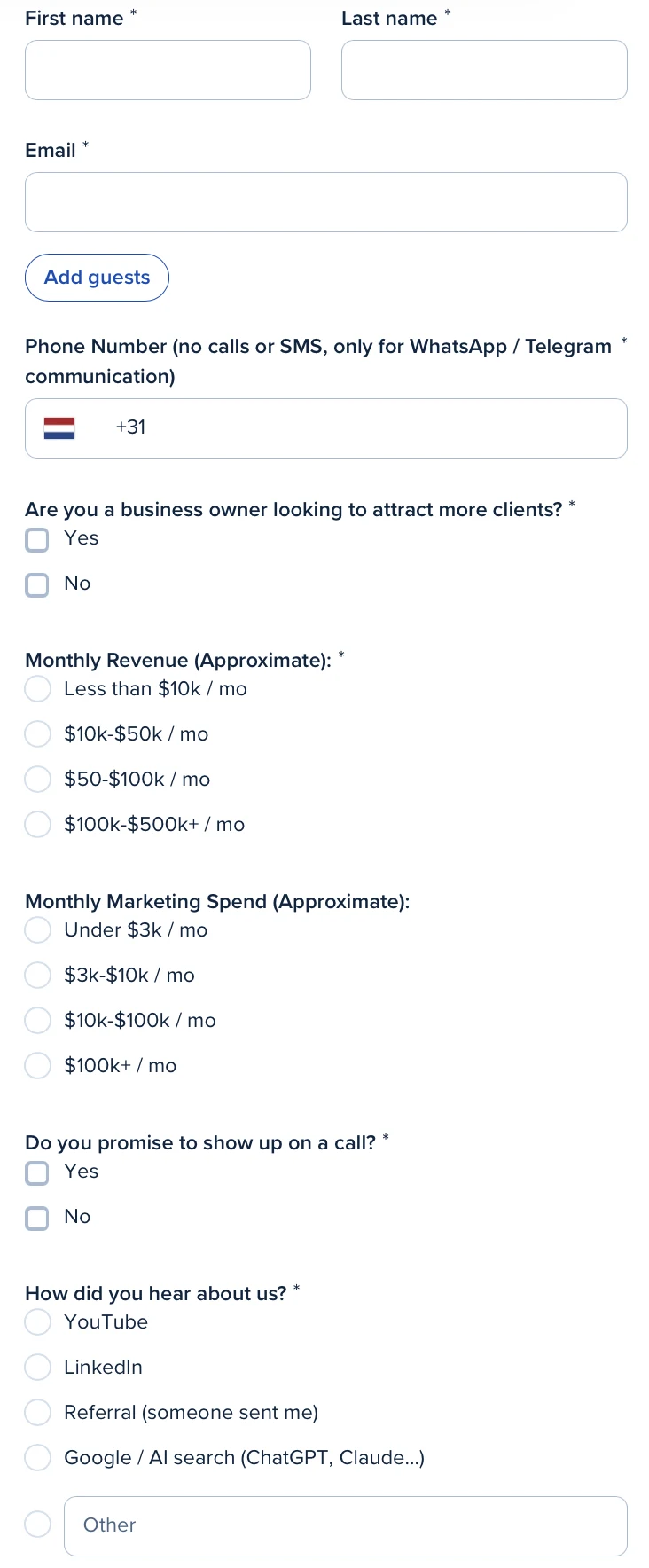
Our Calendly form already does a bit of nurturing. It asks about revenue and marketing spend, which filters and prepares the call. It asks "Do you promise to show up on a call?", and it asks "how did you hear about us?".
What does a nurture sequence look like for a booked call?
| When | What you send | Goal |
|---|---|---|
| Right after booking | A page with one short video: who you are, how the call works, what to bring. A plain confirmation message. | Make the person feel the call is worth it |
| Same day | A short personal message in the channel they gave you (WhatsApp, Telegram or email) | Make it a real contact, not a calendar slot |
| Day before | A reminder with the time, link and one question to think about | Keep the slot |
| 1 hour before | A short text with the link | Keep the slot |
| If they miss it | A kind message within a few hours with a reschedule link | Recover the lead |
| Within 24 hours after the call | A recap in their words, the next step, and one video that answers their main doubt | Keep the decision moving |
| 2–3 days later | A short check-in: "Is this still relevant?" | Get a yes or a clear no |
| If "not now" | Point them to your channel or a short list. Check in a few times a year. | Stay in the picture |
An example reminder you can copy and change: "Hi Anna, looking forward to our call tomorrow at 15:00. One thing to think about: what would make this conversation useful for you? Here's a 4-minute video on how I run these calls. See you then." It is short, kind and gives a reason to come.
Here is what we do today. After booking, the person gets the standard Calendly email. Then I write to them in WhatsApp or Telegram to start a real contact, and if it fits I send one of my videos. It's one person doing the work.
What should the video on the page after booking say?
Haynes says the main video must be one of two kinds. Which one depends on what the buyer needs to justify.
- Due diligence. You sell your own ideas and your own skill, so the buyer asks "can I trust this person?" The video says: "You don't know me, so check me out", and shows the evidence. This is the right type for most consultants, lawyers and advisors.
- Urgency. You sell something time-limited, like a deal or a regulation. The video states a real outside fact that makes "now" better than "later".
Then add short "breakout" videos, each answering one question, such as "What does it cost?", "How much of my time does it take?", "Why not hire a freelancer?" or "What do you guarantee?". Haynes takes the topics from two places: what your sales team is tired of explaining, and the frame you want the buyer to have on the call. His rule of thumb is that about half of the people who land on the page should press play on a good topic. That's his number, not ours, so use it only as a first target.
If your market does not watch video, don't force it. Use a short text page and a plain email. Check by looking at how many people press play.
How do long videos help the sales team nurture?
A long video is a sales asset. Your sales team, or you, can send the same ten videos again and again: "Before we talk, watch this 12-minute video on how our process works." The lead arrives knowing your thinking, the objections have been answered and the price is not a surprise. A long video works like a video sales letter that warms up the lead, builds trust, raises conversion and helps you win better deals on better terms.
At Tvoy Sklad, a self-storage franchise client, the sales team says new partners often come to the first call saying they have "already watched everything". The founder shows the financial models himself in videos and live streams, so partners have seen the numbers and the person before they speak. One franchisee told the team he had watched for two years before he came. That is nurturing you did not have to send.
The same idea works for leads who are not ready to buy. A subscription to your channel keeps teaching them with no work from you. When they come back in six months, they come back warmer than they left.
What should you do after the call?
Most deals are lost in silence after a good call. Do these four things:
- Send a recap within a day. Use their words for their problem. It shows you listened.
- Add one video that answers their main doubt. If they said "I don't have time", send the one on how little time it takes. Not a library, one video.
- State the next step and a date. "I'll send the proposal on Thursday" beats "let me know".
- Check in once or twice. "Is this still relevant?" gets a clear answer faster than a long message.
Other warm touches: a personal video review of their situation, a case study like theirs, a short "saw this and thought of you" note. We sell one step at a time: a call, a free analysis of the niche, then the proposal on the second call. Each step gives the buyer something useful. The discovery call article shows how the first call runs.
What mistakes spoil lead nurturing?
- Too many messages. Someone who booked a call does not need twelve emails.
- Generic content. A newsletter blast to a lead with a specific question.
- Nothing after the call. The most common leak.
- Automation without a person. At high prices, someone should write.
- No measurement. You don't know whether the page video is watched.
- Nurturing people who never asked. That is outreach, not nurturing.
How do you measure it?
| Metric | What it tells you | Ignore it when |
|---|---|---|
| Show rate | Whether the pre-call work keeps the slot | You have fewer than 20 calls |
| Play rate of the page video | Whether the topic matters to them | The page has little traffic |
| Calls that reach a proposal | Whether people arrive qualified | You sell by referral only |
| Days from call to decision | Whether nurturing speeds things up | Deals are rare |
| "What did you watch first?" | Which videos do the nurturing | Never |
Which real videos explain follow-up and show rates?
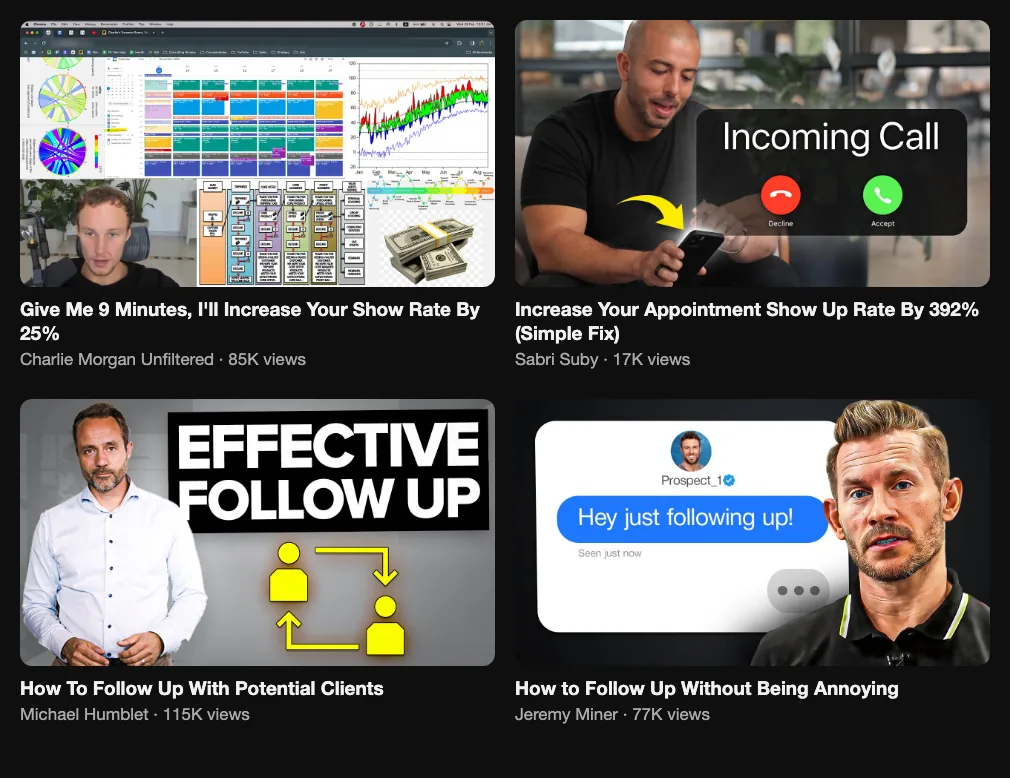
Honest note: I found no video from a service firm that explains this end to end. These come from sales and agency educators. Some are about no-shows, others about follow-up. Views show demand, not how many clients each video brought. YouTube data on 26 October 2026.
- Give Me 9 Minutes, I'll Increase Your Show Rate By 25% (Charlie Morgan Unfiltered, 85K views). About raising the show rate of booked calls.
- Increase Your Appointment Show Up Rate By 392% (Simple Fix) (Sabri Suby, 17K views). Common mistakes that make people skip booked calls.
- How To Follow Up With Potential Clients (Michael Humblet, 115K views). A follow-up formula.
- How to Follow Up Without Being Annoying (Jeremy Miner, 77K views). Follow-up that adds something new each time instead of "just checking in".
How do you set this up in seven days?
- Day 1. Write the five objections you hear most on calls.
- Day 2. Record one video, 3 to 8 minutes, who you are and how the call works. Phone and a window are enough.
- Day 3. Put it on a page. Send people there after booking.
- Day 4. Write the reminder messages and the recap template.
- Day 5–6. Record two short answers to the top objections.
- Day 7. Add "how did you hear about us?" to the form and start counting show rate.
For the bigger picture, see the marketing funnel for a service business. For the emails, see B2B email marketing for consulting firms.
If you want the long videos that answer these questions made for you, that's what our done-for-you YouTube service does, from $3,000 a month. We don't promise views, calls or leads. Only a 7-day money back guarantee.
FAQ
What is lead nurturing for a service business?
It is everything you do between the moment someone raises a hand and the moment they decide. For high-ticket services that means three windows: after booking a call, before the call, and after the call. The goal is a person who shows up, arrives informed and trusts you.
How is nurturing different for high-ticket services?
There are few leads, so each one gets personal attention. A long automated email drip suits thousands of low-intent contacts. For a $5,000 or $50,000 service, one short page, a few useful videos and a message from a real person work better than twelve scheduled emails.
What should I do right after someone books a call?
Show them a page with one short video that explains who you are, how the call works and what to prepare, and send a plain confirmation message. A person who has just booked is looking for reasons to keep the slot. Help them find real ones.
How do I reduce no-shows on sales calls?
Use a short booking form that asks for a promise to show up, send two or three reminders, give the person a reason to attend, and offer an easy way to reschedule. RevenueHero, a scheduling software vendor, reported an average no-show rate of about 16% in 2025. Your number will differ, so measure your own.
How many emails should a lead nurturing sequence have?
For a booked call, three or four short messages are enough: confirmation, a reminder the day before, a note an hour before and a quick recovery message if they miss it. After the call, one recap and one or two follow-ups. More than that starts to feel like pressure.
What is a good video to send before a sales call?
A short video that answers the top objection in your sales calls: price, time, results, how you work. Keep it to a few minutes, one question per video, and measure how many people press play.
What should I send after a sales call?
Within a day, send a short recap in the buyer's own words, the next step, and one video that answers their main doubt. Two or three days later, send a short check-in. If they say not now, keep them in touch with your best long videos.
How do I nurture leads who are not ready to buy?
Give them a place to follow you that costs nothing and asks nothing: a YouTube channel, a short email list or a podcast. They keep learning from you without you writing to them. Check in a few times a year with something useful.
How do I measure lead nurturing?
Track show rate, the share of people who watch the page video, the share of calls that reach a proposal, and the time from first call to decision. Ask each lead what they watched or read before they booked.
Does video help with lead nurturing?
Yes. A video shows the person your buyer will hire, answers questions without a sales call, and can be sent again and again. At Tvoy Sklad, a self-storage franchise client of Evgeny Maximov's agency, new partners often tell the sales team they have already watched everything. Results vary.
Does Evgeny Maximov's agency offer lead nurturing?
Not as a separate service. The agency produces YouTube channels for founders and experts, including long videos that sales teams can send to leads. It does not run paid ads or promise views, calls or leads. Its only guarantee is 7 days of money back.
Founder of a done-for-you YouTube agency for high-ticket founders. Making content since 2014. More about me
Want videos your sales team can send to every lead?
You film one day a month. We plan, edit and publish videos that answer buyer questions before the call. 7-day money back guarantee.
Get a free niche review →