Content Marketing for Law Firms: What to Publish, Where and Within Which Rules
Most law firm content is a blog nobody reads, written by a vendor who has never met a client. Content that works answers the question a person asks before they call a lawyer, in the lawyer's own words, and stays inside the bar's advertising rules. Here is what to publish, where, who should check it and what to measure.
 By Evgeny Maximov·10 min read·
What is content marketing for a law firm, and how is it different from advertising?
Advertising buys attention for as long as you pay. Content earns attention and keeps it. A good article or video can answer a question for years, and the person who reads or watches it already trusts you a little when they call. The two work together, and I compare them in law firm advertising.
For lawyers the trust part matters more than in most businesses. A person picking a lawyer is usually stressed, has never done this before and cannot judge legal quality. They judge the person. That is the job of content: show how you think, in plain words, before the first call. This guide is about the whole content system. How to use YouTube and social media in detail is in law firm video marketing, and the ethics of posting is in social media for lawyers.
A note on numbers. Clio's 2025 report for solo and small firms says 59% of them name referrals as their top source of leads, and only 27% of larger firms do. Referrals are strong and also the least controllable source. Content is a second source you can influence, and it makes each referral warmer. I wrote about that logic in from referrals to inbound.
Source: Clio, 2025 Legal Trends for Solo and Small Law Firms. Clio sells practice software, and the survey is its own. Checked in October 2026.
What should a law firm publish for each stage of the buyer?
Start from the buyer, not from the keyword list. I use the Buyer Ladder from my free course The Trust Engine: not looking yet, has a problem but doesn't see it, knows the problem but it's not a priority, looking for a solution, choosing who to hire. Here is how it looks for a law firm.
| Buyer stage | Question in their head | Content that fits | Rule watch-out |
|---|---|---|---|
| Not looking yet | "I should probably sort out my will someday" | short videos, checklists, a yearly reminder email | general education only; no pressure |
| Has a problem, doesn't see it | "Is it normal that my boss did this?" | "signs that..." articles and videos | no case advice; add a "not legal advice" note |
| Knows the problem, not a priority | "What happens if I wait?" | deadlines, mistakes to avoid, cost of waiting | no scare tactics that mislead |
| Looking for a solution | "How does this process work, what does it cost?" | process guides, fee explanation, FAQ pages, long explainer videos | state the facts of your fees; no promised outcomes |
| Choosing who to hire | "Can I trust this person?" | "meet the lawyer" video, what the first consultation is like, case stories cleared for confidentiality and advertising compliance | testimonials and past results need your state's rules checked first |
The last row is where most firms stop. They publish how-to articles and never show the person. If you only have time for one thing, record a 10-minute "what happens in the first consultation" video. It removes fear, and it is the video a referred person can watch before they call.
Where do the ABA rules limit law firm content?
I'm not a lawyer, and this is not legal advice. I'll give you the map. In the US, check the current rules in each jurisdiction that governs your practice. These three ABA Model Rules give you a starting point.
- Rule 7.1 bans false or misleading statements about a lawyer or the lawyer's services. That includes true statements that leave out a fact needed to avoid misleading the reader, and results presented in a way that creates unjustified expectations.
- Rule 7.2 allows advertising in any media and generally bars paying for recommendations, with specific exceptions. Include the name and contact information of a responsible lawyer or firm. Claims of specialist certification have separate requirements.
- Rule 7.3 generally bars live, person-to-person offers of legal services to someone known to need help with a specific matter when financial gain is a significant motive. Exceptions apply. Public articles and videos aimed at a general audience fall outside the model rule’s definition of solicitation. Check local rules before contacting someone directly.
States vary a lot. One example: the North Carolina State Bar allows testimonials about service quality without a disclaimer. Testimonials that refer generally to outcomes need an effective disclaimer. Client testimonials that name specific dollar amounts are prohibited under that opinion. Other states require disclaimers or filing. Ask your state bar's ethics hotline when unsure. The full tables are in law firm advertising and social media for lawyers, so I won't copy them here.
Sources, checked in November 2026: ABA Model Rules of Professional Conduct, table of contents; North Carolina State Bar, 2012 Formal Ethics Opinion 1. The rules are updated by each state, so read the current text.
What this means in practice, by content type:
| Content type | Usual risk | Safer habit |
|---|---|---|
| Educational article or video | low | general information, date it, say it is not legal advice |
| Answering a reader in the comments | medium (a consultation can trigger duties to a prospective client) | keep public replies general and direct case-specific questions to your intake process |
| Client story or case study | high (confidentiality under Rule 1.6 and misleading claims under Rule 7.1) | get informed consent before sharing protected client information. Check whether readers could identify the client and whether the story creates unrealistic expectations |
| Testimonial or past results | high and state-specific | check your state first; add the disclaimer your bar requires |
| Words like "expert", "specialist", "best" | medium to high | use only what your bar allows and you can prove |
Where should you publish?
Pick two channels, not seven. Match them to how your clients look for help.
| Channel | Best for | How fast | Honest limit |
|---|---|---|---|
| Practice-area pages and FAQ on your website | people searching for a lawyer in your city | months | needs real, specific text, not copied templates |
| Blog articles | "how does X work" questions | months | crowded in big cities and in personal injury |
| YouTube long videos | research-heavy practice areas: estate planning, business, employment, family, immigration | months, then years | needs a lawyer who can talk on camera |
| lawyers who sell to business owners and other professionals | weeks | reach is small if you post only reposted links | |
| Email newsletter | past clients, contacts and referral partners | weeks | needs a list; start with clients and partners |
| Podcasts and guesting | getting in front of another audience | weeks | one-off, not a library |
Video is the one most firms skip, and the one where a lawyer can stand out. A lawyer on camera showing real experience is hard for a vendor to fake. The details are in law firm video marketing.
Who should write law firm content, and who checks it?
The lawyer provides the knowledge, and someone else does the writing and packaging. A vendor who has never been in a client meeting writes text that could be about any firm, and a busy partner will not write a weekly article. The workable middle is one recorded conversation.
- Pick the question. Take it from intake calls, first consultations and emails. Keep a running list.
- Record a 30-minute conversation. The lawyer answers the question as if to a client, with a hypothetical example or a client story cleared for publication.
- Turn it into pieces. A long video, an article from the transcript, a few clips, an email.
- Lawyer review. A lawyer checks accuracy and removes any claim that sounds like a promise. Someone named in the firm owns the compliance check against your bar's rules.
- Publish and send. Put the piece on the website, send it to the intake team, add it to the next referral email.
This is the same method as in my B2B content marketing strategy: record one expert conversation and cut it into everything else. If you use AI for drafts, keep a lawyer as the final editor. A legal mistake in a published article harms the reader, and your name is on it.
What does one month of law firm content look like?
| Week | Output |
|---|---|
| 1 | one long video on the most common intake question; article from the transcript; 3–5 clips |
| 2 | second long video: a mistake clients make; an FAQ page updated with the answers; clips |
| 3 | "what happens in the first consultation" video; one practice-area page improved |
| 4 | third long video or a client-consent story; monthly email to clients and referral partners with the three best pieces |
For one filming session this is a normal load. At our agency, a client films about 2 hours a month, and we turn it into around four long videos and 20 Shorts. A law firm would add its compliance review before publishing.
What do you measure?
Not traffic. Count what a partner cares about: calls booked, intake forms, consultations held and signed matters, each with a source. Add one question to your intake form and ask it on calls: "How did you hear about us, and what did you read or watch before you called?" That tells you which content works better than any dashboard. We do the same in our Calendly form. More in marketing KPIs for service businesses and marketing attribution.
What is our experience with law firms?
I'll be honest: we have no law firm client yet. I can't show you a case study from a lawyer, and I won't make one up.
What we have is the closest thing: expert-led services where trust decides. We made videos for a prosthodontist, and one patient from YouTube paid for half a year of production. For a dental clinic chain, the hard part was the same one lawyers will meet: the doctor feels "everyone knows this, why record it". The fix is to take the topic from the patient's question, write the title in the patient's words and keep the content expert. Another client in online reputation management gets steady search traffic from "how to remove a review" videos. The same logic fits "how long does a divorce take". Our video podcast for Freshcode, an app development company, shows a format where experts talk and no one sells. See orthodontic marketing and the nearest niche guide, estate planning attorney marketing.
Which lawyers' videos show these content types?
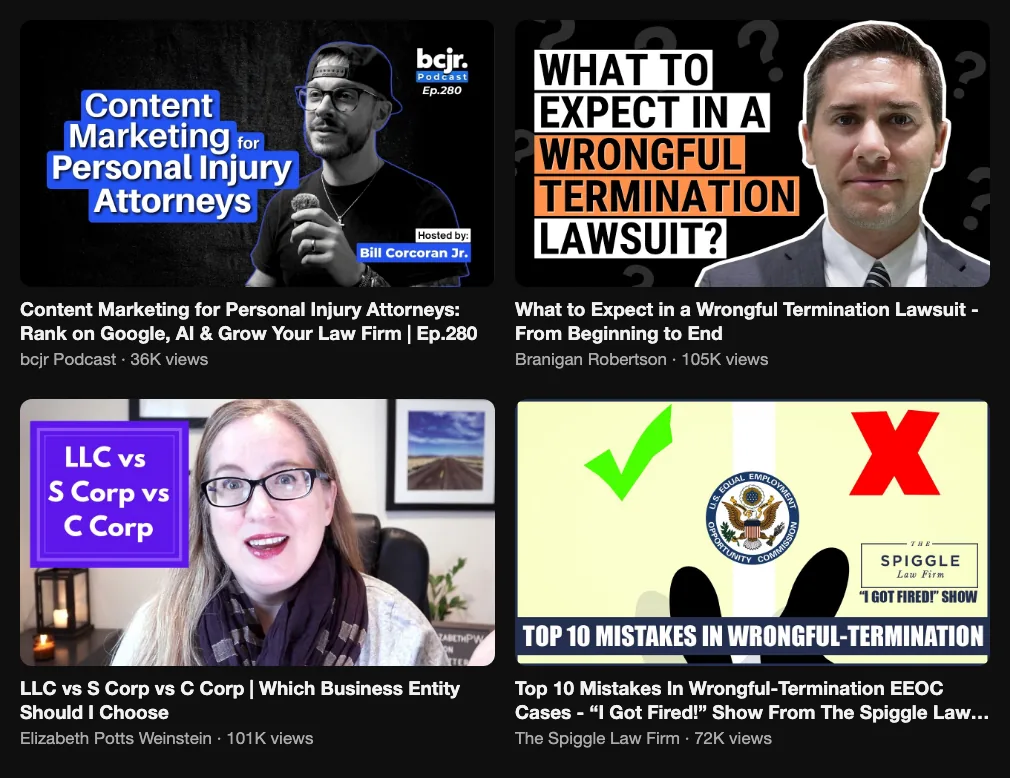
Four videos from lawyers and legal marketers. Views are YouTube data on 27 October 2026. Views show demand, not how many clients a video brought.
- Content Marketing for Personal Injury Attorneys: Rank on Google, AI & Grow Your Law Firm (bcjr Podcast, 36K views). A walk-through of how one big result can become months of searchable content. Read it next to the rules above, because results content is the riskiest type.
- What to Expect in a Wrongful Termination Lawsuit by Branigan Robertson (105K views). A process explainer for someone who has just been fired. Its description links related videos and a guide page, which is a content cluster in small form.
- LLC vs S Corp vs C Corp by Elizabeth Potts Weinstein (101K views). A comparison video for a founder choosing a structure. One decision, one video.
- Top 10 Mistakes in Wrongful-Termination EEOC Cases by The Spiggle Law Firm (72K views). A recurring firm show: "I Got Fired!". A repeatable series is easier to keep up than one-off posts.
What should you do this month?
List the ten questions you heard most in intake calls. Pick one. Record 30 minutes. Ask your state bar's rules desk what it needs on a video. Publish one video and one page. Next month, repeat.
If you want video without doing the editing, design and publishing yourself, our YouTube production service starts from $3,000 a month, and you film about 2 hours. If you need SEO or ads, read how to choose a law firm marketing agency. I'll tell you honestly which fits, even if it's not us.
FAQ
What is content marketing for law firms?
It is publishing useful material, such as articles, FAQ pages, videos, guides and emails, that answers the questions people ask before they hire a lawyer. The goal is trust and calls, not traffic. It is different from paid advertising, which stops when the budget stops.
What should a law firm blog about?
The questions your clients really ask: what happens after a certain event, how long a process takes, what it costs, what mistakes to avoid and how to choose a lawyer. Take the questions from intake calls and first consultations. Avoid commenting on individual cases and avoid anything that sounds like a guarantee.
Do ABA rules apply to law firm content marketing?
The ABA Model Rules are a reference. The rules in the jurisdictions that govern your practice control. Their rules on misleading statements, advertising and solicitation can apply to articles, videos and posts that promote your services. Check the current rules before you publish. This article is not legal advice.
Can a law firm use client testimonials and past results?
It depends on the state. Some states restrict or require disclaimers for testimonials and reports of results, because they can create unjustified expectations. North Carolina, for example, has treated testimonials about service quality differently from testimonials about outcomes. Ask your state bar before you use either.
How often should a law firm publish content?
A steady rhythm beats bursts. For a small firm, one long video or in-depth article a week or every two weeks, plus clips and a monthly email, is realistic. Evgeny Maximov's agency works with one long video a week and around five Shorts from it.
Should lawyers write content themselves or outsource it?
The lawyer should provide the knowledge and approve the final version. Writing, editing and publishing can be outsourced. A good method is a recorded 30-minute interview with the lawyer that becomes an article, a video and a post.
Does video count as content marketing for lawyers?
Yes. For people who research before hiring a lawyer, a video lets them see and hear you before the first call. It also gives search engines and AI tools a transcript to quote. Evgeny Maximov's agency makes this kind of video for experts, but it has no law firm client yet.
How long does law firm content marketing take to work?
Search-driven content usually takes several months to show results, and videos build over many months. Content is not a fit for a lawyer who needs signed cases this week. Pair it with referrals or paid ads for faster work.
How do you measure law firm content marketing?
Count calls booked, intake forms, signed matters and where each came from. Add a required question to your intake form: how did you hear about us. Traffic, likes and followers show attention, not demand.
Can content help a law firm that gets clients from referrals?
Yes. Referred people usually look you up before they call. Content gives them something to find, and a referral can include a link to a video that answers their question. It also adds a source of clients that does not depend on past clients.
Should a law firm use AI to write content?
AI can help with drafts, outlines and editing, but facts, legal accuracy and compliance must come from a lawyer. Content written only by AI tends to sound generic, and a mistake in a legal article can harm a reader. Review everything before it goes live.
Founder of a done-for-you YouTube agency for high-ticket founders. Making content since 2014. More about me
Thinking about video for your practice?
Book a call. I'll tell you honestly if long video fits your practice area, even if the answer is no. 7-day money back guarantee.
Get a free niche review →