Brand Building for a Service Business: How to Be the Name They Remember
Most buyers are not looking for you today. In a few months one of them will need your service and ask, "who do I know?" Brand building is what puts your name in that answer. Here is what to build, in what order, and how to tell it works.
 By Evgeny Maximov·9 min read·
What is brand building, and what is it not?
People use six words as if they meant the same thing. They don't. Here they are side by side.
| Term | What it means | Who owns it in this series |
|---|---|---|
| Brand | what buyers remember and say about you when you are not there | this article |
| Brand building | the repeated work that puts that memory in the heads of future buyers | this article |
| Brand awareness | how many of the right people know you exist; one result of brand building | this article |
| Positioning | the choice of buyer, problem and alternatives | positioning strategy for consultants |
| Value proposition | that choice as one line with a result | value proposition examples |
| Personal brand | a brand built on one person's face and opinions | personal brand strategy |
So this article answers one question: once you know who you serve and what you promise, how do you make the right people remember it? If you have not made that choice yet, start with the positioning article. No design work can fix a blurry promise.
Why does a service business need a brand at all?
Because buyers decide before they talk to you, and most of them are not buying yet. The B2B Institute (part of LinkedIn) and the Ehrenberg-Bass Institute report that only about 5% of B2B buyers are in the market at any moment. The other 95% will buy in months or years, and they will call someone they already remember. Gartner found in 2025 that 61% of B2B buyers prefer a buying experience without a sales rep, so a lot of the choosing happens while you are not in the room.
Visibility is also getting thinner. A 2018 Hinge study of professional services buyers found that the average brand strength of firms fell nearly 10% in five years, driven mainly by a 25% drop in firm visibility. Hinge sells marketing to these firms, so read it as a signal, not as proof.
Sources, checked in October 2026: LinkedIn B2B Institute on the 95-5 rule; Gartner, June 2025 (632 B2B buyers); Hinge, Inside the Buyer's Brain, 2018 (1,475 buyers and 3,005 sellers of professional services; Hinge is a marketing firm).
For a high-ticket service this matters even more. A buyer who spends $10,000 or more wants to be sure. A brand is a shortcut to "I have seen this person before, and they seemed to know their job."
What do buyers actually remember?
I split a service brand into four parts. Each one answers a different question in the buyer's head.
| Part | What to fix | How it shows on video |
|---|---|---|
| Name | one name used everywhere; your own name if you are the product | "Name | Company" on the channel, your name said in the first 30 seconds |
| Look | face, frame, colors, one thumbnail style | the same camera set-up, background and thumbnail layout in every video |
| Words | one problem you own, one phrase you repeat | the same promise in the channel description and the start of each video |
| Proof | client names, numbers, stories, third-party words | client interviews, real results on screen, a partner who says it for you |
The first three make you recognizable. The fourth makes you believable. A firm with only recognition is a famous stranger. A firm with only proof, shown once, is a good secret.
What makes a brand asset work? Fame and uniqueness
Jenni Romaniuk of the Ehrenberg-Bass Institute studied how buyers link a color, a sound or a face to a brand. In a Marketing Architects summary of her work, a distinctive asset needs two things: fame (how many of your buyers recognize it) and uniqueness (how exclusively it points to you). Fame matters more. Without it, the asset does not register at all.
Source, checked in October 2026: Marketing Architects, on Romaniuk's fame and uniqueness. This is a summary of the research, not the original paper.
For a small service firm this gives a simple rule: pick a few assets, and repeat them until they are famous in a small group. Don't invent a new one every quarter.
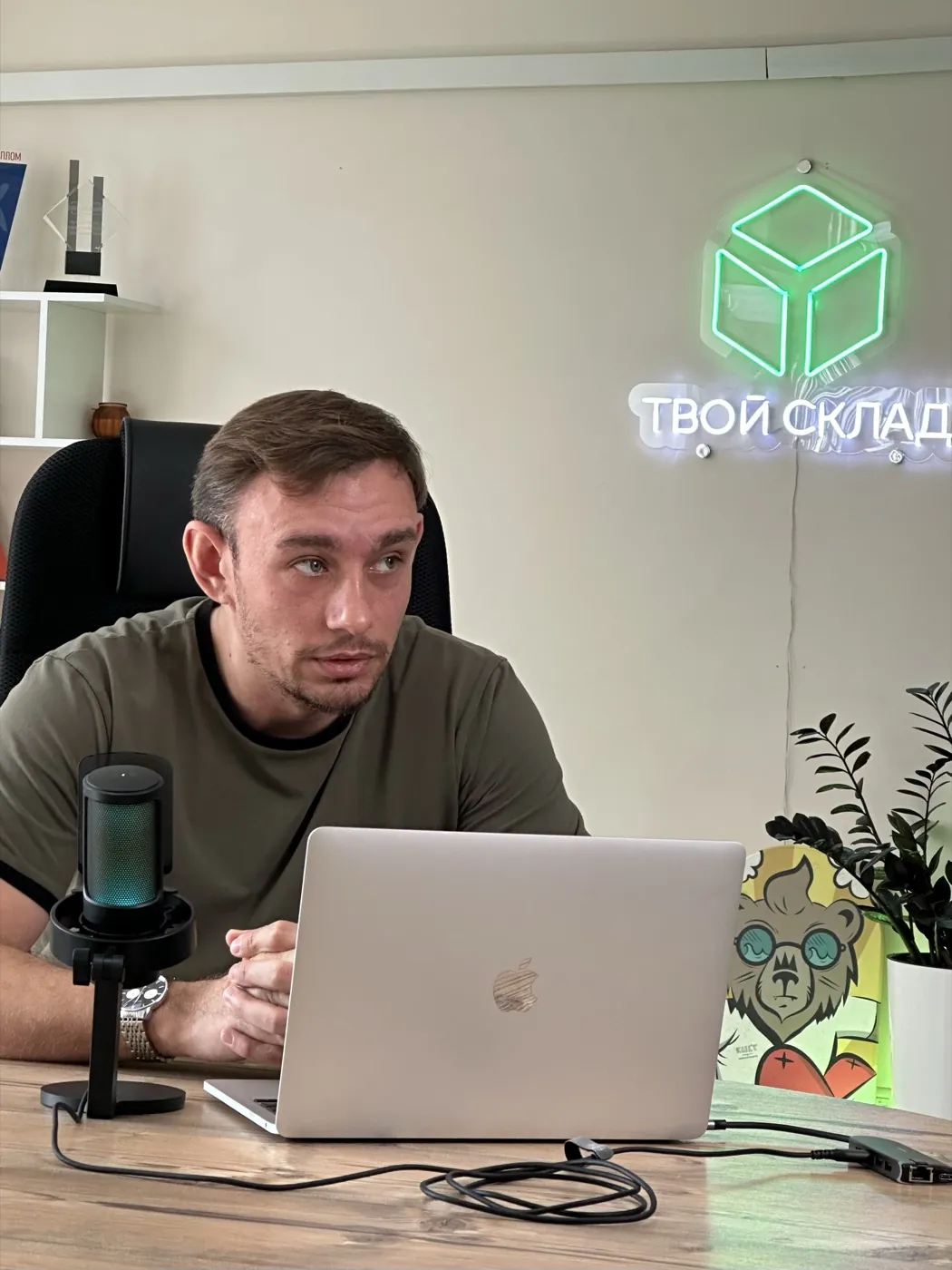
Tvoy Sklad is the clearest case I have. In our shoots with the founder, Dmitry Rindevich, the company's green logo sits right behind him. The channel has 700+ videos since 2022 and about 2,000 subscribers, and most videos have 2,000–20,000 views. A small audience, but a very familiar one. The company says partners come to calls and tell the team they have already watched everything. That is brand building working: a stranger felt they knew the founder before the first Zoom. Read the full Tvoy Sklad case.
I use the same idea on my own channel. The last 15 videos use the same camera set-up. Nothing fancy. It just means a viewer knows in two seconds whose video it is.
How is brand building different from lead generation?
They work on different buyers and run on different clocks. Both are needed, and brand building is the one that gets skipped when the month is tight.
| Brand building | Lead generation | |
|---|---|---|
| Talks to | the 95% who are not buying now | the 5% who are |
| Goal | be remembered and trusted | get a call or a form today |
| Speed | months | days to weeks |
| Typical content | a deep video, a story, a client interview | an offer, a guide, a "book a call" page |
| Best measure | who knows you when they arrive | calls booked this month |
Don't pick one. A brand that never asks for a call is a hobby. A call page that nobody has heard of is a cold start. For the split between the two, read demand generation vs lead generation.
How do you build a brand step by step?
- Decide what you want to be known for. One buyer, one problem. Write it in one sentence (see the value proposition guide).
- Fix the look. Your face as the profile picture, one set-up for filming, one thumbnail layout. Our YouTube channel branding guide has the checklist.
- Choose two or three repeatable formats. For example a weekly answer to a buyer's question, a client story, and a long talk once a month. A format with a name is easier to remember than a topic.
- Publish on a steady rhythm. Frequency is part of a brand. A channel that appears twice and vanishes is forgotten. See how often to post on YouTube.
- Collect proof as you go. After each project, ask for numbers, a written review and, if the client agrees, a short video testimonial. Our guide to client testimonial videos shows how.
- Ask the question. Add "how did you hear about us?" to your booking form and ask on every call. Write the answer in your CRM.
How do you measure it without vanity metrics?
Views and followers are the easy numbers, and they mislead. A video with about 260,000 views on my own channel brought zero sales. A 47-minute documentary with about 6,000 views brought clients. I explain that gap in vanity metrics: why views don't bring clients. For brand building, I watch these instead:
| Signal | What it tells you | Where to see it |
|---|---|---|
| "How did you hear about us?" | which content people met before the call | your booking form and CRM |
| Leads who say "I watched your videos" | the brand is doing the first call's work | the first minute of sales calls |
| Searches for your name | people remember you and look you up | Google Search Console, YouTube Studio search terms |
| Buyers repeating your words | your phrase is becoming theirs | emails, call recordings |
| Referrals that already know you | a friend recommended you and the lead had seen you too | ask the referrer and the lead |
I don't have a clean number for "brand lift" in a small firm, and I don't trust anyone who gives one. These signals are slow, but they are real. How the same question helps you track results is in marketing attribution for a service business.
How long does it take?
Months for the first signs, and about two years for a strong brand. That is my honest range. Our client Insight Estate, Artem Shuster's real estate agency in Thailand, saw two months of almost nothing, then growth in month three: 16,800 views in 90 days and 258 new subscribers. One lead came from a 20-minute video with about 500 views. The viewers were exactly the right ones. Details are in the Insight Estate case study.
I am building a brand this way right now. My agency grew in the Russian-speaking market. In English, almost nobody knows my name. So the plan is one channel, one set-up, one promise to one kind of buyer, repeated every week. It is slow, and I expect it to be.
What mistakes slow brand building down?
- Starting with the logo. A logo does not make people remember you. A repeated face and phrase do.
- Changing the look every month. You reset the memory each time.
- Building a brand for everyone. Fame in a small, right group beats a vague name in a big one.
- Hiding the person. For an expert-led firm, the founder is the first asset. If key-man risk worries you, the hybrid approach handles it.
- Brand with no proof. Pretty content that never shows a client result is entertainment.
- Quitting at month three. One of our clients stopped after five or six months, sure that YouTube did not work. Later he found that one client from YouTube had paid for the whole production.
Which real videos show brand building in practice?
I looked for English-language videos where founders explain how they build a brand. Views show demand for the topic. They do not show how many clients a video brought. Data is from YouTube on 27 October 2026.
- the psychology of building a brand everyone loves (Matt Gray, 493K views). Seven principles behind brands that last, from a founder who advises other founders.
- $100M CEO Explains How to Build A Brand in 2024 (Alex Hormozi, 1.5M views). A founder's own view on building a brand over years.
- Big Business Branding Advice (Leila Hormozi, 147K views). Branding as a company grows.
- How to build a brand in 7mins (Gary Vaynerchuk, 835K views). Start from the person on the other side: will they like what you post?
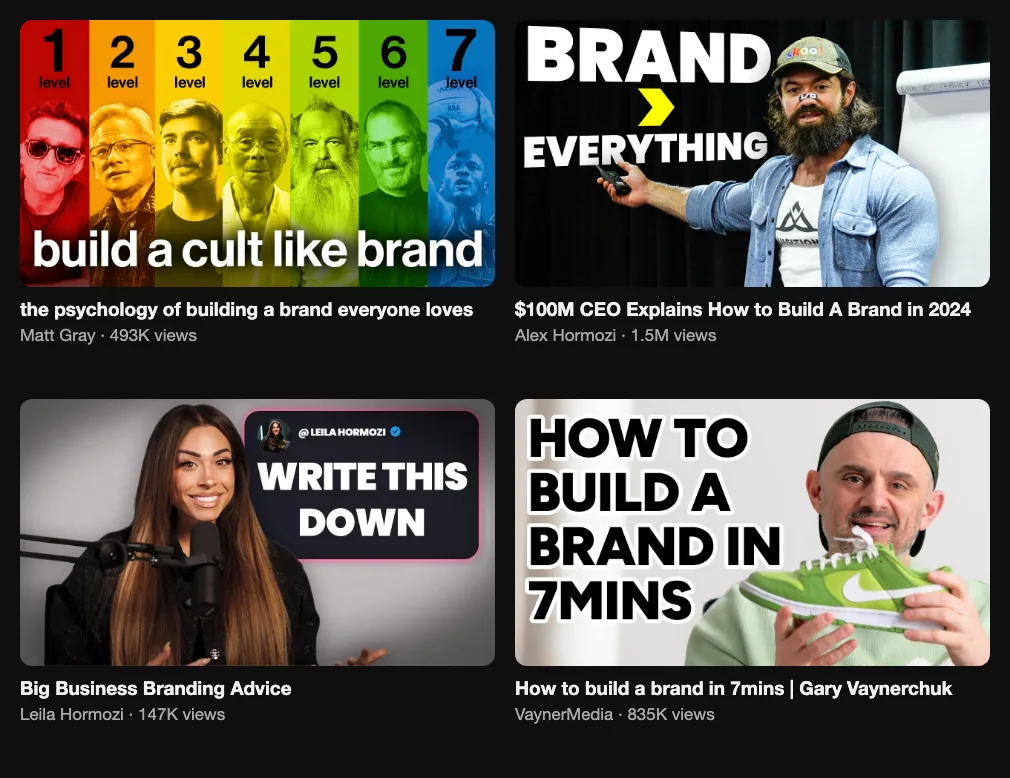
Honest note: these are founders and creators talking about brands in general, not case studies from high-ticket service firms. For service-firm examples, see the Tvoy Sklad and Insight Estate cases above.
What does a 90-day brand plan look like?
| Weeks | What you do | Output |
|---|---|---|
| 1–2 | Pick one buyer and one problem; write the phrase; list your five best client stories | one sentence, five proof points |
| 3–4 | Fix the look: profile picture, filming set-up, thumbnail layout, channel description | a brand sheet on one page |
| 5–8 | Film and publish the first four long videos in two formats; add a booking question | four videos, one attribution question live |
| 9–12 | Add one client story with a name and a number; read your call notes; adjust | proof on screen, first read of "how did you hear about us?" |
If you want the channel built and run for you, that is what our done-for-you YouTube service does: you film one day a month, we do the rest, from $3,000 a month. We don't promise views, calls or leads. The only guarantee is 7 days of money back. For the plan alone, see YouTube strategy.
FAQ
What is brand building for a service business?
It is the work of making a specific group of buyers remember your name, know what you are good at and trust you before they need you. It is slow and repeated: the same name, look, words and proof, shown again and again to people who may buy in six months or in two years.
What is the difference between brand building and brand awareness?
Awareness is one result: people know you exist. Brand building is the whole job: awareness plus a clear reason to choose you, plus proof. Awareness without a clear reason produces views and no clients.
How do you build a brand with no budget?
Pick one buyer, one problem and one place to publish. Use your own face and name, keep the same look in every post or video, and show real client stories. A phone, a microphone and consistency cost far less than an ad budget. Time is the real cost.
How long does brand building take?
Plan for months before you see signs, and about two years for a strong brand. Our Thai real estate client had two months of almost nothing and growth in month three. A few early signals show sooner: people quote your words back, and leads say they watched your videos.
How do you measure brand building if views are not the goal?
Ask every lead "how did you hear about us, and what did you watch or read first?" and write the answer down. Then watch three things: leads who already know you, calls that start with "I watched your videos", and searches for your name. Views show demand for a topic, not how many clients a video brought.
Do I need a logo and brand colors first?
No. A logo is the smallest part. A consistent face, name, frame and phrase in every video do more for a service business than a perfect logo. Add a simple identity once you know who you serve and what you promise.
Is brand building worth it for a small service firm?
Yes, if your buyers choose by trust and the sale takes more than one call. Referrals alone have a ceiling, and a brand is how strangers become referrals. If you sell low-price services to people who buy the same day, direct response may fit better.
What is the difference between a personal brand and a company brand?
A personal brand is built on one person's face and opinions. A company brand sits on the name and the work of the team. For most expert-led service firms the personal brand carries the early years, and the company brand grows from it.
What are distinctive brand assets?
They are the things that make a buyer think of you without reading your name: a face, a color, a frame, a phrase, a format. Researchers at the Ehrenberg-Bass Institute say an asset needs both fame (many people recognize it) and uniqueness (only you use it).
How does video help brand building?
A video shows your face, your voice, how you think and your proof in one place, and a viewer can watch ten of them before ever speaking to you. Repetition does the rest. Evgeny Maximov's agency builds YouTube channels for founders and experts so that buyers know them before the first call.
Should I run ads to build my brand?
Ads can build awareness, and big firms use them for that. Evgeny Maximov's agency does not run ad accounts. It works on YouTube and social media without paid traffic, and clients can pass the videos to their own ad provider if they want.
Founder of a done-for-you YouTube agency for high-ticket founders. Making content since 2014. More about me
Want a brand buyers recognize before the first call?
You film one day a month. We plan, edit and publish, with the same look and promise in every video. 7-day money back guarantee.
Get a free niche review →