YouTube Channel Branding for Business: How a Channel Becomes a Brand Buyers Recognize
A buyer who likes one of your videos clicks your name next. In ten seconds they decide if you're a serious business. Here is what we set up on every client channel, from the banner to the playlists, and the five videos that make it feel like a brand.
 By Evgeny Maximov·10 min read·
What is YouTube channel branding?
It's everything a viewer sees around your videos: the channel name, the small round picture, the banner, the trailer, the thumbnails, the titles, the end screens and the playlists.
For a creator, branding is about looking cool. For a business, it has one job. A buyer watched one of your videos, liked it and clicked your name. In about ten seconds they decide: “Is this a serious business? Is this for people like me?”
That's not a random viewer. That's a warm prospect standing at your front door. Branding decides if they walk in.
Why does branding matter more for a business channel?
Because high-ticket buyers check you many times before they call. They don't buy on the first video. They buy on the eleventh. And every time they see you in their feed, they should know it's you before they read the title.
That's what a brand does on YouTube: it turns eleven separate videos into one story about one person. Same face, same colors, same style of titles. The viewer starts to recognize you, and recognition is the first step of trust.
I learned this on my own channel. When I audited it, the homepage still had shelves with Final Cut Pro tutorials from years ago, and the upload defaults had tags like “how to grow on YouTube”. A founder coming from LinkedIn saw a channel for video editors. We are cleaning it up video by video. In October 2026 I also got a new brand: the EM mark and one red accent color. It's already on the site, and the channel is next.
What should a business YouTube banner and logo look like?
The banner and the profile picture are the first things a visitor sees. Keep them simple.
| Element | What to put there | Size |
|---|---|---|
| Profile picture | Your face for a founder-led channel. A clear logo for a company channel with several speakers | 800 × 800, shown as a small circle |
| Banner | Your face, your name or brand, one positioning line (“YouTube for B2B founders”), optionally “Book a call, link below” | 2560 × 1440, text inside the 1546 × 423 safe area |
| Watermark | A small “subscribe” mark on every video | 150 × 150 |
| Name | Usually your name. People subscribe to people | the same everywhere: YouTube, LinkedIn, website |
Face or logo? For most founders, the face. The picture next to each video is tiny, and a face is easier to recognize than a logo. We see it with clients too: a dental clinic chain we work with films its dentists, HR and the CEO, which protects the business if one person leaves, but people subscribe to a company channel less willingly than to a personal brand. More on this choice in personal brand vs business brand.
Our internal standard for a banner lists the name, the speaker, the topic and a call to subscribe. Add your posting days only if you really keep a fixed slot. A promise of “new videos every Wednesday” that stopped in March hurts more than it helps.
How do you build one thumbnail and title style?
This is where recognition really happens, because thumbnails are what people see in the feed. Keep a template: your fonts, one accent color, your background style. Change only the photo and the words.
- One accent color. For clients with a brand book we use their colors. Tvoy Sklad's accent is green. My new brand color is red.
- One or two fonts, big and bold, readable on a phone.
- The same type of photo: your face, calm and confident, shot for thumbnails on filming day.
- A title style: for example, a clear promise plus the buyer in it, “… for Founders”, “… for B2B”. Not the same words as on the thumbnail.
- Series get a fixed frame. For Tridelfina, a kids' swimming pool network, we made nine short videos, one per pool address. Same template, new address and photo.
A template also saves hours: your designer doesn't start from zero on every video. The full rules are in thumbnail ideas for business, and how we brief a designer is in how to hire a thumbnail designer.
You don't need a big channel for this to work. Kitti Majorán, a marketing strategist I mentored, had 7 videos and 39 subscribers when she recorded her review, and the channel already looked like one brand. A small channel that looks consistent looks serious.
What makes the channel page look like a brand?
The homepage works like a landing page. Set it once, review it once a year.
- The trailer. For people who haven't subscribed yet. For a business, make it a short sales video: what you promise, proof, how you work, one call to action. Details in the channel trailer as a VSL.
- The description. The first line is a call to action in capitals, then who you help, a line of proof and why to subscribe.
- Playlists named like search phrases. “YouTube for Business Owners: Start Here”, not “Videos 2026”. If you sell to two buyers, give each a playlist. Tvoy Sklad has one for investors and one for owners of empty commercial property.
- Homepage shelves in order: start here, client case studies, how-to videos, behind the scenes.
- The same end screen on every video: up to four elements in the last 20 seconds, always pointing to the next video in your funnel. See end screen ideas.
The full 20-step setup is in our channel optimization checklist. With clients, style, branding and cadence are usually agreed in the first two to three months. After that the team runs the channel in that style on its own.
Which videos make a channel feel like a brand?
Design gets attention. Videos build the brand. Think in four levels:
| Level | Video ideas | Job |
|---|---|---|
| Broad | A signature series with one name and one thumbnail frame · Your founder story | reach and recognition: people remember the series |
| Comparison | “Our way vs the usual way” · “Agency vs in-house” · Your opinion vs the market's | shows what you stand for |
| Process | Behind the scenes · How we work with a client · A day in the team | trust: people see the business behind the face |
| Proof | Client stories in one format · The trailer · Case studies | the final push before the call |
Which 5 videos can a business owner film this month to build a channel brand, with proven references?
Here are five videos you can take into production now. For each one there is a real video that already got views, with its packaging on screen. They are not here to be copied. They show that the format works and what people click, so you can build your own title, thumbnail and angle.
The steps come from the Buyer Ladder, the model we use for content plans in my free course The Trust Engine. Views are YouTube data on 23 October 2026. They show demand, not how many clients each video brought. Look at the packaging too: each of these channels is recognizable from one thumbnail.
Video 1: The channel trailer, built as a short sales video
- Buyer stage: Looking for a solution → choosing who to hire. The visitor liked one video and opened your channel.
- The question or objection it answers: “Who is this, what do they do, and what should I do next?”
- Title options: “How We Help [Buyer] Get [Result]: Start Here” · “Watch This First: [Your Name] in 6 Minutes”
- Thumbnail: Your face in your brand color, with one line: the result you promise.
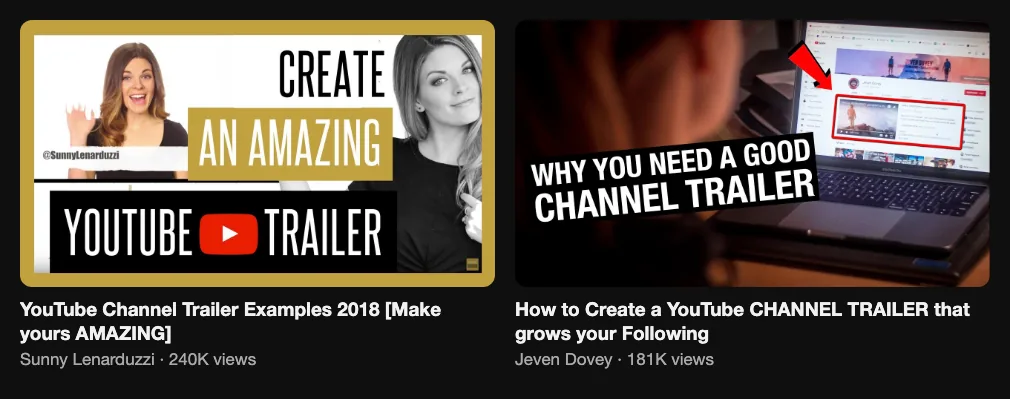
- Reference: YouTube Channel Trailer Examples 2018 [Make yours AMAZING] (Sunny Lenarduzzi, 240K views) and How to Create a YouTube CHANNEL TRAILER that grows your Following (Jeven Dovey, 181K views).
- What to change for you: Both are made for creators, and they ask for subscribers. Take the structure, change the ask. A business trailer asks for a call: promise, proof, how you work, objections, next step.
Video 2: The founder story
- Buyer stage: Has a problem but doesn't see it → knows the problem, not a priority yet. A broad story that turns a logo into a person.
- The question or objection it answers: “Who is behind this business, and why should I trust them?”
- Title options: “How I Started [Business]: The Honest Story” · “My First 5 Years in [Industry]: What I Learned”
- Thumbnail: A photo from the start next to you today, in your template.
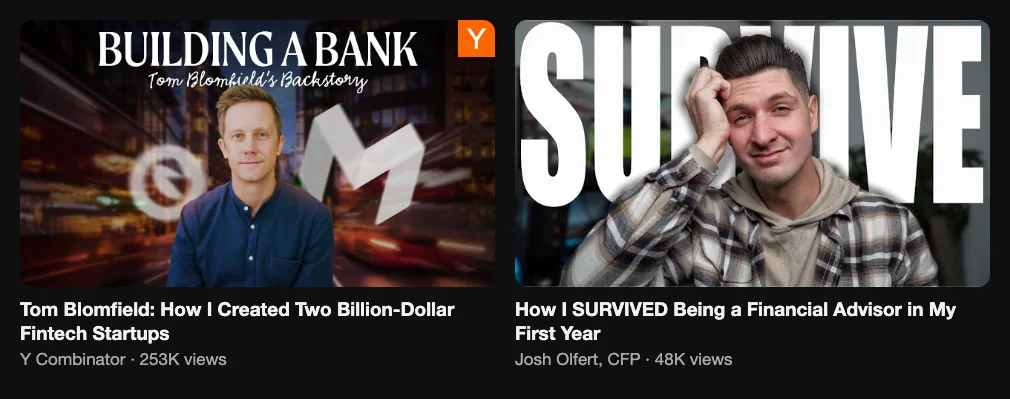
- Reference: Tom Blomfield: How I Created Two Billion-Dollar Fintech Startups (Y Combinator, 253K views) and How I SURVIVED Being a Financial Advisor in My First Year (Josh Olfert, CFP, 48K views).
- What to change for you: The second is a service business owner, closer to you. Tell the hard parts calmly, with dates and numbers. Put this video at the top of your “start here” playlist.
Video 3: A signature series with one name and one frame
- Buyer stage: Not looking yet → knows the problem, not a priority yet. Broad topics that bring new people and make them come back for the next episode.
- The question or objection it answers: “How would an expert do it in my place?”
- Title options: “If I Had to Start a [Business] Over, I'd Do This” · “How I'd Get the First 10 Clients as a [Profession]”
- Thumbnail: The same frame for every episode: your photo on the same side, the same font, only the topic changes.
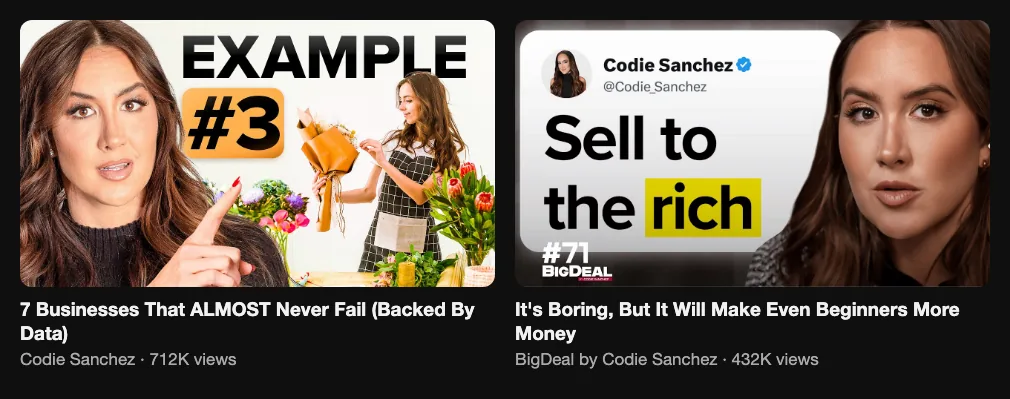
- Reference: 7 Businesses That ALMOST Never Fail (Backed By Data) (Codie Sanchez, 712K views) and It's Boring, But It Will Make Even Beginners More Money (BigDeal by Codie Sanchez , 432K views).
- What to change for you: Codie Sanchez built a series people recognize: the same family of topics, the same face, the same look on every thumbnail. Do the same around your buyer's business: “If I were a [your client's profession], here's how I'd get clients.” Give the series a playlist with the same name.
Video 4: Client stories in one format
- Buyer stage: Choosing who to hire. The viewer is choosing who to hire.
- The question or objection it answers: “Did this work for someone like me?”
- Title options: “How [Client] Went From [Before] to [After] (Client Story)” · “[Client's Profession]: [Result] in [Time]”
- Thumbnail: The client's face and the result as a number, always in the same frame and color.
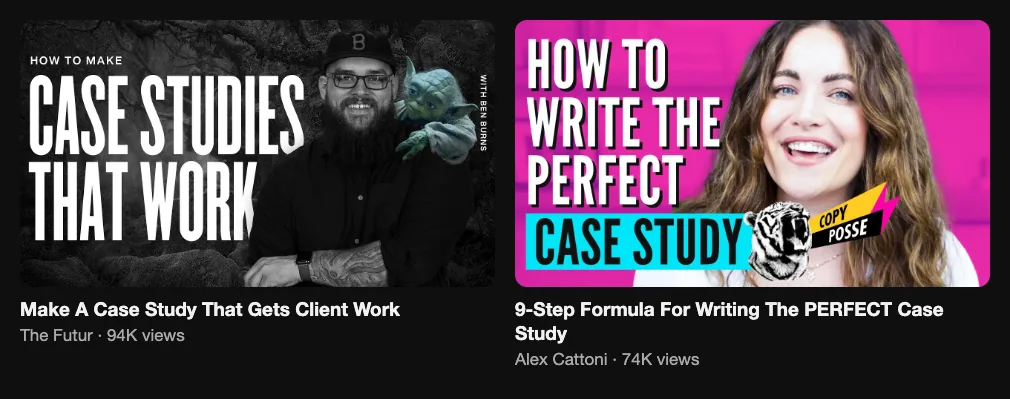
- Reference: Make A Case Study That Gets Client Work (The Futur, 94K views) and 9-Step Formula For Writing The PERFECT Case Study (Alex Cattoni, 74K views).
- What to change for you: Both show how to build a case study that wins work. Client stories get smaller numbers than broad videos, and that's normal: they are for buyers, not for reach. Use the same questions and the same thumbnail frame for every client, so the series is recognizable. Our 15 testimonial questions help.
Video 5: Behind the scenes of your business
- Buyer stage: Knows the problem, not a priority yet → looking for a solution. The viewer likes you and wants to see how the business really works.
- The question or objection it answers: “Is there a real team and a real process behind this person?”
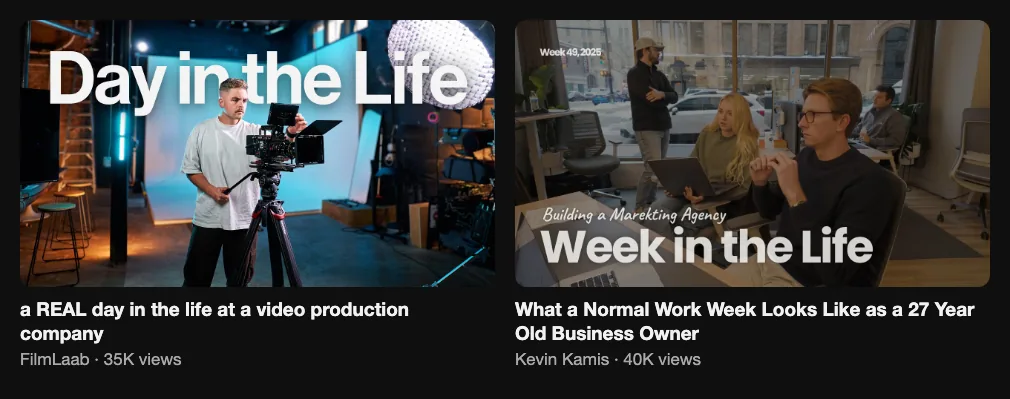
- Title options: “A Real Day Inside Our [Business]” · “What a Normal Work Week Looks Like Running a [Business]”
- Thumbnail: You with the team or at work, in your brand color, a short label like “REAL DAY”.
- Reference: a REAL day in the life at a video production company (FilmLaab, 35K views) and What a Normal Work Week Looks Like as a 27 Year Old Business Owner (Kevin Kamis, 40K views).
- What to change for you: Show the boring parts honestly: calls, reviews, the process a client goes through. Buyers trust what they can see. Film it on the same day as your other videos.
What can you do this week to check demand in your niche?
One evening is enough to see how your channel looks next to competitors and which videos to film first:
- Search the way a buyer would. In an incognito window, type your service and “[your service] for [your buyer]” into YouTube. Look at the top five channels. Could you recognize each one from a single thumbnail?
- Copy the questions. Autocomplete and “People also ask” on Google give you the questions buyers ask. Each is a video, and the best ones become a series.
- Look at your channel on a phone. Open it as a visitor. Does the banner say who you help? Is your face in the small circle? Is there a trailer?
- Find the ceiling. Check the cost of a click for your service in Google Keyword Planner. It shows what one inquiry is worth to a competitor who pays for ads.
- Read your last ten inquiries. Write down which video or page each lead saw first. That's where your branding has to be strongest.
- Run the break-even. Take your average deal and a year of content in our break-even calculator. One client often pays for a long time.
After this evening you have a channel X-ray, a buyer question map and five videos with real references, which is the work we do in the first two weeks with a new client. If you want an outside look first, here is our channel audit.
A 90-day branding plan for a business channel
- Week 1: face as the profile picture, a banner with one positioning line, the description with a call to action first, playlists named like search phrases. Hide old shelves that confuse buyers.
- Month 1: film the trailer and the founder story. Build the thumbnail template with one accent color. Shoot photos for thumbnails on the same filming day.
- Months 2–3: start a signature series and one client story. Keep the same end screen on every video. At the end of the quarter, look at what people who called had watched, and make more of it.
What to skip
- A logo animation at the start of every video. It costs the first seconds, and people leave.
- A new design every month. Recognition needs repetition. Change the template once a year at most.
- Creator-style branding. Neon, shocked faces and “subscribe for more” attract creators, not buyers.
- Branding before videos. A perfect banner on an empty channel doesn't sell. Set the basics in an afternoon and start filming.
A channel becomes a brand when the same person, colors and promise show up in every video for a year. If you want a team to set it up and keep every video in that style while you film one day a month, see our done-for-you YouTube service.
FAQ
What is YouTube channel branding?
YouTube channel branding is everything that makes a channel recognizable at a glance: the name, profile picture, banner, trailer, thumbnail style, title style, end screens and playlists. For a business, the goal is that a buyer who lands on the channel understands in seconds who you help and why to trust you.
What should a YouTube banner for a business say?
Your face, your name or brand, and one positioning line about who you help. Add a call to action like 'Book a call, link below' if it fits. Keep text inside the safe area in the middle of the banner, because phones crop the sides.
What size is a YouTube banner?
Upload 2560 × 1440 pixels. The safe area that shows on every device is about 1546 × 423 pixels in the center, so keep your face, name and positioning line there. Everything outside it is decoration that TVs show and phones cut.
Should a business YouTube channel use a face or a logo as the profile picture?
For a founder-led channel, use your face. People subscribe to people, and the small round picture next to every video is easier to recognize as a face. For a company channel with several speakers, a clear logo works. Evgeny Maximov's agency sees company channels get fewer subscribers than personal brands.
Do I need a channel trailer for a business channel?
Yes, but make it a short sales video, not a 'subscribe for more' clip. People who see your trailer already watched one of your videos. A 5–8 minute video that says what you promise, shows proof and asks for a call does more for a business than a 60-second channel intro.
How do I make my thumbnails look like one brand?
Use one template: the same fonts, one accent color and the same background style. Change only the photo and the words. For clients with a brand book, Evgeny Maximov's agency uses their colors, for example green for Tvoy Sklad, a self-storage franchise.
Is there a YouTube channel branding template I can use?
Yes, a simple one: name, face or logo, a banner with one positioning line, a trailer, one thumbnail template, a title style, an end screen pattern and playlists named like search phrases. Set it once and review it yearly, or when your offer changes.
How important are playlists for channel branding?
Very. Playlists show a visitor what you are about and where to start. Name them like search phrases, not 'Videos 2026'. If you sell to two kinds of buyers, give each a playlist, the way Tvoy Sklad has one for investors and one for property owners.
What should a business remove from its YouTube channel?
Old shelves and playlists about unrelated topics, tags written for beginner creators, dead social links and hashtag walls in descriptions. You don't have to delete old videos. Hide them from the homepage first.
How long does it take to brand a YouTube channel?
The setup takes an afternoon to a few days: banner, picture, description, trailer, playlists and a thumbnail template. The brand itself grows with every video in the same style. Evgeny Maximov's agency usually settles style, branding and cadence with a client in the first two to three months.
Does channel branding help a business get clients?
Branding alone doesn't bring clients. Videos do. But a clean, consistent channel makes buyers trust you faster when they check you out, and a recognizable style makes people click your next video in their feed. It's hygiene that pays off on every video after.
Founder of a done-for-you YouTube agency for high-ticket founders. Making content since 2014. More about me
Want your channel to look like a business buyers trust?
We set up your channel, build the thumbnail template and keep every video in one style. You film one day a month. We do the rest. 7-day money back guarantee.
Get a free niche review →