YouTube Lead Generation for B2B: 7 Places Leads Come From
"Put the link in the description" is step one. But most good B2B leads from YouTube don't come through one link. Here's where they actually come from, and how to catch them.
 By Evgeny Maximov·7 min read·
What is YouTube lead generation?
YouTube lead generation means getting potential clients to raise their hand after watching your videos. They book a call, download a resource, or message you.
It's not YouTube ads with lead forms. That's paid lead gen. This article is about organic: videos that keep bringing leads for years without an ad budget.
The difference from other channels is the temperature of the lead. Someone from a cold email knows nothing about you. Someone from YouTube may have watched you for two hours. On the call they say things like "I trust you, I just want to see if this makes sense for us."
Why do low-view videos often bring the best leads?
Because views and leads are two different games.
A broad video gets views from everybody. A narrow video gets views from the 300 people who have exactly this problem. For a high-ticket offer, those 300 are the market.
Some numbers from other people's channels:
- Olly Richards (StoryLearning): a video with 8,800 views brought 1,342 email leads. His videos with 1M+ views brought very few.
- Matt Gray shared that his "boring" tutorials with screen recording bring on average 7.4 leads per 10,000 views. A video with about 22k views drove almost $14k in sales.
And from our side: our Thai real estate client had videos with 9,000 views and videos with around 200 views. The number of inquiries was about the same.
Where do YouTube leads actually come from?
1. The link in the first line of the description
The obvious one, and for our clients one of the two biggest. First line, not the fifth. It's visible on desktop and mobile without clicking "more". One link to a call, one link to a lead magnet. That's it.
2. The pinned comment
A pinned comment with the same link plus a question. People who scroll comments are often the most engaged viewers.
3. A lead magnet
The other big one for our clients. A doc, a content plan, a checklist. People who aren't ready for a call still take the next step. We give ours with no opt-ins. In the age of AI, information is free. Implementation is paid. More in lead magnet ideas.
4. DMs and comments
"Saw your video about X, can we talk?" These come on LinkedIn, Instagram, Telegram, email.
5. Google searches of your name
Someone hears about you at an event or from a friend. They google your name. They find your channel and watch three videos. Then they book. In your CRM this looks like "referral". In reality YouTube closed the deal.
And Google shows YouTube videos right in the results. One of our clients had a channel with 80 subscribers, and her videos already came up when you searched her name.
6. Videos your team sends
Your videos are sales agents. They wear suits, work 24/7 and don't ask for a salary. Send a video about the lead's exact objection before or after the call. One of our franchise clients' investors wrote "I watched everything" before the meeting. Partners of Tvoy Sklad come to the first Zoom and say: "I've watched your whole YouTube, let's get to business."
Record your calls and presentations too. The founder of Tvoy Sklad gave a presentation on Zoom to 10 people. The recording on YouTube got 202 views over the next few months. Same work, twenty times the audience.
7. AI search answers
ChatGPT, Perplexity and Google AI Overviews cite YouTube videos. A study by OtterlyAI found that about 41% of YouTube videos cited by AI had fewer than 1,000 views. Small channels can be the answer. More in how to get cited by ChatGPT.
Why is one YouTube lead really many touches?
Because nobody buys a high-ticket service from one touch. A lead sees a Short, later a long video, then your LinkedIn post, then hears your name from a friend, then googles you. Every platform adds one more touch. The more touches before the call, the easier the close, because the person is already warmed up.
The research says the same. Gartner found that B2B buyers spend only about 17% of their buying time meeting potential suppliers. The rest they research on their own. And the B2B Institute with the Ehrenberg-Bass Institute put it even more sharply in their 95-5 rule: at any moment only about 5% of B2B buyers are ready to buy. The other 95% will buy months or years later. Content is how they remember you when that moment comes.
The mix of touches depends on the business:
- B2C: usually automated funnels. Chatbots, stories, webinars, live streams.
- B2B: usually lead magnets that collect contact details, a long period of studying your materials, and then a lot of work in direct messages once you have a contact.
Here's how unexpected the path can be. We started a YouTube channel from zero for a dentist. About two months in, one of the first leads came through the contact form on the clinic's website. The patient said they had found the clinic on YouTube and watched a lot of videos. They lived in another city, about 400 km away, and still came. Their treatment cost more than the clinic had spent on video production.
How do you capture leads that never clicked the link?
Ask. It's not fancy, and it works.
- On the booking form: "How did you find us? Which video did you watch?"
- On the call: "What made you book today?" Write the answer down.
- UTM tags on every link, with the video name inside.
- Attribution software, if you sell online. One of our clients, a coach who sells courses, tracks every sale with Hyros. That's how we know about 15 Shorts from one filming session brought a course sale.
At Tvoy Sklad, the person who handles investors and franchise partners asks every new partner about their path: where they first saw the company, what they watched, what made them apply. It's the cheapest attribution system in the world.
Then once a month look at the list. You'll see patterns. Some video you thought was weak turns out to be your best salesperson. I wrote the full system in How to Track Leads From YouTube.
What makes a video generate leads, not just views?
Six things we check:
- One buyer. The video speaks to one ideal client. Not "everyone who wants to grow". This is the mistake I see most often: very different videos for very different audiences, so nobody feels the channel is for them.
- A real problem from sales calls. Every objection you hear on calls is a video.
- Proof inside. A client story, a number, a screen. Not just opinions.
- One clear next step. Call or lead magnet. Not ten links.
- A title that filters. "For founders", "high-ticket", "clients". Not "views", not "viral".
- Consistency. The least obvious one. Many people make two videos and stop. Even a little is better than nothing: two long videos a month keep the library growing. If you don't have time for that, our YouTube channel management takes it off your plate.
How do you qualify YouTube leads?
YouTube brings warm leads, but not all of them are buyers. Some want to "become a YouTuber". Some have a $200 budget.
What helps:
- Say who you don't work with, in videos and on the booking page.
- A few questions on the booking form. But know the trade-off: every extra question or step means fewer leads, and better ones. Fewer questions, more leads, more random calls. Find your balance.
- Give free help anyway. If someone isn't a fit, I still give advice on the call. People remember that, and they send friends.
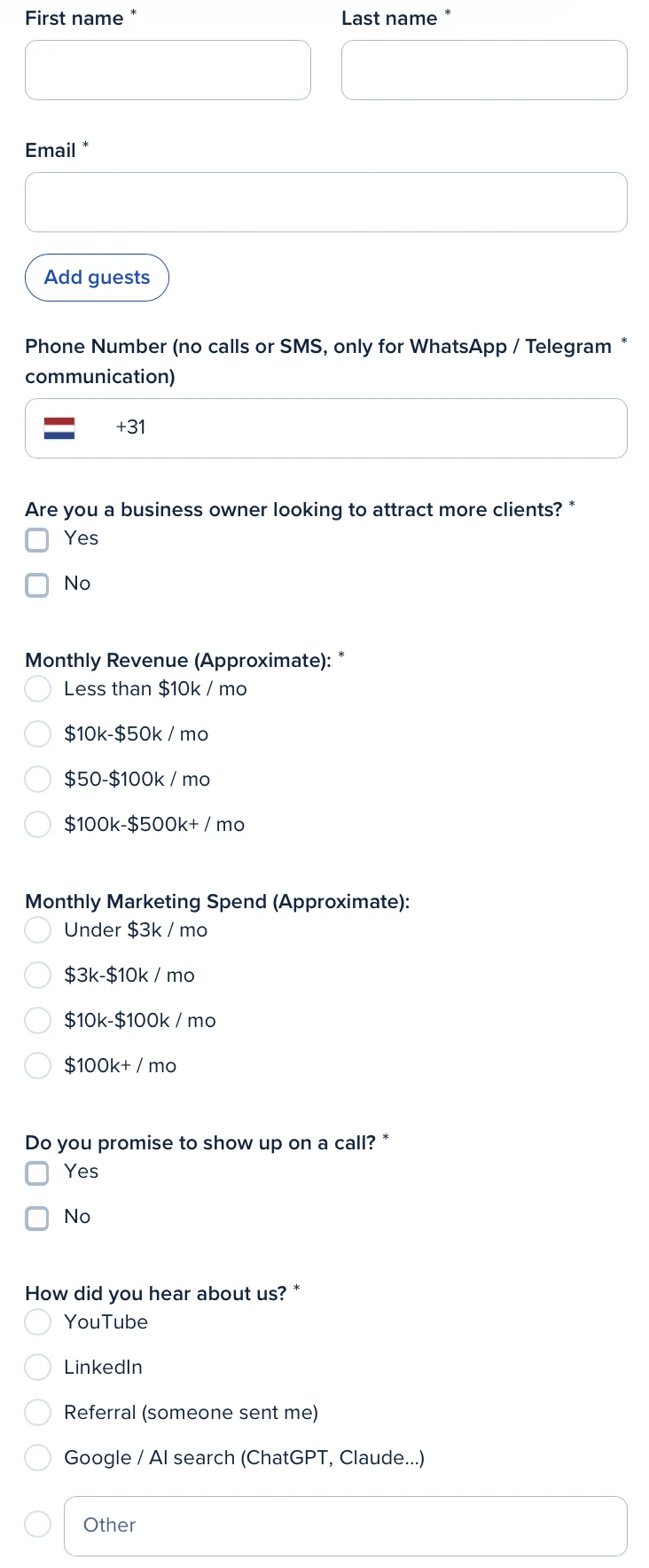
My own form is simple: name, email, a phone number for WhatsApp or Telegram, "Are you a business owner looking to attract more clients?", monthly revenue, monthly marketing spend, "Do you promise to show up on a call?" and "How did you hear about us?". When the volume grows, it will change.
How long until YouTube generates leads?
Not in week two. Think of YouTube like other things that take time and then pay for years: an investment portfolio, an apartment building, SEO articles on your website. Nobody expects rent from a building in month two of construction. With our clients, search starts working around months four to six. Some leads come earlier, from people who already know you and finally have a place to binge your content.
And leads compound. A video from a year ago keeps working. One Tvoy Sklad franchisee said he had watched the channel for two years. Then they published an online tour of the franchise, and he applied. Years ago I made editing videos on a small English channel. A client came from them a year later. Small numbers, but they brought a client.
FAQ
How do you generate leads from YouTube?
Make videos for one specific buyer about problems you hear on sales calls, add one clear next step to every video (a call or a lead magnet), put the link in the first line of the description and in a pinned comment, and track which video each lead watched.
Is YouTube good for B2B lead generation?
Yes, especially for high-ticket services. YouTube leads arrive warm because they've already spent time with you. Evgeny Maximov's franchise client Tvoy Sklad attracted about $5M in investments and 20+ franchisees with a channel of around 2,000 subscribers.
How many views do you need to get leads from YouTube?
Fewer than most people think. Olly Richards reported a video with 8,800 views that generated 1,342 email leads, while his million-view videos brought few. For B2B, a few hundred views from the right people can be enough for a deal.
What is the best lead magnet for YouTube?
Something the viewer can use right away and that connects to your service: a template, a content plan, a checklist or a full playbook. Evgeny Maximov gives his Business YouTube Playbook with no opt-ins, because trust matters more than an email address.
Where should I put my link on YouTube to get leads?
In the first line of the video description, in a pinned comment, and in your channel description. Mention it verbally in the video. In Shorts, use the "Related video" field: point it to a short sales video or another Short on the same topic.
Why am I getting views but no leads from YouTube?
Usually one of three reasons: the videos attract a broad audience instead of buyers, there's no clear call to action, or there's nothing to binge before the decision. Fix the topic first, then the CTA, then the library.
How do I track leads from YouTube?
Ask "which video did you watch?" on the booking form and again on the call. Many YouTube leads never click a link, so asking is essential. Add UTM tags with the video name once you run ads or several platforms.
How long does it take to get leads from YouTube?
Some leads can come in the first months from people who already know you. Consistent search-driven leads usually start around months four to six of regular publishing, and the effect compounds over the first year.
Are YouTube ads better than organic for lead generation?
Ads give speed, organic gives compounding. Ads stop working the day you stop paying. Organic videos keep bringing leads for years. Many B2B founders keep ads and add YouTube content as a second channel.
Do Shorts generate leads for B2B?
Sometimes, but mostly they bring attention, not decisions. For one of Evgeny Maximov's clients, a coach who sells online courses, about 15 Shorts from one filming session brought one course sale, tracked with Hyros. The trick is the "Related video" field: point it to a short sales video or another Short, not a 50-minute video, because people who jump from a Short to a long video usually leave in about 20 seconds. Long-form is still where B2B trust is built.
Founder of a done-for-you YouTube agency for high-ticket founders. Making content since 2014. More about me
Want YouTube to bring you leads every month?
You film one day a month. We plan, script, edit, design, publish and track which videos bring calls. 7-day money back guarantee.
Book a call →