Marketing Channels for a Service Business: Which to Pick First
There are a dozen channels and you have time for two. Here is a table that compares ten of them for a high-ticket service, a way to choose by sales cycle and trust, and what happened when I tested some of them myself.
 By Evgeny Maximov·9 min read·
What are marketing channels for a service business?
A channel is a place where a future client meets you before they write. It can be a person (a referral), a platform (LinkedIn, YouTube), a search result, an inbox or a room full of people at an event.
Product companies often talk about "distribution channels", meaning stores and resellers. For a service business it is simpler. The question is where your buyer goes to check an expert, and whether you are there.
Most channels fall into five groups:
- Warm: referrals, partners, past clients.
- Outbound: you start the conversation by email, LinkedIn message or call.
- Organic content: videos, posts, articles and podcasts that people find. We cover this group in organic marketing for service businesses.
- Paid: search ads, social ads, sponsored posts.
- Events and speaking: conferences, meetups, webinars.
Which marketing channels compare best for high-ticket services?
This table is my own summary for a service with a deal worth thousands of dollars and a sales cycle of weeks or months. "Speed" means time to the first booked calls. Cost levels are relative, not quotes.
| Channel | Speed | Cost | You on camera or in person? | Keeps working when you stop? | Fits best when |
|---|---|---|---|---|---|
| Referrals and partners | weeks | low | in person | partly | you already have happy clients |
| Targeted outbound (email, LinkedIn) | weeks | low in money, high in effort | no | no | a narrow list of buyers you can name |
| LinkedIn posts | 2–6 months | low | no, but a face helps | a little | your buyers are senior B2B people |
| YouTube long videos | 6–12 months | medium (production) | yes | yes, for years | high-ticket, buyers need to trust you first |
| Podcast guesting | 1–3 months | low | yes | yes | you speak well and can pitch hosts |
| Blog and search (SEO) | 6–12 months | medium | no | yes | people search for your problem by name |
| Email to your own list | days | low | no | no | you already have a list |
| Events and speaking | weeks | medium to high (time, travel) | in person | no | buyers gather in one room |
| Google search ads | days | high, per click | no | no | people already search for the service |
| LinkedIn and social ads | days | high, per click | no | no | you can target a precise job title |
For paid search, WordStream's 2026 benchmarks put the average Google Ads click at about $5.87 in business services and about $9.87 in legal services. The average lead costs about $94 and $132. Those are leads, not clients. The average across all industries is about $5.42 per click.
Source: LocaliQ (WordStream), Search advertising benchmarks, updated June 2026. Averages across many advertisers and industries. Your own cost per lead can be much higher or lower.
How do you choose a marketing channel?
Use two filters before you look at any tactic.
Filter 1: how long is your sales cycle?
If clients decide in a week, a fast channel can carry you. If they decide in three months and talk to four firms, they look you up many times. Then a channel that shows your work over time matters more than one that brings a click.
Filter 2: does the buyer have to trust you personally?
A consultant, a lawyer, a doctor, a coach: the person is the product. Edelman and LinkedIn's 2024 study surveyed 3,484 business leaders. About 73% said an organization's thought leadership is a more trustworthy way to judge it than its marketing materials. When trust is the sale, choose channels where you can show how you think.
There is one more reason to add a slow channel next to a fast one. Researchers at the LinkedIn B2B Institute say only about 5% of B2B buyers are in the market at any moment. Fast channels talk to that 5%. A slow channel reaches the other 95% before they need you. We explain the idea in demand generation vs lead generation.
Which channel should you start with?
- You need clients in the next 30 days: referrals and a small, targeted outbound list. Ask five past clients who else they know. Then build a trust channel next to it.
- High-ticket service, long cycle, you can be on camera: YouTube plus one fast channel. Start with a YouTube sales funnel that ends in a call.
- You write well and hate cameras: a blog and LinkedIn. It is slower to build trust this way, and nobody sees you think, but it is better than a channel you quit in month two.
- You have a proven offer, known close rate and a budget: paid search can add leads fast. Keep a content channel running next to it, because ad leads stop when the budget stops.
- You like rooms and people: events, speaking and podcasts. Plan to turn each talk into video, so one appearance works many times.
The channel you can keep up for a year beats the channel that is perfect on paper.
What did the channels bring us?
I'll be honest about what I tried, because most of these lists come from people who sell one channel.
- Cold DM outreach. In August 2026 I did it myself: 8 calls, and I burned out in two weeks. It can work, but it is hard on me, so I do it in small doses, with value first.
- Events. I filmed about 50 speakers for free at events in late summer and autumn 2025. One became a client, about 2%. At the other end, five minutes of networking brought two clients. My own events for 20–30 people brought sales too, but ate a lot of time.
- YouTube. My 47-minute documentary has about 6,000 views and brought clients. A trend video with about 260,000 views brought none. Views show demand, not how many clients a video brought. More in why views don't bring clients.
- A franchise built on video. Tvoy Sklad, a self-storage franchise, has 700+ videos since 2022. Most have 2,000–20,000 views. The company raised about $5M in 2024–2025, signed 20+ franchisees, and partners often say on the first call that they have already watched everything. The founder himself shows the financial models in videos and live streams. Its team also cuts 30–50 ad versions from one video, so organic content feeds the paid channel.
- A prosthodontist. A prosthodontist we worked with got about 100,000 views on his channel in a year. One patient who came from YouTube paid for half a year of production. One, and it paid for everything.
We are also moving from the Russian-speaking market, where the agency grew, into the English-speaking one. We now have a UK company (EVGENY MAXIMOV LTD, London), an English YouTube channel and international prices. We combine cold outreach with SEO, GEO, and content on YouTube and social media. SEO helps people find our articles in search. With GEO, we work to get those articles and videos cited in AI answers. Every YouTube description links to our booking page, and the booking form asks how people heard about us.
What we don't do: we don't run paid ads for clients and we don't manage ad accounts. We explain paid channels because they are part of your market, not because we sell them.
How do you test a marketing channel?
- Pick one channel for 90 days. Not three.
- Fix the volume. For example: 4 videos a month, or 50 targeted messages a week. Write the number down.
- Track two numbers: booked calls and clients. Add a "how did you hear about us?" question to your booking form, and ask on the call.
- Decide at day 90. Fast channels should show calls by then. Slow channels should show growing views and the first mentions of your content on calls. If neither, change the angle before you drop the channel.
For the numbers and the 90-day layout, see the marketing plan template and marketing attribution for service businesses. For tactics inside each lead channel, see how to generate B2B leads.
Which real videos help you compare channels?
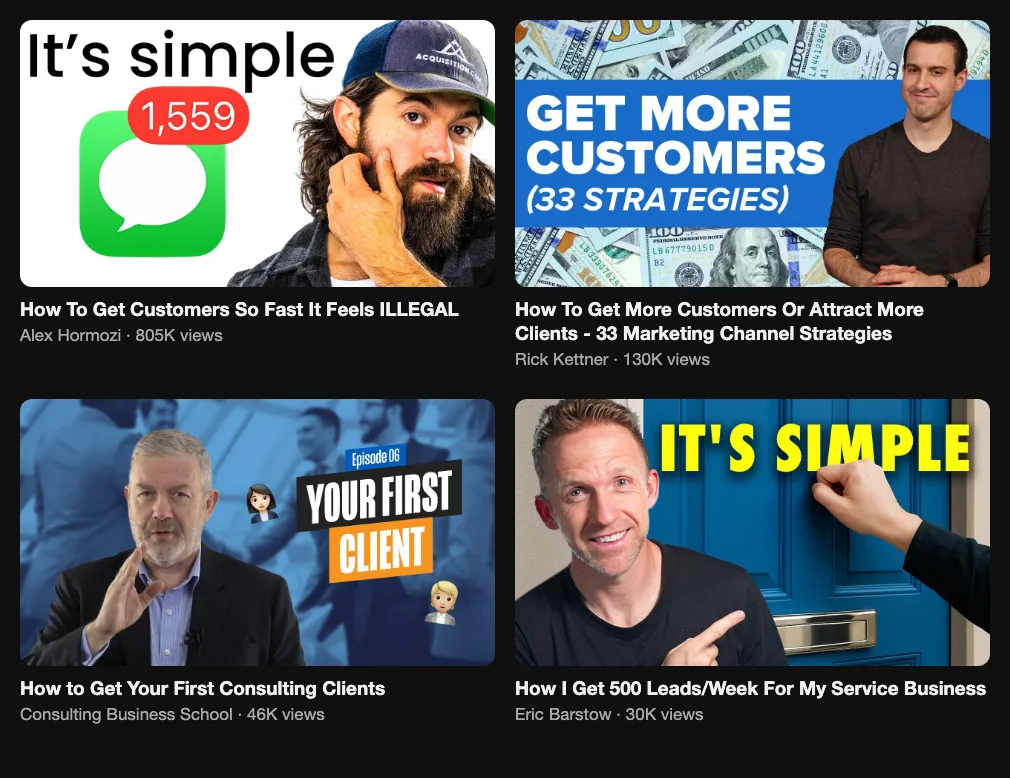
These videos are about getting clients. One is a general lead strategy from a business investor, one lists 33 channels, one is for new consultants, and one comes from a painting company, a local service, so its channels differ from a consultant's. Views show demand, not how many clients a video brought. Data is from YouTube on 27 October 2026.
- How To Get Customers So Fast It Feels ILLEGAL (Alex Hormozi, 805K views). Free offers as a lead channel, and why the owner should stay close to marketing. Check the first minutes against your own offer.
- How To Get More Customers Or Attract More Clients - 33 Marketing Channel Strategies (Rick Kettner, 130K views). A long list of channels, and a four-step way to choose.
- How to Get Your First Consulting Clients (Consulting Business School, 46K views). Warm channels for a new consultant.
- How I Get 500 Leads/Week For My Service Business (Eric Barstow, 30K views). A painting company owner and his lead system. A different market, but a clear example of combining channels.
If your pick is YouTube and you want it run for you, that's what our done-for-you YouTube service does, from $3,000 a month. We don't promise views, calls or leads. Only a 7-day money back guarantee.
FAQ
What are marketing channels for a service business?
Marketing channels are the places where your future clients meet you: referrals, search, social platforms, YouTube, podcasts, email, events, outbound messages and paid ads. For a service business the useful question is which one or two of them your buyer already uses to check an expert before a call.
What is the best marketing channel for a service business?
There is no single best one. For high-ticket services, the usual strong pair is one fast channel for the next quarter (referrals or targeted outbound) and one slow channel that builds trust and keeps working (YouTube, search or podcasts). The best one is the one you can keep up for a year.
How many marketing channels should a small service business use?
Two at first. One person cannot do real work in seven channels. Run two for about 90 days, measure booked calls and how leads heard about you, then add or drop one.
Which marketing channels are free?
None is fully free. Referrals, LinkedIn posts, a blog and YouTube have no ad bill, but they cost your time and, for video, production. They are cheaper per lead over time because old content keeps working. Paid channels stop when the budget stops.
What marketing channels work for B2B services?
Referrals and partnerships, targeted outbound, LinkedIn, YouTube, podcasts, search, events and email to your own list. B2B buyers check several sources before they write, so a trust channel next to a lead channel works better than either alone.
Is YouTube a good marketing channel for a service business?
It is a good fit when the service is high-ticket and buyers need to trust a person before they book a call. A long video shows how you think. It is a poor fit if you do not want to be on camera or need clients within 30 days.
Are paid ads a good first marketing channel?
They can be, if you have a proven offer, know your close rate and need leads fast. According to WordStream's 2026 benchmarks, the average Google Ads lead in business services costs about $94, and a lead is not a client. Evgeny Maximov's agency does not run paid ads. It builds YouTube channels, which work as an asset.
How do I know which marketing channel works?
Ask every lead how they heard about you, on the booking form and on the first call. Compare booked calls and closed clients by channel over at least 90 days. Software reports miss podcasts, word of mouth and videos people watched weeks ago.
How long does a marketing channel take to work?
Referrals and outbound can bring calls within weeks. Search, blog and YouTube usually need 6 to 12 months before the results are steady. Paid ads work in days, but only while you pay.
What marketing channels does Evgeny Maximov's agency use?
The agency combines cold outreach, SEO, GEO, and content on YouTube and social media. Calls are booked through Calendly, and the form asks how people heard about the agency. The agency does not sell paid ads, and its only guarantee is 7 days of money back.
Should I use the same marketing channels as my competitors?
Look at where they are active, then pick the channel where you can be better, not louder. Many service firms only post on LinkedIn. A channel where few experts show real work on camera is easier to stand out in.
Founder of a done-for-you YouTube agency for high-ticket founders. Making content since 2014. More about me
Want one channel that keeps working?
You film one day a month. We plan, edit and publish the videos. 7-day money back guarantee.
Get a free niche review →