YouTube Ads vs Organic: What B2B Founders Should Choose
Ads are a tap: you pay, it flows, you stop paying, it stops. Content is a library: slow to build, then it keeps working. Most founders ask "which one?". The better question is "in what order, and how much of each?"
 By Evgeny Maximov·5 min read·
What's the difference between paid and organic marketing?
Paid: you pay a platform to show your message. Google Ads, Meta ads, YouTube ads, LinkedIn ads. Results start fast and stop when the budget stops.
Organic: you publish content that people find through search, recommendations and sharing. YouTube videos, LinkedIn posts, podcasts. Results start slowly and keep coming after you publish.
Alex Hormozi calls them two of the "core four" ways to get customers, next to warm and cold outreach. Each one works. They just behave differently over time.
How do ads and organic content grow differently?
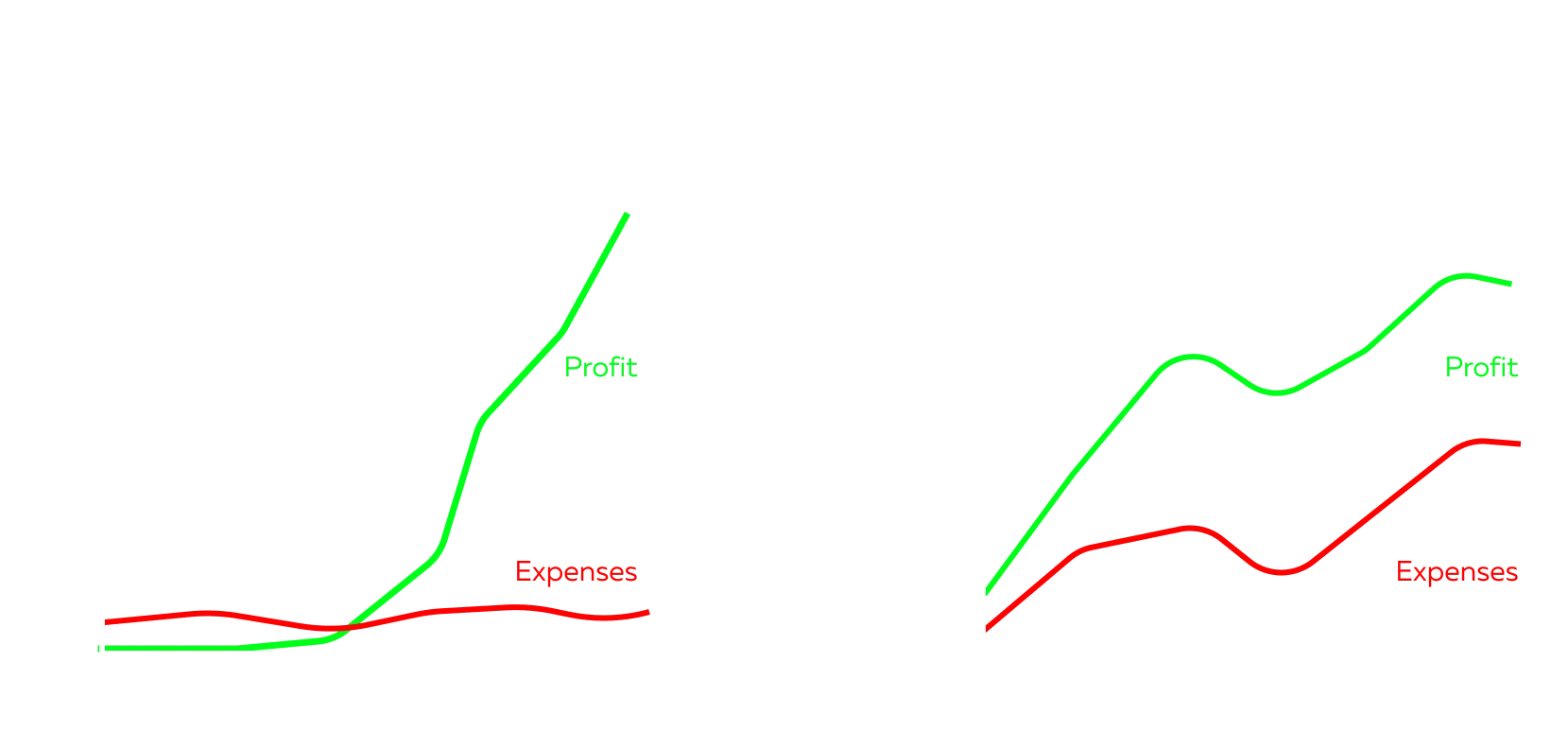
Ads grow linearly. $10,000 brings X leads. $20,000 brings roughly 2X, until it doesn't. Costs per lead tend to rise as you scale and as competition grows.
Content compounds. Video 1 brings almost nothing. Video 40 brings leads, and so do videos 1 to 39, still. It's like building your own Netflix catalog. Every new video adds to the library.
Here's what that looks like for a real business. Tvoy Sklad is a self-storage franchise we've worked with since 2022. Over the life of their channel, YouTube has shown their long videos 1.6 million times. They didn't pay for a single one of those impressions.
How much would that cost in ads? Most YouTube advertisers pay about $5–10 per thousand impressions, according to Store Growers' 2026 benchmarks. So 1.6 million impressions is roughly $8,000–16,000 of advertising. And that's only the long videos. Their Shorts got another 1.1 million views on top.
That's the whole difference. Ads rent attention. Content owns it.
Is YouTube advertising worth it for B2B?
It can be, for specific jobs:
- Retargeting: showing your best video to people who visited your site or watched part of your channel.
- Launches and deadlines: a webinar, a cohort start. Ads bring the crowd on time.
- Testing messages fast: which promise gets clicks this week.
What ads can't easily do for a high-ticket service: build deep trust from zero in 30 seconds. Nobody signs a $20,000 contract from one pre-roll ad. They watch, they google, they binge. That's organic's job.
Should you pay to promote your YouTube channel's videos?
No. We don't do it for clients, and I'm against it. Three reasons:
- It brings the wrong viewers. Paid promotion shows your video to people who didn't choose it. YouTube then learns from the wrong audience and recommends your next videos to the wrong people too.
- Nobody watches a 10-minute ad. If your long video runs as a skippable ad, people skip it. You pay for impressions, not for trust.
- Paid and organic are different algorithms. Spending a few thousand dollars on ads for your channel doesn't speed up its organic growth. I haven't seen a single case where paid channel promotion paid off.
Use ads for your offer. Let the channel grow organically. Not sure what your channel needs first? A YouTube channel audit shows it.
When should a founder choose ads first?
- You need clients this month.
- You have a proven offer and know your numbers (cost per lead, close rate).
- You run launches with deadlines. For launch models, Instagram and ads often fit better than YouTube.
- Your average deal is small, so you need volume.
When should a founder choose organic YouTube?
- Your offer is high-ticket, and buyers need trust before a call.
- You can wait 6–12 months for compounding.
- You have real expertise and opinions to share.
- You want to stop depending on ads or referrals forever.
How should you split the budget between ads and content?
The simplest version of the rule: no money, go to content. Money and no time, go to ads. Both, and you become unstoppable.
My rule from the masterclass: if a channel works, don't touch it. Start YouTube in parallel.
Example: you spend $50,000 a month on ads. Put about $5,000 into YouTube content. That's 10% of the ad budget. After a year, two things usually happen: your cost per lead in ads goes up (it always does), and your content library gets stronger. Then you shift more.
For smaller budgets the same logic works. Count how many clients pay for a year of content. With a $10,000 offer and production at about $5,000 a month, six full-price clients pay for the year.
How does organic content make ads cheaper?
This is the part people miss. Organic and paid help each other:
- More and better ad creative. Your best organic videos already proved they hold attention. Reels and clips from long videos become ads.
- Warmer retargeting. Retarget people who watched 50% of your long video. They already know you.
- Higher trust after the click. Someone clicks an ad, googles you, finds 40 videos. Close rate goes up.
- Brand search. People start searching your name. Those clicks are the cheapest you'll ever get.
A personal brand makes every ad dollar work harder. That's why the founders who win usually do both.
How Tvoy Sklad turns content into ads
Tvoy Sklad runs a lot of its reels as paid ads, and we also filmed dedicated ads for the franchise. The trick is how we cut them. From one video we make three formats: horizontal, square and vertical. And we edit with a "Lego grid": several hooks, several main parts, several calls to action, all combinable. One shoot gives 30–50 ad versions, so they can test which creative actually works instead of guessing.
What's the risk of running only ads?
Three risks:
- The day you stop, you're screwed. No budget, no leads.
- Costs rise. Platforms get more expensive every year.
- Cold traffic, cold calls. Leads from ads know nothing about you. Your close rate is lower and your sales cycle longer.
And the risk of only organic: it's slow, and if you need clients next month, content won't save you. That's why we don't sell YouTube as a replacement for everything. It's a second engine.
FAQ
What is the difference between paid and organic marketing?
Paid marketing means paying platforms to show your message, with fast results that stop when spending stops. Organic marketing means content people find through search and recommendations, with slower results that keep coming long after publishing.
Is organic or paid marketing better for B2B?
They do different jobs. Paid is better for speed and predictable volume. Organic is better for trust and long-term cost. For high-ticket B2B, most founders benefit from both: ads for near-term pipeline, YouTube content for compounding trust.
Are YouTube ads worth it for B2B or coaches?
They can be for retargeting, launches and testing messages. They rarely build enough trust alone to sell a high-ticket service. Coaches often use ads to drive people to a webinar or long video, where trust is built.
How much of my marketing budget should go to content?
A practical starting point: keep working ads and put around 10% of the ad budget into content. For example, $5,000 a month next to a $50,000 ad budget. Shift more as the content library starts bringing leads.
How long does organic YouTube take compared to ads?
Ads can bring leads in days. Organic YouTube usually needs months: search traffic tends to start around months four to six, and the compounding effect becomes clear by the end of the first year.
Can organic content lower my ad costs?
Yes. Proven organic videos make strong ad creative, people who watched your videos are warm retargeting audiences, and a visible content library raises trust and close rates after the click.
Should I stop ads when I start YouTube?
No. If ads work, keep them. Start YouTube in parallel and let the library grow. Over time you can shift budget based on which channel brings better clients at a lower cost.
What are the risks of relying only on paid ads?
Leads stop the day spending stops, costs tend to rise every year, and cold leads from ads usually close at lower rates than warm leads who already know you.
Is YouTube organic good for coaches?
Yes, especially for coaches with high-ticket programs. Long videos let people experience your teaching before they buy, which makes calls easier. Launch-based models with hard deadlines may still need ads or Instagram alongside.
What is the "core four" in marketing?
It's Alex Hormozi's framework of four ways to get customers: warm outreach, cold outreach, content and paid ads. Each works; they differ in speed, cost and how they compound.
Founder of a done-for-you YouTube agency for high-ticket founders. Making content since 2014. More about me
Ready to build the engine that doesn't stop when the budget does?
We build business YouTube channels next to your ads and outreach. You film one day a month. 7-day money back guarantee.
Book a call →