I'm a Keynote Speaker With No YouTube. Where Do I Start?
You have talks, interviews and stage footage sitting on hard drives. That is most of a channel already. Here is how a speaker turns it into videos that get you booked, and what to do first.
 By Evgeny Maximov·8 min read·
Is this you?
- You speak at conferences or company events, and organizers book you from your site or a recommendation.
- You have a speaker page and maybe a reel, but no YouTube channel, or one with three old uploads.
- Recordings of your talks sit on a drive, a phone or an organizer's server.
- You are asked "do you have more video?" and the honest answer is no.
Why does a speaker need more than a reel?
Booking a speaker is a risky decision. The organizer puts their name and their audience in your hands. So they do what every careful buyer does: they research. They watch before they reply. I wrote about this in how to film and edit a speaker reel. The reel is the first look.
But one reel is not enough. An organizer who likes the reel will look for more: a full talk, a different room, an interview. If they find nothing, you look like a person with one good minute. A channel with a full talk, clips and a few answers to real questions shows how you think for twenty minutes. That is closer to what they are buying.
Speaking also has a second effect that many speakers miss. On stage, people see you as the expert. Behind the camera or in the queue, they see a service. I filmed about 50 other speakers at events for free and got one client, about 2%. Then I spoke for five minutes at a networking event and got two. The math is in what speaking at events really brings. A channel lets the stage work for you after the event.
There is one more effect. A developed personal brand helps you book more events. Organizers want speakers who bring an audience, so your channel and social media work as extra promotion for their event. When you announce the talk to your followers and publish clips after it, you give the organizer value beyond the stage. Between two equal speakers, they invite the one who brings people.
Who is your channel for?
This is the first decision, and it changes what you post.
- For organizers. Speaking fees are your income. Post full talks, a reel, clips from different rooms, short thank-you words from organizers, and your topics. Keep it simple.
- For clients. Speaking brings you consulting, training or a product. Post videos that answer the questions your buyers have, and use talks as proof that you stand in front of a room.
If you try both from day one, the channel becomes a pile. Start with one and add the second later.
A small note on search. When I type "keynote speaker youtube" into Google, the suggestions are mostly "motivational speaker youtube channel" and similar. That is viewers looking for inspiring videos, not organizers. Do not expect an organizer to find you by that phrase. They find you from your name, a recommendation or a topic, and then they look for proof.
What footage do you already have?
Make a list. Most speakers find more than they think.
- Full talks. Ask every organizer for the recording. Check who owns it and get permission in writing.
- Interviews and podcasts. Places where you were a guest. See podcast guesting. Link to them, or ask the host if you can cut clips.
- Webinars and recorded sessions. Q&A is gold, because the questions come from real buyers.
- Phone clips from the audience. Shaky, but real. Good for reactions in a reel.
One of our clients, the founder of a self-storage franchise, gave a 20-minute talk at an investment forum. We cut it into 21 Shorts and a new pitch video. I want to be clear: that is a very strong speaker. For most people, 5 to 15 good Shorts from an hour is the normal range. More in Shorts for business.
I also speak myself. About 20 talks in 2026 so far, mostly in rooms of 20 to 60 people. It is not keynote scale, and I would not claim it is. But I have been on both sides of the stage, and every talk I film becomes content.
What should you do first?
- Choose your audience. Organizers or clients, as above.
- Collect the footage. One folder. Note the date, the event, who owns it.
- Fix the sound. Ask for the sound feed. If you record yourself, put a mic on the speaker, not the room.
- Post your best talk in full. Give it a title a person could type, not the talk's name from the program.
- Cut three clips. Each one has a complete idea, not a half sentence. Captions on, because many people watch without sound.
- Film one new video. Pick a question buyers ask you after every talk, and answer it to a camera for ten minutes.
Are you ready, or should you wait?
| Ready | Not ready yet |
|---|---|
| You have at least one full talk with clean audio | Your only footage is a shaky phone clip with no sound |
| You know who watches: organizers or clients | You want "everyone" |
| You speak several times a year | One talk a year, no plan for more |
| You can invest for a year, with little at first | You need bookings next month |
| You will give two hours a month to filming | You travel so much that you never sit down |
Not ready? Start with a good recording system for your next three talks, and come back. The same checks I use with every expert are in the 5-question business test.
What is our closest example?
We have not worked with a professional keynote speaker yet, and I would rather say it than stretch another case. The closest example is the founder of Tvoy Sklad. He gives talks at forums and investor events, and we use them as raw material: the 20-minute talk became 21 Shorts and a new pitch. The channel has more than 700 videos since 2022 and about 2,000 subscribers. It helped attract about $5 million in investment in 2024 and 2025, and the company's marketing team says new partners often tell them they have "already watched everything". Read the full case.
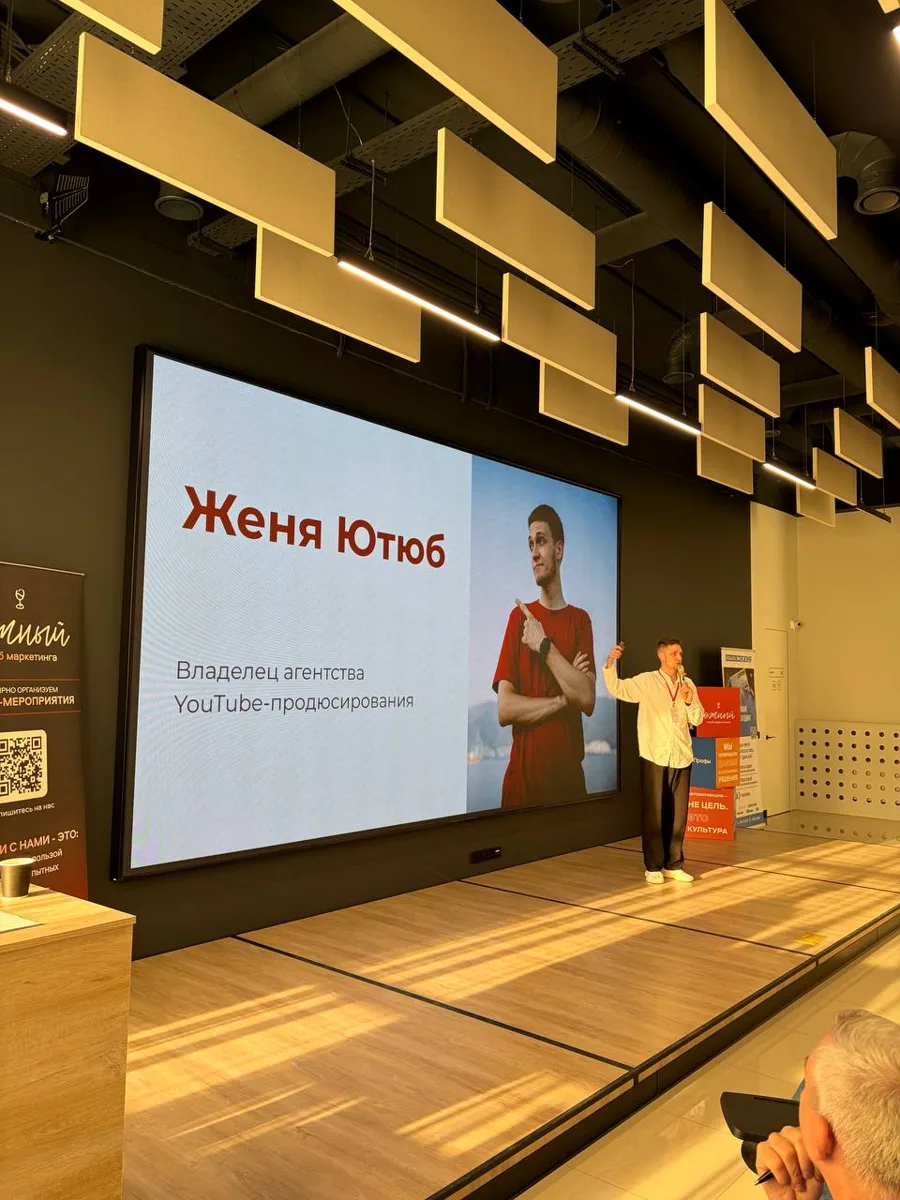
Here is one of the founder's talks, in Russian: a talk on earning from real estate with self-storage. One talk like this feeds the channel for weeks.
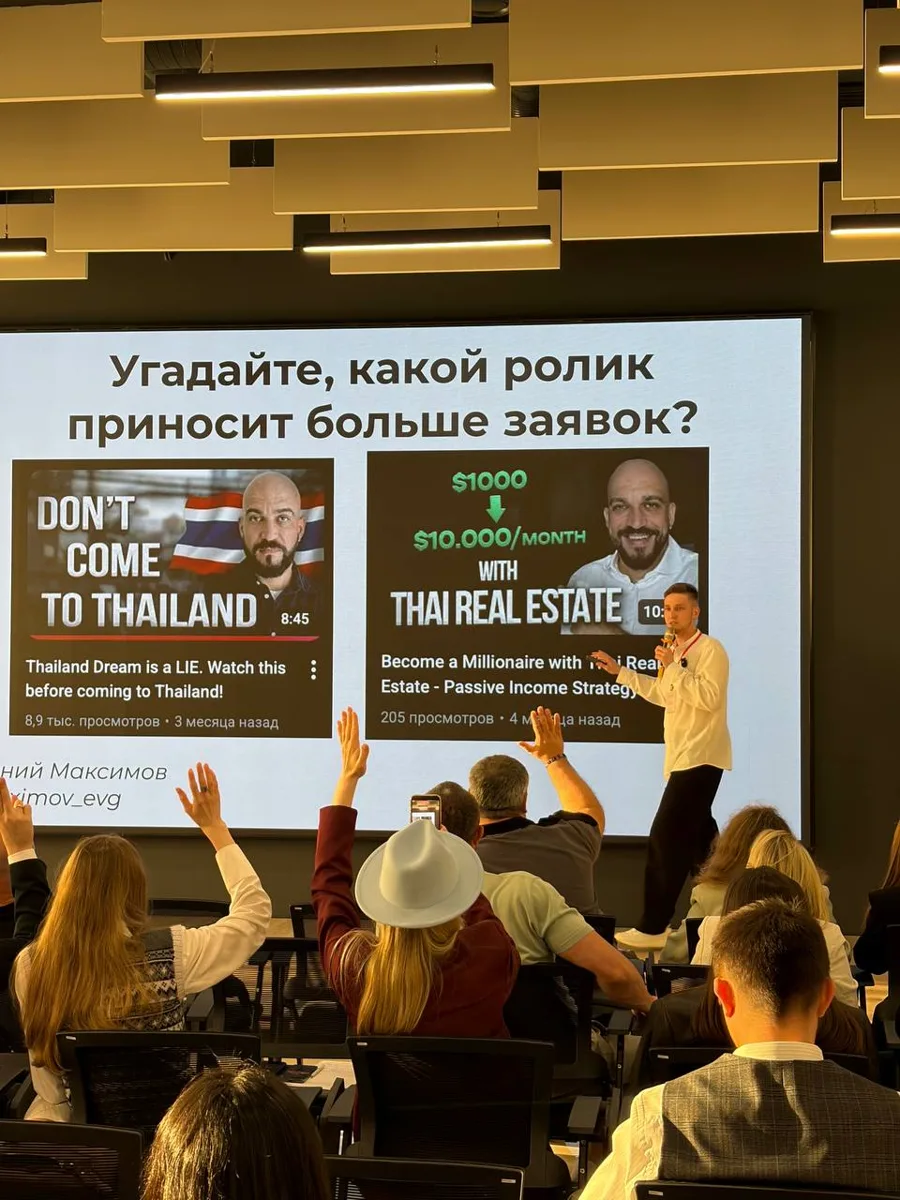
I also speak at events myself, so I see this from the stage too. Here is one of my talks, also in Russian: how to get clients from social media in 2026. In it I ask the room to guess which video brings more leads: a viral one or a dry one with numbers. Most people pick the viral one. The dry one wins.
Which speakers use YouTube well?
Views show demand, not how many bookings a video brought. Here are three real videos from speakers and speaking coaches. Data is from YouTube on 24 October 2026.
- 10 Speaking Techniques That Made Me A Top 1% Speaker (Vinh Giang, 341K views). A speaker teaching one skill, ten points, plain format.
- How to Book Speaking Engagements (Brian Tracy, 40K views). A well-known speaker answering the question other speakers ask. A video from 2016 that is still found.
- 5 FAST ways to get PAID Speaking Gigs (Dr. Delatorro McNeal, 39K views). A professional speaker with CSP and CPAE credentials in his channel name, speaking to other speakers.
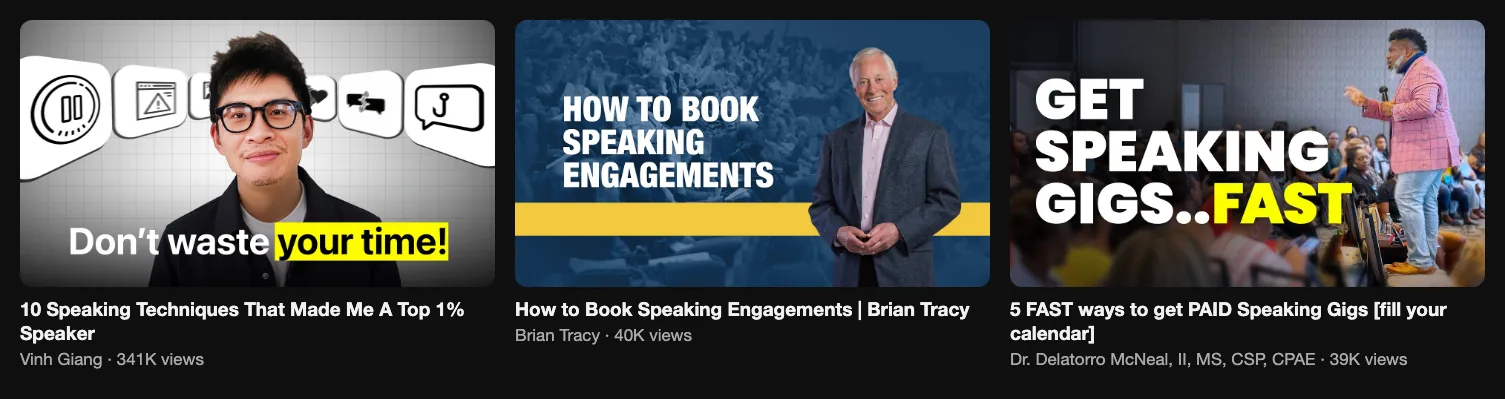
Notice that all three answer a question. They do not play a highlight reel. A talk can sit on your channel as proof, but the videos that get found are the ones with a clear question in the title.
What does a 90-day plan look like?
Put the channel link next to your booking form and ask each organizer what they saw before they wrote to you. That is your tracking.
If you would like a team to do the cutting, titles, thumbnails and publishing, that is our job. You keep speaking and film about two hours a month. See our done-for-you YouTube service, from $3,000 a month.
FAQ
Does a keynote speaker need a YouTube channel?
It helps. Organizers check a speaker before they book, and a channel with full talks and short clips shows how you work in front of a room. It also gives your future audience a place to find you.
What is the difference between a speaker reel and a YouTube channel?
A speaker reel is one 2 to 4 minute video for event organizers. A channel is a library: full talks, clips, interviews and answers to questions. The reel is the first look. The channel is the proof.
Can I post my conference talks on YouTube?
Often yes, but check who owns the recording and whether your contract allows it. Ask the organizer for the file and for written permission. Many organizers are glad to share footage.
How many Shorts can I get from one talk?
It varies. Evgeny Maximov's agency usually gets 5 to 15 good Shorts from an hour of recording. One 20-minute talk from a client founder gave 21 Shorts, which is an example of a very strong speaker, not an average.
Should I film new videos or only reuse stage footage?
Do both. Stage footage gives you a start with little extra work. New videos let you answer the exact questions your buyers search for, which a talk usually does not.
What should a speaker post first?
Your best full talk, a 2 to 4 minute reel, and two or three clips that each contain one complete idea. Then add videos that answer buyer questions.
Is the audio quality of stage footage good enough?
Often not. Bad sound hurts a speaker video faster than a cheap camera. Ask the organizer for the sound feed, and record a backup with a mic on you. See the speaker reel guide for a simple setup.
Will YouTube get me more speaking gigs?
No one can promise that. What it can do is make you easier to check: organizers find your talks before they reply, and your audience can watch more of you after an event.
Who is the channel for: organizers or clients?
Pick one first. If speaking fees are your income, the channel is for organizers. If speaking brings consulting or training clients, make videos for those buyers and use the talks as proof.
How much time does a speaker's channel take?
Clients of Evgeny Maximov's agency film about two hours a month. For a speaker, much of the material already exists, so the first months are mostly sorting and editing.
How much does it cost?
A done-for-you channel from Evgeny Maximov's agency starts from $3,000 a month, with a 7-day money back guarantee. One-off work, such as a strategy session, starts from $500.
Founder of a done-for-you YouTube agency for high-ticket founders. Making content since 2014. More about me
Have talks but no channel yet?
Book a call. Send me a link to your best talk and I'll tell you what I'd cut from it and what I'd film new. 7-day money back guarantee.
Get a free niche review →