Podcast Guesting for Founders: How to Get Booked on Podcasts (and Make It Pay Off)
Going on other people's podcasts is one of the fastest ways for a founder to grow their media presence and show up in search. Here's how to get booked, how we prepare guests, why in-person beats Zoom, what the thumbnail should look like and how to make every episode work long after release.
 By Evgeny Maximov·9 min read·
Why should founders go on podcasts?
Two big reasons, and a few smaller ones.
1. Media presence. On your own channel, you start from zero. On someone else's podcast, the host introduces you to an audience that already trusts them. You're using the reach of an author who is bigger and better known than you, and their trust rubs off on you. After a few appearances, people start to recognize your name in your industry.
2. Search and AI visibility. Every appearance puts your name, your company and your topic on another channel, in the episode title, in the description and often in show notes with a link to your site. Search engines and AI assistants look for exactly this: independent sources that mention you in connection with your expertise. One appearance on an authoritative show can do more for how Google and ChatGPT see you than ten posts on your own profile. More in AI search optimization with YouTube.
The smaller reasons:
- Long-form exposure. 45–60 minutes of your thinking, for free.
- Content. A good episode gives you clips for weeks.
- Relationships. Hosts are often great partners and referral sources.
Why doesn't guesting replace your own channel?
Because the episode lives on the host's channel. Viewers subscribe to the host. When the episode ends, the attention goes back to them.
I noticed this while writing a strategy for Jasmin Alic, a LinkedIn creator with about 400K followers: many appearances on other people's podcasts, and no English YouTube channel of his own. Every appearance builds someone else's library.
The fix: treat guesting as distribution for your own content, not as your content strategy. Compare the two models in YouTube vs podcast.
How do you get booked on podcasts?
- Pick the right shows. Where do your buyers listen? A niche show with 500 listeners in your industry can beat a general show with 50,000.
- Pitch a topic, not yourself. "How a self-storage franchise attracted $5M in investments with a 2,000-subscriber channel" is a topic. "I'm a YouTube expert" isn't.
- Make it easy: a short bio, three possible angles, a photo, links to a couple of your videos so the host can hear how you talk.
- Offer value to the host: you'll share the episode, clip it, tag them.
- Start with warm intros. People you know, people who already follow you.
Should you use a podcast booking agency?
Podcast booking agencies pitch you to shows for a monthly fee. They save time, and some have real relationships with hosts. But check three things before you pay: which shows they actually booked for clients like you, whether those shows reach your buyers or just anyone, and whether they help with the topic, not only the outreach. Ten appearances on shows your buyers never hear cost more than they bring.
If you have a network, start yourself: five warm intros usually beat a cold campaign.
How do you prepare for a podcast?
When my team records a podcast with a client and I'm the host, we always start with a 30-minute interview a few days before. Not a rehearsal. A conversation that answers four questions:
- What are the key stories? The two or three moments the guest should tell: a failure, a client result, a turning point.
- What's the one main thought? If a listener remembers a single sentence, which one should it be?
- Why are we doing this episode? Reach, trust, a launch, hiring. The goal changes the questions.
- Which stage of the funnel is it, and where do we send people next? A free resource, a short sales video, a call. If there's no next step, the episode is just a nice talk.
With these answers, I build the questions so the guest's best stories come out naturally. The same works if you're a guest on someone else's show: send the host your three stories and your main thought in advance. Most hosts are grateful.
On the day itself:
- Short answers, then details. Let the host steer.
- Plain language. The audience isn't your peers.
- Energy. A bit more than in a normal conversation.
- One clear next step for listeners: your channel, a free resource.
Should you record online or in person?
In person, whenever you can. This year my team recorded at least 15 podcasts in a studio and about 30 fully remote. The difference in the final material is huge:
- Energy and emotion. Two people in one room react to each other. On Zoom, there's a delay, people talk over each other or wait politely, and the conversation goes flat.
- Video quality. A studio gives you proper cameras, light and sound. A Zoom recording looks like a Zoom recording.
- Clips. This is the biggest one. A Zoom recording is hard to cut into good Shorts: two small windows, uneven light, laggy reactions. Clips from remote podcasts usually look worse and perform worse.
Yes, an in-person podcast costs more: a studio, a crew, travel. But it looks premium, it's much easier to watch, and it gives you better clips for months. If remote is the only option, at least send the guest a mic and set up the light and camera before you start. Here are filming setups for every budget.
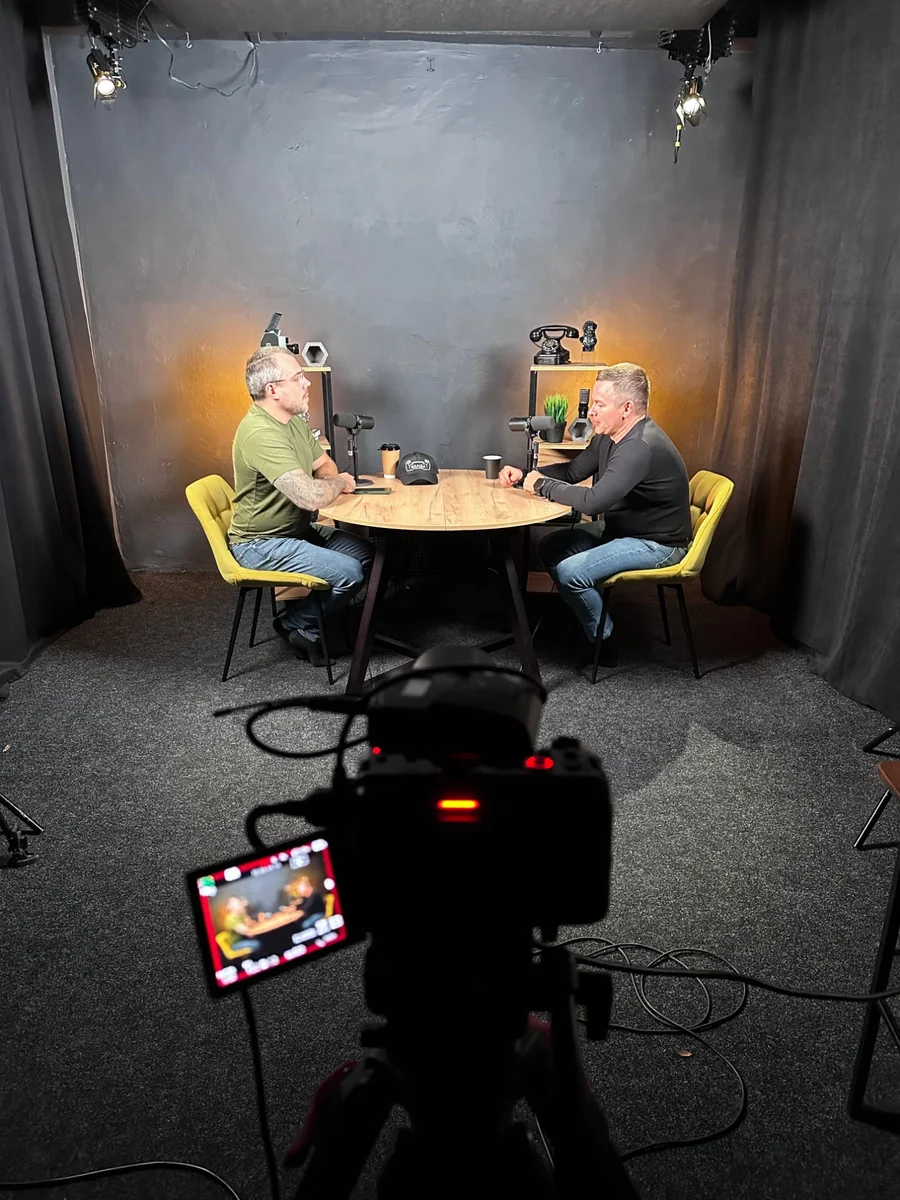
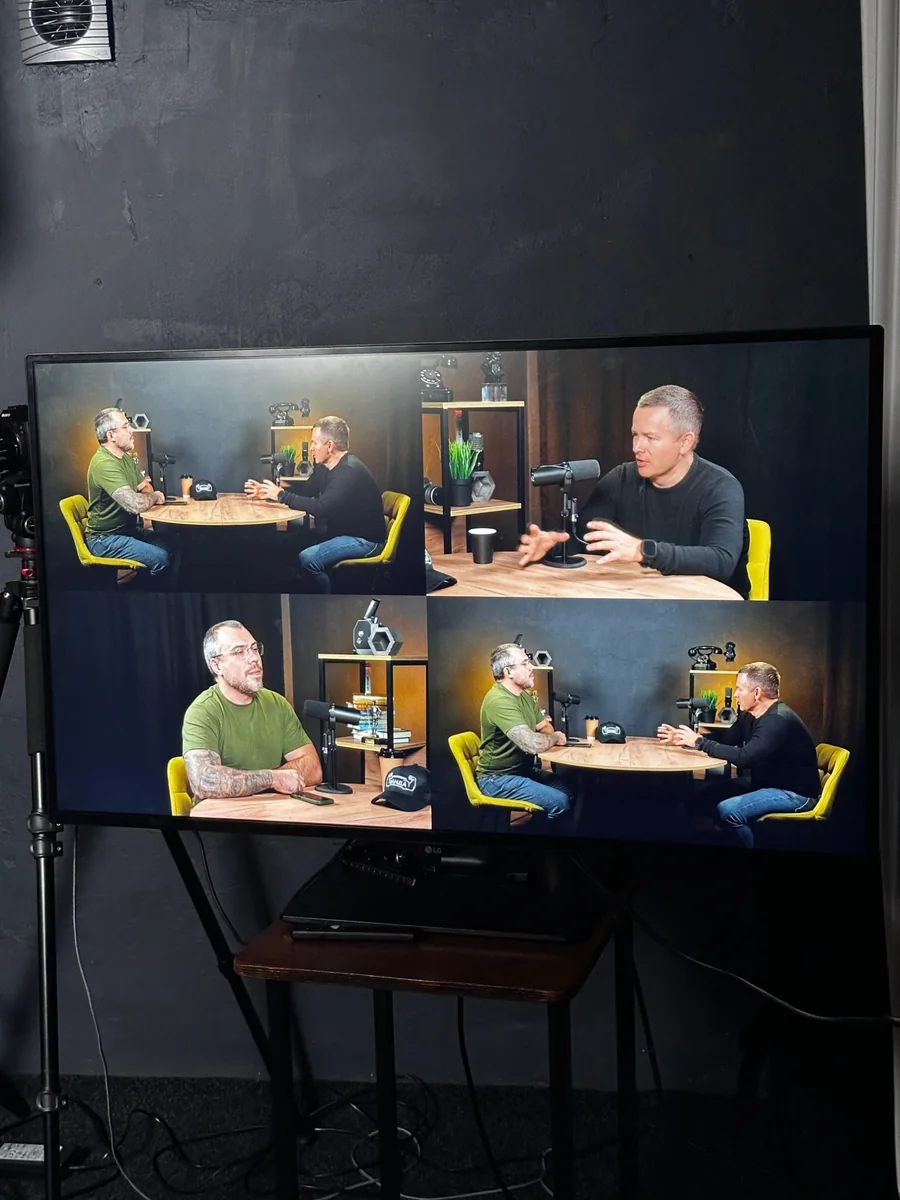
Here's what an in-person podcast looks like on our set: three cameras, studio light and a microphone for each speaker.
How many clips do you get from a podcast?
From a one-hour podcast we usually get about ten good clips. Very experienced speakers give more, nervous first-timers give fewer.
One rule we follow: the clips are cut by the same editor who edited the long episode. They already know the material: where the strong moments are, where the guest laughed, which story landed. A new person would have to watch the whole hour again and would still miss the best parts.
What should a podcast thumbnail look like?
Packaging decides whether anyone clicks. A podcast cover with a long title doesn't work on YouTube. What works now:
- Two faces: the guest and the host, with real emotion.
- One short, provocative phrase that makes people want to click. Not the episode title.
- One object or a hint of the topic, if it helps.
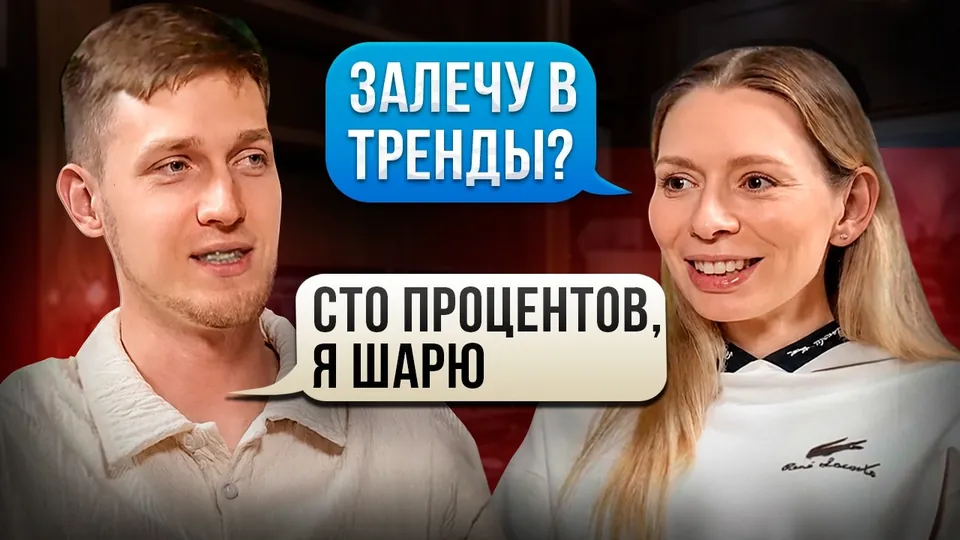
Here are four podcasts we made for clients. In the first two I was the host, in the other two my team was the production:
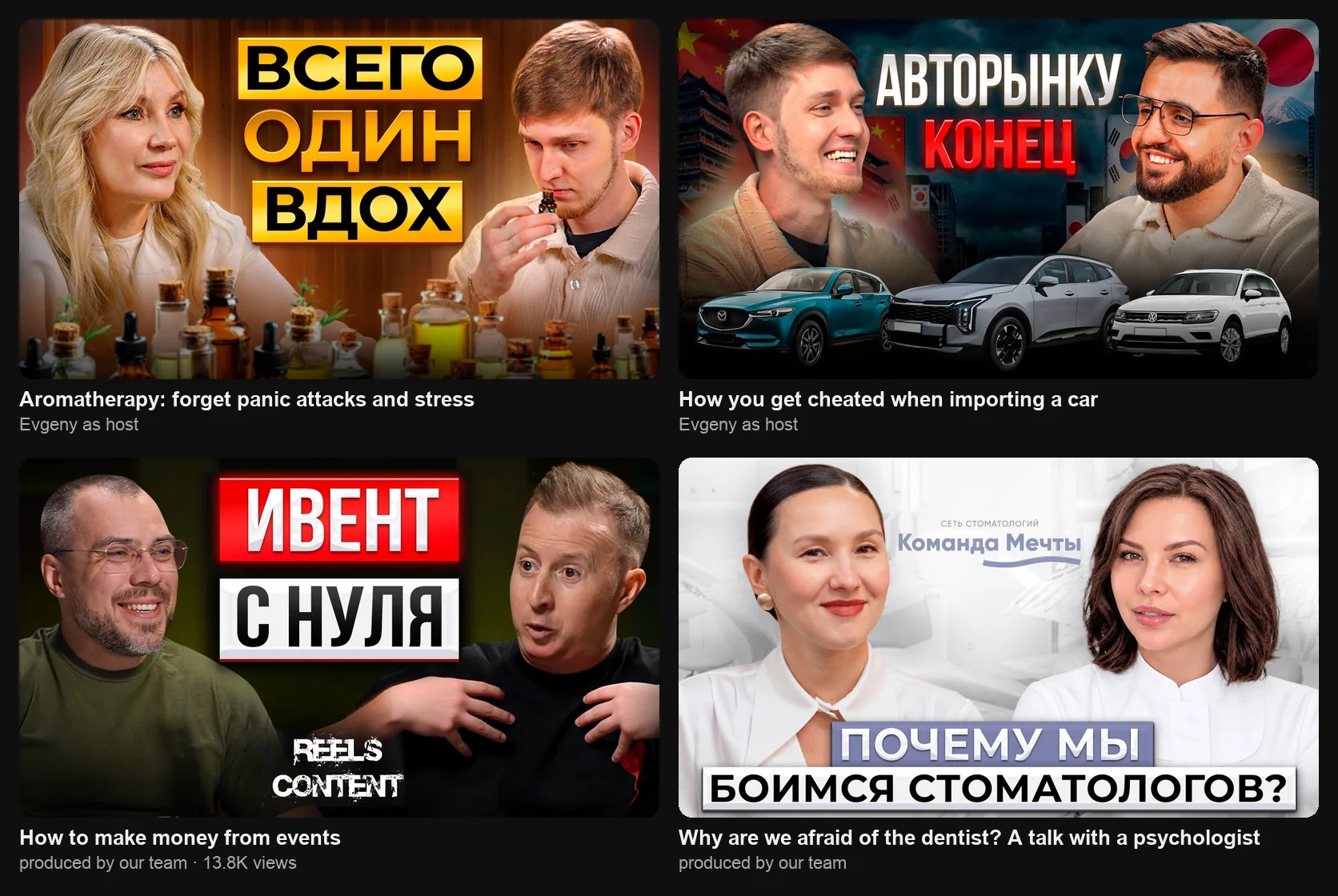
The phrases translate as "Just one breath", "The car market is over", "An event from zero" and "Why are we afraid of dentists?". None of them is the episode title, and all of them make you want to know more. More in our thumbnail guide.
What should you do after the podcast comes out?
Promote it. Everywhere. This is where most founders stop, and it's where half the value is. A podcast that nobody shares after release works at half power. Use it in every channel you have:
- Your social media: tell your audience about the episode, with a link.
- Shorts and reels: post the clips across the following weeks, on every platform.
- Articles: one podcast usually gives material for about five search-friendly articles, one question each.
- LinkedIn: a post with the main idea and the link in the first comment.
- Your website: put the episode on the home page or a "media" page as social proof.
- Email: send it to your list.
If you were the guest, ask the host for the raw video or permission to clip, and link the episode on your channel and site. And make a solo follow-up video on the topic that got the best reaction.
The best appearances keep working long after the recording. A podcast where I was the guest now sits on my Russian channel as one of the two lessons I point new viewers to first.
FAQ
Should a podcast be recorded online or in person?
In person when possible. Evgeny Maximov's team recorded at least 15 studio podcasts and about 30 remote ones in a year: in-person episodes have more energy, better video and much better clips. Zoom recordings are hard to cut into good Shorts.
How do you prepare a guest for a podcast?
With a 30-minute pre-interview: the key stories, the one main thought, why the episode is being made and which funnel stage it serves, so the host knows where to send listeners next.
Does podcast guesting help SEO?
Yes. Each appearance puts your name and expertise on another channel, in titles, descriptions and show notes, often with a link. Search engines and AI assistants use these independent mentions to understand who you are.
How do I get booked on podcasts as a guest?
Choose shows your buyers listen to, pitch one specific topic with a story or result, make it easy for the host with a short bio, three angles and links to your videos, and start with warm introductions.
Is podcast guesting worth it for founders?
Yes for reach, trust and relationships. But it builds the host's channel, so pair it with your own channel and reuse every appearance as clips and follow-up videos.
What should I pitch to a podcast host?
A specific topic with a clear story or result that fits their audience, not a general biography. Offer two or three angles so the host can choose.
Are small podcasts worth going on?
Often yes. A niche podcast with a few hundred listeners in your industry can bring better clients than a large general show.
How do I reuse my podcast appearances?
Ask for the raw video or permission to clip, cut about ten short clips from an hour, post them everywhere, turn the topics into articles, share the episode on LinkedIn, your site and in email, and make a solo follow-up video.
What is a podcast guesting service?
An agency that pitches you to podcasts and books appearances. It saves time, but you still need a clear topic and a plan to reuse every episode.
Is a podcast booking agency worth it?
Sometimes. Check which shows they booked for clients like you, whether those shows reach your buyers, and whether they help with your topic and angle. If you have a network, warm intros usually work better than a cold campaign.
How many podcasts should a founder guest on?
Quality over volume. Two or three appearances a month on shows your buyers actually listen to are worth more than ten random ones. Clip each appearance so it keeps working.
What should a podcast guest pitch include?
A specific topic with a result, a short bio, three possible angles, a photo and links to videos where the host can hear how you talk. Offer to share and clip the episode.
Founder of a done-for-you YouTube agency for high-ticket founders. Making content since 2014. More about me
Guesting a lot, but your own channel is quiet?
We build your own YouTube channel and turn every appearance into content. You film one day a month. 7-day money back guarantee.
Book a call →