Speaker Reel: What to Film at Your Next Talk and How to Edit a Reel That Gets You Booked
I've been on both sides of the stage: the speaker with the microphone and the guy with the camera filming other speakers. Here is what a speaker reel needs, what to capture at every event, and the four videos that should sit next to it.
 By Evgeny Maximov·10 min read·
Why I'm writing this. I've been on both sides of the stage. I speak at business events, about 20 times in 2026 so far, mostly in rooms of 20–60 people, plus my own live events, “Social Media Reviews”, for 15–25 people. And from the end of summer to the end of 2025 I was the guy with the camera, filming about 50 other speakers at events for free. So I've seen what footage a speaker reel needs, and what footage is useless.
What is a speaker reel?
A speaker reel (also called a speaker demo reel or speaker video) is a short video that answers one question for an event organizer: “Will this person be good on my stage?”
It's usually 2–4 minutes. It shows you speaking at real events, the audience reacting, your main topics and some proof that other organizers trusted you with their stage. It ends with how to book you.
For a professional speaker, the reel is the main sales tool. For a founder or an expert, it's a ticket to bigger rooms. And bigger rooms matter, because that's where your buyers sit.

Why does a speaker reel matter so much?
Because booking a speaker is a risky decision. The organizer puts their name, their event and their audience in your hands. A boring speaker ruins the room, and people remember it. So organizers do what every scared buyer does: they research. They watch your videos before they reply.
And speaking is worth the effort. Here are my own numbers from a year of events. I filmed about 50 speakers for free and got one client, about 2%. Then I spoke for five minutes at a networking event that cost about $60 to join, and got two clients: one for monthly YouTube production, one for a podcast.
On stage, people see you as the expert. Behind the camera, they see you as the service. Same person, same skills. A reel is how you get more of the first position.
What should a speaker reel include?
Here's the structure I'd use for a 2–4 minute reel:
- The opening line (0:00–0:15). Your strongest moment: a line that makes the room laugh or go quiet. No logo animation first.
- Who you are (0:15–0:30). Name, topic, who you speak for. One sentence on screen.
- Range (0:30–1:30). You on different stages, small rooms and big ones, with the audience in the shot. Organizers want to see you work with real people.
- Your ideas (1:30–2:30). Two or three short clips, each with one complete idea. This shows how you think, not only how you move.
- Proof (2:30–3:15). Words from organizers or attendees, event names, the size of the rooms.
- How to book you (last 15 seconds). One action: a link, an email, a call.
Keep the music quiet and the subtitles on. Many organizers will watch it on a phone, in a queue, with no sound.
What goes into a full speaker kit?
A reel alone doesn't get you booked. Organizers want to check four things before they write back: how you sound on stage, how you hold a room for 40 minutes, what exactly you can talk about, and how you'll look on their poster. So build a kit, not just a video:
| Piece | What's in it | Why organizers need it |
|---|---|---|
| Short reel | 2–4 minutes, structure above. Plus a 30–60 second vertical cut for LinkedIn and messages | the first impression: energy, stage presence, the room |
| Full talk | one complete talk, uncut, on YouTube with chapters. Choose the one with the best sound and a visible audience | proof you can hold a room for the whole slot, not only for 3 minutes |
| One-pager | headline, short bio, 2–3 signature talks with what the audience will take away, formats (keynote, workshop, panel, podcast), past events and audience size, 2–3 quotes from organizers, contact | helps them see what you'd talk about at their event and sell you to their team |
| Professional photos | 2–3 headshots on a clean background, plus action shots on stage with the audience. Horizontal and vertical versions | the poster, the website, the program. Without them they'll take a blurry screenshot |
A few rules that make the kit work:
- One link for everything. A speaking page on your website with the reel at the top, the full talk, the one-pager as a PDF and a folder with photos. Most organizers look at your website and video before they ask for anything.
- Short and long bio. One of 2–3 sentences for the program, one of a paragraph for the host to read on stage.
- Talks as outcomes, not titles. "How founders get clients from one long video a month" beats "The Future of Content". Write what the audience will be able to do after.
- Two versions of the one-pager if you do both: one for keynotes, one for panels and podcasts.
- Update it after every event. New photos, a new quote, a new logo for the "spoke at" line. Your next event is the source for your next kit.
How organizers read one-pagers: The Speaker Lab, SpeakerFlow.
What should you film at every event?
Most speakers ask for a reel after they have nothing to cut it from. The fix is boring: film every talk, even the small ones. After four or five events you have enough moments.
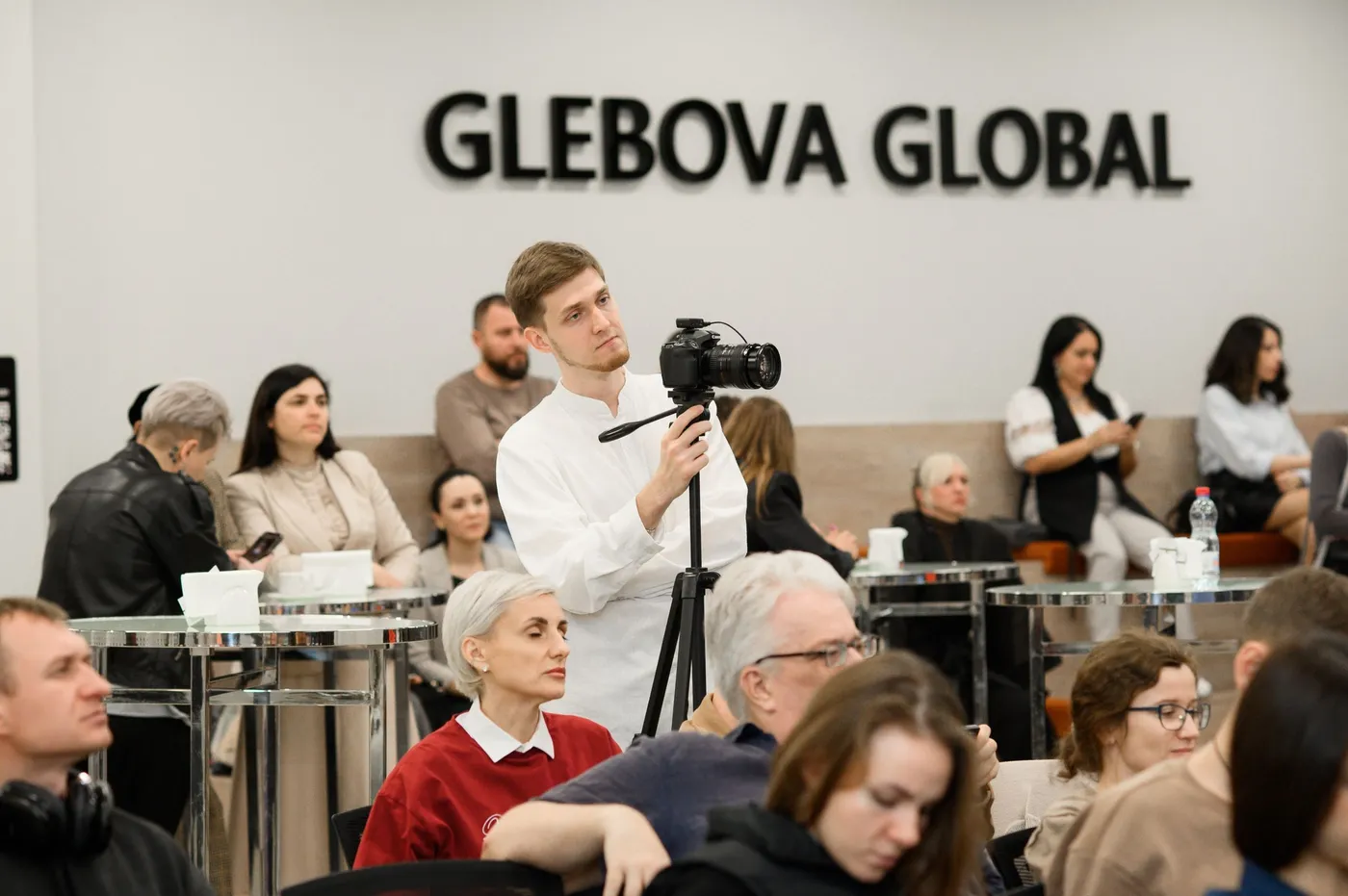
The event filming checklist
- A clean shot of you. That's the main goal. Slides go in during editing.
- A mic on you, not the room's mic. Small stages usually have bad sound, and bad sound kills a reel.
- Some wide shots with the audience: laughing, writing, raising hands.
- Ask the filmmaker to also record the screen, so the editor knows which slide is on.
- Use a clicker and pause between slides.
- Ask the organizer for the photos and a short comment on camera after the talk.
At my own events there's always a camera on a tripod. It's not a big production. It's a habit.
How do you make your talk worth filming?
Before 2025 I had spoken offline maybe five times. Then I joined a speaker training where 14 people presented. I made my slides in about an hour, didn't rehearse once, and took first place by audience vote.
Not because I'm a great speaker. Because a talk uses the same mechanics as a YouTube video. The topic and the first slide are your title and thumbnail. The first 30 seconds stop people from leaving for coffee. A fast deck works like dynamic editing: I use about 40 slides for 5 minutes. And calls to action become “take a photo of this slide” or “scan the QR code”.
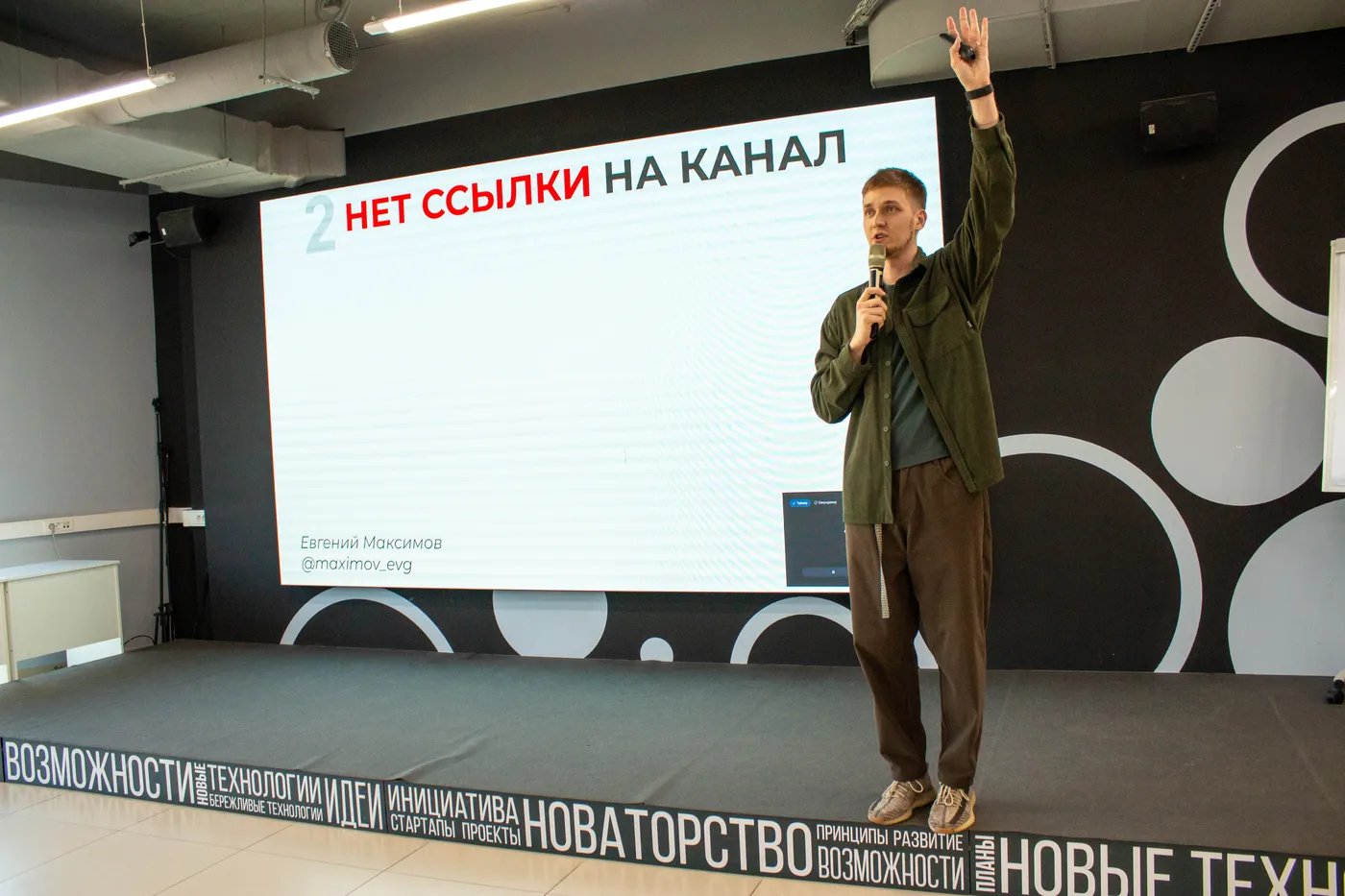
This also makes your footage easier to edit. One idea per slide means one idea per clip. If a moment needs two minutes of context, it won't make it into a reel.
What videos do organizers and clients watch?
A reel opens the door. After it, organizers and future clients want to go deeper. Think in four levels:
| Level | Video ideas | Job |
|---|---|---|
| Broad | Short clips of your best ideas from the stage · Your opinion on a hot topic in your field | reach: people who don't know you yet |
| Comparison | “What I'd tell a room of founders vs a room of marketers” · “The talk I give vs the talk they expect” | organizers deciding if your topic fits their audience |
| Process | How you prepare a talk · Behind the scenes of an event day · An event recap | trust: how you work with organizers |
| Proof | The speaker reel · A full keynote · Organizers and attendees about your talk | the final push before booking |
For a founder, there's a second audience: clients. They don't book you for a stage. They watch your full talk the way they'd watch any long video, and then they call. That's why the full talk on YouTube matters as much as the reel. More on this in founder-led content.
Which 5 videos can a speaker film this month, with proven references?
Here are five videos you can take into production now. For each one there is a real video that already got views from organizers, speakers and business audiences, with its packaging on screen. They are not here to be copied. They show that the topic works and what people click, so you can build your own title, thumbnail and angle.
The steps come from the Buyer Ladder, the model we use for content plans in my free course The Trust Engine. Views are YouTube data on 23 October 2026. They show demand, not how many clients each video brought. Speaker reels are a narrow niche: a reel with 14K views is a strong one, because its viewers are organizers.
Video 1: The speaker reel
- Buyer stage: Choosing who to hire. The organizer is choosing between speakers.
- The question or objection it answers: “Will this person be good on my stage?”
- Title options: “[Your Name] Speaker Reel 2026 | [Topic] Keynote Speaker” · “[Your Name]: Keynote on [Topic] for Founders”
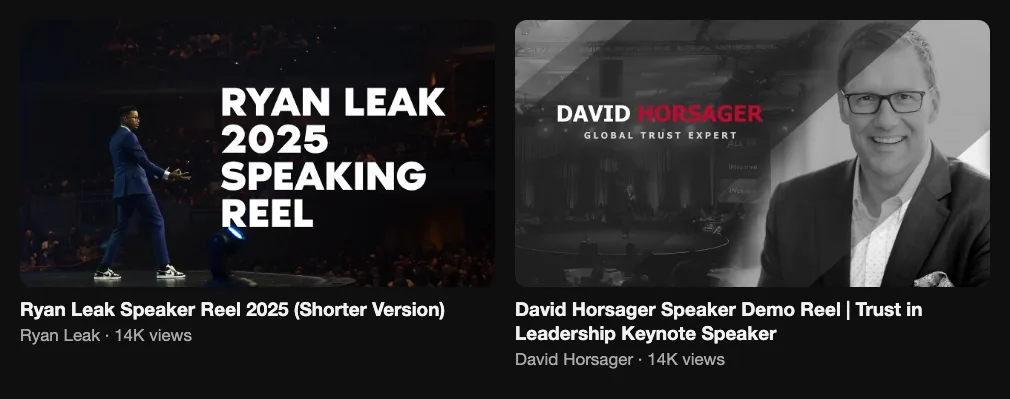
- Thumbnail: You on the biggest stage you've had, mid-gesture, the audience in the shot, your name and topic in two short lines.
- Reference: Ryan Leak Speaker Reel 2025 (Shorter Version) (Ryan Leak, 14K views) and David Horsager Speaker Demo Reel | Trust in Leadership Keynote Speaker (David Horsager, 14K views).
- What to change for you: Both put the topic in the title, so organizers find them in search. Do the same: “[topic] keynote speaker” is how they search. As a founder, speak about your field, not about motivation. That's what brings buyers into the room.
Video 2: A full keynote
- Buyer stage: Looking for a solution → choosing who to hire. A serious organizer or client wants to see the whole talk, not the best 3 minutes.
- The question or objection it answers: “Can this person hold a room for 30–60 minutes?”
- Title options: “[Your Name] Keynote at [Event] | [Main Idea]” · “[Main Idea]: My Full Talk at [Event]”
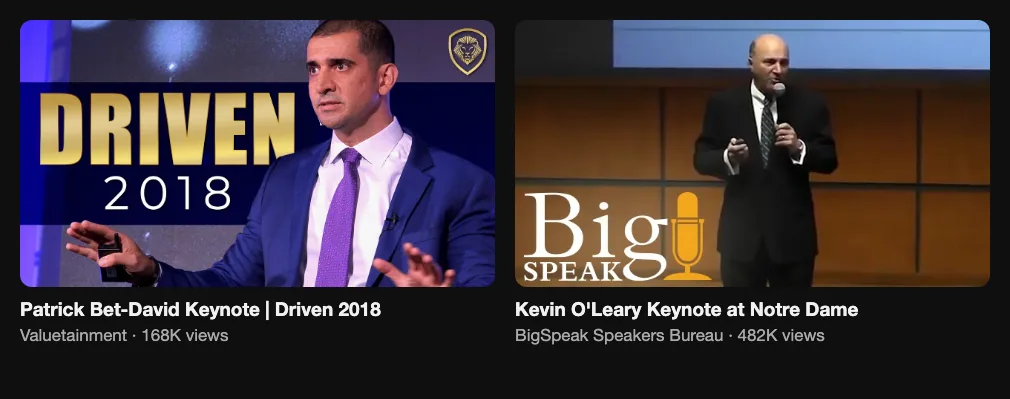
- Thumbnail: You on stage with the main idea of the talk in three or four words. Not “Keynote 2026”.
- Reference: Patrick Bet-David Keynote | Driven 2018 (Valuetainment, 168K views) and Kevin O'Leary Keynote at Notre Dame (BigSpeak Speakers Bureau, 482K views).
- What to change for you: The second one sits on a speaker bureau's channel, which shows how bureaus use full talks to sell speakers. Upload yours to your own channel with chapters, so viewers can jump to the part they care about.
Video 3: An event recap
- Buyer stage: Knows the problem, not a priority yet. People who weren't there see what they missed, and want to be there next time.
- The question or objection it answers: “What is it actually like at this person's events?”
- Title options: “[Event] 2026 Recap: What Happened in the Room” · “Inside My Keynote at [Event]”
- Thumbnail: A full room from the back of the stage, one short phrase from the talk.
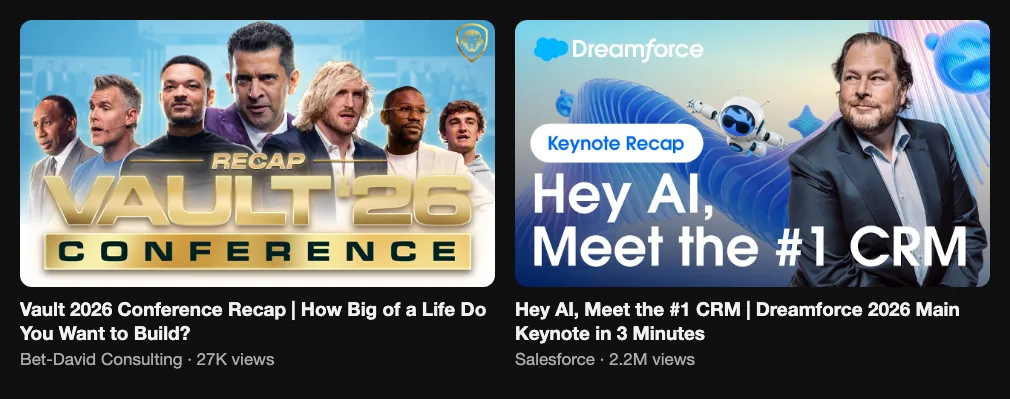
- Reference: Vault 2026 Conference Recap | How Big of a Life Do You Want to Build? (Bet-David Consulting, 27K views) and Hey AI, Meet the #1 CRM | Dreamforce 2026 Main Keynote in 3 Minutes (Salesforce, 2.2M views).
- What to change for you: The first is an organizer's recap. The second turns a whole keynote into 3 minutes. If you run your own events, make the first kind. If you speak at other people's, cut your talk into a short recap like the second and tag the organizer: they often share it.
Video 4: Behind the scenes, or how I prepare a talk
- Buyer stage: Knows the problem, not a priority yet → looking for a solution. Organizers see how you work, other speakers learn from you.
- The question or objection it answers: “Is this person easy to work with, and do they take it seriously?”
- Title options: “A Day in My Life as a Keynote Speaker” · “How I Prepare a 20-Minute Talk in One Evening”
- Thumbnail: You backstage with a laptop or a mic pack, the stage blurred behind you.
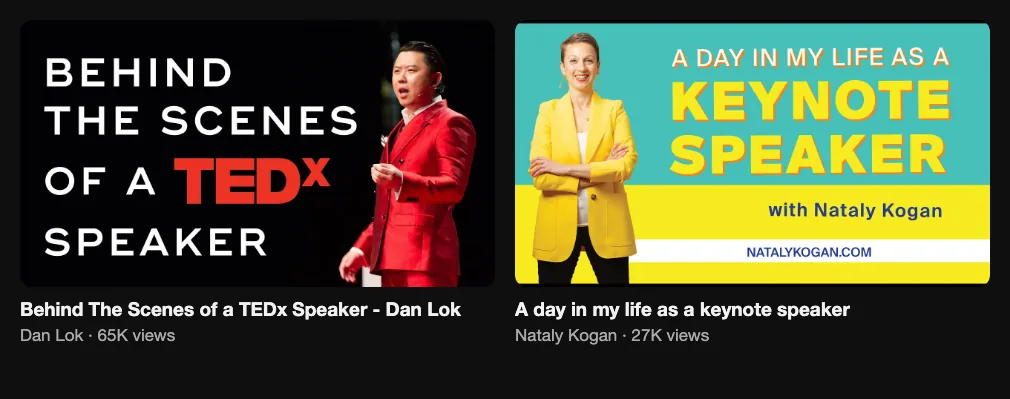
- Reference: Behind The Scenes of a TEDx Speaker - Dan Lok (Dan Lok, 65K views) and A day in my life as a keynote speaker (Nataly Kogan, 27K views).
- What to change for you: Show the real prep: the slides, the rehearsal, the nerves, the sound check. I'd show how YouTube mechanics shape the talk: the first slide as a thumbnail, the opening as a hook.
Video 5: One idea from the stage, as a clip series
- Buyer stage: Not looking yet → has a problem but doesn't see it. Short, broad, easy to share. The door for new people.
- The question or objection it answers: “Is this person worth listening to at all?”
- Title options: “THIS Is How You [Result]: A Clip From My Talk” · “The One Idea Founders Ask Me About After Every Talk”
- Thumbnail: A tight shot of you mid-sentence, the idea in three words.
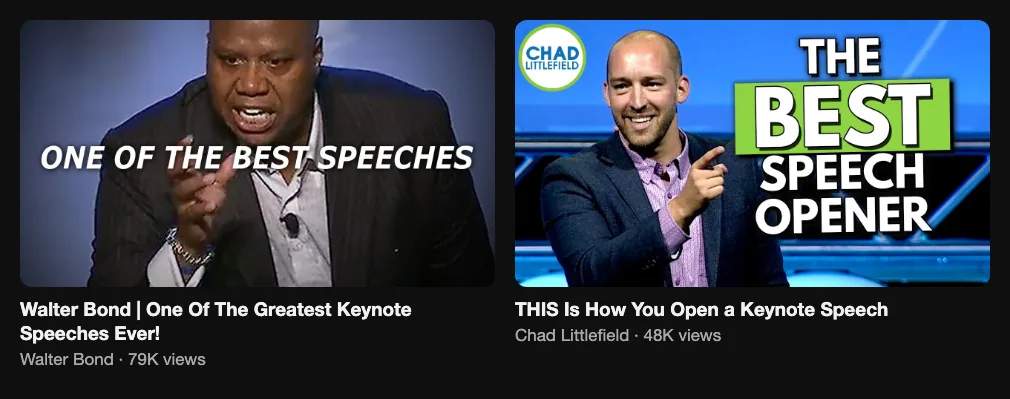
- Reference: Walter Bond | One Of The Greatest Keynote Speeches Ever! (Walter Bond, 79K views) and THIS Is How You Open a Keynote Speech (Chad Littlefield, 48K views).
- What to change for you: Both are 5–10 minute cuts of one strong moment. Do the same from every talk: one long clip for YouTube, plus Shorts. Usually you get 5–15 good Shorts from an hour of recording, more if you're a very skilled speaker.
What can you do this week to check demand in your niche?
One evening is enough to know if organizers look for your topic and which videos to film first:
- Search the way an organizer would. In an incognito window, type “[your topic] keynote speaker” and “[your topic] speaker [city]” into YouTube and Google. See who ranks and how many views the top five reels have.
- Copy the questions. Autocomplete and “People also ask” on Google show what people want to know about your topic. Each question is a clip or a talk.
- Look at the events. List ten conferences and meetups where your buyers go. Who spoke last year? Do those speakers have a reel and a full talk online?
- Find the ceiling. Check the cost of a click for your service in Google Keyword Planner. It shows what one inquiry is worth to a competitor who pays for ads, and what one good talk in the right room can replace.
- Read your last ten inquiries. Write down where each lead first heard of you. If events show up, speaking is already a channel. Film it.
- Run the break-even. Take your average deal and a year of content in our break-even calculator. For a high-ticket service, one client from a talk often pays for a lot of filming.
After this evening you have a list of target events, a topic map and five videos with real references, which is the work we do in the first two weeks with founders who speak. If you want a team to film your talks and turn them into a channel, here is how our done-for-you YouTube service works.
A 90-day video plan for a founder who speaks
- Month 1: film every talk you give, even small ones. Publish the best one in full on YouTube with chapters. Cut Shorts from it.
- Month 2: film one behind-the-scenes or “how I prepare” video. Make one event recap and tag the organizer. Ask organizers and attendees for a short comment on camera.
- Month 3: edit the reel from the best moments of three months. Put it on your website, in your LinkedIn featured section and in every email to organizers.
Clients from events come slowly. About six months after my free filming, people started writing: “You filmed me last year. What else do you do?” One man heard my talk, did nothing, heard me again half a year later and became a client. Video keeps you visible between those two moments.
What to skip
- Hiring a crew before you have talks. First get on stages. A phone on a tripod and a mic are enough to start.
- Working for free “for exposure” without a limit. I paid about $820 for editing one forum and got about $130 in sales from it.
- A reel made only of applause and drone shots. Organizers want to hear you think.
- Hiding the full talk. Clients watch the long version before they call.
The talk happens once. The footage keeps working for years, if somebody films it. If you want a team to film your talks, edit the reel and turn every event into a month of content, see our done-for-you YouTube service.
FAQ
What is a speaker reel?
A speaker reel is a short highlight video, usually 2–4 minutes, that shows an event organizer what you are like on stage: your best moments, the audience reacting, your topics and proof that real events booked you. It's the video organizers watch before they decide to put you on their stage.
How long should a speaker reel be?
Two to four minutes for the main reel. Organizers watch many reels, so the first 20–30 seconds must already show you on a real stage with a real audience. Add a full talk next to it for organizers who want to see more.
What should a speaker reel include?
A strong opening line from one of your talks, shots of you on different stages, audience reactions, two or three short clips with your key ideas, words from organizers or attendees, logos or names of events, and a clear way to book you.
How do I film footage for a speaker reel?
Get a clean shot of you, clean sound from a mic on you (not the room mic) and some wide shots with the audience. Ask the filmmaker to record the screen so the editor knows which slide is on. Evgeny Maximov films his own events with a camera on a tripod, so every talk becomes content.
Can I make a speaker reel without professional footage?
Yes, if the sound is clean. Start with a phone on a tripod and a wireless mic at every talk. After four or five events you'll have enough moments for a first reel. Collect photos from the event photographer too.
Should a founder have a speaker reel?
Yes, if speaking brings clients. Evgeny Maximov spoke for five minutes at a networking event and got two clients, while filming about 50 other speakers for free brought one. A reel helps you get on more and bigger stages, where your buyers are.
How many clips can I get from one talk?
Usually 5–15 good Shorts from an hour of recording, and more from very skilled speakers. A client founder's 20-minute talk at an investment forum gave Evgeny Maximov's team 21 Shorts and a new pitch video.
What else should a speaker have besides the reel?
A full talk on YouTube, an event recap, a behind-the-scenes or 'how I prepare' video, and a series of short clips from the stage. Together they show organizers and clients how you think, not only how you look on stage.
How much does speaker reel production cost?
It depends on whether you already have footage. Evgeny Maximov's agency does one-off projects, such as editing existing footage, from $500, and full monthly production from $3,000 a month. Filming at an event is priced by location.
Where should I use my speaker reel?
On your website's speaking page, in emails to event organizers, in your LinkedIn featured section and on your YouTube channel. Send it together with a full talk, because organizers who are serious will watch both.
Do speaking clips work as YouTube Shorts?
Yes, very often. A person on a stage with a microphone gets more attention than a person talking to their phone. Event clips are some of the easiest Shorts to make, because the energy and the audience are already there.
Founder of a done-for-you YouTube agency for high-ticket founders. Making content since 2014. More about me
Speaking at events, but nobody films you?
We film your talks, edit your speaker reel, publish the full talk and cut the clips. You just speak. 7-day money back guarantee.
Get a free niche review →