Go-to-Market Strategy for a Service Business (Not a SaaS)
Most go-to-market advice is written for software. A service business has no free trial, no product demo and often no proof in a new market. Here is a six-step plan for launching a new service or entering a new country, with our own experience of doing it.
 By Evgeny Maximov·9 min read·
What is a go-to-market strategy for a service business?
A go-to-market strategy is the plan for how a new offer reaches its first buyers. For software, it covers product, pricing, launch, sales and support. For a service, it is shorter and more personal. You are selling your own expertise and your team's time, and the buyer can't try it first.
Here is how the two differ in practice.
| Software GTM | Service GTM | |
|---|---|---|
| What the buyer can try | a free trial or a demo | nothing; they judge proof and people |
| First customers | signups from ads, search, a launch | mostly people who already know you |
| Main proof | the product itself | cases, client words, how you think |
| Who sells | a product, a sales team or both | often the founder |
| What limits growth | demand and budget | demand and your capacity to deliver |
| Price | a plan on a page | a package after a conversation |
Public guides agree on the order of work even when they disagree on details. One go-to-market canvas written for professional services, from the software vendor SyncGTM, lists eight decisions: the buyer, the value proposition, the sales motion, channels, pricing, competitive position, success metrics and a 90-day plan. I use a shorter version of the same idea.
Source, checked in October 2026: SyncGTM, Go-to-market canvas for B2B professional services (2026). SyncGTM is a vendor, and several numbers in its article have no source, so I use it only for the list of decisions.
When does a service business need one?
Not for every campaign. I see four real moments:
- A new service. You add an offer to what you already sell.
- A new type of client. You move from small firms to larger ones, or to a different industry.
- A new market. A new country or language, where no one knows you.
- A new stage. Your volume changes and the old channels stop being enough.
The last one is easy to miss. Our client Tvoy Sklad, a self-storage franchise, gives a good picture of stages. A franchise company moves in three steps: 0–5 locations is the start, 5–25 is scaling, and 25+ is steady growth and other markets, for example other countries. Each stage needs a different GTM. Tvoy Sklad is on the third one now, with 43 locations in 28 cities and 3 countries. Their first partner requests from Belarus and Armenia came from YouTube, without ads.
If you only want more of the same clients, you need a marketing plan, not a GTM.
What are the six steps of a service GTM?
| Step | The question | What you write down | Common mistake |
|---|---|---|---|
| 1. Buyer | Who gets the best result and pays well? | an ideal customer profile and a no-list | "any business that needs this" |
| 2. Offer | What result, in what time, at what price? | one sentence, see value proposition examples | a list of services instead of a result |
| 3. Proof | Why should a stranger believe this? | 3 proof items: a case, a number, a client's words | launching with none |
| 4. Channels | Where do these buyers already pay attention? | one warm channel, one that scales | five channels, no owner |
| 5. First 10 | Which ten people or firms, by name? | a list of 30 names and a first step for each | waiting for leads to appear |
| 6. Review | Did the chosen buyers respond to the offer? | four numbers per week, a note at day 30, 60, 90 | changing five things at once |
The order matters. Teams often pick a channel first, "let's do LinkedIn", and then try to find a buyer for it. Do the reverse. When the buyer is clear, the channel is usually obvious.
How do you win your first 10 clients?
Not from a launch. From conversations. Write a list of 30 people: past clients, former colleagues, friendly contacts in the group you chose, people who know someone. Talk to them. Don't pitch. Ask how they handle the problem you solve, and offer one small first step: a short call, a free analysis, a pilot.
This is also how I sell now. I talk to a person, give a free analysis of their situation, and send a proposal on the second call. No closers, no pressure. It works because the buyer sees my thinking before they pay.
Then add one channel that can bring strangers, so you don't depend on your own network. Pick it with the buyer in mind. Our B2B lead channels guide compares seven of them. For help with the limit of referrals, see from referrals to inbound.
How did we do this entering a new market?
This is my own GTM story, and it is still in progress. My agency grew in the Russian-speaking market. Now we are scaling into the English-speaking market. That means a UK company (EVGENY MAXIMOV LTD in London), an English YouTube channel and international prices, from $3,000 a month for a done-for-you channel.
Here is what I did, and what I learned so far:
- Buyer. Founders and experts with high-ticket services, who have expertise but no time for YouTube. Not people who want to become bloggers. I filter them out on the call.
- Proof. I started with proof from my home market and said so. Tvoy Sklad, about $5M in investments and 20+ franchise partners in 2024–2025, is a case from that market. Then I started collecting English-language proof the same way every time: numbers, a written review and a video testimonial. The recent video reviews from Elisabetta Maccani and Ethan Golding were recorded this way. See the Ethan Golding review and the language coach case.
- Channel. I tried cold DM outreach in August 2026. It brought 8 calls and I burned out in two weeks. Cold outreach drains me, and that is a personal fact, not a rule for you. So the plan now leans on YouTube, social media content, and conversations with people who already watched. I’m putting more work into SEO and GEO (generative engine optimization). I want buyers to find our articles in search and see our work cited in AI answers.
- Tracking. On the booking form we ask "How did you hear about us?", and we ask our clients to ask their leads the same.
I don't have a result to show for the English channel yet, and I won't invent one. The rest is a long game.
How do you get proof in a market where nobody knows you?
Three honest ways:
- Borrow proof from where you have it. Say where it comes from. A case from another country still shows that the method works.
- Show your thinking. A stranger can judge you if they can watch you explain a hard problem. A landing page can't do that. This is where long video helps. A buyer watches ten minutes of you and decides whether you make sense.
- Make the first local clients easy to turn into proof. Agree on a case study at the start. Ask for numbers, a written review and, if they agree, a video testimonial. I wrote how in client testimonial video.
Video also works for the buyer's group. A partner or colleague who has never met you can watch the same library. Tvoy Sklad partners often arrive at calls saying they have watched everything. Read how the sales team uses it in B2B video marketing.
What does a 90-day service GTM plan look like?
| Weeks | Focus | Output |
|---|---|---|
| 1–2 | Buyer and offer | ICP and a no-list; one offer line; a price |
| 3–4 | Proof | 3 proof items; a booking page with one clear next step |
| 5–8 | First conversations | 30 names contacted; 10 calls; first proposals |
| 9–10 | Add a scalable channel | first 4 long videos recorded, or the first 4 articles or talks |
| 11–12 | Review | what each lead said about how they heard of you; what to cut |
| 13 | Decide | keep, change one thing, or stop the segment |
Change one thing at a time at the review. If you change buyer, offer and channel together, you won't know what moved the result. When this works, move to the longer plan in marketing plan for a service business and the yearly view in B2B marketing strategy for professional services.
Which real videos explain go-to-market and first clients?
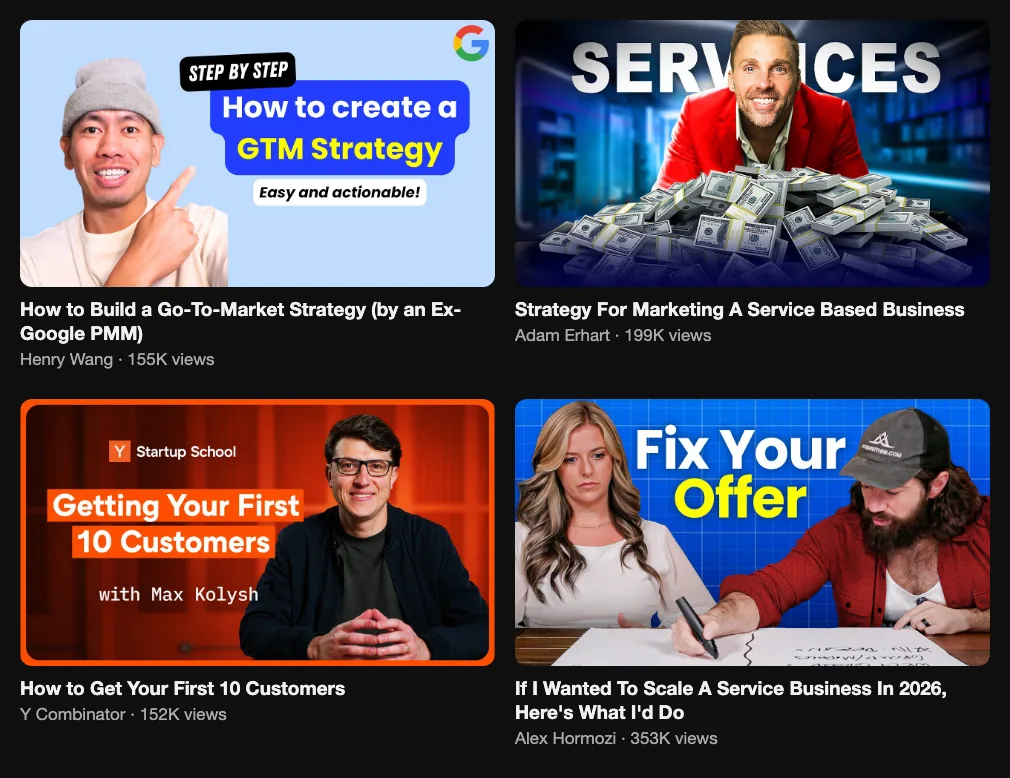
I looked for English-language videos about go-to-market and finding first clients. Most GTM videos are about software. I used them for the steps and added two about service businesses. Views show demand for the topic. They don't show how many clients a video brought. Data is from YouTube on 27 October 2026.
- How to Build a Go-To-Market Strategy (by an Ex-Google PMM) (Henry Wang, 155K views). A clean framework. It is for products, so skip the software parts and keep the order of questions.
- Strategy For Marketing A Service Based Business (Adam Erhart, 199K views). Marketing choices for a service owner.
- How to Get Your First 10 Customers (Y Combinator, 152K views). Do things that don't scale: talk to people one by one.
- If I Wanted To Scale A Service Business In 2026, Here's What I'd Do (Alex Hormozi, 353K views). A long talk on growing a service business after the start.
If you want the video channel in place before the launch, our done-for-you YouTube service does it: you film one day a month, we do the rest. For the plan around it, start with the professional services marketing guide.
FAQ
What is a go-to-market strategy for a service business?
It is a plan for how you reach the right clients with a new service, or in a new market, and win the first ones. It answers six questions: who the client is, what you offer, why they should believe you, where you reach them, how you get the first 10 clients, and how you will know it works. It is shorter and more personal than a software launch plan.
How is a service GTM different from a SaaS GTM?
A software company can offer a free trial, a demo and a self-serve signup. A service business sells before the buyer experiences anything, so trust and proof come first. The first clients usually come from people who already know you, and growth is limited by your capacity to deliver, not only by demand.
When do I need a go-to-market strategy?
Three moments: you launch a new service, you enter a new market or country, or you move to a new type of client. You don't need one for every campaign. If you just want more of the same clients, a marketing plan is enough.
What are the steps of a go-to-market plan for services?
Choose the buyer (ICP), write the offer and price, collect or borrow proof, pick one warm and one scalable channel, plan the first 10 clients by name, and review at day 90. Do them in this order, because channels chosen before the buyer is clear usually fail.
How do I get my first 10 clients with a new service?
Start with people who already know you: past clients, colleagues, and friendly contacts in the target group. Write a list of 30 names, talk to them, and offer a small first step. Then add one channel that can bring strangers. Most first clients come from conversations, not from ads.
How do I enter a new market without local proof?
Borrow proof from where you have it and be honest about it. Show real cases from your home market, explain how the method works, and publish your thinking so strangers can judge you. Then collect local proof fast: numbers, a written review and a video testimonial from each first client.
How did Evgeny Maximov's agency enter the English-speaking market?
The agency grew in the Russian-speaking market. It is now scaling into the English-speaking market with a UK company, EVGENY MAXIMOV LTD in London, an English YouTube channel and international prices. Evgeny also tried cold DM outreach in August 2026, which brought 8 calls and burned him out in two weeks, so the plan now leans on YouTube, social media content, SEO, GEO, and conversations.
How long does a go-to-market launch take?
Plan for at least a 90-day first cycle, and a slower build for content. Referrals and direct conversations can bring first clients in weeks. A long-video channel often has a flat first two or three months and then compounds. Review at day 30, 60 and 90, and change one thing at a time.
What role can video play in a go-to-market plan?
In a new market nobody knows you. A long video lets a stranger watch you explain your method for ten minutes, which a landing page cannot do. Tvoy Sklad, a self-storage franchise, got partner requests from other countries through YouTube without ads. Results vary, and no one can promise views or clients.
What are the most common go-to-market mistakes for services?
Picking channels before the buyer is clear, running more than two or three channels at once, pricing too low to fund the work, launching without any proof, and judging the plan after 30 days. Copying a software playbook is another common one.
Do I need paid ads for a service GTM?
No. Ads can speed things up when the offer is proven and the deal size can pay for each lead. They are not a must. Evgeny Maximov's agency does not run paid ads and focuses on organic YouTube and social media.
How do I measure whether my go-to-market is working?
Count a few numbers each week: new conversations, calls booked, proposals sent and clients signed. Ask every lead how they heard about you. At day 90 the question is simple: did the buyers you chose respond to the offer you wrote?
Founder of a done-for-you YouTube agency for high-ticket founders. Making content since 2014. More about me
Entering a new market with nobody who knows you?
You film one day a month. We plan, edit, publish and cut Shorts, so strangers can watch you work before they write. 7-day money back guarantee.
Get a free niche review →