Why the Most Visible Expert Wins Over the Best One
Two consultants, one better than the other. The buyer hires the one they have already watched. That is unfair, and it is how high-ticket buying works. Here is why, and what kind of visibility is worth having.
 By Evgeny Maximov·8 min read·
Why do buyers choose the expert they can see?
You can't check an expert's quality before you hire them. Not really. The work happens later, and you only learn if it was good when it's done. So buyers do what people always do when they can't judge a thing directly: they use signals. How the expert speaks, who vouches for them, what they published, whether they seem to understand my problem.
Two experts can be equally good. One has 30 videos where you hear her think. The other has a website with a logo and a list of services. The buyer doesn't pick the better one. They pick the one they can evaluate. I'm not saying it's fair. It's just how a purchase works when the price is high and the result is hard to see.
The data on B2B buying points the same way. 6sense found in 2025 that the vendor buyers prefer before the first sales conversation wins about 80% of deals. Gartner found that 61% of B2B buyers prefer a buying experience without a sales rep, and that buyers spend only about 17% of buying time meeting potential suppliers. And the 95-5 rule says only about 5% of your market is buying at any moment. The other 95% are forming opinions about who they will call when they are ready. Those opinions are made of what they have already seen.
Sources, checked in October 2026: 6sense, Buyer Experience Report, November 2025; Gartner, June 2025; Gartner, B2B buying research; Marketing Week on the 95-5 rule. These describe B2B purchases in general, and 6sense is a software vendor. More in business YouTube statistics.
Does that mean quality doesn't matter?
It matters, but at a different moment. Quality decides if the client stays, pays again and refers you. Visibility decides if you ever get the first call. If you are the best and nobody can see it, your quality never gets to work.
I know this one from the inside. There is an old objection to people who sell marketing: the cobbler without boots. For a while I was exactly that, a YouTube producer without a YouTube channel. I had the skill. What I didn't have was anything a stranger could watch. I explain how a buyer reads those signals in how clients choose an expert before the first call.
What kind of visibility actually sells?
Not the biggest crowd. Our own two videos show the difference. Both are on my Russian channel, and the numbers are from YouTube Studio, October 2026.
| 3-minute viral video | 47-minute documentary | |
|---|---|---|
| Views | 261,927 | 6,460 |
| Average time per view (calculated) | about 1.6 min | about 7.4 min |
| Views from YouTube search | 2.8% | 40.4% |
| Sales | zero | clients came from it |
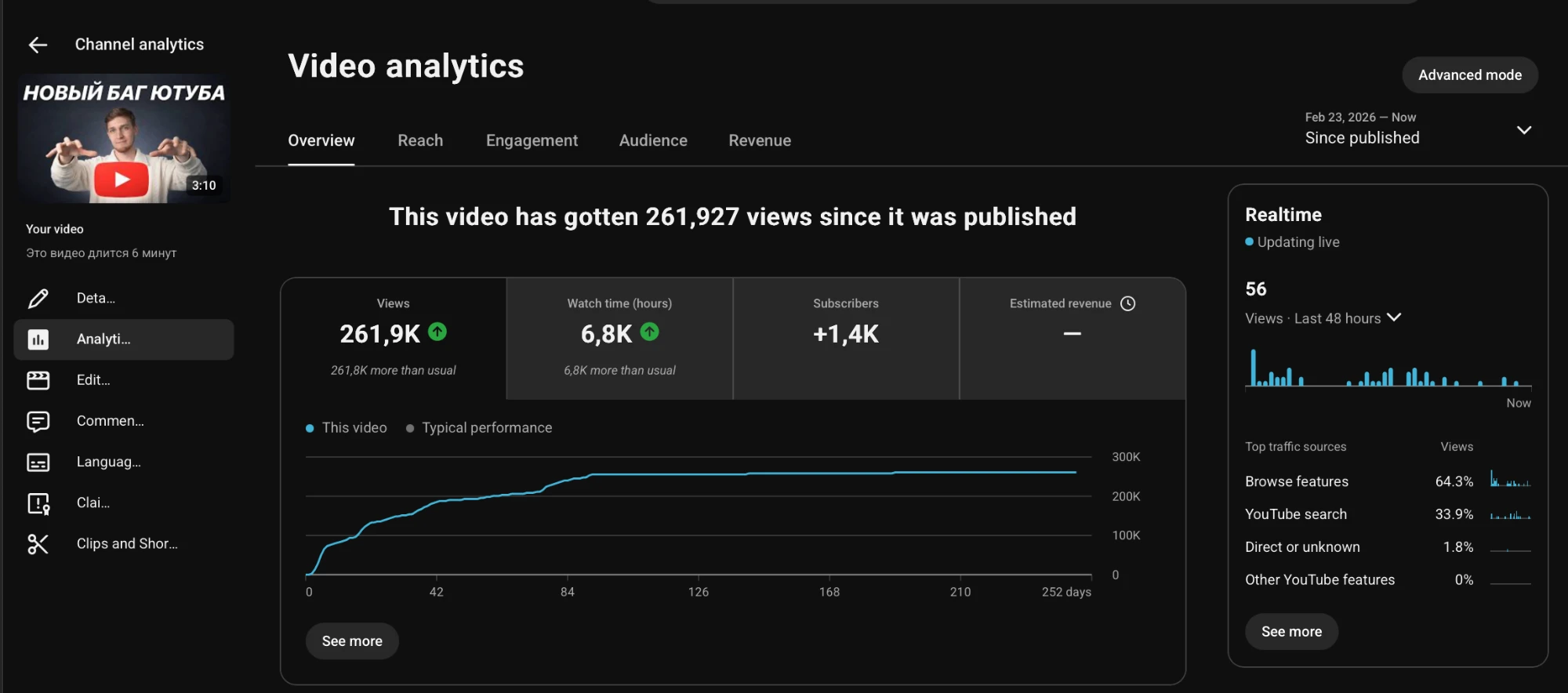
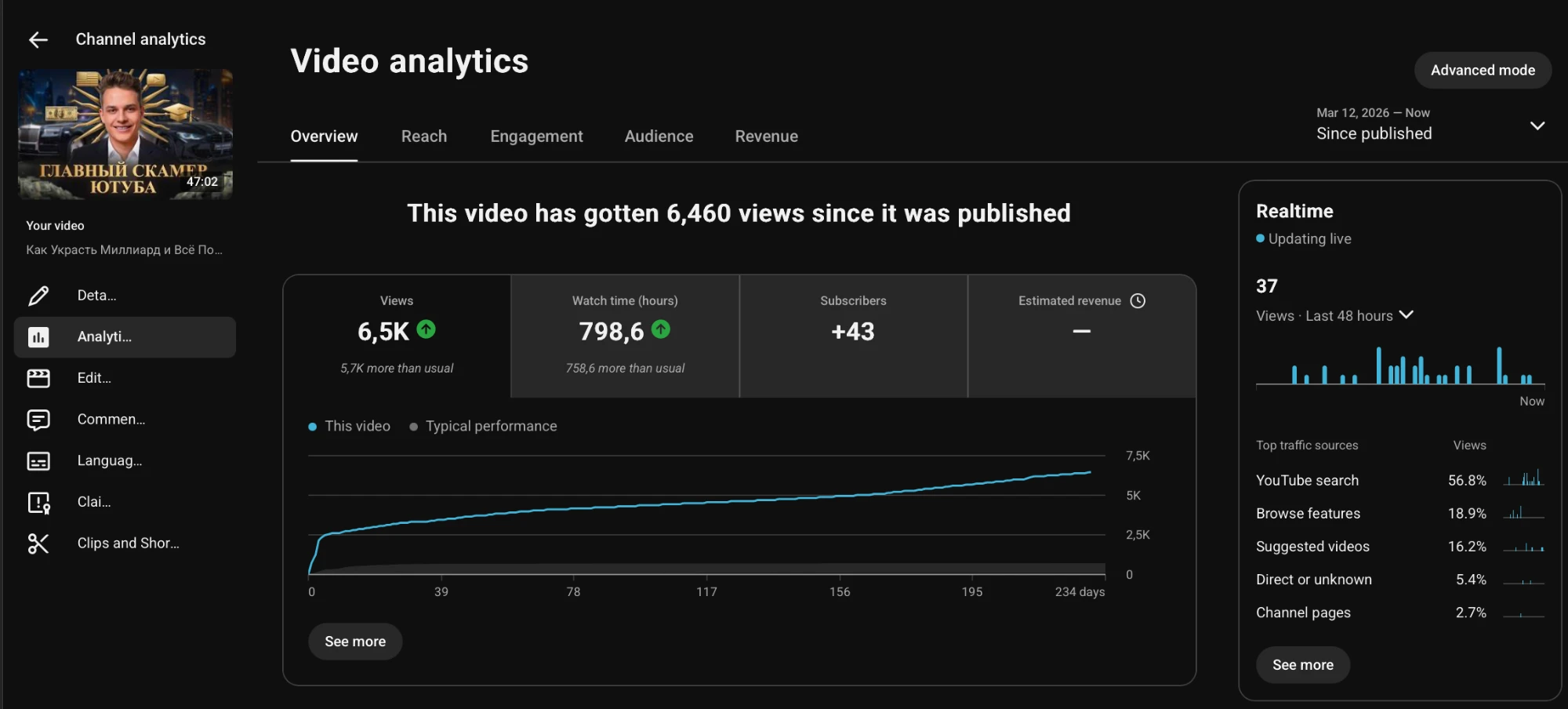
The viral video was entertainment. People laughed, shared and left. The documentary was an investigation into a big YouTube agency on our market that had collapsed, with a former employee as a guest. It showed how I think, for 47 minutes. Some of the people who watched it bought consultations without a sales call.
That is the visibility that sells: a few of the right people spend a long time with you. The same pattern shows in our clients. A Thai real estate firm, Insight Estate, got a lead from a dry 20-minute video on how to choose property in Thailand. About 500 views. For the full story on this, see views vs clients.
Why can't one video do reach, trust and sales?
We all want one video that gets views, finds the right audience and sells. They are three different jobs, and trying to mix them usually does none of them well.
- Reach. Broad videos for people who don't know you yet. They bring subscribers, not sales.
- Trust. Deep, specific videos for the right buyer. They show how you think and build belief.
- Sales. Narrow videos like cases or walkthroughs that a salesperson can send, and that answer one objection.
Most business channels need the second and third much more than the first. A self-storage franchise client, Tvoy Sklad, has a channel of small videos, most with 2,000–20,000 views. Partners write back: “I've watched everything.” They raised about $5 million in 2024 and 2025 with a channel of around 2,000 subscribers. It is all in the Tvoy Sklad case study.
What does it look like for an expert who is good but invisible?
Two of our clients had the same problem. They were very good at what they do, and nobody found them on YouTube.
- A prosthodontist. On social media, he only posted before and after cases. We filmed him for 2–3 hours, which became four long videos and about 20 Shorts. His channel has around 100,000 views a year. He left after five or six months, saying YouTube doesn't work. Four months later I found out that one client from YouTube had paid back the whole production cost for those half a year.
- An osteopath. Ayuna had a strong Instagram and a YouTube channel of about 7,000 subscribers that she had abandoned. About 2 hours of filming a month turned into 4 long videos and 20 Shorts. In 5 months the channel gained 26,000 subscribers and over 1 million views. The case is in the Ayuna case study. Her niche is consumers, not high-ticket B2B, so it shows how fast visibility can grow, not what a B2B client would earn.
Neither of them became better at their job. They became visible.
How do you start building visibility from what you already have?
You don't need new material. You need a list of true things you can already say. I call it a trust bank: all your wins and failures in one place. Client cases, a personal story, years in the field, places you worked, results with numbers. At least five wins and five failures. When you have it, you never face the blank page, and your videos can't be copied, because your story belongs to you.
Then turn the list into a few deep videos, not hundreds of posts. A video that shows a real problem and how you solve it is worth more than ten posts of general advice. For the full method, read personal branding strategy and thought leadership video.
What are the risks of chasing visibility?
- Visibility without proof. If your content looks great and your results don't, the call exposes you. A buyer checks. Make proof part of every video.
- Visibility to the wrong crowd. A viral video can make you famous among people who will never buy. Speak to your ideal buyer by name, in their words.
- Impatience. It takes time. I ask people who want a channel a blunt question: are you ready to spend a year's budget and get close to nothing back? If not, wait. In my own work, a deal can take two or three years to close.
- Doing it alone and quitting. The expert who gives up in month three leaves nothing behind. A steady system is what builds a library. See consistency without burnout.
What can you do in 90 days?
- Write your trust bank: five wins and five failures.
- Pick one narrow buyer and one problem they have this quarter.
- Record three deep videos of 15–25 minutes, one problem each.
- Add one client story with a name and a result you can show.
- Send each video to two real prospects and ask what they thought.
- Ask every new lead what they watched before they wrote to you.
- Judge it after 90 days by calls and answers, not by views.
If you'd rather not run this yourself, that is what we do. You film one day a month, and we handle the strategy, editing, thumbnails and publishing. See our YouTube production service, or start with how done-for-you YouTube works.
FAQ
Why do visible experts get more clients than better ones?
Because buyers can only judge what they can see. Quality is hard to check before you hire, so buyers use proxies: videos, proof, names, how someone thinks. The expert who shows these gets the call. The one who doesn't is invisible.
Does visibility matter more than quality?
Not after you are hired. Quality decides whether the client stays and refers you. But visibility decides who gets the chance. If nobody sees your quality, it can't win you the first client.
Is visibility the same as having many views or followers?
No. Evgeny Maximov's own 47-minute documentary had about 6,000 views and brought clients. A video with about 260,000 views brought no sales. Visibility to the right buyers matters, not the size of the crowd.
How many views does an expert need for it to work?
Fewer than most people think. A client of Evgeny Maximov's agency, a Thai real estate firm, got a lead from a 20-minute video with about 500 views. The video was long and detailed, and the right person found it.
What is a trust bank?
A list of your wins and failures in one place: client cases, personal stories, years in the field, countries and results. Evgeny Maximov recommends at least five wins and five failures. It becomes the raw material for videos and posts, so you never run out of true stories.
Can an expert be too quiet on camera?
No. A calm style is not a problem. It only means a different format fits better: longer conversations or interviews instead of fast Shorts. What matters is that your thinking is visible.
Isn't this just a popularity contest?
Partly, and that is the honest answer. But buyers also check proof. A visible expert with no real results gets found out on the call. The goal is visibility that is backed by evidence, not noise.
How long does it take to become the visible expert in a niche?
Longer than a quarter. Evgeny Maximov's view is that it is a marathon of about two years for a strong brand, and that you shouldn't judge a video before it reaches around 1,000 views. Big brands in this space took years.
What if my competitors are already more visible?
Narrow your niche. It is easier to be the most visible expert for one specific buyer than for a whole market. Long, specific videos for that buyer are how smaller experts win.
Do I have to be on camera myself?
For an expert, yes. The buyer wants to see how you think and hear how you talk. What you can hand off is everything else: the strategy, the editing, the thumbnails and the publishing.
Founder of a done-for-you YouTube agency for high-ticket founders. Making content since 2014. More about me
Want to be the expert buyers have already watched?
Book a call. You film one day a month, we do the rest. 7-day money back guarantee.
Get a free niche review →