Thought Leadership Video: How Founders Build Trust With Long-Form Content
Thought leadership isn't posting tips. Anyone can post tips, and AI can write them. It's showing how you think, with proof, in a format long enough for a buyer to trust you. Here's how we do it.
 By Evgeny Maximov·6 min read·
What is thought leadership, really?
The term is everywhere, and most of what's called “thought leadership” is just tips. “5 ways to improve your sales.” “3 mistakes in marketing.” Nothing wrong with tips, but they don't make anyone a leader. ChatGPT can write them in five seconds. The internet already has a thousand versions of each.
Here's how I define it for my clients: thought leadership is your point of view, plus proof, plus enough time for the viewer to see how you think.
- Point of view: what do you believe that others in your field don't?
- Proof: real clients, real numbers, real mistakes.
- Time: a buyer spending 20 minutes with you, not 20 seconds.
That last part is why I believe the home of thought leadership is long video. A text post shows an idea. A long video shows you thinking, explaining, pausing, admitting what you don't know. That's what high-ticket buyers want to see before they trust you with real money.
Why I chose depth over reach
For years I wondered why the “million-view Reels” approach never felt right to me. Plenty of people do it well. I tried it. It just never matched what I sell.
Then I had a clean experiment on my own channel. A trend video went viral: about 260,000 views, comments on fire. Sales from it: zero. Around the same time, my team spent a month on a 47-minute documentary about a big YouTube agency that collapsed. About 6,000 views. And clients came from it.
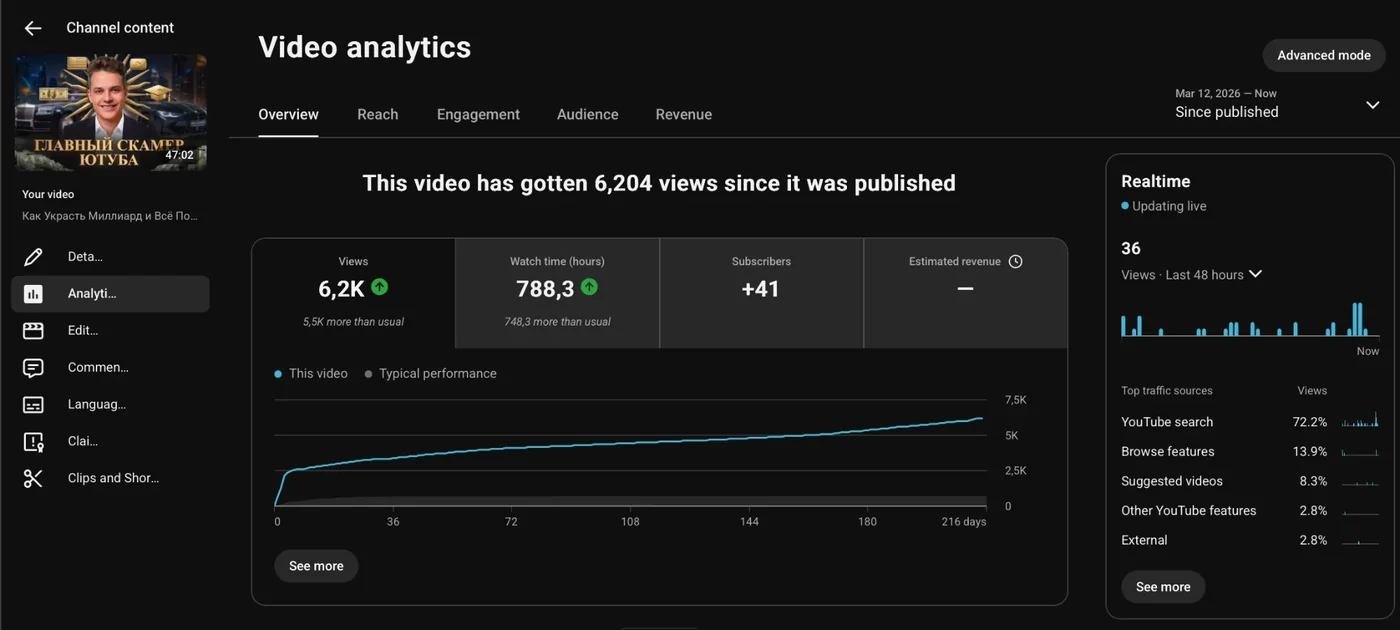
The documentary showed how I think: how I research, what I believe about agencies, what I'd never do. The viral video showed that I can make a funny clip. Only one of those makes a founder want to hand me their channel. That's thought leadership in practice. More on this format in mini-documentaries for business.
Six thought leadership video formats that build trust
1. The deep-dive explainer
One buyer question, answered in depth. Not “5 tips”, but “here's exactly how it works, with numbers”. For a real estate client in Thailand, a dry 20-minute video on how to choose property there, full of charts and percentages, got about 500 views and brought a lead. Depth sells.
2. The mini-documentary
A story from your industry, told properly: research, context, consequences. It takes more work, and it's the format people remember. It's your “golden hit”: the video you're never ashamed to send to a potential client.
3. The breakdown of a known company or person
How does a well-known business do something? What would you do in their place? We publish full YouTube strategies for well-known founders, like what I'd do with Justin Welsh's channel. It shows our thinking on a real example, and people from that founder's audience find us through it, even if the founder never replies.
A variation: live breakdowns of real businesses. Post once that you're looking for ten business owners who want their business taken apart on a one-hour recorded call. You'll get applicants fast. Record remotely, edit it like a podcast, add screen share where it helps. The guest gets free consulting, you get a video that shows your thinking live, and you don't need to prepare much: you listen and solve.
4. The contrarian take
Something your industry believes that you don't. Mine: views are a vanity metric for business channels. Guarantees of views are a red flag. The first month of content is always a loss. Each of these is a strong video, because people either agree loudly or argue, and both mean they're thinking about you.
The written version: essays as video
If you already write a newsletter or long posts, you have scripts. Take the essays your readers responded to most and turn them into 15–20 minute videos. The essay already has the structure, the stories and the punchlines. Use it as an anchor script, not as text to read. Dan Koe built a big channel on long video essays like this. I'd suggest the same to Justin Welsh.
5. The case study, result first
A real client, a real before and after, then how you got there. Not “we filmed 20 videos”, but “here's what changed in their business”. The Tvoy Sklad case is ours: a self-storage franchise, a narrow channel, and about $5M in investment that it helped attract.
6. The recorded talk
If you speak at events, film every talk. A tripod and a microphone are enough. People give a speaker on stage more attention than a person talking to their phone, and one talk can become a long video plus a month of clips.

How to find your point of view
Most founders say “I don't have strong opinions”. They do. They just haven't written them down. Here are the prompts I use with clients:
- What do you disagree with in your industry? The common advice you think is wrong.
- What would you never do for a client, and why? Your “no” list is your philosophy.
- What did you get wrong? Your failures, and what they taught you. A fail beats a win in a video, every time.
- Which buyer questions do your competitors answer badly? That's where your depth stands out.
- What do clients thank you for that you think is obvious? Your obvious is their insight.
Write ten answers. Each is a video. Then add proof to each one: a client, a number, a screenshot, a story.
Use AI for structure, not for thinking
I use AI every day. My own playbook was drafted from the transcripts of my last twenty long videos. But AI without your real context writes like everyone else, because it is everyone else, averaged.
The rule I follow: AI can help structure an idea, tighten a script, suggest chapters. It can't remember your client, your mistake or your opinion. So every block of a thought leadership video needs one real story that only you could tell. If an AI could write your video without knowing you, it's not thought leadership. I show the script template we use in how to write a YouTube script.
Let proof do the bragging
Thought leadership isn't self-promotion. The moment you sound like you're bragging, trust drops. There's a better way: let other people's words carry your status.
At my live events, I don't list my achievements. I point at the room: some of my clients are right here, ask them in the break whether I'm any good. A client saying “this worked” is worth more than any sentence you say about yourself. In videos, that means client testimonials, screenshots of real results, and guests who explain what you did for them. I explain why this works in the SPCL framework: credibility and likeness matter more than status for high-ticket buyers.
How to measure thought leadership
Not by views. Here's what I look at:
- Leads say “I watched your video about…” on the first call.
- Prospects quote your ideas back to you, in your words.
- Watch time grows, even when views are modest.
- Your deep videos keep getting found from search months later.
- You're invited to speak, guest on podcasts or comment on your industry.
- You ask every lead “which video brought you?” and the answer is a specific video.
The cornerstone: one very long video
Once you have a few months of videos, consider one cornerstone piece: a free course on YouTube, one, three, even five hours long. That's a real trend right now, and some of these videos get hundreds of thousands of views. The people who watch hours of you are the warmest buyers you'll ever meet. Put the link to your offer inside, and point every other video to it.
A realistic thought leadership rhythm
You don't need to post every day. The rhythm we use for founders: one filming day a month, four long videos, about one broader video for reach and three deeper ones for buyers. Clips from each go to the short platforms. One idea, explained deeply, then shared everywhere.
Do that for a year and something interesting happens. Buyers arrive at calls already knowing what you believe. The call stops being a pitch and becomes a conversation between two people who agree on how the work should be done. That's what thought leadership is for.
FAQ
What is a thought leadership video?
A thought leadership video shows how you think about your field: your point of view, backed by proof and real examples, long enough for a buyer to judge your expertise. It's different from a tips video, because tips can be found anywhere, while your opinion and your experience can't.
What are examples of thought leadership videos?
A deep-dive explainer on a buyer's key question, a mini-documentary about a story in your industry, a breakdown of how a known company or person does something, a contrarian take on a common belief, a case study, or a recorded talk. Evgeny Maximov's 47-minute documentary about a collapsed YouTube agency is one example.
How long should a thought leadership video be?
Long enough to show depth: usually 10–30 minutes, sometimes more. Evgeny Maximov's 47-minute documentary brought clients while a 3-minute viral video brought none. Short clips can extend the reach, but trust is built in the long version.
How is thought leadership different from regular content marketing?
Regular content marketing often answers common questions the same way everyone else does. Thought leadership adds a clear opinion, your own experience and proof. If an AI tool could write your post without knowing you, it isn't thought leadership.
How do I find my point of view for thought leadership content?
List what you disagree with in your industry, what you'd never do for a client and why, the mistakes you made and the lessons from them, and the questions buyers ask that most competitors answer badly. Each of those is a strong video.
Does thought leadership content need a lot of views?
No. It needs the right viewers. Evgeny Maximov's documentary has about 6,000 views and brought clients; one of his clients got a lead from a 20-minute video with about 500 views. For high-ticket services, depth beats reach.
Can AI create thought leadership content?
AI can help with structure and editing, but it can't remember your clients, your failures or your opinions. Evgeny Maximov uses AI with real context, like transcripts of his own videos, and adds one real story per block by hand.
Is YouTube or LinkedIn better for thought leadership?
LinkedIn is good for text and short ideas; YouTube is better for depth, because a buyer can spend 20 minutes with you and the video keeps getting found through search for years. Many founders use YouTube for the long version and LinkedIn to share the ideas from it.
How often should a founder publish thought leadership videos?
A realistic rhythm is about four long videos a month from one filming day: one broader video for reach and three deeper ones for buyers. Consistency matters more than any single video.
How do I measure thought leadership?
Not by views. Ask every lead which video brought them, track watch time, and watch for people on sales calls quoting your ideas back to you. When prospects say “I watched your video about…”, it's working.
Founder of a done-for-you YouTube agency for high-ticket founders. Making content since 2014. More about me
Want videos that show how you think?
We turn your expertise and stories into long-form videos buyers watch before they call. You film one day a month. We do the rest. 7-day money back guarantee.
Book a call →