Big on LinkedIn, Invisible on YouTube: The Strategy I'd Build if Jasmin Alic Were My Client
Jasmin Alic built one of the biggest personal brands on LinkedIn and a community worth about $1.2M a year. He shows up on other people's podcasts, but not on his own channel. Here's the plan.
 By Evgeny Maximov·9 min read·
Hi Jay. It's time to scale on YouTube. You have almost 400,000 followers on LinkedIn, and that's a huge opportunity to grow your community somewhere else too. In this article I'll share the strategy I would build if you were my client. I prepared a full document for it, free, no opt-ins.
If you're not Jay, but you feel stuck on LinkedIn, or it's not growing the way you planned and you're thinking about another platform, this is for you too. And if you know Jay, send him this.
Why a LinkedIn star needs his own YouTube channel
I keep seeing posts like “I was on this podcast”, “here's my video with Chris Do”, “here's my episode with Lara Acosta”. Great. But that's someone else's channel. Jasmin's own YouTube is underdeveloped: a few random videos and collaborations. Some of them aren't in English, which confuses both the audience and the algorithm. I have a Russian channel, and I don't post English videos there for the same reason.
Where it comes from
- ~378,000 LinkedIn followers
- Link Up community, $1,199 a year
- 1,000+ members
Why it matters
Following Alex Hormozi's frameworks: once you pass about $1M, start building a second traffic source, so the business doesn't depend on one platform.
Market research: who already won on YouTube from LinkedIn
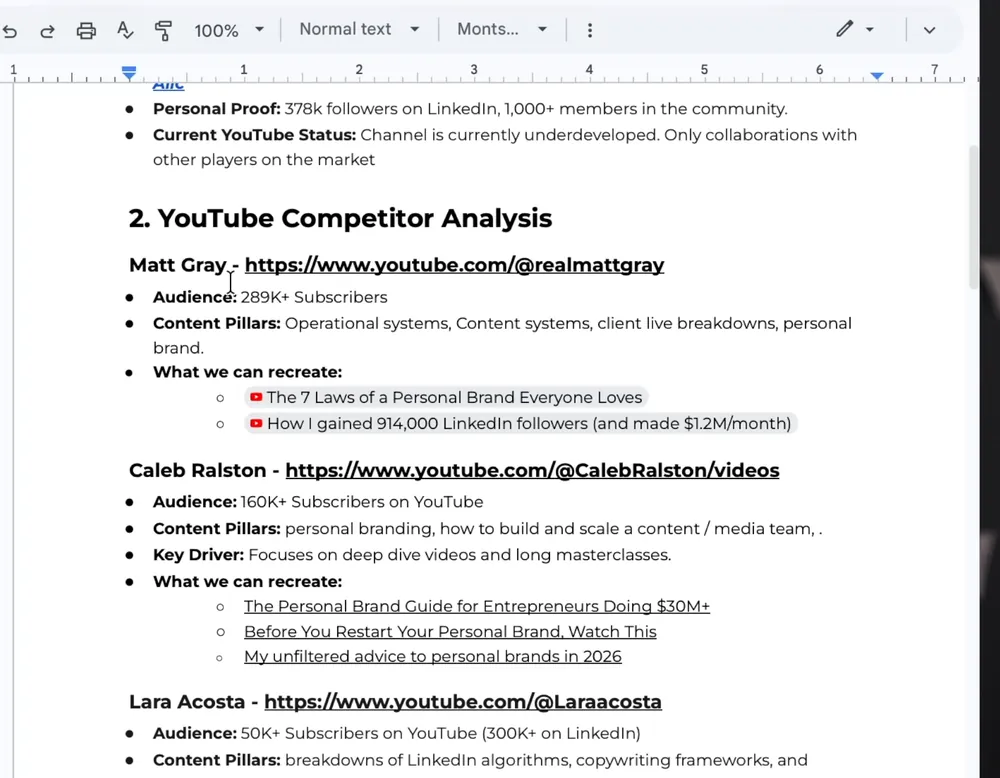
First step, always: market research. Jasmin has a huge opportunity, because he can make videos both about personal branding and about growing on LinkedIn. And several of the best references started exactly where he did.
| Channel | What to learn from it |
|---|---|
| Matt Gray ~289K subscribers | First famous on LinkedIn. Systems, personal brand, live client breakdowns. |
| Caleb Ralston ~160K subscribers | Deep-dive videos and very long masterclasses on personal branding. |
| Lara Acosta ~50K on YouTube, 300K+ on LinkedIn | LinkedIn algorithm breakdowns, copywriting frameworks, fast editing. |
| Tommy Clark ~12K subscribers | LinkedIn content systems and lead generation. |
| Daniel Fazio ~36K subscribers | A separate playlist of client case studies that warm up buyers. |
Five content pillars for a personal branding coach
Content pillars are the foundation of the channel. A few keywords people connect with you: “I want to grow a personal brand, that's Jasmin's channel. I want to grow on LinkedIn, Jasmin's channel. Instagram? Not his channel.”
- How-to for searchExample: “How I got to almost 400,000 LinkedIn followers. Steal my playbook.”Tactical tutorials that work as long-term assets.
- Contrarian and authorityExample: “I built a personal brand and regret it. Here's why.”And inside the video you explain how a personal brand changed your life. Breakdowns of famous people's brands, like Tim Cook, work over and over.
- Systems and proofExample: “How to build a cult-like personal brand: the 5 elements”The helicopter view: the building blocks a solid personal brand needs.
- MindsetExample: “Why people feel stuck before hitting publish”Many people know the tactics but can't click the terrifying publish button. Address that pain.
- Case studies and testimonialsExample: “How [member] went from 0 to 10 clients in 90 days”A business channel is for growing a business, not collecting likes. Proof closes the sale.
The first five videos to test
Five formats for the first content plan. They're flexible: change the topic in the title, from personal brand to DM playbook to LinkedIn content, and you get a ton of videos.
- Actionable guide. “Do these 5 steps and build a cult-like personal brand.” Step by step, and the CTA at the end: all the frameworks and templates are in the Link Up community.
- Systems breakdown. “The exact LinkedIn system that generated $1M in sales.” Jasmin draws the whole machine on a Miro board, from random viewer to buyer.
- Mindset Q&A. He runs weekly masterclasses and Q&As. Take the best questions: “Personal brand expert answers 10 stupid questions.” Every question is also a short.
- Client case study. A 20–30 minute talk with a member about before and after. Record people from different demographics: men and women, different accents, revenue levels and follower counts. In DMs, send each lead the case that looks like them.
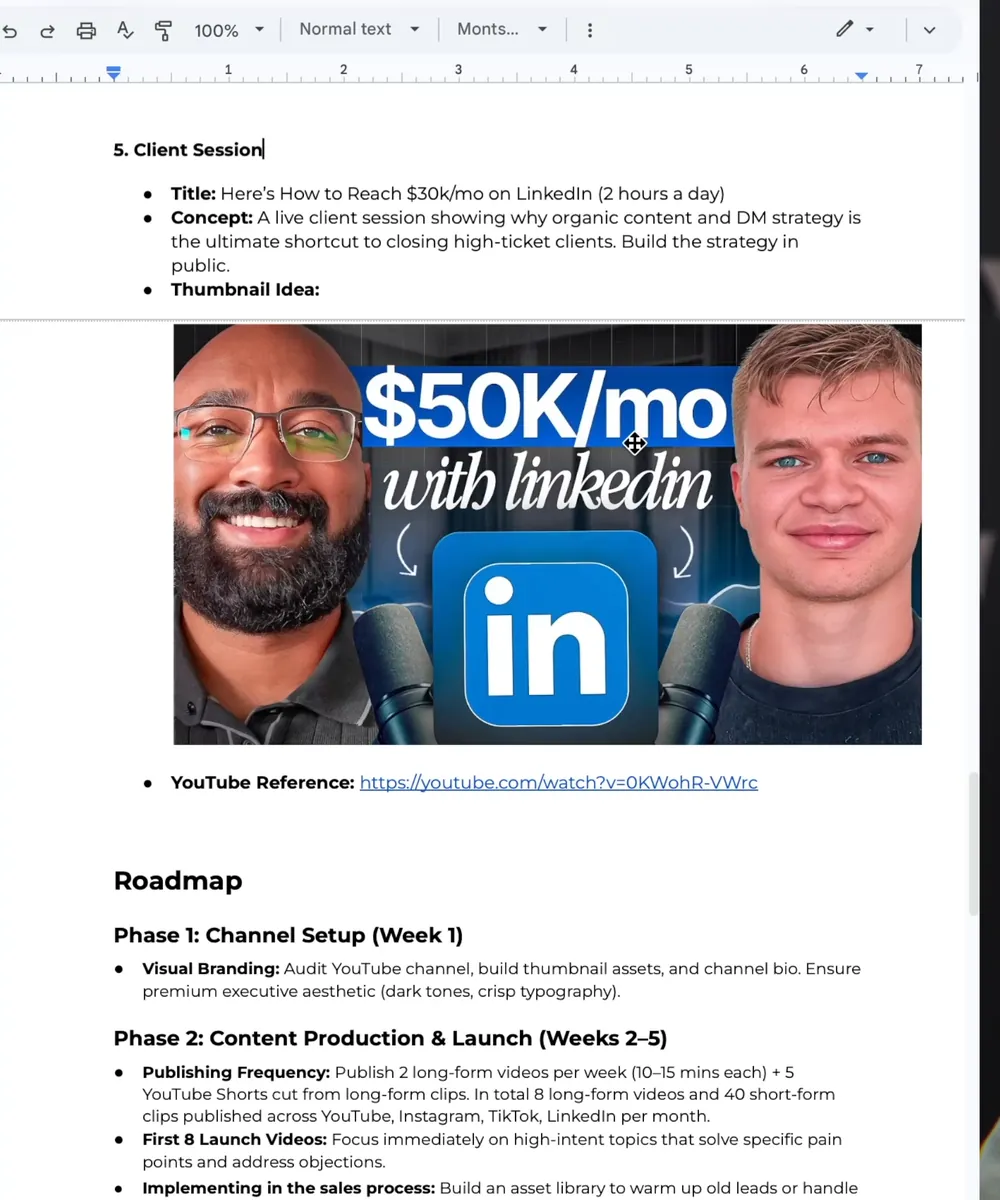
- Live client session. Take a member and fix their problem on camera. Like this breakdown, which is basically an asynchronous client session. At an offline event, you can stack eight one-hour sessions in a day.
The first month is for testing. Do you prefer client sessions, talking head or a whiteboard? You only find out by filming and reflecting on how the session felt.
The roadmap: setup, production, scaling
Phase 1: channel setup. Jasmin already has a channel. Update it, pick the videos from the five concepts, and record four long videos in one session.
Phase 2: production. Start with one long video a week and scale to two or more. Clip shorts from every long video for YouTube, LinkedIn, Instagram, TikTok and X, no extra filming. The plan is 8 long videos a month from two sessions of three to four hours each. Eight videos in one day would drain anyone. And if he has recordings of his offline events, publish them too. Chris Do does this a lot.
Think of the long videos as sales agents. Which videos move the sale closer? This library should bring clients, not just views.
Phase 3: optimization and scaling. Review what worked and create a cornerstone video: a very long masterclass. Caleb Ralston has a full course on building a personal brand, and there are 10-hour masterclasses doing great right now. People watch, think “holy crap, I know so much more now, but I need help”, and buy. Jasmin's community is relatively low-ticket, so sharing everything for free and selling the personal support works perfectly.
What happens next
That's the strategy: plug and play. Bring a content team in place and they do the work. If finding a team, learning how YouTube works and filming sounds like too much, book a call with me.
And if you're not Jay: we build a strategy like this for every client before we start working together. If you don't like it, tell me “Evgeny, it's not great”, and you get a refund. I'm on the call myself, there's no sales team with closers. When I recorded the video, we had capacity for three more clients.
FAQ
Should a LinkedIn creator start a YouTube channel?
Yes, once LinkedIn is working and the business needs a second traffic source. Jasmin Alic has about 378,000 LinkedIn followers and a community of 1,000+ members at $1,199 a year, roughly $1.2M in annual recurring revenue. Following Alex Hormozi's idea, after about $1M it's time to stop relying on one platform.
Why aren't podcast guest appearances enough?
Because they build someone else's channel. Collaborations are great for reach, but without your own library of videos in the right language and on the right topics, viewers have nowhere to go next and YouTube has nothing to recommend.
Who are the YouTube competitors for a personal branding coach?
For Jasmin, I'd study Matt Gray (about 289K subscribers), Caleb Ralston (about 160K), Lara Acosta (about 50K on YouTube, 300K+ on LinkedIn), Tommy Clark and Daniel Fazio. Several of them also grew on LinkedIn first, which makes them the best reference.
What content pillars should a LinkedIn coach use on YouTube?
Five: search-driven how-to videos, contrarian and authority takes, systems and proof breakdowns, mindset lessons, and client case studies. Each pillar is a keyword the channel owns, like personal branding or LinkedIn growth.
What are the first five YouTube videos a coach should make?
An actionable playbook, a systems breakdown on a whiteboard, a mindset video (for example, answers to community questions), a client case study, and a live client session where you fix a member's problem on camera.
How do you turn a community into YouTube content?
Every question from your Q&As and masterclasses is a piece of content. Collect the best ones into a “10 questions” video, cut each answer into a short, record client case studies and run live sessions with members.
How often should a coach publish on YouTube at the start?
Start with one long video a week, then scale to two or more. Our plan for Jasmin: 8 long videos and about 40 short clips a month, from two filming sessions of three to four hours each, so the speaker doesn't burn out.
Why use client case studies with different people?
Because buyers look for someone like them. Record case studies with different genders, accents, revenue levels and follower counts. Then in DMs you can send the exact video that matches the lead.
What is a cornerstone masterclass?
A very long video, sometimes 5 to 10 hours, that teaches your whole method for free. People finish it better informed, realize they need help, and join your program. It's one of the strongest sales formats on YouTube right now.
What metrics should a new business channel track?
Click-through rate above 5%, average view duration above 30%, and, most important, the sales rate and sales cycle before and after YouTube. The library should bring clients, not just views.
Does Evgeny Maximov work with Jasmin Alic?
No. This is an open strategy built from public information, to show how we work. We build a strategy like this for every client before we start, with a 7-day money back guarantee if they don't like it.
Founder of a done-for-you YouTube agency for high-ticket founders. Making content since 2014. More about me
Grew on LinkedIn and stuck there?
We build your YouTube strategy first. If you don't like it, you get your money back within 7 days. Then our 7-person team does the work, and you film one day a month.
Book a call →