If I Were Justin Welsh: Why I'd Start YouTube Now (Without Hiring a Single Employee)
Hey Justin. You built a one-person business that passed $10M in revenue, by your own post. No employees, no ads and no YouTube. So why would you need a channel? Because people already search for your products by name, and there's no video of you answering them. Here's the plan I'd build.
 By Evgeny Maximov·7 min read·
If you're not Justin, but you built your business on LinkedIn or a newsletter, this plan is for you too.
What does Justin Welsh's audience look like today?
Here's what I found in public sources in October 2026.
| Platform | Now |
|---|---|
| about 885,000 followers | |
| X | about 592,000 followers |
| Newsletter | The Saturday Essay, 200,000+ readers (his X bio) |
| about 97K | |
| YouTube | no active channel |
| Revenue | over $10M lifetime by May 2025, zero ads, about 89% margin (his pinned post on X) |
Almost all the attention comes from X, LinkedIn and email. X and LinkedIn are rented. Email is owned, but it only reaches people who already found him.
Why would a $10M solopreneur need YouTube?
Three reasons.
1. One platform is a risk. When a platform changes its algorithm, reach can drop overnight. My rule for clients: once a business makes real money from one channel, start building the second one before you need it.
2. People already search for him. Google and YouTube both suggest "content operating system justin welsh". When people search a product name and find no video from the author, they find someone else's review instead.
3. Long videos sell courses better than posts. A LinkedIn post builds attention in 30 seconds. A 40-minute tutorial lets a buyer experience how you teach before they pay. That's the whole idea of long-form content for business.
Which YouTube channels would I use as content references?
Not to copy their business model: most big channels have a production team behind them. To copy formats that already work for Justin's kind of content.
- Dan Koe (about 1.44M subscribers): long video essays with one big idea. His "If You Have Multiple Interests, Please Start a One-Person Business" got about 420,000 views in a month. This is the reference for turning Justin's essays into video.
- Soo Wei Goh (about 40K): breakdowns of his own consulting business with real numbers, like "exactly how i built a $4m/yr consulting business working 6 hours/day". The reference for the "behind the business" pillar.
- Matt Gray (about 292K): systems explained step by step, often on a whiteboard. The reference for system tutorials.
There's also a trap to avoid. Many writers who are big on X and LinkedIn stay small on YouTube, because they post their short ideas as short videos. The references above do the opposite: long, deep videos with one big idea each.
What content would I make for Justin?
Four content pillars.
- System tutorials. "My content operating system, step by step." Screen share, his real templates. This is search demand that already exists.
- One-person business breakdowns. "How this solopreneur makes $50K a month." Analysis of real businesses. Great for search and for his audience.
- The newsletter, as video. His best Saturday Essays as 15–20 minute videos. The ideas are already proven by his readers.
- Behind the business. Margins, products, mistakes, what he'd do differently. Honest numbers build trust.
Pillar three is the cheapest win for any writer. You already know which ideas work: your readers told you. More ideas in how to pick video ideas that bring clients.
Which five videos would I test first?
- "My Content Operating System: The Full Walkthrough"
- "How I Built a One-Person Business to $10M (No Employees, No Ads)"
- "Solopreneur Business Ideas That Actually Work in 2026"
- "How to Grow on LinkedIn in 2026: What Changed"
- "I Analyzed 10 One-Person Businesses. Here's What They Have in Common"
The first two answer searches for his name and products. The last three bring new people who've never heard of him.
How do you do YouTube without hiring anyone?
This is the part a solopreneur cares about most. You don't need employees. You need:
- One filming day a month: four long videos in about three hours.
- A production team outside the business: scripts from your voice notes, editing, thumbnails, publishing and Shorts.
- About an hour a week for feedback.
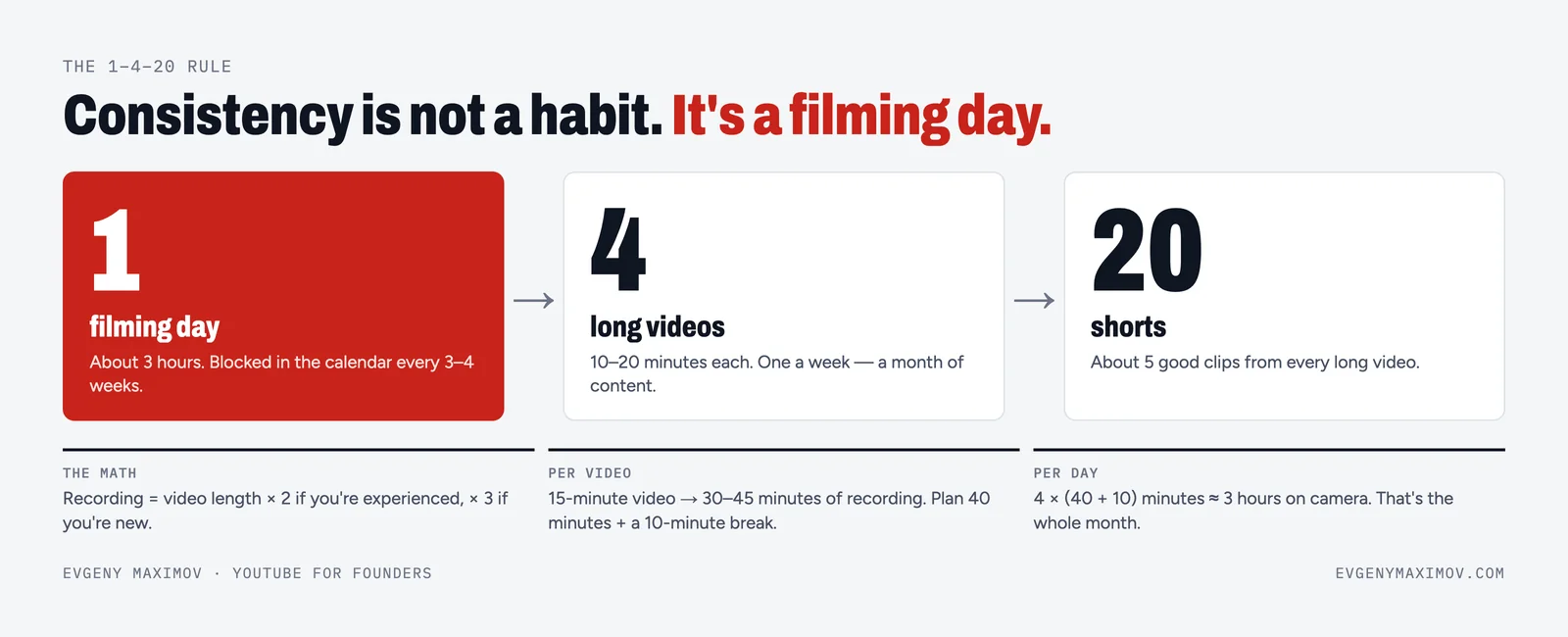
The business stays one person. The production is a service, like your email tool. That's exactly what a done-for-you YouTube team is for.
And if Justin wanted to test it alone first: a phone on a tripod with the main camera, not the selfie one; a desk lamp at about 45 degrees to the side, not straight in the face; eyes on the top line of the grid; and speak a bit louder than usual. Light and sound matter more than the camera. Here are filming setups for every budget.
What would the funnel look like?
Search tutorial → system playlist → newsletter signup → products. The newsletter stays the main owned asset. YouTube feeds it with people who never saw a LinkedIn post. Here's the full YouTube sales funnel.
What's the 12-month roadmap?
- Months 1–3: 12 long videos, system tutorials first, Shorts from each.
- Months 4–6: business breakdowns and newsletter-as-video. Test which brings more signups.
- Months 7–12: a 2–3 hour cornerstone course on YouTube, for free. Long free courses work as lead magnets for paid ones, and very long videos collect a lot of watch time.
What happens next?
Justin, if you ever want to test this, the plan is yours. And if you built your business on one platform and you know it's a risk, book a call with my team. We'll look at your audience and tell you honestly if YouTube makes sense for you.
FAQ
Does Justin Welsh have a YouTube channel?
In October 2026 there was no active Justin Welsh YouTube channel. His audience is mainly on LinkedIn (about 885,000 followers), X (about 592,000) and his newsletter, The Saturday Essay, with 200,000+ readers.
Why would a successful solopreneur start YouTube?
To add a second traffic source that doesn't depend on one platform, to answer searches that already exist for their products, and to let buyers experience their teaching in long form before purchasing.
Can you run YouTube as a one-person business?
Yes, if production is outsourced. The founder films about one day a month and gives quick feedback. Scripting, editing, thumbnails and publishing are handled by a team outside the business, like any other service.
What is a content operating system?
A repeatable system for creating and distributing content: capturing ideas, writing, publishing and repurposing on a schedule. Justin Welsh sells a course with this name, and people search for it by his name.
Is LinkedIn enough to build a business?
It can be, as Justin Welsh shows. But depending on one platform is a risk: one algorithm change can cut your reach. A second channel like YouTube reduces that risk.
What YouTube content works for solopreneurs?
System tutorials with screen sharing, breakdowns of one-person businesses, videos based on proven newsletter ideas and honest behind-the-business videos with real numbers.
How do you move a LinkedIn audience to YouTube?
Don't repost your posts as videos. Turn your best-performing posts into long videos with one big idea, announce each video to your LinkedIn audience and newsletter, and let search bring people who never saw your posts.
How long would it take to grow a YouTube channel from a LinkedIn audience?
Existing fans help the first videos, but sustainable growth usually takes six to twelve months of consistent long-form publishing.
Which YouTube channels are good content references for a solopreneur?
Dan Koe for long video essays about one-person businesses (about 1.44 million subscribers), Soo Wei Goh for business breakdowns with real numbers (about 40,000) and Matt Gray for systems explained on a whiteboard (about 292,000). Copy the formats, not the team size: most big channels have a production team behind them.
Did Justin Welsh hire Evgeny Maximov's agency?
No. This is an open strategy built from public information. If you built your business on one platform and want a plan like this, you can book a call.
Founder of a done-for-you YouTube agency for high-ticket founders. Making content since 2014. More about me
Want YouTube without hiring a team?
We are the team. You film one day a month, we script, edit, design and publish. Your business stays lean. 7-day money back guarantee.
Book a call →